
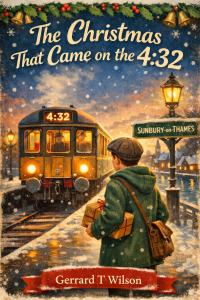
The Christmas That Came on the 4:32
Sunbury-on-Thames, December 1964.
The frost arrived early that year, settling itself politely on the rooftops as though it had been invited weeks in advance. By mid-month, every hedge wore a thin white collar, and the river—slow and thoughtful at the best of times—seemed to move only out of habit.
Twelve-year-old Peter Hargreaves noticed things like that.
He noticed the way the milk bottles chimed faintly in the cold mornings.
He noticed the smell of coal fires drifting through Green Street.
And, most particularly, he noticed trains.
The 4:32 from Waterloo was his favourite.
It wasn’t the fastest, nor the most important, but it had a certain… pause about it. A hesitation. As if, just before arriving at Sunbury station, it considered whether it ought to go somewhere else entirely.
Peter mentioned this once to his father.
“Nonsense,” said Mr Hargreaves, without looking up from The Daily Express. “Trains don’t think. They run to schedule.”
But Peter wasn’t so sure.
The Parcel
On the 22nd of December, the 4:32 arrived under a sky the colour of old tin. Peter stood on the platform as usual, hands in pockets, breath puffing like a small steam engine of his own.
The train slowed.
Stopped.
Waited.
And then—this was the curious part—no one got off.
The doors opened, but the carriage nearest Peter remained empty. Completely empty. No passengers. No luggage. Nothing at all.
Except for a single parcel on the seat.
Peter glanced up and down the platform. The stationmaster was busy arguing with a man about a missing umbrella. No one else seemed to notice.
So Peter did what any sensible boy would do.
He stepped into the carriage.
The air inside was warmer, faintly smelling of leather and something else—pine, perhaps, or snow. The parcel sat squarely in the centre of the seat, wrapped in brown paper and tied with red string.
There was a label.
It read:
“To Whoever Notices First.”
Peter swallowed.
“Well,” he said quietly, “that would be me, then.”
The Opening
He took the parcel home under his coat.
His mother was in the kitchen, humming along to the wireless while peeling potatoes.
“You’re late,” she said.
“Train was… thinking,” Peter replied.
She nodded absently. “They do that this time of year.”
Peter blinked. “They do?”
“Mm,” she said. “Now wash your hands.”
That evening, after supper, Peter sat by the small electric fire in the sitting room. The Christmas tree—slightly crooked, decorated with glass baubles and tinsel that refused to behave—glowed softly beside him.
He placed the parcel on his lap.
For a long moment, he simply looked at it.
Then he untied the string.
Inside was a small wooden box.
Inside the box…
…was a bell.
Not a large bell, nor particularly shiny—just a simple, brass handbell, the sort one might find in a railway office long ago.
There was a note tucked beneath it.
Peter unfolded it.
It read:
“Ring this only when something has been forgotten.”
The Missing Thing
At first, Peter couldn’t think of anything that had been forgotten.
Everything seemed perfectly in place.
The tree was up.
The presents (or what he assumed were presents) sat beneath it.
His father had even managed to find proper Christmas crackers this year.
And yet…
There was a feeling.
A small, quiet gap in things. Like a word on the tip of your tongue that refuses to arrive.
The next morning, Peter walked through Sunbury with the bell in his pocket.
Something was off.
Mrs Dalrymple at the post office wrapped parcels carefully—but didn’t smile.
The baker sold mince pies—but didn’t hum.
Even the church bell rang—but somehow sounded… empty.
Peter stopped by the river.
“What’s missing?” he asked aloud.
The river, as usual, declined to answer.
So Peter took out the bell.
He hesitated.
“Only when something has been forgotten,” he murmured.
He thought of Christmases past—paper chains, laughter, his mother singing, his father pretending not to enjoy it but always laughing at the worst jokes.
And suddenly, he knew.
“It’s the feeling,” he said.
“The proper Christmas feeling.”
And with that, he rang the bell.
What Came Back
The sound was small.
Clear.
And impossibly distant, as though it had travelled a long way to be heard at all.
For a moment, nothing happened.
Then—
The air shifted.
A breeze—not cold, but crisp—moved through the street. The frost on the hedges glittered brighter. Somewhere, someone began to laugh—properly laugh, not just politely.
Mrs Dalrymple looked up from her parcels and smiled for no reason at all.
The baker began humming again, loudly and badly.
Even the river seemed to move with a little more purpose.
Peter felt it most of all.
A warmth—not from the fire, not from his coat—but something deeper, older.
Something remembered.
The Return Journey
On Christmas Eve, Peter returned to the station.
The 4:32 arrived exactly on time.
This time, the carriage was not empty. It was full of people—chatting, laughing, carrying parcels and stories and all the small chaos of Christmas.
But on the same seat…
There was space.
Peter stepped inside and placed the bell back where he had found it.
“Thank you,” he said, though he wasn’t entirely sure to whom.
As he stepped off the train, the guard gave him a curious look.
“Did you leave something behind, lad?”
Peter smiled.
“No,” he said. “I think we got it back.”
The train doors closed.
The 4:32 pulled away.
And just before it vanished into the winter dusk, Peter could have sworn it paused—just slightly—as if satisfied.
Afterwards
That Christmas in Sunbury-on-Thames was remembered for many reasons.
For the cold.
For the snow that finally came in the early hours of Christmas morning.
But most of all, though no one quite said it plainly, it was remembered for feeling right again.
As for Peter…
He still watched the trains.
And every so often, when one lingered just a moment longer than it ought to…
He would nod, very slightly.
Because some things, he knew now, did not run on schedules at all.


 The Crazymad Writer Writes Again