
The Malaga Mystery
Shepperton Terminus, November 1965
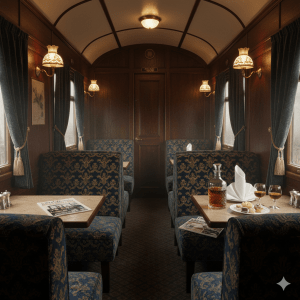
The terminus of the Shepperton line was a desolate place on a Friday evening, swallowed by a dense, ochre fog. The electrified third rail glinted with dampness, and the metallic ring of the buffer stops provided a lonely full-stop to the city’s constant noise. At the very end of the track, divorced from the modern glass of Terminal House, sat Pullman Car No. 92, Malaga.
It was a sanctuary frozen in time, its umber and cream livery faded but proud. Inside, the carriage was a time capsule of Edwardian luxury, the air thick with the ghosts of expensive champagne and stale cigar smoke. Polished mahogany panels reflected the soft, amber light cast by etched glass lampshades. Heavy velvet curtains drawn over the long windows cut off the miserable scene outside. Brass luggage racks gleamed, and the plush, blue-and-gold motif of the upholstery felt like a defiant echo of a bygone, grander age.
It was in this opulent setting that Inspector Miles Corbin found himself just after 10:30 PM.
“They found him just here, sir,” Sergeant Davies whispered, his heavy, damp coat scraping against the armrest of a velvet armchair. “Hardly fits, does it? A murder in a palace.”
The victim, Mr. Julian Thorne, the company’s celebrated railway historian, was slumped at a small table, his face hidden. His expensive tweed jacket showed a dark, spreading stain. Nearby, a heavy, silver-plated paper knife lay on the seat, a theatrically obvious weapon.
Corbin circled the scene, his polished boots silent on the deep pile carpet. On the table: a crystal decanter, two brandy snifters, and a plate of untouched petit fours. He noticed the brass plaque near the door, engraved: SECR 92. Malaga. Parlour First. 1921.
“The paper knife is a feint,” Corbin stated, not looking up. “The wound is superficial. Pathologist confirmed it. Cyanide in the brandy, Davies. Clean, fast. An assassin’s choice, not a frantic editor’s.”
“It was Mr. Arthur Finch who raised the alarm, sir. Junior Editor. He claims they had a row, a social drink, and Thorne collapsed while Finch was in the main office washroom.”
“The row wasn’t over a book error, was it?” Corbin asked, his eyes narrowing on the details.
Davies consulted his notes, his voice dropping further. “No, sir. It seems Thorne discovered something far worse. Finch’s new manuscript contained schematics of the GWR’s strategic freight lines—the ones designated for classified government use in the event of an… incident. Thorne believed Finch was leaking secrets to a hostile power and threatened to go to the Ministry of Defence tonight.”
The motive had shifted from professional rivalry to high-stakes espionage.
The decanter was centered. Thorne’s snifter was empty on his right. Finch’s snifter, still half-full, was on his left. The crucial detail was a single, pristine white napkin, folded like a swan, resting directly underneath Finch’s half-empty glass.
“Davies, look at this. Finch claims his glass is half-full. But why would he use a fresh napkin to coaster a glass he was supposedly still drinking from? And why is his hand-blotting napkin missing?”
Corbin delicately lifted the napkin. It was cool, damp only at the edges from the glass’s condensation, but underneath the dampness was a faint residue of panic sweat from a frantically grasping palm.
The Conclusion and Epilogue
Corbin had Finch brought back to the silent, elegant carriage.
“The brandy, Mr. Finch, tasted strongly of almonds, didn’t it? Cyanide,” Corbin said, tapping the half-full glass. “But the almond taste only develops in the air. The first sip kills. You poured the poison into Mr. Thorne’s glass first, knowing he would take the first sip. You then pretended to drink from your own, but you didn’t.”
Finch, pale and twitching, remained silent.
“You needed to dispose of your own poisoned drink. When you ‘went to the washroom,’ you actually went to the galley, poured your glass into a napkin—the missing one—which you disposed of in the carriage’s tiny coal fire-box. But your hand, Mr. Finch, was sweating profusely with the terror of your act. You reached for a new napkin to blot your palm, and then, in a desperate attempt to cover the fact that your glass was empty, you placed the untouched glass back down on the fresh, slightly clammy napkin.”
Finch finally cracked, his voice a choked whisper. “He didn’t understand! Thorne was going to expose the whole network! He would have started a war over a railway map!” Finch pointed to the silver knife. “That wasn’t for him. That was for me. If I’d been caught, I was supposed to use that, not the poison. The poison was cleaner.”
Finch was escorted away, the sound of the steel door closing on the police van a harsh, modern sound that fractured the quiet history of Shepperton.
The Aftermath:
Within forty-eight hours, the Pullman Car Malaga was subjected to a forensic sweep and a deep clean. All evidence of the night—the spilt brandy, the cyanide traces, the oppressive shadow of international espionage—was systematically erased. The mahogany was polished, the velvet vacuumed, and the etched glass wiped clean. Malaga returned to its function as a silent, luxurious hospitality suite for Ian Allan Publishing, retaining its rich, umber-and-cream exterior, but now holding one more terrible secret in its panelled walls, sealed off at the very end of the line.
 The Crazymad Writer Writes Again