RSS

Monthly Archives: September 2025

Embracing the Chaos: A Writer’s Journey

Embracing the Chaos: A Writer’s Journey

The Crazymad Writer, that’s me, you see,

A brain in chaos, a wild decree.

My thoughts, a whirlwind, a tangled yarn,

A literary tempest in a barn.

The words they tumble, they leap, they fly,

A frantic stampede beneath the sky.

A comma here, a semi-colon there,

A frantic dance on the brink of despair.

I write of dragons with spectacles perched,

Of teacups singing, for them I’ve searched.

Of socks that vanish, a mystery grand,

Of polka-dot elephants in the land.

Why do I do it? The mad, mad scrawl?

It’s either that, or climb the wall!

The stories bubble, they must break free,

Lest I become a footnote in history.

So forgive the frenzy, the ink-stained hand,

The logic lost on this scribbling land.

It’s not a choice, it’s a desperate need,

To plant this crazy, literary seed.


Tags: , ,

A Long Time Ago in Owerri

Those were the days

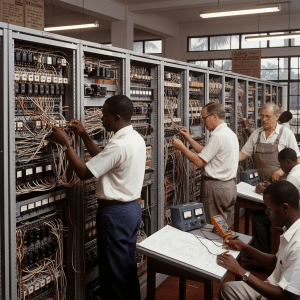
lm ericsson ltd

The late 1970s in Owerri were a time of electric change, not just in the air, but under the ground and in the new buildings rising along the dusty roads. The Nigerian Civil War had left scars, but the city was in a furious race to rebuild, and nothing symbolized this more than the arrival of the future: the automatic crossbar telephone exchange.

Before, telephone calls in Owerri were a ceremony. A man—it was almost always a man—would stride into the P&T (Posts and Telecommunications) office, fill out a form, and wait for a switchboard operator to manually connect his call. The operators, a special breed of human, held the city’s social and business life in their hands. They knew who was trying to reach whom, and a wrong number could be a tragedy, a missed business deal or a family crisis. The air in the exchange room was a hum of low-voiced commands, the clatter of plugs being inserted, and the soft, perpetual static of a connection being made.

Then came the project. A team of engineers, a mix of seasoned veterans from LM Ericsson and bright, young Nigerian graduates, descended on Owerri. Their arrival was quiet at first, marked only by the excavation of trenches and the laying of thick, sheathed copper cables that snaked their way through the city’s soil. The real show began with the delivery of the equipment.

The heart of the new system was a hulking, metallic beast: the crossbar exchange. It arrived in crate after crate, a puzzle of relays, selectors, and racks. The younger engineers, like Chike, a fresh graduate from the University of Ibadan, stared at the components in awe. They had studied the theory—the marvel of the crossbar’s matrix of horizontal “select” bars and vertical “hold” bars, controlled by electromagnets that could close a connection at any intersection. But seeing the physical machine, a monument to electromechanical ingenuity, was something else entirely.

The installation was a dance of organized chaos. The exchange building, a squat, modern structure designed for the purpose, filled with the aroma of solder and fresh paint. Chike and his colleagues worked long, hot days, meticulously wiring circuits and mounting the heavy frames. Every connection was critical. A single misplaced wire could bring the entire system to a halt. The older engineers, men like Mr. Svensson, with his perpetually stained overalls and a knowing squint, offered quiet, gruff wisdom. “No hurry, boy,” he’d say to a frantic Chike. “The machine is a patient master. You must be its steady servant.”

The true test was the cutover. The day arrived with the tension of a drum being stretched tight. All of Owerri’s old manual lines were to be disconnected, and the new automatic system would come online. The P&T office buzzed with nervous energy. The operators from the old switchboard watched from the sidelines, their faces a mix of anxiety and curiosity. The old way of life was ending, and they wondered if this new, unfeeling machine could ever replicate their human touch.

Chike, his heart pounding, stood before a panel of blinking lights and switches. At the command of the project manager, a new, younger man from Lagos, he flipped a master switch. A soft, continuous hum filled the room—the sound of the crossbar exchange coming to life. It was a sound that would soon become the ambient soundtrack of modern Owerri.

Then came the calls. Not routed through a human, but through the whirring, clicking logic of the machine. The first call was a simple test, from the P&T office to the Government House. Chike watched as a series of lights on the panel lit up, relays clicked in rapid succession, and a clear connection was established. The line was crisp, with none of the old static.

Word spread like wildfire. A man in Aladinma estate could now dial his brother’s number in Ikenegbu and be connected almost instantly, without speaking to a third party. The new exchange didn’t ask “Who are you calling?” or “Is it urgent?” It simply made the connection.

The city adapted quickly. The distinctive dial tone became a familiar sound. The new, five-digit telephone numbers were scrawled in notebooks and memorized. The crossbar exchange, a technological marvel of its time, was more than just a piece of equipment; it was a symbol of Owerri’s future. It connected the city to itself, and in time, to the wider world, paving the way for the digital age that lay just over the horizon. The clicking of its relays was the sound of progress, a mechanical heartbeat in the new, vibrant city of Owerri.

 
Leave a comment

Posted by on September 6, 2025 in 1970s, owerri


Tags:

Story Idea

The Collective Dream

Concept: The World Collective is a global organization that uses a shared digital platform to facilitate direct democracy. Every citizen has a vote on every law, policy, and initiative. The Collective’s motto is “All for One, One for All,” and its platform is celebrated as the ultimate form of democratic expression. Citizens feel empowered and engaged, believing they are shaping the future themselves.

The Twist: The voting system is a sham. The World Collective is a front for a powerful cabal of corporate and political elites who use advanced psychological algorithms to manipulate the outcome of every vote. They don’t rig the vote directly; they rig the voter. Using targeted misinformation, emotional triggers, and subtle psychological nudges, they guide the public to vote for the policies that benefit the cabal, all while the people believe they are acting on their own free will.

Characters:

  • The Protagonist: A data analyst working for the World Collective who notices bizarre, statistically impossible patterns in the voting data. They realize the results are not organic, but are being actively engineered.
  • The Antagonist: The founder of the World Collective, a tech billionaire who genuinely believes that regular people are too stupid to govern themselves and that this “guided democracy” is a necessary step for humanity’s survival.
  • The Whistleblower: A former high-ranking member of the cabal who, after seeing the extreme lengths to which they are willing to go, is now living in hiding and trying to expose them.
  • A note: is this where we are heading?
 
Leave a comment

Posted by on September 5, 2025 in the world collective


Tags: , ,

The Haunting of Silas

a ghost story

For two and a half centuries, Silas had been the singular, undisputed master of his ghostly domain. His presence was a finely tuned machine of subtle dread and atmospheric unease. He was a creature of habit, and his haunt was a meticulously choreographed performance. Every single creak in the floorboards of the west wing, every sudden gust of wind down the main hall, and every spectral sigh that chilled the blood of a trespassing mortal was a deliberate, practiced act. He was a ghost who had found his peace in the performance of his un-life, forever bound to the sharp, crystalline memory of his betrayal and murder.

Then came the rustling. It wasn’t a sound, but a sensation—like brittle, unseen leaves scraping against the spectral fabric of the air. It was a cold so profound it didn’t just lower the temperature; it seemed to absorb all light and hope, leaving a sterile void in its wake. This was Elara, a ghost not of a person, but of an idea—a swirling, cold vortex of pure, un-sourced sorrow. Her purpose was not to frighten, but to erase. She sought to dissolve Silas’s specific, individual story into her formless ocean of collective, meaningless grief.

The initial terror that had sent Silas fleeing was replaced by a cold, spectral fury. Elara had touched his most cherished memory, the ghost of his beloved, and in doing so, she had crossed an invisible line. He realized he could not fight her on her terms. Her power was in her vastness, her formlessness, her lack of a specific story. But a ghost’s true power, Silas now understood, was in its singular, defining narrative. To defeat her, he would have to become more himself than he had ever been.

His counter-haunting began in the west wing, the very site of his demise. Instead of passively re-enacting his death, he began to actively reconstruct it with a horrifying precision. He willed the air to drop in a single, focused point, colder than any cold she could muster, a chill that carried the memory of a knife’s blade. He didn’t just make a noise; he summoned the exact, rasping sound of his killer’s leather boots on the floorboards, replaying it over and over with a furious intensity. He wove the memory of a specific glint of moonlight on steel into the very essence of the room, a chill that was not generic, but personal and specific to him alone. Each spectral groan of the manor became a declarative statement, a terrifying mantra echoing through the halls: “This is my pain. This is my story.”

Elara’s response was swift and terrifying. She flooded the manor with her own despair, a silent, weeping grief that tried to turn every room into a featureless gray void. But Silas was ready. He found the grand ballroom, a place of a shared, joyful memory with his beloved, and he used every ounce of his power to hold onto it. He didn’t just conjure her ghost; he recreated the specific music from that night, a faint, melancholic waltz that resisted Elara’s sorrowful hum. He willed the very dust motes to dance in the moonlight, tiny, brilliant sparks of light against the growing darkness, a defiant celebration of his single, precious memory against her vast, meaningless emptiness.

The climax arrived in the master bedroom, the place of his beloved’s fading silhouette. Elara manifested as a towering, roiling cloud of silver smoke, a living embodiment of the void, a silent chorus of a thousand forgotten screams. She reached out, a phantasmal claw of despair, to touch his essence, to finally turn him into a nameless wisp. But Silas stood his ground. He didn’t scream in fear this time. He screamed in defiance. He forced the raw, specific feeling of a broken heart into the very fabric of the air. He held the image of his beloved’s face so intensely in his mind that it shone like a beacon through the haze of Elara’s sorrow. His narrative was not to be erased; it was being forged anew in the fire of this desperate battle.

The two forces clashed, a singular, personal story against a collective, formless despair. The manor became the epicenter of an ethereal hurricane. Paintings rattled on the walls, not from a simple haunt, but from the shockwaves of two opposing realities tearing at the very fabric of the building. In the end, a victor did not emerge. Silas, by sheer force of his concentrated narrative, had become too solid, too specific to be absorbed. Elara could not erase him, but she also did not retreat.

The manor is now a place of terrible, perpetual war. The cold of Elara’s sorrow still permeates the air, but beneath it, like a defiant heartbeat, is the distinct, sharp chill of Silas’s specific pain. He still haunts the manor, but his purpose has changed. He is no longer just haunting the living; he is eternally performing a play of defiance, a constant reiteration of his story to keep from being consumed. He is a ghost who must forever haunt himself to keep from being haunted by the ghost of everything he once was.

 
Leave a comment

Posted by on September 4, 2025 in ghost story


Tags: , ,

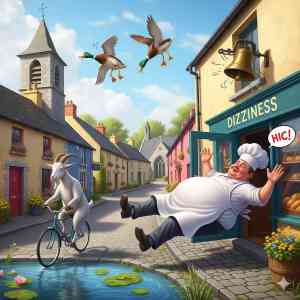
The Ballad of Dizziness Day

The Ballad of Dizziness Day

by the Crazymad Poet of Ballykillduff

Oh the world did sway on a curious day,
When the clouds spun ’round like socks in a fray,
And Ballykillduff, in its charming old way,
Woke up to find balance had wandered away.

Sean the Ram did a somersault flip,
The postman delivered a letter to a skip,
The church bell chimed with a hiccup and blip,
And the milk turned itself into strawberry whip.

Mrs McFadden clung tight to a tree,
“That’s my third bush this morning,” said she.
A goat rode a bicycle (accidentally),
And the vicar did cartwheels, shouting “Wheeeee!”

The baker rolled out of his shop like dough,
Shouting, “All my baguettes have learned to go!”
The ducks flew backwards in uneven rows,
And a sheep tried to tango with Farmer Joe’s toes.

Young Nora O’Bannigan spun in a whirl,
Chasing her braid like a dizzy young squirrel.
She tripped on a hedgehog, collided with Pearl,
Then shouted, “I’ve seen three versions of the world!”

The Council convened by the village green pond,
Where they’d buried the Beacon of Anti-Spin Bond.
With goggles, a chicken, and ceremony fond,
They summoned its power with a mystical wand.

Old McGroggin raised high the gold cone,
(While humming a strangely off-key baritone),
And the village fell still with a satisfied groan,
As balance returned—at least to the stone.

But the wobble, my friends, still comes once in a spell,
With tales of the time when Miss Bridie fell
Into a wheelbarrow halfway to Kells,
Still claiming she met a dimension called “Smell.”

So here’s to the Day of the Great Bally Sway,
Where gravity quit and ran far away—
If you’re ever in town when your legs go astray,
You’ll know you’ve arrived on… Dizziness Day!

 
Leave a comment

Posted by on September 3, 2025 in crazy, crazymad, humor, humour, poems


Tags: , , , , , ,

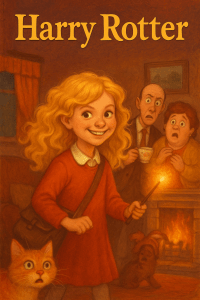
Rotter, What a Trotter!

Harry Rotter, What a Totter!

rotter, what a trotter

Harry Rotter’s quite a sight,
Grinning wide with wicked delight,
Golden curls and polished shoes,
Always plotting mischief’s news.

She pinched the biscuits, hid the jam,
Bamboozled Box, annoyed poor Gran,
Turned the kettle into a frog,
And hexed the neighbour’s yappy dog.

At school she made her teachers swoon,
By swapping chalk with a magic spoon,
And when the head cried, “What a disgrace!”
She vanished entirely—without a trace.

The Privets sigh, “Oh, mercy me!
She’s chaos wrapped in dungarees!”
Yet Harry just winks, without regret:
“The fun’s not started—you ain’t seen yet!

So guard your china, lock your pie,
Check your shoes before you try,
For Harry Rotter’s here to stay—
And she’ll turn your world the wrongest way!


Tags: , ,

Alice on Top of the World – a novel

Alice on Top of the World – a novel

alice of Wonderland fame

Alice on Top of the World

Alice climbed a ladder of air,
Past rooftops, chimneys, clouds so rare,
She balanced on a silver breeze,
And skipped across the tallest trees.

The mountains bowed, the oceans curled,
For Alice stood on top of the world;
A crown of starlight in her hair,
The moon itself just hanging there.

She asked the sun to play a tune,
She taught the night to hum at noon,
She juggled planets, tossed them wide,
Then hopped upon a comet’s ride.

The White Rabbit clapped from below,
“Careful, Alice, mind where you go!”
But Alice only laughed and twirled,
For she was dancing with the world.

And when at last she looked down deep,
The earth was quiet, fast asleep;
She whispered softly, calm and mild:
“Goodnight, dear world — from your wild child.”


Tags: , , , , ,