RSS

Daily Archives: December 19, 2025

Tullow Pyramid

Tullow Pyramid

The morning mist in Tullow usually smells of damp grass and the Slaney river, but on a Tuesday in October, it carried the scent of sun-baked cedar and ozone.

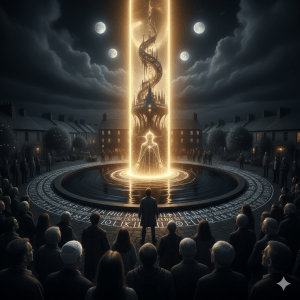
When the sun finally burned through the fog, the townspeople found it: a pyramid, no taller than a two-story townhouse, sitting perfectly centered in the middle of The Square. It hadn’t made a sound. No one’s Ring doorbell had captured a delivery truck, and the gravel beneath it hadn’t even been displaced. It looked as though it had been there for ten thousand years, and the town of Tullow had simply grown around it overnight.

The Impossible Stone

The structure wasn’t gold or limestone. It was made of a deep, matte basalt that seemed to “drink” the light around it. Local historian Sean O’Shea was the first to approach it with a magnifying glass.

“It’s not Egyptian,” he whispered to the huddle of onlookers. “The carvings… they’re Ogham, but they’re wrong. The lines are moving.”

He was right. The deep grooves etched into the stone weren’t static. If you looked at a symbol and then blinked, the notches had shifted, crawling like slow-motion insects across the surface of the dark stone.


The “Goings-On”

As the day progressed, the “mysteries” escalated from architectural anomalies to full-blown local phenomena:

  • The Weightless Zone: Within ten feet of the pyramid, gravity seemed to lose its grip. Local kids discovered they could jump six feet into the air with a single hop. A stray Border Collie was seen drifting three feet off the ground, looking mildly annoyed as it paddled through the air.
  • The Radio Silence: Every digital device in Tullow began to act up. Car radios played music that hadn’t been recorded yet—melodies with instruments that sounded like glass breaking in harmony. Phone screens showed maps of stars that didn’t exist in the Milky Way.
  • The Echoes of the Past: At noon, the air around the pyramid grew thick. People standing near the Post Office reported seeing “shadows” of people in ancient robes walking through the walls of the modern shops. They weren’t ghosts; they looked solid, but they were silent, focused on a city that had stood in Tullow’s place eons ago.

The Door Without a Seam

By sunset, the Irish Defense Forces had cordoned off the area, but the pyramid had its own ideas about security. A seam appeared on the eastern face—not a door opening, but the stone simply evaporating into a fine purple mist.

A low hum, like a thousand bees vibrating in a cello case, began to pulse through the pavement. Those standing closest reported a sudden, overwhelming memory of a life they had never lived—a memory of a Great Library and a sky with three moons.

“It isn’t a tomb,” Sean O’Shea shouted over the rising hum as the military tried to push the crowd back. “It’s a bookmark! It’s holding our place in time!”

As the clock struck midnight, exactly twenty-four hours after its arrival, the pyramid didn’t vanish. Instead, the colors of Tullow began to bleed into it. The gray pavement turned to gold dust; the local pub’s neon sign turned into a floating orb of cold fire. The pyramid wasn’t visiting Tullow—it was starting to rewrite it.


The Morning After

The next day, the pyramid was gone. The Square was empty. But the people of Tullow were different. Everyone in town now spoke a second language—a melodic, ancient tongue they all understood but couldn’t name. And in the center of the Square, where the pyramid had sat, the grass now grows in the shape of a perfect, unblinking eye.


The transition from a sleepy market town to a high-security “Linguistic Quarantine Zone” happened in less than seventy-two hours.

The Irish Defense Forces were replaced by international suits: UN observers, cryptographers from Fort Meade, and stone-faced men in lab coats. They set up a perimeter around Tullow, but they weren’t looking for radiation or biological weapons. They were looking for words.

The Incident at Murphy’s Hardware

It started small. Mrs. Gately, a grandmother of seven, was trying to explain to a scientist that she felt “perfectly fine.” But as she spoke the new melodic tongue—the Tullow Tongue—she reached for a word that sounded like ‘Lir-un-teth’.

As the syllable left her lips, the air in the room didn’t just vibrate; it crystallized. Every loose nail and bolt in Murphy’s Hardware rose from its bin, suspended in mid-air, forming a perfect, rotating sphere of jagged metal. When she stopped speaking out of shock, the metal fell, clattering to the floor like a thousand spilled coins.

The scientists stopped taking notes. They started taking measurements.


The Architecture of Sound

The townspeople soon realized that their new language was actually a User Interface for the Universe.

Phrase (Phonetic) Observed Effect
Vora-shé Localized gravity increases by 15%; footsteps feel like lead.
Kael-o-min Objects become transparent for exactly sixty seconds.
Thu-lar-is Temperature drops to freezing point within a three-meter radius.
 
Leave a comment

Posted by on December 19, 2025 in time travel


Tags: , , , ,

The Silver Needle

The Silver Needle

The Silver Needle

The North Wind did not blow; it exhaled, a long, shivering breath that flattened the dead grass of the meadow. Then came the Quiet.

I arrived in the lungs of the night. I am the Frost, the silent architect, the silver needle that sews the world shut.

I began at the edge of the pond. I am not like the Snow, who is heavy and loud, smothering the earth under a white wool blanket. I am delicate. I moved across the surface of the water, knitting a skin of glass so thin that the fish below looked up and saw a sky made of diamonds.

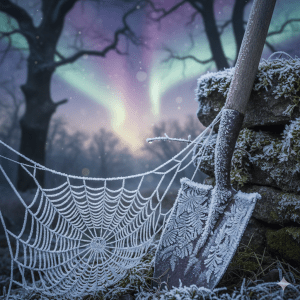
I climbed the stalks of the sleeping hemlock. I turned the spider’s web—a discarded, messy thing—into a lace veil fit for a ghost. I moved with a mathematician’s precision, tracing the jagged rim of every fallen oak leaf, outlining their veins in crushed pearls.

I found a discarded iron spade leaning against a stone wall. To the humans, it was rust and cold metal. To me, it was a canvas. I grew a forest of ferns across its blade, silver fronds that would never see the sun, for the sun is my executioner.

Near the Haroldstown stones, I found a small wooden birdhouse, empty and forgotten. I did not enter. Instead, I feathered the roof with a thousand tiny daggers of ice, pointing toward the stars.

The world was now a museum of stillness. No twig snapped. No breath was drawn. I had turned the unruly, muddy earth into a kingdom of crystal geometry. I sat upon the world, cold and perfect, waiting for the first grey light of the dawn to turn my silver into gold, knowing that as soon as I was most beautiful, I would vanish.

I am the ghost of the water. I am the memory of the cold. And for one night, I held the earth perfectly still.


Tags: , , , ,

The Echo of the Dolmen

The Echo of the Dolmen

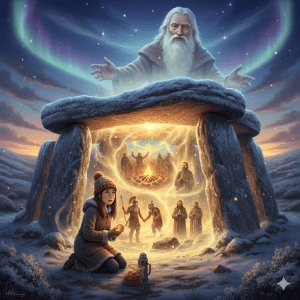
The air above Haroldstown Dolmen on Christmas Eve was thick with the kind of ancient magic that hummed just beneath the surface of Ballykillduff. It wasn’t the boisterous, unpredictable magic of sentient sausages, but a quieter, deeper power, woven into the very stones themselves. The three massive granite capstones, perched precariously atop their six supporting uprights, looked like a giant’s forgotten Christmas table, dusted with a fine layer of frost.

Young Aoife, a girl whose imagination was as wild and untamed as the gorse bushes on the surrounding hills, was convinced the Dolmen was a portal. Not to another dimension, perhaps, but to another time. Every Christmas Eve, armed with a thermos of lukewarm tea and a pocketful of slightly squashed shortbread, she’d trek up to the ancient burial site, hoping for a glimpse of… something.

This year, however, was different. As the last sliver of the setting sun dipped below the horizon, painting the sky in hues of bruised purple and fiery orange, a strange light began to emanate from beneath the Dolmen. It wasn’t the cold, ethereal glow of faerie lights, but a warm, pulsating amber, like a forgotten hearth fire.

Aoife, shivering more from anticipation than cold, crept closer. The air around the stones grew surprisingly warm, smelling faintly of woodsmoke and something sweet, like honey and frankincense. As she peered into the dark crevice beneath the capstone, she saw not darkness, but a swirling, golden mist.

Suddenly, a voice, deep and resonant, yet as gentle as a lullaby, drifted from the mist. “Welcome, child. You have come at the turning of the year, when the veil is thinnest.”

Aoife gasped, dropping her shortbread. “Who… who are you?”

From the swirling light emerged not a spectral figure, but a kindly old man with eyes as bright as winter stars and a beard that cascaded like freshly fallen snow. He wore robes woven from what looked like spun moonlight, adorned with intricate patterns that shimmered with forgotten symbols.

“I am the Spirit of the Dolmen,” he replied, a warm smile crinkling the corners of his eyes. “Or perhaps, the echo of all who have celebrated the turning of the light here, since before memory.”

He gestured to the mist, and it parted, revealing a breathtaking scene. It wasn’t Ballykillduff as she knew it. Instead, she saw a circle of ancient people, bundled in furs, gathered around a roaring fire beneath the very same Dolmen. They weren’t celebrating Christmas as she knew it, but rather the Winter Solstice, sharing stories, feasting on roasted meat, and offering thanks to the sky.

Then the scene shifted. She saw Roman soldiers, their helmets glinting, leaving offerings of coins and wine at the base of the stones, their voices hushed with respect. Later, she saw early Christian monks, their solemn chants blending with the whisper of the wind, blessing the ancient site. And in every scene, spanning centuries, there was the same profound sense of gathering, of hope, of light returning in the darkest days.

“This place,” the Spirit explained, his voice weaving through the visions, “has always been a place of gathering, of hope, of welcoming the light. Every celebration, every prayer, every shared meal has left its mark, echoing through these stones.”

The visions faded, and Aoife found herself back in the present, the golden glow dimming, the cold air returning. The Spirit of the Dolmen stood before her, a gentle smile still on his face.

“Christmas, child,” he said, “is but the latest song sung in this ancient choir. The message remains the same: gather, hope, welcome the light.” He reached into his luminous robes and produced a small, smooth pebble, glowing faintly with the amber light. “A token. Remember the echoes.”

As the last flicker of light faded, the Spirit of the Dolmen dissolved back into the stones, leaving only the biting cold and the quiet majesty of the ancient monument. Aoife clutched the warm pebble in her hand, feeling a profound connection to all the Christmases, all the Solstices, all the gatherings that had ever taken place beneath those silent, watchful stones.

She trudged home through the frost, the pebble a comforting warmth in her pocket. This Christmas, she realized, she wouldn’t just be celebrating with her family; she’d be celebrating with the echoes of centuries, with the Spirit of the Dolmen, and with the timeless magic that bound Ballykillduff to its ancient past. And as she curled up in her bed, she could almost hear the faint, distant hum of generations, singing a lullaby of hope under the watchful eyes of the old stones.

Aoife trudged home through the biting frost, her fingers wrapped tightly around the glowing amber pebble. Her heart was full; she felt she had witnessed the very heartbeat of history. The Spirit had shown her that Christmas was just one layer of a much older story of light and hope.

As she entered her house, the smell of cinnamon and roasting turkey greeted her. Her parents were in the kitchen, laughing and clinking glasses.

“There you are, Aoife!” her father called out. “We were starting to think the pooka had snatched you away. Did you see anything interesting at the stones?”

Aoife smiled, her thumb stroking the smooth surface of the gift in her pocket. “Just the wind and the stars, Dad,” she said, keeping her secret safe.

She went upstairs to her room and placed the pebble on her windowsill. It cast a soft, golden light across her wallpaper, illuminating her old books and toys. Exhausted by the magic of the evening, she fell into a deep, dreamless sleep.

On Christmas morning, Aoife was woken not by the sound of bells, but by a heavy, rhythmic thudding coming from outside. She ran to the window, expecting to see a neighbor’s tractor or perhaps a stray cow from Farmer Giles’s field.

But the village of Ballykillduff was gone.

In its place stood a vast, prehistoric forest of towering oaks and dense ferns. The air was thick and humid, smelling of damp earth and ancient moss.

Terrified, she looked down at her windowsill. The amber pebble was no longer glowing; it was now a dull, grey piece of granite. Beside it sat her modern smartphone, but the screen was dead, showing a “No Signal” icon that flickered strangely.

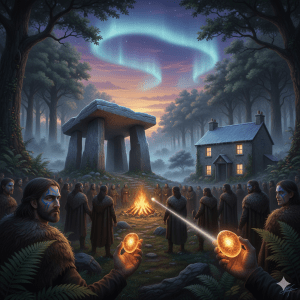
She looked back out at the horizon where the Haroldstown Dolmen stood. It wasn’t a ruin anymore. It was brand new, the stones sharp and clean, surrounded by hundreds of people dressed in furs, their faces painted with blue woad. They weren’t “echoes” or “visions”—they were real, breathing, and looking directly toward her window with expressions of profound confusion.

One of the men stepped forward, holding a spear. In his other hand, he held an identical amber pebble. He held it up toward her, and as the morning sun hit it, the stone began to pulse.

Aoife realized then that the Spirit hadn’t shown her a portal to the past. He had made her the “echo.” She wasn’t a girl in 2025 dreaming of the ancient world; she was now the ancient mystery that the people of the Dolmen would spend the next five thousand years trying to explain.


Leave a comment

Posted by on December 19, 2025 in dolmen, haroldstown


Tags: , , , ,