RSS

Tag Archives: dolmen

The Echo of the Dolmen

The Echo of the Dolmen

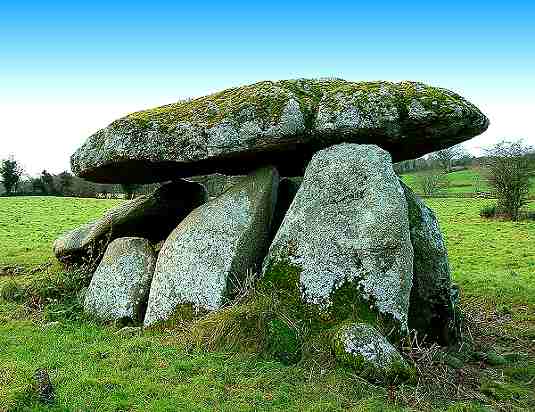
The air above Haroldstown Dolmen on Christmas Eve was thick with the kind of ancient magic that hummed just beneath the surface of Ballykillduff. It wasn’t the boisterous, unpredictable magic of sentient sausages, but a quieter, deeper power, woven into the very stones themselves. The three massive granite capstones, perched precariously atop their six supporting uprights, looked like a giant’s forgotten Christmas table, dusted with a fine layer of frost.

Young Aoife, a girl whose imagination was as wild and untamed as the gorse bushes on the surrounding hills, was convinced the Dolmen was a portal. Not to another dimension, perhaps, but to another time. Every Christmas Eve, armed with a thermos of lukewarm tea and a pocketful of slightly squashed shortbread, she’d trek up to the ancient burial site, hoping for a glimpse of… something.

This year, however, was different. As the last sliver of the setting sun dipped below the horizon, painting the sky in hues of bruised purple and fiery orange, a strange light began to emanate from beneath the Dolmen. It wasn’t the cold, ethereal glow of faerie lights, but a warm, pulsating amber, like a forgotten hearth fire.

Aoife, shivering more from anticipation than cold, crept closer. The air around the stones grew surprisingly warm, smelling faintly of woodsmoke and something sweet, like honey and frankincense. As she peered into the dark crevice beneath the capstone, she saw not darkness, but a swirling, golden mist.

Suddenly, a voice, deep and resonant, yet as gentle as a lullaby, drifted from the mist. “Welcome, child. You have come at the turning of the year, when the veil is thinnest.”

Aoife gasped, dropping her shortbread. “Who… who are you?”

From the swirling light emerged not a spectral figure, but a kindly old man with eyes as bright as winter stars and a beard that cascaded like freshly fallen snow. He wore robes woven from what looked like spun moonlight, adorned with intricate patterns that shimmered with forgotten symbols.

“I am the Spirit of the Dolmen,” he replied, a warm smile crinkling the corners of his eyes. “Or perhaps, the echo of all who have celebrated the turning of the light here, since before memory.”

He gestured to the mist, and it parted, revealing a breathtaking scene. It wasn’t Ballykillduff as she knew it. Instead, she saw a circle of ancient people, bundled in furs, gathered around a roaring fire beneath the very same Dolmen. They weren’t celebrating Christmas as she knew it, but rather the Winter Solstice, sharing stories, feasting on roasted meat, and offering thanks to the sky.
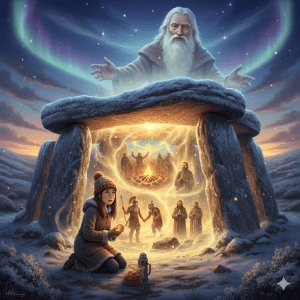
Then the scene shifted. She saw Roman soldiers, their helmets glinting, leaving offerings of coins and wine at the base of the stones, their voices hushed with respect. Later, she saw early Christian monks, their solemn chants blending with the whisper of the wind, blessing the ancient site. And in every scene, spanning centuries, there was the same profound sense of gathering, of hope, of light returning in the darkest days.

“This place,” the Spirit explained, his voice weaving through the visions, “has always been a place of gathering, of hope, of welcoming the light. Every celebration, every prayer, every shared meal has left its mark, echoing through these stones.”

The visions faded, and Aoife found herself back in the present, the golden glow dimming, the cold air returning. The Spirit of the Dolmen stood before her, a gentle smile still on his face.

“Christmas, child,” he said, “is but the latest song sung in this ancient choir. The message remains the same: gather, hope, welcome the light.” He reached into his luminous robes and produced a small, smooth pebble, glowing faintly with the amber light. “A token. Remember the echoes.”

As the last flicker of light faded, the Spirit of the Dolmen dissolved back into the stones, leaving only the biting cold and the quiet majesty of the ancient monument. Aoife clutched the warm pebble in her hand, feeling a profound connection to all the Christmases, all the Solstices, all the gatherings that had ever taken place beneath those silent, watchful stones.

She trudged home through the frost, the pebble a comforting warmth in her pocket. This Christmas, she realized, she wouldn’t just be celebrating with her family; she’d be celebrating with the echoes of centuries, with the Spirit of the Dolmen, and with the timeless magic that bound Ballykillduff to its ancient past. And as she curled up in her bed, she could almost hear the faint, distant hum of generations, singing a lullaby of hope under the watchful eyes of the old stones.

Aoife trudged home through the biting frost, her fingers wrapped tightly around the glowing amber pebble. Her heart was full; she felt she had witnessed the very heartbeat of history. The Spirit had shown her that Christmas was just one layer of a much older story of light and hope.

As she entered her house, the smell of cinnamon and roasting turkey greeted her. Her parents were in the kitchen, laughing and clinking glasses.

“There you are, Aoife!” her father called out. “We were starting to think the pooka had snatched you away. Did you see anything interesting at the stones?”

Aoife smiled, her thumb stroking the smooth surface of the gift in her pocket. “Just the wind and the stars, Dad,” she said, keeping her secret safe.

She went upstairs to her room and placed the pebble on her windowsill. It cast a soft, golden light across her wallpaper, illuminating her old books and toys. Exhausted by the magic of the evening, she fell into a deep, dreamless sleep.

On Christmas morning, Aoife was woken not by the sound of bells, but by a heavy, rhythmic thudding coming from outside. She ran to the window, expecting to see a neighbor’s tractor or perhaps a stray cow from Farmer Giles’s field.

But the village of Ballykillduff was gone.

In its place stood a vast, prehistoric forest of towering oaks and dense ferns. The air was thick and humid, smelling of damp earth and ancient moss.

Terrified, she looked down at her windowsill. The amber pebble was no longer glowing; it was now a dull, grey piece of granite. Beside it sat her modern smartphone, but the screen was dead, showing a “No Signal” icon that flickered strangely.

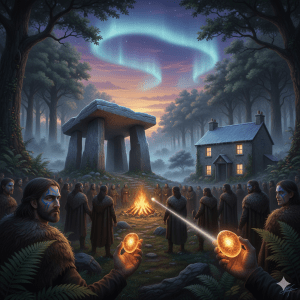
She looked back out at the horizon where the Haroldstown Dolmen stood. It wasn’t a ruin anymore. It was brand new, the stones sharp and clean, surrounded by hundreds of people dressed in furs, their faces painted with blue woad. They weren’t “echoes” or “visions”—they were real, breathing, and looking directly toward her window with expressions of profound confusion.

One of the men stepped forward, holding a spear. In his other hand, he held an identical amber pebble. He held it up toward her, and as the morning sun hit it, the stone began to pulse.

Aoife realized then that the Spirit hadn’t shown her a portal to the past. He had made her the “echo.” She wasn’t a girl in 2025 dreaming of the ancient world; she was now the ancient mystery that the people of the Dolmen would spend the next five thousand years trying to explain.


Leave a comment

Posted by on December 19, 2025 in dolmen, haroldstown


Tags: , , , ,

Doctor Who and the Music of the Dolmen

Doctor Who: The Music of the Dolmen

A lonely Irish field. An ancient stone table the locals dare not cross after dusk. And music—sweet, wordless, and terrible—drifting over the hedgerows at twilight.

When the TARDIS sets down near Haroldstown Dolmen in nineteenth-century County Carlow, the Doctor dismisses it as a simple megalith. But the parish books tell another story: of vanished boys and broken fiddle-bows left upon the stone; of a lady in green velvet singing the living down into silence. Investigating beneath the dolmen, the Doctor discovers a chamber of whispering figures—neither alive nor dead—while the song coils tighter around his companions.

What lies under the stone is no tomb—but a trap still feeding. To save Ian, Barbara and Susan from the music’s call, the Doctor must confront the intelligence that plays human souls like strings… before the last note falls.


Contents

  1. A Harp in the Hedgerows – In which the travellers meet a worried historian, a superstitious farmer, and a song that is not a song.
  2. Parish Ink and Green Velvet – Testimonies, tokens on stone, and a vision upon the capstone that nearly claims Ian.
  3. What the Earth Remembered – The Doctor digs; a lantern shows too much; Susan hears her name from beneath.
  4. The Unplayed Note – A bargain, a breaking, and a silence that does not quite hold.

 Do you want to read more?

Click on the link – and enjoy.


Leave a comment

Posted by on September 30, 2025 in Uncategorized


Tags: , ,

A Tale of County Carlow

A Tale of County Carlow

The Woman on the Dolmen

A Tale of County Carlow

It was in the late summer of 1848 that I made my visit to Tullow in the county of Carlow. My business there, though of a trifling and unromantic nature, afforded me several days among scenery which, if not grand in the manner of the Wicklow mountains, possessed a quieter charm.

The Slaney flowed past the town; the hedgerows were thick with bramble and honeysuckle; and in the evening one might hear corncrakes calling from the meadows. I took lodgings at a modest inn near the market square. My host was a man of much conversation, with a particular relish for tales of the district. It was he who first directed my attention to Haroldstown Dolmen, an ancient monument some miles to the northeast, near the River Derreen.

“You’ll see it from the road to Hacketstown,” he said, pouring me a glass of cider. “A great stone laid upon others, like a table set for giants. Some say it marks a burial place.” He lowered his voice. “Others say it is a doorway. Once in a while, sir, the dead come out to sit upon it.”

I laughed lightly, as travellers often do when hearing the beliefs of a countryside not their own. Yet I resolved to see the place. I have always been drawn to old stones and the questions they leave unanswered.

Two days later, my business took me part of the way towards Hacketstown. I arranged to be set down near Acaun Bridge in the late afternoon, intending to walk to the dolmen and return before dark. The driver warned me that I had left myself little time, but the sky was clear, and I paid his caution no heed.

The road ran between high hedges. Bees still hummed among the flowers, though the warmth of the day was fading. After a turn, I caught sight of the Derreen below and, beyond it, the dolmen standing in a field.

Its great capstone rested upon several uprights. The lowering sun cast their shadows across the grass, and the field appeared empty except for a few sheep grazing at a distance. I stopped at the gate, uncertain why the sight should trouble me.

Then I heard music.

At first I thought it a shepherd’s pipe carried upon the wind. But the sound came again, and I knew it for a harp: a single clear note, followed by another. A woman’s voice rose with it.

She sang in no words that I could discern. Her voice was sweet and mournful, yet powerful enough to make me feel the notes in my chest. I lifted the gate latch and went in, scarcely aware that I had done so.

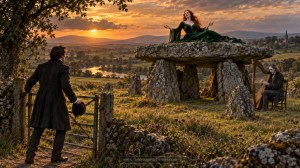
A woman lay upon the capstone as though it were a couch. Her deep red hair fell over her shoulders, and her green gown caught the last of the sunlight. She held her pale hands slightly raised, shaping the air as she sang.

Beside the dolmen sat a man playing a harp. His chair was an ordinary wooden one, such as might have been brought from the parlour of a farmhouse. Nothing else about him was ordinary. His face was thin and deathly pale, and his eyes remained fixed upon the strings. He played with the grave attention of a man who dared not make a mistake.

I stood still. The woman’s eyes were half closed, yet I felt certain she knew I was there. Her song wound about the harp’s notes and seemed to draw me forward.

As the sun touched the hedge, her voice faltered. The harpist missed a note. For an instant, the woman looked towards the failing light with something like alarm.

Then she turned to me, and the music ceased.

“You hear us,” she said. Though she spoke softly, her words carried across the field. “Most do not.”

I could find no answer.

She rose from the stone. I would swear upon any book that the moss where she had lain bore no mark of her body. The harpist lifted his face at last. I saw then that the legs of his chair had sunk several inches into the hard, dry ground. The turf around them was unbroken.

He plucked a single string. Its sharp note passed through me, and the great stones seemed to tremble.

“Come closer,” the woman said. “Every ear that hears our song is chosen. We need one more voice.”

I wished to leave. Instead, I took a step towards her, and then another. The grass brushed my knees. Nettles, which I had scarcely noticed on entering, crowded the path behind me.

The harpist raised his hands to play again. At that moment a cloud crossed the sun, and the field fell into shadow. The woman turned her head sharply towards the harp. Whatever held me loosened.

I ran.

I stumbled through the gate, caught my sleeve upon its latch, and fled along the road without looking back. Behind me the music began once more. It sounded sweeter now, full of such sorrow that I nearly stopped. I kept going until I reached the place where the driver had agreed to collect me. He was waiting with his horse and cart, and I climbed aboard before he could ask why I was breathless.

By the time we reached Tullow, I could hear only the wheels on the road and the ordinary voices of the town.

My host was standing in the inn doorway.

“So,” he said, looking at my torn sleeve, “you have been to Haroldstown.”

I could not bring myself to tell him what I had seen. He asked me nothing further.

In the nights that followed, I sometimes woke believing I had heard the trembling of a harp string. Once, I thought a woman was singing beneath my window. I rose and looked out, but the street was empty.

Many years have passed since that evening. I have never returned to Haroldstown, nor do I intend to. Yet when summer fades and the wind carries the scent of nettles and cut grass, I hear again the echo of that song.

And I wonder what would have become of me had the sun remained uncovered for one moment more.


Tags: , , , , , ,

Haroldstown Dolmen

haroldstown dolmen

Haroldstown Dolmen

Harolodstown Dolmen sits quite in a field,

Alone and uncared for adrift from the real,

From the life we consider so important, though rushed,

Yet it will be there when we’re gone, when we’re hushed.


Older than pyramids and older than sea,

Haroldstown Dolmen contained and yet free,

It’s neighbous are cattle, some sheep and a goat,

Blissfully unaware of its significant note.

 *

It’s a place of sanctitude, a place to set free,

Your mind and your spirit, your heart and your chi,

To rest for a while away from the rush,

Of everyday life and of everyday fuss.

*

Some tourists do seek it out now and then,

Taking a photo or two then moving on again,

Perhaps one day it will be known far and near,

As the dolmen of sanctitude; a place so rare.

*************

 
Leave a comment

Posted by on July 7, 2014 in Ireland


Tags: , ,