
No one noticed the monster at first, because it was very careful not to be noticed.
This was partly manners, and partly survival.
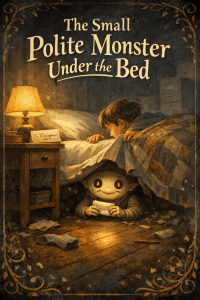
It lived beneath the bed in the narrow, dust-soft space where lost socks go to forget themselves. It was not large. About the size of a loaf of bread, if bread had eyes and a posture suggesting apology. Its skin was the colour of old paper. Its teeth were small, tidy, and almost never used.
Most importantly, it had been raised correctly.
The monster waited until the child was asleep before emerging, and even then it did so quietly, easing one claw onto the carpet and pausing to listen, just in case.
If the child stirred, the monster froze.
If the child sighed, the monster nodded, sympathetically.
If the child kicked the blankets off, the monster tucked them back in.
On its first night, the monster wrote a note…

Do you want to read more?
Click HERE and be scared!
When twilight settles over Ballykillduff, a strange hush falls across the fields… and a tent no one saw being built begins to glow.
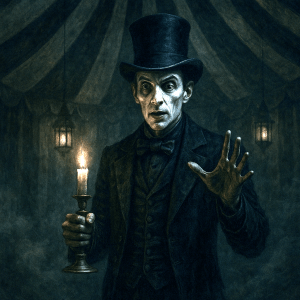
“The Circus Came at Twilight” is a dark, melodic folk ballad inspired by the haunting tale of The Circus of the Grotesques — a place where shadows breathe, lanterns flicker without flame, and laughter sometimes sounds like weeping.
This version blends cinematic musical-theatre emotion with eerie dark-folk storytelling, creating a mysterious, immersive journey into the heart of a cursed circus that appears only at dusk… and remembers everyone who enters.
✨ About the Song
🎵 Style: Dark folk • Cinematic • Theatrical
🎤 Vocals: Haunting male lead
🎻 Mood: Melancholy, magical, foreboding
🎪 Inspired by the story Circus of the Grotesques
✨ What You’ll Hear
• Warm yet eerie harmonies
• Whispering strings and distant calliope echoes
• A rising sense of mystery as the tent “comes alive”
• Lyrics that weave a ghostly narrative of arrival, memory, and fate
✨ Story Theme
The circus arrives without warning.
It grows like moonlight on empty ground.
Those who step inside may leave… but not unchanged.

Read the entire twelve chapter story HERE
(Spoken, low and hypnotic)**
“Ladies… gentlemen… wanderers in the dusk…
Lean closer now.
Don’t worry—
the shadows lean closer too.
In this tent of trembling light,
names slip,
faces shift,
and truths grow thin as moth-wings.
Repeat after me—
silently,
inside your obedient little minds:
Look not too long…
Look not too deep…
The circus wakes what should not wake from sleep…
For here, under the pearl and black,
the mirrors do not show you—
they show
what you fear you are becoming.
Listen…
Do you hear the canvas breathing?
Do you feel the ground remembering your steps?
Good.
It means the circus has seen you.
Now hush.
The show begins when the tent blinks.
And if it keeps its eyes open…
you may yet walk out
the same shape
as you walked in.”


The air in the Wasteland of the Forgotten didn’t move; it pressed, thick with the dust of ages and the silence of the long-dead. This was the domain of Malak, the Watcher.
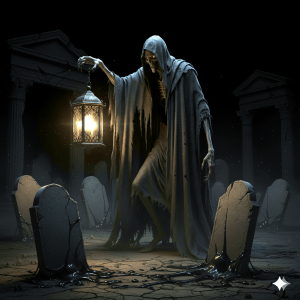
Malak was less a creature and more a convergence of dread, draped in rags the color of grave-soil. His face was a hollowed skull, his eyes two pinpricks of yellow hunger. In his skeletal hand, he held a lantern—an antique cage of pitted brass, whose light was an impossible, warm amber. It was the only light in the infinite black, and it was the problem.
His sole, unending task was to patrol the endless, cracked earth. The cracks weren’t from drought; they were fissures in reality. Beneath the crumbling crust lay the Before, and the things that still squirmed there longed for the air, for a taste of the thin, weary world Malak occupied.
The weirdness wasn’t the monster, but the light. Malak wasn’t lighting his own way; he was illuminating the cracks. And every time the warm glow fell upon a particularly deep, vibrating fissure, he had to stop. He’d bring the lantern close, its heat making the dust shimmer, and listen.
Tap. Tap-tap.
The sound was like a tiny, insistent knuckle-rapping on glass. It was the sound of something from the Before—something with too many limbs and no real shape—testing the barrier. Malak’s duty was horrifyingly simple: if the tapping was too quick, too loud, or if the amber light caught a sudden, glistening wetness oozing up, he had to feed the crack.
Slowly, agonizingly, he would lower his lamp, not snuffing it, but placing it gently over the most active fissure. The tap-tapping would cease, replaced by a sucking sound, and the light—the precious, warm, only light—would dim, then flicker, then be gone. The thing below had consumed the illumination, the hope, of the little flame.
Then, Malak would remain in the absolute dark, his skull tilted, waiting. After an eternity that might have been a minute, a tiny, fresh flicker would reignite inside the empty brass cage. A new spark, a new life, drawn from the sheer, unending need for a Watcher. And Malak would lift the lamp, its amber glow illuminating the next set of cracks, and continue his patrol, knowing that eventually, he would have to feed the light away again.
He was the guardian of the dark, and the perpetual sacrifice of the light.

The figure known only as the Scribe of Silence (the lantern-bearer) had a singular, maddening realization: the cracks in the ground were not new. They were the seams of an ancient wound, and the things that crawled out of them had a disturbing habit.
The ruined tombstones scattered across the cracked plain were the first victims. They weren’t merely weathered by time; they had been scoured. Malak, the Scribe, knew the process well, for it was his fault.
A thousand years ago, this was a proud, vast necropolis, a fortress of memory. When the Great Tear first opened, spewing forth the Grave-Flesh—amorphous, hungry, and impossibly patient—the people fled. The priests tried to seal the Tear with prayer. The warriors tried with steel. Malak, then a common grave-tender, watched them all fail.
The Grave-Flesh did not eat bodies. It ate identity.
When it spilled out, it crept onto the grandest mausoleums, the tallest pillars, and the most lovingly carved headstones. It covered the stone like a damp, black mold. Where it lingered, the names disappeared. The dates vanished. The sentimental epitaphs—Beloved Father, True Friend, Eternal Rest—were polished away until the stone was blank and cold.
The crumbled tombstones in the image are the ones the Grave-Flesh has finished feeding on. They are smooth, faceless wreckage, the stone equivalent of a man’s mind wiped clean.
Malak’s curse is that he was the last one alive, forced to watch the final, agonizing erasure of his own people. His lantern’s light is not a guide, but a warning beacon he must shine only on the new cracks. He is searching for any stone that still carries an inscription, an old mark, or a piece of a forgotten name.
His fear is that one day, he will turn his lantern’s gaze upon the shattered remnants of the necropolis and find that not a single stone bears a mark, leaving the Wasteland perfectly, horribly, clean—the final triumph of the Grave-Flesh. And when the memories are all gone, Malak knows, he will be next.


It was in the late summer of 1848 that I made my visit to Tullow in the county of Carlow. My business there, though of a trifling and unromantic nature, afforded me several days among scenery which, if not grand in the manner of the Wicklow mountains, possessed a quieter charm.
The Slaney flowed past the town; the hedgerows were thick with bramble and honeysuckle; and in the evening one might hear corncrakes calling from the meadows. I took lodgings at a modest inn near the market square. My host was a man of much conversation, with a particular relish for tales of the district. It was he who first directed my attention to Haroldstown Dolmen, an ancient monument some miles to the northeast, near the River Derreen.
“You’ll see it from the road to Hacketstown,” he said, pouring me a glass of cider. “A great stone laid upon others, like a table set for giants. Some say it marks a burial place.” He lowered his voice. “Others say it is a doorway. Once in a while, sir, the dead come out to sit upon it.”
I laughed lightly, as travellers often do when hearing the beliefs of a countryside not their own. Yet I resolved to see the place. I have always been drawn to old stones and the questions they leave unanswered.
Two days later, my business took me part of the way towards Hacketstown. I arranged to be set down near Acaun Bridge in the late afternoon, intending to walk to the dolmen and return before dark. The driver warned me that I had left myself little time, but the sky was clear, and I paid his caution no heed.
The road ran between high hedges. Bees still hummed among the flowers, though the warmth of the day was fading. After a turn, I caught sight of the Derreen below and, beyond it, the dolmen standing in a field.
Its great capstone rested upon several uprights. The lowering sun cast their shadows across the grass, and the field appeared empty except for a few sheep grazing at a distance. I stopped at the gate, uncertain why the sight should trouble me.
Then I heard music.
At first I thought it a shepherd’s pipe carried upon the wind. But the sound came again, and I knew it for a harp: a single clear note, followed by another. A woman’s voice rose with it.
She sang in no words that I could discern. Her voice was sweet and mournful, yet powerful enough to make me feel the notes in my chest. I lifted the gate latch and went in, scarcely aware that I had done so.
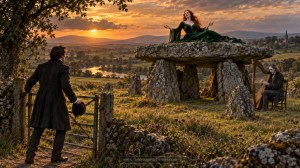
A woman lay upon the capstone as though it were a couch. Her deep red hair fell over her shoulders, and her green gown caught the last of the sunlight. She held her pale hands slightly raised, shaping the air as she sang.
Beside the dolmen sat a man playing a harp. His chair was an ordinary wooden one, such as might have been brought from the parlour of a farmhouse. Nothing else about him was ordinary. His face was thin and deathly pale, and his eyes remained fixed upon the strings. He played with the grave attention of a man who dared not make a mistake.
I stood still. The woman’s eyes were half closed, yet I felt certain she knew I was there. Her song wound about the harp’s notes and seemed to draw me forward.
As the sun touched the hedge, her voice faltered. The harpist missed a note. For an instant, the woman looked towards the failing light with something like alarm.
Then she turned to me, and the music ceased.
“You hear us,” she said. Though she spoke softly, her words carried across the field. “Most do not.”
I could find no answer.
She rose from the stone. I would swear upon any book that the moss where she had lain bore no mark of her body. The harpist lifted his face at last. I saw then that the legs of his chair had sunk several inches into the hard, dry ground. The turf around them was unbroken.
He plucked a single string. Its sharp note passed through me, and the great stones seemed to tremble.
“Come closer,” the woman said. “Every ear that hears our song is chosen. We need one more voice.”
I wished to leave. Instead, I took a step towards her, and then another. The grass brushed my knees. Nettles, which I had scarcely noticed on entering, crowded the path behind me.
The harpist raised his hands to play again. At that moment a cloud crossed the sun, and the field fell into shadow. The woman turned her head sharply towards the harp. Whatever held me loosened.
I ran.
I stumbled through the gate, caught my sleeve upon its latch, and fled along the road without looking back. Behind me the music began once more. It sounded sweeter now, full of such sorrow that I nearly stopped. I kept going until I reached the place where the driver had agreed to collect me. He was waiting with his horse and cart, and I climbed aboard before he could ask why I was breathless.
By the time we reached Tullow, I could hear only the wheels on the road and the ordinary voices of the town.
My host was standing in the inn doorway.
“So,” he said, looking at my torn sleeve, “you have been to Haroldstown.”
I could not bring myself to tell him what I had seen. He asked me nothing further.
In the nights that followed, I sometimes woke believing I had heard the trembling of a harp string. Once, I thought a woman was singing beneath my window. I rose and looked out, but the street was empty.
Many years have passed since that evening. I have never returned to Haroldstown, nor do I intend to. Yet when summer fades and the wind carries the scent of nettles and cut grass, I hear again the echo of that song.
And I wonder what would have become of me had the sun remained uncovered for one moment more.

(From the Papers of Canon O’Shaughnessy, with Notes and an Appendix on “An Faire Dorcha”)
By Dr. H. C. Ellingham, F.S.I.A.

In arranging the literary remains of the late Canon O’Shaughnessy of Carlow, I discovered a packet of letters, tied with twine and labelled in his hand “Ballyroguearty — Donnelly.” These were addressed to him from Father Donnelly, parish priest of Ballyroguearty, in the closing months of 1874.
The contents pertain to certain manifestations within the parish church of St. Brendan’s. I beg leave to lay the documents before the Society, together with marginalia of Canon O’Shaughnessy, and such commentary as I may append.
Letter, Oct. 18th, 1874:
“I perceived at the last pew, beneath the north wall, a figure robed in darkness, so dense the candles gave it no light. Its head was bowed, and it muttered in broken Latin.”
Transcription (as copied by Donnelly):
MIS-ER-E-RE NOBIS
DEVS TENEBRARVM
ORDO ÆTERNVM
EXTERMINARE PECCATVM
(Translation: “Have mercy upon us, God of Shadows, eternal order, destroy sin.”)
Letter, Nov. 2nd, 1874:
“Wax poured like wounds from the candles; the bells swung without hand; the saints wept black tears. Through it all the shadow chanted…”
Transcription:
SANC-TV[S] SANC-TV[S] SANC-TV[S]
ORDO DOMINATORVM
PLENVM EST VNIVERSVM
GLORIA TENEBRARVM
(A parody of the Sanctus. Here the glory belongs to shadows, not the Lord of Hosts.)
Want to reead more?
Click on the link, below, and be scared!
The Shadow that learned to pray
I saw a lone figure, a shadowy sight,
While walking the woods one dark wintry night,
So I quickened my pace and hurried my step,
To escape its attention and forget we had met.
The mysterious figure following my route,
Shadowing my steps, copying my truth,
Never let up despite my great pains,
To escape its attention and break free of its reign.
Minutes passed, hours and then days,
Weeks followed by months and years deathly grey,
Until one dark wintry night while walking the same wood,
I confronted the thing that held onto my truth.
Having prevailed over fear, I could see what it was,
An angel, a guardian angel, sent down from above,
Then it opened its wings, showing me the light of my life,
And I welcomed it into my soul with delight.