
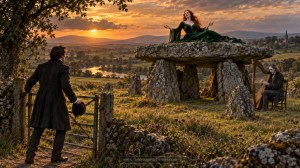
The Woman on the Dolmen
A Tale of County Carlow
It was in the late summer of 1848 that I made my visit to Tullow in the county of Carlow. My business there, though of a trifling and unromantic nature, afforded me several days among scenery which, if not grand in the manner of the Wicklow mountains, possessed a quieter charm.
The Slaney flowed past the town; the hedgerows were thick with bramble and honeysuckle; and in the evening one might hear corncrakes calling from the meadows. I took lodgings at a modest inn near the market square. My host was a man of much conversation, with a particular relish for tales of the district. It was he who first directed my attention to Haroldstown Dolmen, an ancient monument some miles to the northeast, near the River Derreen.
“You’ll see it from the road to Hacketstown,” he said, pouring me a glass of cider. “A great stone laid upon others, like a table set for giants. Some say it marks a burial place.” He lowered his voice. “Others say it is a doorway. Once in a while, sir, the dead come out to sit upon it.”
I laughed lightly, as travellers often do when hearing the beliefs of a countryside not their own. Yet I resolved to see the place. I have always been drawn to old stones and the questions they leave unanswered.
Two days later, my business took me part of the way towards Hacketstown. I arranged to be set down near Acaun Bridge in the late afternoon, intending to walk to the dolmen and return before dark. The driver warned me that I had left myself little time, but the sky was clear, and I paid his caution no heed.
The road ran between high hedges. Bees still hummed among the flowers, though the warmth of the day was fading. After a turn, I caught sight of the Derreen below and, beyond it, the dolmen standing in a field.
Its great capstone rested upon several uprights. The lowering sun cast their shadows across the grass, and the field appeared empty except for a few sheep grazing at a distance. I stopped at the gate, uncertain why the sight should trouble me.
Then I heard music.
At first I thought it a shepherd’s pipe carried upon the wind. But the sound came again, and I knew it for a harp: a single clear note, followed by another. A woman’s voice rose with it.
She sang in no words that I could discern. Her voice was sweet and mournful, yet powerful enough to make me feel the notes in my chest. I lifted the gate latch and went in, scarcely aware that I had done so.
A woman lay upon the capstone as though it were a couch. Her deep red hair fell over her shoulders, and her green gown caught the last of the sunlight. She held her pale hands slightly raised, shaping the air as she sang.
Beside the dolmen sat a man playing a harp. His chair was an ordinary wooden one, such as might have been brought from the parlour of a farmhouse. Nothing else about him was ordinary. His face was thin and deathly pale, and his eyes remained fixed upon the strings. He played with the grave attention of a man who dared not make a mistake.
I stood still. The woman’s eyes were half closed, yet I felt certain she knew I was there. Her song wound about the harp’s notes and seemed to draw me forward.
As the sun touched the hedge, her voice faltered. The harpist missed a note. For an instant, the woman looked towards the failing light with something like alarm.
Then she turned to me, and the music ceased.
“You hear us,” she said. Though she spoke softly, her words carried across the field. “Most do not.”
I could find no answer.
She rose from the stone. I would swear upon any book that the moss where she had lain bore no mark of her body. The harpist lifted his face at last. I saw then that the legs of his chair had sunk several inches into the hard, dry ground. The turf around them was unbroken.
He plucked a single string. Its sharp note passed through me, and the great stones seemed to tremble.
“Come closer,” the woman said. “Every ear that hears our song is chosen. We need one more voice.”
I wished to leave. Instead, I took a step towards her, and then another. The grass brushed my knees. Nettles, which I had scarcely noticed on entering, crowded the path behind me.
The harpist raised his hands to play again. At that moment a cloud crossed the sun, and the field fell into shadow. The woman turned her head sharply towards the harp. Whatever held me loosened.
I ran.
I stumbled through the gate, caught my sleeve upon its latch, and fled along the road without looking back. Behind me the music began once more. It sounded sweeter now, full of such sorrow that I nearly stopped. I kept going until I reached the place where the driver had agreed to collect me. He was waiting with his horse and cart, and I climbed aboard before he could ask why I was breathless.
By the time we reached Tullow, I could hear only the wheels on the road and the ordinary voices of the town.
My host was standing in the inn doorway.
“So,” he said, looking at my torn sleeve, “you have been to Haroldstown.”
I could not bring myself to tell him what I had seen. He asked me nothing further.
In the nights that followed, I sometimes woke believing I had heard the trembling of a harp string. Once, I thought a woman was singing beneath my window. I rose and looked out, but the street was empty.
Many years have passed since that evening. I have never returned to Haroldstown, nor do I intend to. Yet when summer fades and the wind carries the scent of nettles and cut grass, I hear again the echo of that song.
And I wonder what would have become of me had the sun remained uncovered for one moment more.

