The Day Reilly the Slug Learned Nothing (and Then Something, but Not for Long)
A Ballykillduff Story
In the village of Ballykillduff—where the post box is green, the wind occasionally argues with itself, and even the paving stones have been known to sigh—there once lived a slug called Reilly.
He lived, if such a word can be used generously, beneath a damp and rather opinionated stone at the edge of the village square. The stone had been there longer than most of the villagers and was known to mutter, particularly about moisture levels and passing beetles.
Reilly, however, had very little interest in stones, beetles, or indeed anyone at all—except when they were useful.
He was, by all accounts, incredibly slimy.
Not merely in the physical sense (though that was undeniable), but in the manner of his dealings. He borrowed dew and never returned it. He left trails where trails were expressly unwelcome. He once told a very small mushroom that it would grow into a grand oak tree, which was both untrue and unnecessarily upsetting.
“Morning, Reilly,” said Mrs Flannery one day, sweeping the step of her shop.
Reilly slid past without reply, leaving behind a glistening remark that required two buckets and a firm word to remove.
“Uncivil,” said the broom, which had seen better slugs.
Reilly preferred the night.
At night, he thought himself clever.
At night, he thought no one saw him.
At night, he could glide where he pleased, whispering unkind things to unsuspecting leaves and rearranging small piles of gravel purely for inconvenience.
“I am a creature of great intelligence,” Reilly once announced to a puddle, which, to its credit, did not respond.
It was on one such night—quiet, dark, and slightly too proud of itself—that Reilly made a mistake.
He was gliding along the edge of Currans Lane, composing what he believed to be a particularly cutting remark about a passing dandelion, when—
slip.
slide.
plop.
Reilly vanished.
He had fallen into a hole.
Now, holes in Ballykillduff are rarely just holes.
This one, for instance, was deeper than it should have been, darker than it needed to be, and faintly echoing in a way that suggested it had opinions about those who fell into it.
Reilly landed with a soft, undignified sound.
It was very dark.
It was very quiet.
And, most troubling of all—
there was no one to be unkind to.
At first, Reilly was annoyed.
“This is inconvenient,” he said to the darkness.
The darkness, being thorough, did not respond.
After a while, annoyance gave way to something less familiar.
Thinking.
Reilly began, for perhaps the first time in his life, to think about himself.
He thought about the mushroom.
He thought about the beetles.
He thought about the puddle, which had always been rather patient with him.
He thought about Mrs Flannery’s step.
He thought about the trail.
“Oh,” said Reilly, quietly.
It is a small word, “oh,” but in Ballykillduff it has been known to change entire weather patterns.
“I have not been… very good,” he admitted.
The hole, which had been waiting for this moment, seemed to grow just a little less dark.
“I shall change,” Reilly declared.
“I shall be kind. I shall be thoughtful. I shall be… less Reilly.”
Time passed.
(No one in Ballykillduff was quite sure how much, as the clocks occasionally took personal days.)
Then, quite suddenly—
thunk.
A stick fell into the hole.
It landed beside Reilly, leaning at just the right angle, as though it had been sent with purpose—or at least with good timing.
Reilly looked at it.
The stick looked at Reilly.
“Well,” said Reilly, “this seems promising.”
With some effort, and a great deal of sliding, Reilly climbed.
Up he went.
Up past the thinking.
Up past the promises.
Up into the light.
Reilly emerged from the hole.
The world was as it had always been.
The stone was still muttering.
The post box was still green.
Mrs Flannery was still sweeping.
And Reilly—
Reilly paused.
He remembered his promise.
He remembered his thoughts.
He remembered his oh.
For a moment—just a moment—he considered keeping it.
Then he didn’t.
“Well,” he said, “one mustn’t be unreasonable.”
And off he went, leaving a trail that suggested nothing at all had been learned.
Days passed.
Reilly returned to his habits.
The mushroom was confused again.
The beetles avoided him.
The puddle grew slightly less patient.
And Reilly, as ever, did not notice.
Until one day—
a very hot day.
A day so bright that even the shadows considered taking cover.
Reilly, having spent the morning being particularly disagreeable to a passing daisy, returned to his home beneath the stone.
Only—
he forgot to cover it properly.
He left the entrance open.
He did not think.
The sun did.
It shone.
And shone.
And shone.
Down into Reilly’s damp little world.
The stone muttered something about “consequences.”
Reilly began to feel… uncomfortable.
Then dry.
Then very dry indeed.
“Oh,” said Reilly again.
But this time, it was a different sort of oh.
By the time the shade returned, Reilly was no longer quite himself.
He had, in a manner of speaking, been reduced to a lesson.
And in Ballykillduff, lessons do not go to waste.
The children of the village, passing by the stone, would sometimes pause.
“Was that Reilly?” one might ask.
“It was,” said the stone, which had decided to be helpful for once.
“What happened to him?”
The stone would consider this.
Then say:
“He remembered something important.
But not for long enough.”
And so, if you ever find yourself in Ballykillduff—
where the post box is green, the wind occasionally argues, and even the smallest creatures are given their moment—
you may hear the quiet moral whispered by stones, puddles, and particularly thoughtful sticks:
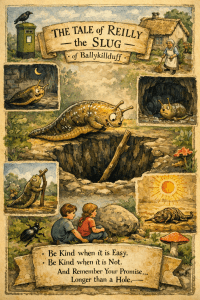
Be kind when it is easy.
Be kind when it is not.
And if you promise to change—
do try to remember it longer than a hole.
 The Crazymad Writer Writes Again