
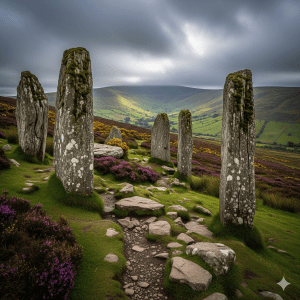
The air was alive with the sound of music, a reel so fast and joyous it could make the very stones dance. Fiadh, her red hair a fiery blur, spun in the center of the ring, her feet a rapid-fire beat against the soft earth. The piper, a man known simply as Séamus, stood a little apart, his fingers a blur over the chanter. The melody poured from the bagpipes, a wild, untamable thing that wrapped around the dancers and pulled them into a frenzy of merriment.
The sun was high above the Wicklow Hills, a golden disk in a pale blue sky. It was the Sabbath, a day of rest, but here in this secluded glen, rest was the last thing on anyone’s mind. The laughter and music were an irresistible force, a defiance of all the solemnity of the day. One by one, more villagers joined the circle, their faces flushed with glee. They were a motley crew—farmers, weavers, even the grumpy blacksmith—all united by the irresistible pull of Séamus’s tune.
But a dark figure watched from the edge of the forest. The local druid, a gaunt man with eyes as sharp as flint, had warned them. “The old ways are fading,” he’d said, “but the gods still watch. To dance on the Sabbath is to tempt their wrath.” His words, however, had been lost in the chorus of fiddles and flutes.
As the sun began to dip toward the horizon, casting long, purple shadows, the music reached a fever pitch. Séamus’s cheeks were puffed out, his eyes squeezed shut in concentration, pouring every ounce of his soul into the pipes. The dancers spun faster, a dizzying whirlwind of color and movement.
It was then that the first tremors began. The ground beneath their feet started to shake, a low rumble that vibrated through the air and sent a shiver of fear through the crowd. The laughter died on their lips, replaced by gasps of alarm. The music faltered, a discordant squeal from the pipes, as Séamus’s fingers stilled.
The world seemed to hold its breath. A blinding flash of light, brighter than the noonday sun, erupted from the sky, engulfing the entire glen. When the light faded, the grass lay undisturbed, the air was eerily still. There was no music, no laughter, no sound at all.
Where a circle of lively dancers had once stood, there was now a ring of cold, gray stone. Some of the stones stood upright, their forms still vaguely human, as if caught mid-spin. Others lay flat on the ground, a testament to a fall. And some ways off, a tall, silent pillar of granite stood alone, a silent sentinel over the ossified dancers. This was Séamus, the piper, forever silenced, his pipes gone, his merriment a memory etched in stone.
The villagers who had fled watched from a distance, their faces pale with shock. They had seen the wrath of the gods, a swift and terrible judgment. From that day on, the place was known as the Piper’s Stones, a silent warning to all who would defy the sacred day, a tale of merriment gone wrong that would echo through the glens for centuries to come.
 The Crazymad Writer Writes Again