The Midnight Mass of Haroldstown
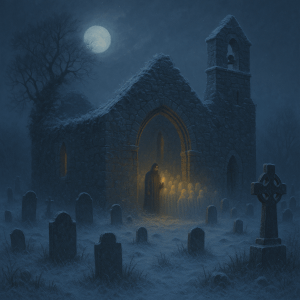
On Christmas morning, long before the living stir, Haroldstown lies heavy with frost. The moon still hangs in the sky, pale and watchful, and the ruined church is black against the whitened fields.
It is then, the old ones say, that the congregation gathers. Not the living parish, but the other one — the flock that never left. Their procession begins in silence, rising from the graves where frost glitters like stars. From every crooked headstone they come, from beneath the yew roots and from the bog earth beyond the wall. Their feet make no mark in the snow.
They enter through the broken arch, and inside the roofless nave they take their places. Shoulder to shoulder, row upon row, a congregation of pale faces lifted toward the altar. From the southern wall comes a sound like breath — the little door hidden by ivy sighs open, and out steps the priest. None remember his name. His vestments are black, edged with silver thread, and in his hand he holds no book, no chalice, only a bell that has not rung in centuries.
When he lifts it, the toll spreads across the valley. Dogs shiver in their kennels, cattle shift in their stalls, and sleepers dream of voices whispering at the foot of their beds. The service begins, not in Latin, not in English, but in a tongue older than either, the syllables rolling like water over stones.
Those who dare to listen from the lanes say the dead reply in one voice, low and unearthly. They kneel, rise, and kneel again, as if the ruined church still had pews, as if the roof still sheltered them from the snow. Some claim the very air glows faintly within the walls, as if candlelight burns where no candle stands.
And then, just before the first cock crows, the bell tolls once more. The priest lowers his hand, and the congregation fades. The altar stands empty. The frost lies unbroken again.
When the villagers wake and walk to their own Christmas Mass in Tullow, the church at Haroldstown is silent, its ruin unchanged. But if you lean close to the stones, you may find them faintly warm, as though hundreds of hands had rested there only moments before.


 The Crazymad Writer Writes Again