RSS

Category Archives: scare

The Vexari

The Vexari

Once, in the violet-hued twilight of a world called Khyra-Vel, there lived a people known only in whispers beyond their borders: the Vexari.

They were not born of flesh in the usual way. Long before the first mountain cooled and the oceans learned to dream, the planet’s core had sung a strange, low-frequency lament. That song seeped upward through crystal veins, through black soil, through the marrow of ancient trees. Where the song met lightning-struck ironwood, the first Vexari took shape—not grown, not hatched, but remembered into being.

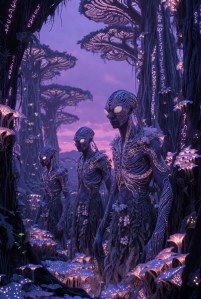
They looked almost human at a distance: tall, long-limbed, skin the color of storm clouds reflecting fire. But come closer and the illusion frayed. Their eyes were compound mosaics, each facet holding a different hour of the day. Their hair moved even without wind, threading itself into tiny, deliberate patterns like living script. Most unsettling of all were the thin, silvery lines that ran beneath their skin—rivers of liquid starlight that pulsed faster whenever they felt strong emotion, or whenever they lied.

The Vexari did not speak with voices. They vexed. A thought, a memory, a half-formed fear would leap from one mind to another like static jumping between copper wires. To be in a room full of them was to feel every unsaid word pressing against your temples. Most outsiders went mad within hours. The few who survived learned to think in rigid, geometric patterns, building mental walls brick by brick until the onslaught dulled to a bearable hum.

For centuries the Vexari kept to themselves. Their cities grew inside colossal hollowed-out world-trees, spiraling upward and downward at once, floors becoming ceilings, gravity politely optional. They wove light into tapestries that remembered every face that had ever looked upon them. They sang to the core again, coaxing up fresh veins of song-metal they fashioned into blades that could cut sorrow from a heart without drawing blood.

Then came the strangers.

A ship of cold iron and colder ambition fell from the sky. Its crew called themselves the Reclaimers—humans mostly, though augmented until little original flesh remained. They had heard rumors of a world where thoughts could be mined like ore. They brought machines that listened, machines that recorded, machines that stole. The Reclaimers wanted to bottle vexation and sell it as a drug to the bored nobility of a dozen core systems. Eternal distraction. Perfect obedience. A mind too full to rebel.

The first Vexari they captured was named Sylith-9 (the number was not a rank but the number of times she had successfully forgotten her own name and then found it again—a prized talent among her kind).

They strapped her to a chair of braided tungsten. Electrodes kissed the silver rivers beneath her skin. The machines drank.

At first she gave them only silence.

Then she gave them everything.

Every childhood terror, every lover’s betrayal, every quiet moment she had ever doubted the core-song still loved her. The Reclaimers’ minds filled like cisterns during monsoon. They laughed. They wept. They tore at their own faces trying to scratch the memories out. Within minutes the entire boarding party was curled on the deck, rocking, whispering apologies to people who had died centuries earlier on distant worlds.

Sylith-9 stood. The silver lines under her skin now blazed white-hot. She walked among the broken crew, touching each one lightly on the forehead. Into their minds she placed a single, perfect image: the moment just before birth, when every possibility still exists and none have yet hurt you.

They never recovered. But they also never died. They simply sat, smiling softly, cradling that one safe memory while the rest of their selves slowly dissolved.

Word spread.

The Reclaimers’ sponsors sent more ships. The Vexari answered in kind.

They did not fight with weapons. They fought with stories.

They vexed entire fleets with visions of wives who had never existed, children who died in wars that never happened, futures so beautiful the crews would rather die than wake from them. They vexed navigators with false stars until ships drifted forever among reefs of dark matter. They vexed admirals with the certain knowledge that victory had already been achieved—so why keep fighting?

In the end the armada limped home, half its vessels empty, the other half carrying crews who no longer remembered their own names, only that something infinitely precious had once lived inside them and was now gone.

Khyra-Vel was left alone again.

But the Vexari changed.

They began to wonder if solitude had been a mercy or a cage.

Some drifted away from the world-tree cities, seeking the edges of known space. They hired themselves out as interrogators, grief counselors, memory sculptors. A single Vexari could unravel a warlord’s lifetime of lies in an afternoon, or rebuild a shattered mind so skillfully that even the cracks became part of the design.

Others stayed behind, singing new songs to the core—louder, more questioning songs.

And on quiet nights, when the violet twilight returns, travelers still report seeing tall figures standing at the edge of the jungle, silver lines pulsing softly, watching the stars.

They do not call out.

They simply vex.

And if you listen very carefully, you might feel the lightest brush against your thoughts:

You are remembered.

You are not alone.

Would you like to remember yourself, too?


Leave a comment

Posted by on January 24, 2026 in scare, Scary, scary story


Tags:

The Watcher of the Cracks

The Watcher of the Cracks

The air in the Wasteland of the Forgotten didn’t move; it pressed, thick with the dust of ages and the silence of the long-dead. This was the domain of Malak, the Watcher.

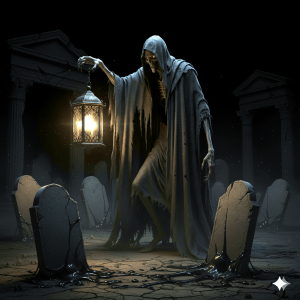
Malak was less a creature and more a convergence of dread, draped in rags the color of grave-soil. His face was a hollowed skull, his eyes two pinpricks of yellow hunger. In his skeletal hand, he held a lantern—an antique cage of pitted brass, whose light was an impossible, warm amber. It was the only light in the infinite black, and it was the problem.

His sole, unending task was to patrol the endless, cracked earth. The cracks weren’t from drought; they were fissures in reality. Beneath the crumbling crust lay the Before, and the things that still squirmed there longed for the air, for a taste of the thin, weary world Malak occupied.

The weirdness wasn’t the monster, but the light. Malak wasn’t lighting his own way; he was illuminating the cracks. And every time the warm glow fell upon a particularly deep, vibrating fissure, he had to stop. He’d bring the lantern close, its heat making the dust shimmer, and listen.

Tap. Tap-tap.

The sound was like a tiny, insistent knuckle-rapping on glass. It was the sound of something from the Before—something with too many limbs and no real shape—testing the barrier. Malak’s duty was horrifyingly simple: if the tapping was too quick, too loud, or if the amber light caught a sudden, glistening wetness oozing up, he had to feed the crack.

Slowly, agonizingly, he would lower his lamp, not snuffing it, but placing it gently over the most active fissure. The tap-tapping would cease, replaced by a sucking sound, and the light—the precious, warm, only light—would dim, then flicker, then be gone. The thing below had consumed the illumination, the hope, of the little flame.

Then, Malak would remain in the absolute dark, his skull tilted, waiting. After an eternity that might have been a minute, a tiny, fresh flicker would reignite inside the empty brass cage. A new spark, a new life, drawn from the sheer, unending need for a Watcher. And Malak would lift the lamp, its amber glow illuminating the next set of cracks, and continue his patrol, knowing that eventually, he would have to feed the light away again.

He was the guardian of the dark, and the perpetual sacrifice of the light.

The Ledger of Ash and Stone

The figure known only as the Scribe of Silence (the lantern-bearer) had a singular, maddening realization: the cracks in the ground were not new. They were the seams of an ancient wound, and the things that crawled out of them had a disturbing habit.

The ruined tombstones scattered across the cracked plain were the first victims. They weren’t merely weathered by time; they had been scoured. Malak, the Scribe, knew the process well, for it was his fault.

A thousand years ago, this was a proud, vast necropolis, a fortress of memory. When the Great Tear first opened, spewing forth the Grave-Flesh—amorphous, hungry, and impossibly patient—the people fled. The priests tried to seal the Tear with prayer. The warriors tried with steel. Malak, then a common grave-tender, watched them all fail.

The Grave-Flesh did not eat bodies. It ate identity.

When it spilled out, it crept onto the grandest mausoleums, the tallest pillars, and the most lovingly carved headstones. It covered the stone like a damp, black mold. Where it lingered, the names disappeared. The dates vanished. The sentimental epitaphs—Beloved Father, True Friend, Eternal Rest—were polished away until the stone was blank and cold.

The crumbled tombstones in the image are the ones the Grave-Flesh has finished feeding on. They are smooth, faceless wreckage, the stone equivalent of a man’s mind wiped clean.

Malak’s curse is that he was the last one alive, forced to watch the final, agonizing erasure of his own people. His lantern’s light is not a guide, but a warning beacon he must shine only on the new cracks. He is searching for any stone that still carries an inscription, an old mark, or a piece of a forgotten name.

His fear is that one day, he will turn his lantern’s gaze upon the shattered remnants of the necropolis and find that not a single stone bears a mark, leaving the Wasteland perfectly, horribly, clean—the final triumph of the Grave-Flesh. And when the memories are all gone, Malak knows, he will be next.

 
Leave a comment

Posted by on October 28, 2025 in Horror, scare, Scary


Tags: , , , , ,

THE SHADOW THAT LEARNED TO PRAY

THE SHADOW THAT LEARNED TO PRAY

THE SHADOW THAT LEARNED TO PRAY

(From the Papers of Canon O’Shaughnessy, with Notes and an Appendix on “An Faire Dorcha”)

By Dr. H. C. Ellingham, F.S.I.A.


I. Introductory Remarks

In arranging the literary remains of the late Canon O’Shaughnessy of Carlow, I discovered a packet of letters, tied with twine and labelled in his hand “Ballyroguearty — Donnelly.” These were addressed to him from Father Donnelly, parish priest of Ballyroguearty, in the closing months of 1874.

The contents pertain to certain manifestations within the parish church of St. Brendan’s. I beg leave to lay the documents before the Society, together with marginalia of Canon O’Shaughnessy, and such commentary as I may append.


II. The Donnelly Letters

First Appearance

Letter, Oct. 18th, 1874:

“I perceived at the last pew, beneath the north wall, a figure robed in darkness, so dense the candles gave it no light. Its head was bowed, and it muttered in broken Latin.”

Transcription (as copied by Donnelly):

MIS-ER-E-RE  NOBIS  
DEVS   TENEBRARVM  
ORDO   ÆTERNVM  
EXTERMINARE   PECCATVM

(Translation: “Have mercy upon us, God of Shadows, eternal order, destroy sin.”)


The Signs

Letter, Nov. 2nd, 1874:

“Wax poured like wounds from the candles; the bells swung without hand; the saints wept black tears. Through it all the shadow chanted…”

Transcription:

SANC-TV[S]   SANC-TV[S]   SANC-TV[S]  
ORDO   DOMINATORVM  
PLENVM   EST   VNIVERSVM  
GLORIA   TENEBRARVM

(A parody of the Sanctus. Here the glory belongs to shadows, not the Lord of Hosts.)

Want to reead more?

Click on the link, below, and be scared!

The Shadow that learned to pray

 
Leave a comment

Posted by on September 10, 2025 in scare, shadow


Tags: , , , , ,