A father was approached by his small son who told him proudly, “I know what the Bible means!”
His father smiled and replied, “What do you mean, you ‘know’ what the Bible means?
The son replied, “I do know!”
“Okay,” said his father. “What does the Bible mean?”
“That’s easy, Daddy…” the young boy replied excitedly,” It stands for ‘Basic Information Before Leaving Earth.’
What the BIBLE means
AIWS- Alice in Wonderland Syndrome
THE INFINITE INCH: A NAVIGATOR’S TALE
THE INFINITE INCH: A NAVIGATOR’S TALE
Chapter 1: The Heavy Hands
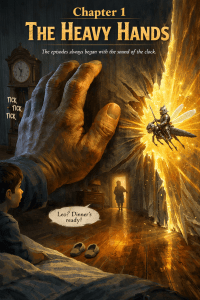
The episodes always began with the sound of the clock. In the hallway of the old house, the grandfather clock was usually a steady, comforting pulse. But as Leo lay in bed, pushed past the point of exhaustion, the rhythm shifted. Tick-tick-tick-tick. The seconds became frantic, aggressive, and impossibly fast.
Leo sat up, and that’s when the world dropped away. He looked down at his feet. The rug, which had been just inches from his toes, suddenly receded. The floorboards stretched out like a vast, polished canyon. His slippers looked like two tiny boats lost on a dark mahogany sea, miles below.
“Not again,” he whispered. His own voice sounded like a giant’s rumble. He lifted his hand to rub his eyes, but he stopped, frozen. His hand didn’t look like his hand. It was a monumental thing—a heavy, tectonic slab of flesh and bone. It felt as if it weighed a thousand pounds, yet it moved through the air with a strange, gliding lightness.
Then, the wall opposite his bed began to thin. Through microscopic gaps in the stretching space, Leo saw a shimmering, golden glow. A tiny knight, clad in silver-leaf armor and riding a dragonfly, appeared in the light.
“The one who sees the Great Span,” a voice boomed in Leo’s pulse. “Do not let the world shrink you back down. We have been waiting for a Navigator.”
Chapter 2: The Heartbeat of Bronze

The next day, Leo found his Grandfather Silas’s old sea chest in the attic. Inside was a leather-bound book. The first page read: “To those who see the miles in a thumb-width: You are not ill. You are merely un-tethered.”
That night, Leo didn’t fight the tiredness. He stared at the grandfather clock until the “Stretch” took hold. The clock became a Bronze Tower reaching into the clouds. Sir Valin, the tiny knight, appeared at the keyhole. “The Static has entered the Mainspring! If the clock stops, the Static will spill into your world!”
Leo looked at his gargantuan hand. He focused his energy, imagining his index finger becoming as thin as a hair. The sensation was agonizing, but he managed to insert the silver thread of his finger into the keyhole. Inside, massive brass wheels spun like tectonic plates. Clinging to the spring was the Static—a flickering mass of grey pixels.
Leo used the Tachy-pulse, speeding up his perception until the gears slowed to a crawl. He flicked the Static away, and it dissolved into dust. He pulled his hand back just as the world snapped into its “small” shape. He wasn’t just a boy anymore; he was a guardian of the gears.
Chapter 3: The Frozen Hallway
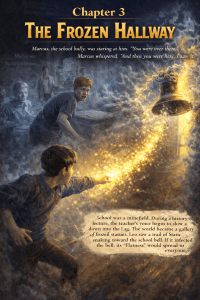
School was a minefield. During a history lecture, the teacher’s voice began to slow down into the Lag. The world became a gallery of frozen statues. Leo saw a trail of Static snaking toward the school bell. If it infected the bell, its “Flatness” would spread to everyone.
Leo stepped out of his desk. Because of the Lag, he covered the classroom in a single heartbeat. He grabbed a handful of golden Aether from the “Gap” behind the bell and threw it. The Static hissed and vanished. Leo lunged back to his seat just as reality slammed back to full speed. Marcus, the school bully, was staring at him. “You were over there,” Marcus whispered. “And then you were here. I saw it.” Marcus was starting to see the Gaps, too.
Chapter 4: The Weight of Mountains
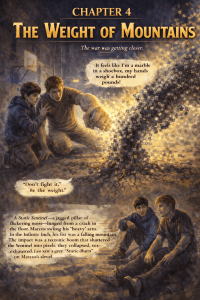
In the empty gym after school, Leo saw Marcus struggling as the world began to warp. “It feels like I’m a marble in a shoebox,” Marcus panicked. “My hands weigh a hundred pounds!”
“Don’t fight it,” Leo commanded. “Be the weight.”
A Static Sentinel—a jagged pillar of flickering noise—lunged from a crack in the floor. Marcus swung his “heavy” arm. In the Infinite Inch, his fist was a falling mountain. The impact was a tectonic boom that shattered the Sentinel into pixels. They collapsed, exhausted. Leo saw a grey “Static-Burn” on Marcus’s sleeve. The war was getting closer.
Chapter 5: The Map in the Marrow
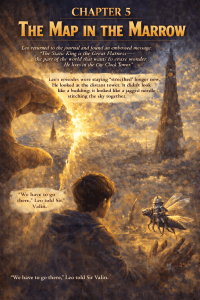
Leo returned to the journal and found an embossed message: “The Static King is the ‘Great Flatness’—the part of the world that wants to erase wonder. He lives in the City Clock Tower.”
Leo’s episodes were staying “stretched” longer now. He looked at the distant tower. It didn’t look like a building; it looked like a jagged needle stitching the sky together. “We have to go there,” Leo told Sir Valin. He wasn’t afraid of the heavy hands anymore; he was ready to use them.
Chapter 6: The Grids of the Grey City
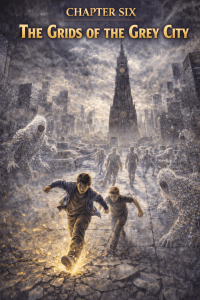
As Leo and Marcus entered the city, the Static King began his siege. The skyscrapers lost their depth, turning into flickering cardboard cutouts. The ground was smoothing out into a featureless grey plane.
“Think heavy!” Leo roared. He slammed his “heavy” foot down, sending a shockwave of Depth through the concrete. The 3D world snapped back wherever he stepped. Signal-Wraiths hissed past them, but Leo used the Tachy-pulse to turn the rushing city into a frozen landscape. They weaved through the statues of cars and people, reaching the base of the tower as the Flatness erased the streets behind them.
Chapter 7: The Heart of the Mechanism
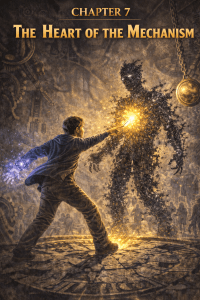
They climbed into a forest of iron. At the center stood the Static King, a flickering, 2D shadow. “Why cling to the stretch?” the King hissed. “In my kingdom, everything is flat. No pain. No heavy hands.”
Leo felt his body being squeezed into paper. He realized he had to be both scales at once. He reached out with his left hand as a “Galaxy-Hand” and his right as a “Needle-Hand.” The paradox ignited a golden spark in his chest.
“I am the Navigator!” Leo screamed. He anchored himself with his giant hand and reached into the King’s chest with his needle-finger, plucking out a tiny speck of “Perfect Stillness.” He threw it into the Grand Pendulum.
TICK. A wave of color and volume exploded. The King shattered. The world regained its depth.
Epilogue
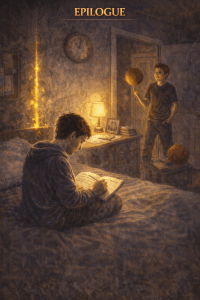
A week later, Leo sat on his bed. The clock ticked steadily. Marcus stopped by, tossing a basketball. They didn’t talk about the Infinite Inch, but they both saw the golden glow behind the wallpaper. Leo opened the journal to the last page and wrote: “The world is as big as you need it to be. As long as there is a Navigator, the world will never be flat.”
Author’s Note
The sensations in this book—of worlds stretching thin and hands feeling like heavy stones—come from my own life. As a child, I experienced Alice in Wonderland Syndrome (AIWS). I remember the disorientation of a room receding miles away and the “Heavy-Hand” feeling during bouts of exhaustion.
I wrote this to transform those confusing glitches into a superpower. If you have felt the world stretch or the silence roar, you are not broken. You are a Navigator.
Tweedle Do and Tweedle Don’t at the Funfair

Tweedle Do and Tweedle Don’t at the Funfair
The funfair arrived in Wonderland on a Thursday morning without asking permission.
Nobody saw the lorries arrive.
Nobody saw anyone putting up the rides.
One moment there was an empty meadow beside the road to the Queen’s croquet ground, and the next there were striped tents, coloured flags, swinging boats, spinning teacups and a magnificent Ferris wheel turning slowly against the blue sky.
A huge sign stood at the entrance:
THE WONDERLAND GRAND FUNFAIR
RIDES! GAMES! PRIZES!
FUN GUARANTEED
REFUNDS STRICTLY IMPOSSIBLE
Tweedle Do read the sign.
“Fun guaranteed,” he said. “That sounds promising.”
Tweedle Don’t read it too.
“Refunds impossible,” he said. “That sounds suspicious.”
They bought two tickets from a rabbit wearing a green waistcoat.
“Sixpence each,” said the rabbit.
Tweedle Do handed him a shilling.
The rabbit gave him three buttons, a peppermint and a small potato.
“What’s this?” asked Tweedle Do.
“Your change.”
“But it isn’t money.”
“It changed, didn’t it?”
Tweedle Don’t nodded thoughtfully.
“He’s got you there.”
They went inside.
Their first stop was the Merry-Go-Round of Uncertain Destination.
It looked perfectly ordinary except that every wooden horse was facing a different direction.
A notice beside it said:
ALL RIDERS MUST REMAIN SEATED UNTIL THEY HAVE ARRIVED SOMEWHERE.
“Shall we?” asked Tweedle Do.
“We probably shouldn’t,” said Tweedle Don’t.
So naturally they climbed aboard.
The music began.
The horses started moving.
Tweedle Do’s horse galloped clockwise.
Tweedle Don’t’s horse went anticlockwise.
A third horse went sideways.
A fourth climbed halfway up its pole and refused to come down.
The ride spun faster and faster.
“THIS IS WONDERFUL!” shouted Tweedle Do.
“THIS IS TERRIBLE!” shouted Tweedle Don’t.
They passed one another.
“WONDERFUL!”
“TERRIBLE!”
“WONDERFUL!”
“TERRIBLE!”
When the ride finally stopped, Tweedle Do was wearing Tweedle Don’t’s cap, Tweedle Don’t was holding somebody else’s umbrella, and neither of them could remember which direction the entrance was.
“That,” said Tweedle Do, “was excellent.”
“That,” said Tweedle Don’t, “should be illegal.”
They moved on.
Next came the Hall of Mirrors.
A tall man with a moustache like two frightened caterpillars stood outside.
“Step inside!” he cried. “See yourselves as you have never seen yourselves before!”
“That sounds interesting,” said Tweedle Do.
“That sounds unnecessary,” said Tweedle Don’t.
They entered.
The first mirror made Tweedle Do enormously tall and Tweedle Don’t extremely thin.
The second made them both square.
The third gave Tweedle Do seventeen ears.
The fourth showed no reflection at all.
Tweedle Don’t stared into it.
“I’m not there.”
Tweedle Do looked.
“Neither am I.”
“Perhaps we’ve gone missing.”
“Should we report it?”
“To whom?”
Then, quite suddenly, the mirror itself spoke.
“Next!”
A small door appeared in the glass and swung open.
Tweedle Do and Tweedle Don’t ran out.
“I didn’t like that one,” said Tweedle Do.
“I did,” said Tweedle Don’t.
They both stopped.
Tweedle Do frowned.
“You liked it?”
“I appear to have done.”
“This fair is doing something to us.”
Before Tweedle Don’t could answer, there came a tremendous clang.
DING! DING! DING!
A crowd had gathered around a brightly painted stall.
Above it hung a sign:
THE GREAT WONDERLAND STRENGTH TEST
HIT THE BUTTON
RING THE BELL
WIN AN IMPOSSIBLY LARGE PRIZE
Behind the stall stood an enormous stuffed flamingo.
Tweedle Do gasped.
“I want that.”
“You have nowhere to put it.”
“I’ll find somewhere.”
“You haven’t got enough room.”
“I’ll make some.”
“You shouldn’t.”
“I shall.”
The stallholder handed Tweedle Do an enormous wooden mallet.
“One strike,” he said.
Tweedle Do lifted the mallet.
He swung.
WHUMP!
The weight shot up the tower.
It passed WEAK.
It passed AVERAGE.
It passed SURPRISINGLY STRONG.
It passed SHOWING OFF NOW.
Then it struck the bell.
DING!
The crowd cheered.
The stuffed flamingo was presented to Tweedle Do.
It was nine feet tall.
Tweedle Don’t stared at it.
“How are we going to carry that?”
“We?”
“Yes, we.”
“I thought you said I shouldn’t win it.”
“That was before you won it.”
They carried the flamingo between them.
Or rather, they attempted to.
Its neck became tangled in the bunting.
Its feet knocked over a toffee-apple stand.
Its beak accidentally removed a man’s hat.
“Sorry!” called Tweedle Do.
“Not sorry!” shouted Tweedle Don’t.
Tweedle Do stopped.
“What?”
“I don’t know why I said that.”
Things were definitely getting peculiar.
Then they saw the biggest attraction in the entire fair.
It was surrounded by flashing lights.
Trumpets played.
Drums rolled.
A mechanical voice boomed:
“COME ONE! COME ALL! RIDE THE GREAT DO-OR-DON’T MACHINE!”
Tweedle Do froze.
Tweedle Don’t froze.
They looked at each other.
The machine consisted of two enormous chairs mounted on a circular platform.
Above one chair was the word:
DO
Above the other:
DON’T
“This seems rather specifically aimed at us,” said Tweedle Do.
“We definitely shouldn’t ride it,” said Tweedle Don’t.
Five minutes later they were strapped in.
The stuffed flamingo had been propped against the side of the machine, where it leaned crookedly with its long beak pointing towards the sky.
The operator pulled a lever.
The machine began to spin.
A mechanical voice asked:
“WOULD YOU LIKE SOME CAKE?”
“DO!” shouted Tweedle Do.
“DON’T!” shouted Tweedle Don’t.
A slice of cake landed in Tweedle Do’s lap.
The machine spun faster.
“WOULD YOU LIKE TO JUMP IN A PUDDLE?”
“DO!”
“DON’T!”
A puddle appeared beneath Tweedle Do’s chair.
“WOULD YOU LIKE TO WEAR A CHEESE HAT?”
“DO!”
“DON’T!”
A large wedge of cheddar dropped onto Tweedle Do’s head.
“This is brilliant!” he cried.
“This is ridiculous!” shouted Tweedle Don’t.
The machine rattled.
The lights flashed.
The platform spun faster and faster.
Then everything suddenly slowed.
The fairground music faded.
The mechanical voice became much deeper.
“FINAL QUESTION.”
Tweedle Do stopped smiling.
Tweedle Don’t gripped the sides of his chair.
The voice continued.
“WOULD YOU LIKE THE FUNFAIR TO CONTINUE FOREVER?”
Tweedle Do opened his mouth.
Then he hesitated.
Forever?
No going home.
No supper.
No beds.
No quiet afternoons.
No chance ever to do anything except ride rides and eat toffee apples.
For the first time all day, the answer did not seem obvious.
“Don’t,” said Tweedle Do.
At exactly the same moment, Tweedle Don’t shouted:
“DO!”
The machine stopped.
Everything stopped.
The Ferris wheel froze.
The carousel froze.
The music stopped.
Even a toffee apple falling from a stick stopped halfway to the ground.
Tweedle Do stared at Tweedle Don’t.
“You said do.”
“You said don’t.”
“I know.”
“So do I.”
A little panel opened in front of them.
Inside was a red button.
Above it were the words:
IN CASE OF CONTRADICTION, PRESS ONCE
Below that, somebody had added:
DO NOT PRESS TWICE
Tweedle Do reached for it.
Tweedle Don’t reached for it too.
Their fingers touched the button together.
CLICK.
For one terrible second, nothing happened.
Then the whole funfair sneezed.
AAAAA-CHOOOOOO!
Flags flew into the air.
Balloons shot sideways.
The Ferris wheel turned backwards.
Three coconuts rolled out of the coconut shy and escaped beneath a fence.
The Hall of Mirrors reflected the wrong tent.
The merry-go-round horses applauded.
And the enormous stuffed flamingo gave the tiniest twitch.
Nobody noticed.
Then everything became still.
The operator unfastened the brothers.
“Well done,” he said.
“What did we do?” asked Tweedle Do.
“You disagreed the wrong way round.”
“But we always disagree,” said Tweedle Don’t.
“Yes,” said the operator. “That was the problem. The machine expected you to disagree in the usual way. The moment you swapped answers, it couldn’t decide which of you was which.”
Tweedle Do smiled.
Tweedle Don’t smiled too.
Then they both stopped smiling because agreeing about smiling seemed dangerous.
They collected their enormous flamingo and made for the exit.
At the gate, the rabbit in the green waistcoat waved.
“Did you enjoy yourselves?”
“Yes,” said Tweedle Do.
“No,” said Tweedle Don’t.
They paused.
Then Tweedle Do added:
“Mostly.”
And Tweedle Don’t said:
“Possibly.”
Behind them, the funfair lights blinked on.
A new sign appeared over the entrance.
TWEEDLE DO & TWEEDLE DON’T SPECIAL OFFER
COME AGAIN TOMORROW
OR DEFINITELY DON’T
Tweedle Do looked at his brother.
“Tomorrow?”
Tweedle Don’t considered this.
“Absolutely not.”
They walked another six paces.
“Same time?” asked Tweedle Do.
“Of course,” said Tweedle Don’t.
As they walked away, with the enormous stuffed flamingo wobbling between them, it gave a small shudder.
“Did you feel that?” asked Tweedle Do.
“Don’t be ridiculous,” said Tweedle Don’t.
Then the flamingo began to laugh.
Neither of them looked back.
One Eye Jack

The Secret Diary of One Eye Jack.
***************************************
Friday, 11th September: The Hedge That Sneezed
I inspected the hedge this morning.
This is one of my duties. Nobody appointed me to inspect it, but nobody else seems prepared to do the job properly.
Halfway along, the hedge sneezed.
I stepped backwards and stared at it with my one excellent eye.
“Bless you,” I said.
“Thank you,” replied the hedge.
A small hedgehog crawled out from beneath the leaves wearing a handkerchief around its neck. It apologised for the confusion and explained that it had caught a cold while sleeping in a damp flowerpot.
I showed it the driest corner of the old shed and shared half my breakfast with it.
I did not share the better half.
There are limits to kindness.
**One Eye Jack**
*Official Inspector of Suspicious Hedges*
See less