Chapter One
The Posters Arrive Out of Nowhere
On the morning it began, Ballykillduff woke up to an extra silence.
It wasn’t the usual sort of quiet you get before the rain, or the muffled hush after a good snowfall. This was a listening sort of silence, as if the whole village were holding its breath and waiting for something it couldn’t quite remember ordering.
The first to notice anything odd was a sheep.
She was an elderly ewe with a permanently offended expression and a tendency to wander off, which is exactly what she was doing—stomping along the lane toward the bridge, muttering in a sheepish sort of way—when a sudden gust of wind slapped a sheet of paper against her woolly flank.
The paper stuck there, fluttering like a strange rectangular tail.
The sheep stopped, blinked slowly, and decided—fairly—that this was one indignity too many. She shook herself. The paper refused to budge.
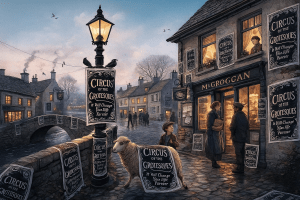
So Ballykillduff began its day with one very grumpy sheep trotting around the village green wearing an enormous poster as a cape.
No one questioned this at first. Ballykillduff was that kind of place.
Bridget O’Toole noticed the posters second.
She came out of McGroggan’s shop with a bag of flour in one hand and a packet of teabags in the other, intending to head straight home and not talk to anyone if she could possibly help it. That was her usual morning plan, and it rarely worked.
Today it didn’t even survive the pavement.
She stopped dead on the step, the way you do when something is so out of place that your brain needs a moment to catch up.
The noticeboard outside the shop was usually a patchwork of ordinary life: lost dogs, second-hand bikes, offers to teach the tin whistle, the eternal yellowing flyer for “Yoga with Maureen (Beginner Friendly, Bring Your Own Mat!).”
Today, every single scrap of paper was gone.
Instead, the whole board was covered edge to edge by one vast poster, so fresh the corners still curled.
It was printed in deep inky black and a strange, shimmering pearl that seemed to move when she looked at it. Not like glitter, which twinkled and sparkled and showed off, but like the inside of a seashell, where colours slid shyly from one to another.
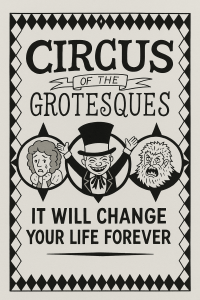
In the centre, in letters that looked almost hand-drawn and yet impossibly perfect, were the words:
CIRCUS OF THE GROTESQUES
It Will Change Your Life Forever

Bridget read it twice, then a third time just to be sure it still said the same thing.
“Grotesques,” she murmured under her breath. “That doesn’t sound very nice at all.”
“Depends what you mean by nice,” said a voice behind her.
She jumped and spun around, slopping a little flour onto the step.
Jimmy McGroggan stood there, hands in his pockets, hair doing its usual impression of a startled hedgehog. He peered at the poster over her shoulder, squinting.
“If I’d made that,” he declared, “I’d have used better paper.”
“Did you make it?” Bridget demanded.
Jimmy looked genuinely offended. “Bridget O’Toole, if I were going to plaster the village with something, I’d sign my name at the bottom and probably add a small diagram. No, this isn’t mine. The ink’s wrong. Smell it.”
“I’m not smelling a poster,” Bridget said crisply.
Jimmy leaned closer anyway and inhaled. “Huh. Thought so.”
“What?”
“Smells like the page of a book you haven’t opened yet,” he said. “And just a bit like matches. Interesting.”
Before Bridget could decide what sort of reply that deserved, a small boy barrelled between them and slammed to a halt in front of the board.
“Whoa,” breathed Patrick Byrne. “Did you see the sheep?”
“What about the sheep?” asked Bridget.
“She’s wearing one of these things!” Patrick waved an arm at the poster, eyes wide. “Walked right past our gate like a circus queen. Nearly choked on my toast.”
“Then someone’s been busy,” Jimmy muttered. “This one here, and one on the sheep… I suppose the bridge lamppost has one too.”
He said it like a joke.
But when they turned to look, there it was: another poster wrapped neatly around the lamppost on the bridge, the pearl letters catching the weak morning sun.
By ten o’clock, everybody knew.
The posters had not appeared in ones and twos, the way normal notices did. They had multiplied in the night like mushrooms after rain.
There was one on the door of The Giddy Goat pub, another tucked neatly inside the window of the tiny post office, one pinned to the fence outside the primary school (which the headmistress removed three times before giving up, because every time she walked away, another one very quietly took its place).
There was even a poster folded under the sugar bowl in Mrs Prendergast’s kitchen, which was especially impressive because Mrs Prendergast never let anything lie around in her kitchen without first interrogating it sternly.
She unfolded it with two fingers as if it might explode.
“Circus of the Grotesques,” she read aloud to her kettle. “It will change your life forever.”
The kettle, wisely, said nothing.
Mrs Prendergast sniffed. “Nothing good ever promises to change your life forever, unless it’s a winning lottery ticket or a decent pair of slippers.”
She turned the paper over, looking for a clue. There was no address, no phone number, no small print, no “terms and conditions apply.”
Just the same message, printed again in tiny lettering along the bottom edge. The pearl ink winked at her.
She crossed herself three times and put the poster on top of the bread bin, where she could keep an eye on it.
By half past eleven, Ballykillduff had achieved the rare and powerful state known as Total Gossip Saturation.
In McGroggan’s shop, people queued for bread they didn’t need and milk they already had, purely for the pleasure of discussing the matter at length.
“It’s a prank,” declared Seamus Fitzgerald, who was naturally nervous about everything and found comfort in deciding things were nothing to worry about. “Has to be. Someone from Tullow, probably. They think they’re very funny up there.”
“Tullow wouldn’t know a proper prank if it bit them,” said Jimmy. “And anyway, have you seen the paper? Feel that.”
He shoved a folded poster into Seamus’s hands. Seamus took it like it might be electrified.
“It’s just paper,” he said.
“Ah, but is it?” Jimmy grinned. “It’s like no paper I’ve ever seen. Flexible, but strong. Look—no crease marks. The ink doesn’t smudge. And smell it.”
“Why does everyone want me to smell things this morning?” Seamus muttered, but he leaned in all the same.
He sniffed once, hesitated, then sniffed again. “It smells… odd.”
“Like the inside of a magician’s sleeve,” Jimmy suggested.
“Like trouble,” Bridget put in from behind, placing a loaf and a packet of tea onto the counter. “We don’t need any kind of circus here, grotesque or otherwise.”
“What’s a grotesque?” asked Patrick from his place by the door. He had been hovering there for the best part of twenty minutes, listening to every word, and was now buzzing with an excitement nobody else seemed to share.
“A gargoyle that’s taken itself too seriously,” Jimmy said promptly.
Bridget rolled her eyes. “It means strange. Ugly, maybe. Twisted.”
Patrick considered this. “So… like Aunt Philomena’s hat.”
Despite herself, Bridget half-smiled. “Something like that.”
“Maybe it’s one of those fancy modern circuses,” Seamus ventured, clearly trying to talk himself out of being anxious. “You know the sort. People dangling from the ceiling with ribbons. Clowns that don’t wear proper noses. They call everything grotesque these days.”
“They do not,” said Bridget.
“Well,” said Seamus feebly, “they might.”
Jimmy tapped the poster. “Whoever they are, they’re good. No phone number, no website, no nothing. That means they’re confident.”
“Or careless,” said Bridget.
“Or magical,” said Patrick.
The adults ignored that, which only strengthened his belief.
At lunchtime, the older children escaped the primary school and poured into the lane like bottled-up marbles, spilling in all directions and converging, as marbles often do, on the most interesting thing nearby.
Which today was, of course, the posters.
“It will change your life forever,” Patrick read aloud for the fiftieth time as he and his friends clustered around the one on the school fence.
“That’s a big promise,” said Maeve Molloy, folding her arms. “What if I like my life the way it is?”
“It might change it for the better,” Patrick said. “Like, I could get taller. Or be able to do that football trick where the ball spins and curves around everyone and into the goal.”
“You can barely tie your laces,” Maeve reminded him.
“That’s because laces are a trap designed by adults,” Patrick said solemnly. “Besides, it’s a circus. There’ll be acrobats and lions and people swallowing fire.”
“Grotesques,” Maeve said pointedly. “Not lions.”
“Grotesque lions, then. Even better.”
Behind them, the sheep trotted past, still wearing her poster cape. Some of the younger children applauded. The sheep rolled one unamused eye and kept walking.
“Do you think it’s real?” Patrick asked, quieter now.
Maeve shrugged. “The posters are real.”
“No, I mean the bit about changing your life.” He ran a finger along the swirling letters. “You think a circus can do that?”
Maeve hesitated. Her parents had told her in no uncertain terms that it was advertising nonsense and she was not to go lurking near any strange tents that might appear.
But the words on the paper sent a fizzy little feeling up her arms all the same.
“It’s just a poster,” she said, a little too briskly. “Posters say all sorts of things. Anyway, where would a circus even go? The meadow by the bridge is too small. And Dad says the ground’s terrible.”
“Maybe they know a trick,” Patrick said. “Maybe it just… appears.”
Maeve rolled her eyes in a way that said, You’re ridiculous and I hope you’re right all at once.
By late afternoon, even the birds seemed to have joined in.
Crows perched along the telegraph wires like a line of scruffy punctuation marks, cawing their opinion of the matter to anyone who would listen. Starlings swooped and spiralled above the fields, patterns shifting as if trying to spell something no human eye could quite read.
The wind picked up, tugging at the posters, making them flicker and flap.
Every now and then, if the breeze caught them just right, a few words seemed to whisper loose and go floating across the village in snatches.
“Circus…”
“…grotesques…”
“…change your life…”
Bridget heard them while she hung washing on the line.
She paused, a damp shirt in her hands, and looked up. The sky was pale blue and ordinary. The fields were just fields. The washing just washing.
And yet.
She thought of the words on the noticeboard. It will change your life forever.
“I don’t want my life changed,” she told the pegged-up socks and small flapping ghosts of shirts. “I just want it… not to hurt so much.”
The shirts declined to comment. A poster on the opposite fence rippled, folded in on itself, and unfolded again, as if quietly breathing.
Bridget shivered and went back indoors.
By evening, Ballykillduff had made up its collective mind in the way small places often did: noisily, contradictorily, and all at once.
In The Giddy Goat, the regulars declared it a swindle, a wonder, a sign of the times, a sign of the end times, a ridiculous fuss about nothing, and definitely, definitely not as interesting as the bad winter of ’82 when the milk froze in the bottles and the cows had to be persuaded not to lie down and give up.
In the houses and cottages scattered along the lanes, people argued quietly over dinner. Parents told children they certainly would not be going to any circus that turned up unannounced like a stray dog. Children nodded and said of course not, and wondered which window would be easiest to climb out of.
Jimmy McGroggan stayed up late at his workbench, a poster pinned under the light, muttering to himself as he tested the ink with cotton buds and strange little devices of his own invention.
Mrs Prendergast moved her poster three times—to the bread bin, then the mantelpiece, then finally under her mattress, where she could feel its faint, pearly warmth through the sheets.
And in his small bedroom at the back of a narrow house with peeling paint, Patrick lay awake, staring at the ceiling.
He could just see the corner of the poster on his wall from his pillow. He had very carefully peeled one off the school fence on the way home and worn it under his jumper like a secret armour until he reached his room.
Now it hung opposite his bed, perfectly flat, as if the wall had been waiting for it.
“Circus of the Grotesques,” he whispered in the dark. “It will change your life forever.”
He tried the words out in different tones.
Excited.
Scared.
Suspicious.
Hopeful.
In the end, they always came out sounding the same: like a promise and a dare wrapped around each other.
“I wouldn’t mind a bit of changing,” he admitted to nobody.
The house creaked the way old houses do when they’re settling in for the night. A car went by on the lane, its headlights briefly licking at the poster’s surface. For the smallest moment, the pearl letters seemed to glow with their own inner light.
Patrick sat up.
“Hello?” he whispered, feeling rather foolish.
The poster did not reply in any way a sensible person would recognise.
But somewhere in the village, carried on a wind that didn’t belong to the weather, a handful of words drifted faintly through the open crack of his window—so faintly that he might almost have dreamed them:
Step inside the pearl-and-black…
Patrick caught his breath.
He scrambled out of bed and pushed his face to the glass, squinting out into the night.
The meadow by the bridge lay dark and empty. The lamppost stood straight and lonely. The old sheep was asleep somewhere, cape and all.
There was no tent. No lights. No circus.
Only the posters, shivering on their nails and fences and lampposts, quivering as if holding in a secret.
Patrick pressed his forehead to the cool pane.
“You’ll come,” he told the night. “I know you will.”
Far off, beyond the fields and hedges and the comforting boundaries of Ballykillduff, something heard him.
Something that travelled between villages like a rumour and between hearts like a song.
The wind shifted, just a little.
The posters all over Ballykillduff rustled at once, a soft papery sigh like an audience taking their seats.
In the morning, everyone would say the same thing:
The posters had been odd enough.
But the truly strange part—the part no one could explain, no matter how they argued—was this:
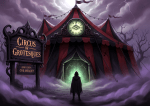
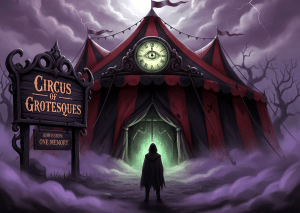
The next day, without a single person seeing so much as a rope, a peg, a wagon, or a man with a hammer, a great striped tent stood in the meadow by the bridge.
But that is for another chapter.
To be continued
Click HERE to continue reading this story








 The Crazymad Writer Writes Again