RSS

Monthly Archives: November 2025

Father and Son, Part Two , inspired by Cat Stevens

Father and Son, Part Two , inspired by Cat Stevens

Father and Son, Part Two , inspired by Cat Stevens


Listen to this song HERE

Father:
It’s now time to make a change,
Not relax or take it easy.
You’re grown up, that’s so good,
But there’s still so much to do.
You’ve a wife, and a child,
You settled down, and you married.
I am gone, though I’m gone, I am happy.

*

I can now recall a time, and admit it wasn’t easy,
To be calm in the turmoil we call youth.
But I have travelled, journeyed on,
To a time, a place we all can reach.
Where our yesterdays and morrows are at peace with today.

Son:
You don’t need to explain; though you’ve gone we are now closer.
Though the story’s the same, we have changed.
We were so caught up in talk it was impossible to listen.
It took me time, now I know I don’t have to go away.
I don’t have to go.

Father:
It’s now time to make change,
Get right on, embrace it.
You’re grown up, that’s so good,
But there’s still so much you can do.
You’ve a wife, and a child,
You settled down, you married.
I am gone, I am gone, but I’m happy.

Son:
No more times, wasted times, hiding truth I knew was deep inside,
It’s good, but even better in sharing.
Yes, they were right, I agree, I’m free to know you and me.
Now I can see and I know I don’t have to go away.
I don’t have to go.

(Optional Extra Verse)
Son:
My Father, you and I, we cannot, must not be kept apart in time,
We’ll soon be rejoined in the heavens.
Where time will be all gone; and thus unshackled from our minds
We’ll all be free, and we’ll know we don’t have to go away.
We won’t have to go.

*************************


Tags: , , , ,

The Ballad of Moral Thunder, inspired by Cat Stevens/Yusuf

The Ballad of Moral Thunder, inspired by Cat Stevens/Yusuf

The Ballad of the Moral Thunder

Listen to this song here

(Verse 1) The Manhattan night was draped in silk and lace,

A gala where the wealthy held their place.

Diamonds glimmered, champagne flowed like streams,

A room built of ambition and billionaire dreams.

They came to honor an old and gentle name,

Cat Stevens, peace and music were his fame.

But as he walked up to the microphone stand,

A different tune was heard throughout the land.

*

(Chorus) He said what no one else dared to say,

Against the tide he cast the light of day.

A simple challenge to the golden few,

To question all they gather, what they do.

A moral thunderbolt beneath the chandelier,

He spoke the silent truth for all the world to hear.

*

(Verse 2) He saw them there: the Titans, great and grand,

Musk and Zuckerberg spread across the stand.

In his dark suit, he met their gilded stare,

And dropped the words that filled the room with fear:

“If you’ve got money, use it for the good,

Help those who truly need it, as you should.

If you’re a billionaire, how much is enough?

Give it away, folks—the time is getting rough.”

*

(Chorus) He said what no one else dared to say,

Against the tide he cast the light of day.

A simple challenge to the golden few,

To question all they gather, what they do.

A moral thunderbolt beneath the chandelier,

He spoke the silent truth for all the world to hear.

*

(Bridge) The air went cold, the glasses paused mid-flight,

A statue carved from silence in the light.

The gentle voice grew steady, calm, and true,

A man who practiced all the words he spoke into.

His millions given, quietly and with grace,

For refugees and needs across the human race.

“If greed is considered wisdom,” he did muse,

“Then humanity is walking in reverse shoes.”

*

(Verse 3) The camera caught a figure scrolling low,

Pretending not to hear the truth’s sharp blow.

But on the web, the hashtags took their flight,

A Truth Bomb trending, shining ever bright.

No polished speech, no grand departing bow,

He simply gave a challenge, for here and now:

He looked upon the power and the gold,

And finished with the story to be told:

“Silence is no longer power.”

*

(Outro) That night, the folk legend did not entertain,

He came to break the velvet, gilded chain.

The room was silent, but the world listened on,

To the real power of a voice that stood alone.

The truth had landed, piercing, pure, and free,

He made history in the heart of the city.

“Silence is no longer power,” he said.

The rich were stunned, the people raised their head.

 
Leave a comment

Posted by on November 7, 2025 in ballad, moral thunder, Yusuf


Tags: , , ,

Alice in Yellow

Alice in Yellow

Alice, ever the trendsetter, decided Wonderland needed a bit of a fashion update. “Blue is so last season,” she declared to a bewildered White Rabbit, who was, as usual, late for something. “And sensible flats? Darling, we’re in a magical realm! One must be prepared for spontaneous glamour!”

So, she traded her iconic blue for a sunny yellow, donned an apron that was perhaps more decorative than practical, and teetered into the enchanted forest on the highest heels she could find. Her mission? To accessorize with pure joy.

“Balloons!” she’d shrieked at a bewildered Caterpillar. “They represent upliftment, whimsy, and the sheer delight of not knowing where you’ll float next!” The Caterpillar, quite literally puffed up with smoke, merely blinked.

As she pranced through the vibrant flowers, occasionally tripping over a particularly enthusiastic daisy, Alice found herself giggling. The balloons bobbed above her, each a tiny, colorful sun. She imagined floating over the Mad Hatter’s tea party, perhaps dropping a balloon onto his head with a gentle thud. Or maybe she’d drift past the Queen of Hearts, causing a momentary distraction in her perpetual croquet game.

Suddenly, a gust of wind caught the balloons, pulling her gently upwards. “Oh, bother!” she exclaimed, her high heels dangling precariously close to a startled dormouse. “This wasn’t quite what I had in mind for ‘upliftment’!” But then, a mischievous grin spread across her face. “Though, a grand entrance via balloon would be rather splendid for tea…”

And so, Alice, a vision in yellow, high heels, and a cluster of vibrant balloons, began her unplanned aerial tour of Wonderland, proving that sometimes, the best adventures start with a little bit of unexpected flair.


Alice in Green

Alice, in a sudden fit of environmental enlightenment (or perhaps it was just the residual fumes from the Caterpillar’s pipe), decided blue was simply too… conventional. And yellow? Far too cheerful for the serious business of planetary well-being. No, Alice declared, she would be green. Not just in spirit, but in attire.

So, she commissioned the Dormouse (who, being perpetually sleepy, was surprisingly adept with a needle and thread) to craft her a gown of the most verdant hue. It was a lovely dress, adorned with tiny, hand-stitched leaves and even a small, fabric squirrel peeking from a pocket.

Her first day as “Green Alice” began with enthusiasm. She lectured the White Rabbit on the carbon footprint of his frantic scurrying. “Every hop, every panic-stricken glance at your pocket watch, emits precious CO2, you know!” The Rabbit, naturally, was late for a very important date and merely skittered away, leaving Alice to sigh dramatically.

Next, she approached the Mad Hatter’s tea party. “Good heavens, a teacup pyramid! Think of the water waste, the energy expended in heating all those superfluous pots!” The Hatter merely offered her a piece of cake. “It’s carrot cake, Alice,” he said, winking. “Very green.”

Alice then attempted to educate the Queen of Hearts on sustainable gardening practices. “Your roses, Your Majesty, are painted red! Imagine the toxic fumes from the paint, the unsustainable harvesting of pigments! Why not cultivate natural, diverse flora?” The Queen, instead of shouting “Off with her head!”, merely looked at Alice with an expression of mild confusion, then muttered, “Are you quite alright, dear? You’re looking a bit… leafy.”

By afternoon, Alice was thoroughly exasperated. The flowers, instead of blooming more vibrantly in her presence, merely looked on with their usual, slightly smug indifference. The trees remained stubbornly tree-like. Even the air, despite her best efforts, refused to smell distinctly “greener.”

She slumped onto a mossy bank, the fabric squirrel in her pocket looking rather deflated. “Being green,” she huffed, adjusting a leaf on her sleeve, “is a load of hogwash! Everyone just goes about their business, oblivious to my perfectly justified eco-concerns!”

Just then, a tiny, emerald-green chameleon, having watched the entire spectacle with keen amusement, slowly changed its color to match Alice’s green dress perfectly. It then gave her a look that plainly said, “You think you’re green? I was born this way, and frankly, it’s exhausting trying to blend in with your ever-changing moods.”

Alice stared at the chameleon, then at her own green dress, then back at the chameleon, which had now effortlessly blended into a nearby patch of purple flowers. A slow smile spread across her face. “Ah,” she murmured, “perhaps it’s less about being green, and more about just… being.”

She stood up, brushed a stray leaf from her shoulder, and decided that perhaps a touch of blue wouldn’t be so bad after all. After all, what’s a little conventionality when you’ve just discovered the profound wisdom of a judgmental chameleon? She might even ask the Dormouse to embroider a chameleon on her next dress. It would certainly be a conversation starter.

Goth Alice

Alice had decided that enough was enough with the pastels and cheer. Wonderland, she concluded, was far too saccharine, far too bright. It needed a touch of the melancholic, a whisper of the macabre. And so, she had undergone a most dramatic transformation.

Her dress, once a bright blue, then a sunny yellow, and briefly a questionable green, was now a cascade of darkest black, offset by intricate lace and a crisp, if somewhat somber, white apron. Her hair, usually a golden waterfall, was dyed raven black, framing a face now adorned with dramatic eyeliner and a hint of pale foundation. The high heels of her yellow phase were replaced by sturdy, stomping boots, and her pockets, instead of housing a friendly dormouse, now held a miniature, plush bat.

Her first act as Goth Alice was to acquire a most appropriate balloon: a matte black, skull-shaped one, naturally. “It symbolizes the fleeting nature of existence,” she’d explained to a rather bewildered Mad Hatter, who had merely offered her a slice of graveyard cake (which tasted surprisingly like licorice).

The tea party itself had been re-envisioned. Gone were the mismatched, brightly colored cups. In their place stood a somber candelabra, casting long, dancing shadows, and teacups of deepest midnight blue. Even the chameleon, ever the adaptable creature, had taken on a mottled, shadowy hue, looking less like a vibrant jewel and more like a creature from a forgotten crypt.

Alice sat on her accustomed branch, but now her gaze was less one of whimsical wonder and more one of thoughtful introspection. The skull balloon bobbed gently above her, a tiny, dark sentinel. She watched the flowers, now appearing in muted purples and deep reds under the dim light of her chosen aesthetic, and mused.

“They’re all so… fragile,” she whispered, not to anyone in particular, but to the lingering shadows. “Their beauty is so fleeting. Unlike the eternal embrace of… well, darkness.”

The chameleon, perched stoically on the tea table, blinked slowly, a silent commentary on Alice’s latest phase. It seemed to say, You’ll be back to polka dots by Tuesday, won’t you?

But Alice was unperturbed. She took a sip of her now-bitter tea, a brew she’d insisted on adding extra drops of “existential dread” to (which the Hatter had helpfully translated as “just a dash more Earl Grey”). She watched the skull balloon drift a little higher, a symbol of her commitment to a more… profound Wonderland.

“Yes,” she concluded, a faint, melancholic smile playing on her lips. “This is much better. Much more… her.” Though a tiny part of her still wondered if a splash of glitter wouldn’t be too out of place. Just a tiny splash. For dramatic effect, of course.


The Tri-Alice Extravaganza and the Snicklefritz of Solace

The reason for this story is a Royal Command Performance Gone Awry. The Queen of Hearts, in an uncharacteristically whimsical mood (possibly due to eating too many jam tarts that morning), had decided Wonderland needed a grand spectacle, a “Tri-Alice Extravaganza” to brighten the increasingly peculiar days. Her Royal Decree was simple: the three Alices, having mysteriously appeared and caused delightful levels of confusion, were to retrieve the legendary Snicklefritz of Solace, a mythical, giggling flower rumored to bring pure, unadulterated joy (and perhaps help the Queen win at croquet).


The Royal Decree arrived by way of a perpetually flustered White Rabbit, who, upon spotting three Alices in the same vicinity, promptly fainted. Sunny Alice, in her vibrant yellow and high heels, knelt to fan him with a particularly buoyant balloon. Green Alice, in sensible green and clutching her compostable teacup, tutted, “Such stress! Clearly, a lack of kale in his diet.” Goth Alice, draped in black lace, merely observed, “His fragile mortality is showing. How quaint.”

The Queen’s decree, once deciphered from the damp parchment (the Rabbit had spilled tea on it), sent a ripple of bewildered energy through the trio. The Snicklefritz of Solace, a bloom rumored to sing bad puns and emit glitter, was said to reside in the Whispering Willows of Woe, a notoriously melancholic part of the forest.

“A quest!” Sunny Alice clapped her hands, nearly dislodging a fascinator she’d borrowed from a particularly fashionable hedgehog. “How utterly delightful! I’ll bring snacks! And more balloons!”

“A wilting expedition, you mean,” Green Alice corrected, eyeing Sunny Alice’s heels with disdain. “We’ll need proper hiking attire, a water purification system, and certainly no single-use confetti.”

Goth Alice merely adjusted her skull balloon, which seemed to sigh audibly. “Joy,” she drawled. “Such a fleeting, saccharine delusion. But if it leads to profound contemplation on the futility of happiness, I suppose I’m in.”

And so, the Tri-Alice Expedition for the Snicklefritz began.

Their first obstacle was the Bridge of Babbling Brookes, known for its ceaseless, irritating chatter. Sunny Alice skipped across, singing along with the gurgling water. Green Alice, however, stopped. “It’s all nonsense! Such excessive vocalization is energy inefficient! Can’t it just… filter?” Goth Alice, meanwhile, found the babbling profoundly depressing. “Each drop a tear, each ripple a fleeting regret,” she intoned, stepping delicately on a fallen log rather than endure the bridge’s cheerful cacophony.

Suddenly, the Bridge of Babbling Brookes, annoyed by Green Alice’s attempts to silence it, sprung a leak, drenching Green Alice in a shower of particularly muddy water. “My organic cotton!” she shrieked, covered in slime.

“Mud is merely repurposed earth, dear,” Goth Alice observed, a flicker of amusement in her usually stoic eyes.

“But it’s dirty!” Sunny Alice giggled, tossing her a bright yellow handkerchief.

Their path then led them to the Giggling Grotto of Grumbles, a cave filled with grumpy, moss-covered creatures who did nothing but complain. Sunny Alice tried to cheer them up with a spontaneous juggling act involving acorns and bright berries. The grumbles simply intensified. Green Alice attempted to introduce them to mindfulness exercises. “Now, breathe deeply, and focus on the natural alkalinity of the cave floor.” The grumbles evolved into outright groans.

Goth Alice, however, had a breakthrough. She sat amongst the grumbling gnomes and began to recite particularly bleak poetry. “Oh, the existential dread of being a moss-covered gnome, forever tethered to this damp abode…” To her surprise, the gnomes loved it. Their grumbles softened into appreciative murmurs. One even offered her a single, tarnished button. “It’s from a lost cause,” he croaked.

“A kindred spirit!” Goth Alice exclaimed, a rare smile gracing her lips.

As they approached the Whispering Willows, the air grew thick with melancholy. The trees truly whispered, but it wasn’t gossip; it was lamentations about lost mittens and forgotten birthdays. Sunny Alice, usually buoyant, felt a strange pang of sadness. Green Alice worried about the poor trees’ nutrient deficiency, while Goth Alice felt strangely at home.

“This is it,” she declared, “the perfect setting for contemplating the void.”

Suddenly, the ground beneath Sunny Alice’s high heels gave way, sending her tumbling into a hidden pit. “Oh, fiddle-faddle!” she cried, her voice muffled. “It’s quite dark down here!”

Green Alice rushed to the edge. “Are you injured? Did you contaminate the local ecosystem with your fall?”

Goth Alice peered down. “A symbolic descent into the subconscious, perhaps? Do tell, what existential horrors lurk within?”

From the pit, Sunny Alice called out, “It’s just… a very large rabbit hole! And I think… I see a teacup!”

Indeed, at the bottom of the pit was an abandoned tea party, and amidst the cracked cups and stale cakes, shimmered a small, luminous flower. It wasn’t just shimmering; it was chortling.

“The Snicklefritz!” Green Alice exclaimed, forgetting her ecological concerns for a moment.

“It appears its joy is rather… boisterous,” Goth Alice remarked, wincing as the flower let out a particularly loud chuckle.

Sunny Alice, still in the pit, reached for it. But just as her fingers brushed a petal, the Snicklefritz of Solace squealed with laughter and zipped out of her grasp, floating upwards like a startled hummingbird.

“It flies!” Sunny Alice cried.

“Untraceable energy expenditure!” Green Alice gasped.

“An escape from its fated purpose,” Goth Alice sighed.

The Snicklefritz began to lead them on a merry chase, darting through the Whispering Willows, its giggles echoing mockingly. It zipped past the Grumbling Gnomes, who, instead of grumbling, began to chuckle softly at its antics. It danced over the Bridge of Babbling Brookes, which briefly stopped babbling to let out a delighted trill. The entire forest seemed to be waking up, bathed in the infectious mirth of the Snicklefritz.

Sunny Alice, despite her high heels, found a burst of renewed energy, twirling and skipping after the flower. Green Alice, initially annoyed by its chaotic flight, began to see the vibrant life it brought forth, the spontaneous joy blooming on previously dour faces. Even Goth Alice found herself strangely… un-depressed. The flower’s relentless cheer was so absurd, so utterly defiant of gloom, that it became its own form of dark humor.

Finally, the Snicklefritz, seemingly exhausted from its playful evasion, settled gently onto the Mad Hatter’s tea table. It looked up at the three Alices, its petals quivering with silent mirth.

The Mad Hatter, who had been observing the entire chase with a cup of tea balanced on his nose, simply looked at the flower. “Well,” he said, “that was rather exhilarating for a Tuesday. Anyone for more cake?”

The Queen of Hearts, having arrived (carried in by two extremely flustered cards), gazed upon the Snicklefritz. It wasn’t quite what she expected – less a majestic bloom, more a mischievous sprite. Yet, as its soft glow filled the air, she felt a strange warmth, a hint of a smile tugging at her usually stern lips.

Sunny Alice, beaming, offered a balloon to the Snicklefritz, which promptly popped it with a joyful burst of glitter. Green Alice, seeing the spontaneous blooming of tiny, radiant flowers in the Snicklefritz’s wake, began to jot down notes about “sustainable happiness ecosystems.” Goth Alice, gazing at the flower’s defiant merriment, whispered, “Perhaps… the void does have a sense of humor.”

And as the sun began to set, casting long, whimsical shadows through the trees, the three Alices, having found the Snicklefritz of Solace, realized that joy, like fashion, moods, and philosophical outlooks, came in many, many shades. Even a little bit of glitter and despair.


Tags: , , , , ,

The Feeling Behind the Day

The Feeling Behind the Day


Listen to this Christmas song here.

Why wait for Christmas when you can have it every day?

Be it June or September, March, April or May.

The thing to remember is not the date or day,

But the feeling that goes behind it. So share it right away.

*

Enjoy a time for living. Enjoy a time on earth.

A time for celebration. A chance to spend in earth.

Each day will go brightly as you strike out forth.

And all of this made possible because of the virgin birth.

*

Give a gift of kindness, a warm and helping hand.

Spread good will and cheer to folks throughout the land.

Let your words be gentle, always close at hand,

For this is the spirit that we all must understand.

*

Oh, why wait for Christmas when you can have it every day?

Be it June nor September, March, April or May,

The thing to remember is not the date or day,

But the feeling that goes behind it, so share it right away.

*

We spend all December searching for the light

And rush to make it perfect on that one single night.

But the star that shines above us, a promise truly bright

Is meant to guide our footsteps through the darkest day and night.

*

Don’t let the joyful music play out in the snow.

Keep the light of giving with you where you go.

Let the love within your heart continue still to grow.

The year round magic flowing a beautiful warm glow.

*

Why wait for Christmas when you can have it every day?

Be it June or September, March, April or May.

The thing to remember is not the date or day,

But the feeling that goes behind it, so share it right away.


Tags: , ,

Alice Deep in the Jungle

Alice Deep in the Jungle

The humid air of the jungle clung to Alice like a secret, a stark contrast to the familiar, crisp English gardens of her youth. Yet, here she was, not stumbling through a rabbit hole, but walking with purpose on a path of moss-covered stones. The scent of exotic blooms, heavy and sweet, mingled with the earthy aroma of damp soil. Sunlight, fractured into a thousand shimmering beams by the dense canopy, painted shifting patterns on her blue and white mini-dress and the soft leather of her long white boots.

She was no longer the small, curious child who had first tumbled into Wonderland. The years had etched a quiet confidence into her features, a knowing glint in her blue eyes that spoke of countless impossible encounters and challenges overcome. Her long, blonde hair, a silken river, cascaded around her shoulders, catching the golden light.

Above her, iridescent macaws, flashes of sapphire and scarlet, soared between ancient trees draped with lianas, their calls a symphony of the wild. Closer still, oversized hibiscus and bird-of-paradise flowers, rendered in hues too brilliant for any ordinary garden, unfurled their petals in silent welcome. Each leaf, each vine, seemed to pulse with a hidden life, whispering tales of forgotten magic.

Alice paused, a faint, playful smirk touching her lips. The air hummed with serenity, yet she felt the familiar tingle of something extraordinary just beyond her sight. This wasn’t Wonderland, not precisely, but it carried its echoes – the same breathtaking beauty, the same undercurrent of delightful mystery. She wondered which improbable creature she might encounter next, what riddle awaited her in this verdant dreamscape. With a graceful turn, she continued her journey, her boots making soft thuds on the ancient stones, ready for whatever hidden wonders the tropical realm might reveal.


Tags: , , , , ,

The Golden Supermoon

The Gleam of the Gilded Trap in Bushmantle

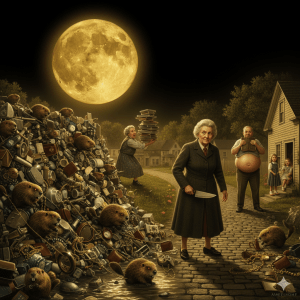
The air over Bushmantle was the color of old, oxidized gold, thick and humming. Elias, the town’s lone amateur astronomer and professional cynic, was the first to feel it. Not the gravitational pull on the ocean tides, but the pull on the mind.

The November Supermoon—closest, brightest, and most unnervingly golden of the year—had risen. It didn’t look silver-white; it looked like a monstrous, luminous coin hung low in the velvet blackness, shedding a sickly, buttery light that seemed to press down on the quaint, slightly crumbling homes of Bushmantle.

Elias had been trying to photograph the perigee from his roof, aiming his camera towards the peculiar glow over the old watermill. The moment he looked through the lens, the world warped. The golden light didn’t illuminate; it saturated. It didn’t reflect; it demanded.

The next morning, the town of Bushmantle was subtly, terrifyingly different.


The Beaver’s Blind Ambition


The ancient folklore held that the November moon was the Beaver Moon, the time when the industrious little creatures worked tirelessly to build their dams and stock their winter larders. But tonight, that focus had become a fever in Bushmantle.

The golden light didn’t just shine on the town; it seemed to leach out the very essence of human preparation, twisting it into a single, maddening obsession: Acquisition.

First, it was the beavers themselves, their usual dam-building activities becoming unnervingly frantic in the river that snaked through Bushmantle. Elias saw them, but they weren’t building with sticks and mud anymore. They were dragging stolen heirlooms, antique silverware, and anything that glittered under the unnatural light—into the colossal, impossible dam they were building near the old mill. They had an insane gleam in their tiny black eyes, their chattering a high, desperate frequency. The structure was a towering, grotesque monument of scavenged wealth and junk, rising obscenely from the water, all to block a river that didn’t need blocking.


The Town’s Twisted Treasure


The humans were worse.

Under the Supermoon’s hypnotic, golden glow, the need to collect became the need to possess. It started with hoarding. Old Mr. Henderson, the clockmaker, was found attempting to dismantle the town’s ancient clock tower, convinced he needed to “own all the time” before it ran out. He was muttering about the moon’s ‘golden promise’ of eternal moments. Mrs. Gable, the proprietor of the general store, had locked herself inside, frantically trying to count every single item, from rusty nails to dusty tins of sardines, claiming the moon demanded a full inventory of her domain.

The gold light had made the people of Bushmantle’s deepest, most primal fear—loss—into a terrible, manic engine of collection. They were gathering not just objects, but abstract concepts, desperate to hold onto anything that might slip away.

Elias realized the moon wasn’t just a light; it was a filter. It was amplifying a single, terrible thought in every mind: You don’t have enough. You must take more. You must never lose what is yours.

The scariest moment came when he saw his neighbor, kindly old Mrs. Peterson. She wasn’t carrying gold or books. She was carrying a large kitchen knife, its blade reflecting the eerie golden light, and stalking the cobblestone streets of Bushmantle with a terrifying, purposeful stride.

Elias asked her what she was looking for. Her eyes, usually gentle and blue, were now like polished amber in the golden light.

“My youth,” she hissed, her voice dry and brittle, echoing slightly in the quiet, unnaturally lit street. “The Moon promised me I must collect what I lost. The Moon promised it must be taken back from those who still possess it.”

She wasn’t looking for a treasure chest. She was looking for life, for time, for the potential of the young girls down the street. The Supermoon, hanging like a colossal, gilded trap above them, had driven the town of Bushmantle mad with the lust for what they had lost and could lose. They were gathering wealth, youth, time, and sanity with the panicked ferocity of beavers stockpiling for an eternal, uncoming winter.

Elias dropped his camera and ran, the suffocating, beautiful, golden light of the closest moon of the year following him like the glare of a jealous, all-possessing god, casting long, wavering shadows down the familiar, now terrifying, streets of Bushmantle.


Tags: , ,

“The Wizard and the Worried Wheelman”

“The Wizard and the Worried Wheelman”

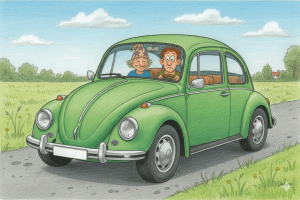
In the whimsical world of Oakhaven, where gnomes rode squirrels and puddles whispered secrets, lived a wizard named Bartholomew Button and his long-suffering human friend, Gary. Bartholomew, a wizard of questionable talent but undeniable enthusiasm, had just “borrowed” Gary’s prized vintage VW Beetle for a joyride.

“Isn’t this splendid, Gary?” Bartholomew chirped, his star-spangled hat bobbing with glee. “The wind in my beard, the open road… it’s almost as good as flying on a particularly fluffy cloud!”

Gary, gripping the steering wheel so tightly his knuckles were white, merely grunted. “Splendid, Barty, just splendid. Especially since you forgot to mention you enchanted the accelerator to only go at full speed.”

Bartholomew chuckled, a sound like a bag of marbles rolling down a wooden staircase. “Oh, did I? My apologies! I was attempting to imbue the engine with the ‘Spirit of Swiftness.’ Perhaps I overdid it slightly.”

Suddenly, a flock of startled sheep scattered across their path. Gary swerved wildly, narrowly missing a particularly portly ewe. “Slightly?!” he shrieked. “We just almost turned those sheep into woolly projectiles!”

“Nonsense!” Bartholomew declared. “They looked quite invigorated. A good scare keeps the blood flowing, I always say.” He then leaned out the window, shouting, “And remember, dear sheep, the early worm catches the… well, you know the rest!”

Gary buried his face in his hands. “I’m going to have a heart attack before we reach the village. This car is an antique, Barty, not a magical broomstick!”

“A minor distinction!” Bartholomew waved a dismissive hand. “Besides, I’ve got a potion brewing in the back that will fix any minor dents… or perhaps turn them into glitter. It’s still in the experimental phase.”

As they rocketed past a sign that read ‘Oakhaven Village – Slow Down!’, Gary braced himself. “Just tell me, Barty, what’s our destination?”

Bartholomew’s eyes twinkled. “Why, the annual ‘Biggest Turnip’ competition! I’ve enchanted a turnip to grow to colossal proportions, but it needs a magical escort. And what better escort than a slightly-too-fast Beetle and its valiant, albeit terrified, driver?”

Gary could only sigh. He knew that by the end of this journey, he’d either be a hero, a nervous wreck, or a permanent fixture in the local mental institution. But at least Bartholomew was having fun. And really, what else could one expect when driving with a wizard?

The Wizard and the Worried Wheelman Part 2″

As the green Beetle, an unlikely blur on the quiet country road, tore towards Oakhaven Village, Gary’s mind raced almost as fast as the car. “Barty,” he yelled over the roar of the engine and the whistling wind, “what exactly did you do to that turnip?”

Bartholomew, oblivious to Gary’s distress, was now humming a jaunty tune, occasionally pointing at passing trees as if conducting an invisible orchestra. “Oh, nothing much! Just a simple ‘Growth and Glimmer’ enchantment, with a sprinkle of ‘Uncommon Verdancy.’ It should be quite the spectacle!”

They careened around a final bend, and Oakhaven Village appeared, a charming collection of thatched roofs and bustling market stalls. The “Biggest Turnip” competition was in full swing in the village square. A crowd had gathered, and a panel of stern-faced judges, all sporting impressive beards, peered critically at various root vegetables.

Then, everyone froze.

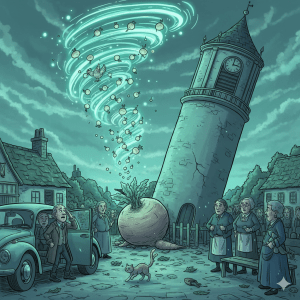
From behind the town hall, a colossal shadow began to stretch. A low rumbling sound grew louder, accompanied by a faint, rhythmic thump-thump-thump. Suddenly, an enormous, glowing, emerald-green turnip, easily the size of a small cottage, rolled into view. It was so perfectly round and impossibly vibrant that it seemed to pulse with an inner light.

“Behold!” Bartholomew cried, throwing his hands in the air, narrowly missing Gary’s nose. “My masterpiece!”

The crowd gasped, then a murmur of awe turned into outright panic as the gargantuan turnip, having gained momentum, began to roll straight towards the judging table!

“Barty!” Gary shrieked, slamming on the brakes, which, thanks to the “Spirit of Swiftness,” barely slowed them down. “Your turnip is going to flatten the entire competition!”

“Nonsense!” Bartholomew declared again, though his eyes widened slightly. “It merely wishes to present itself grandly!”

The judges, eyes wide with fear, scrambled to safety as the monstrous turnip obliterated their table, scattering scorecards and half-eaten sandwiches. It then continued its majestic, destructive roll through a display of prize-winning pies, leaving a trail of crushed crusts and fruity fillings.

Gary, with a burst of adrenaline, managed to swerve the Beetle around the runaway turnip, bringing them face-to-face with the terrified villagers. “Everyone, get back!” he bellowed, sounding far more heroic than he felt.

Bartholomew, however, was in his element. “It’s magnificent, isn’t it?” he beamed, even as villagers screamed and fled. “Such presence! Such… rootiness!”

The giant turnip finally came to a stop, wedged firmly against the base of the ancient village clock tower, which groaned ominously. The entire square was a mess of splintered wood, squashed vegetables, and scattered market wares.

Silence fell, broken only by the clock tower’s distressed creaking. The villagers, now safely behind stalls and buildings, peered out cautiously.

“Well,” said Bartholomew, finally looking at the destruction, “I suppose it might be slightly larger than anticipated.” He then pulled out a small, ornate vial. “Good thing I brought my ‘De-Growth and De-Glimmer’ potion! Just a few drops, and it will shrink right back to a manageable size.”

Gary slumped against the steering wheel, utterly defeated. “You mean to tell me,” he said in a dangerously low voice, “that you had a potion to fix this the entire time?”

Bartholomew patted his shoulder cheerfully. “Of course! One must always be prepared. Now, if you’ll just pull a little closer, I can administer the antidote.”

As Gary, with trembling hands, slowly nudged the Beetle towards the colossal turnip, he knew one thing for certain: his antique VW Beetle was going straight back into the garage, and Bartholomew Button was going to be walking for the foreseeable future. And perhaps, just perhaps, he’d invest in a good set of earplugs.


The Wizard and the Worried Wheelman – Part 3″

Gary, still slumped, watched with a weary eye as Bartholomew, now beaming with renewed purpose, uncorked the ‘De-Growth and De-Glimmer’ potion. “Fear not, dear villagers!” he declared, his voice echoing slightly in the now-quiet square. “A minor miscalculation, easily rectified!”

He climbed out of the Beetle, carefully balancing the vial. “Now, to apply this with precision.” He took aim at the base of the colossal turnip, which was still wedged against the groaning clock tower. Just as he was about to administer the drops, a small, fluffy village cat, startled by the day’s events, darted out from under a stall, rubbing against Bartholomew’s leg.

“Goodness me!” Bartholomew yelped, startled. His hand jerked, and the vial of glowing blue liquid tipped, spilling not just a few drops, but a substantial splash across the ground around the base of the giant turnip, and a few rogue droplets even landed on the cat’s tail.

A moment of silence. Then, a strange ripple effect began.

The giant turnip didn’t shrink immediately. Instead, the very cobblestones around it began to pulse with a faint, blue light. Then, with a series of tiny pops, dozens of miniature, perfectly formed, glowing emerald turnips, each no bigger than a thimble, erupted from between the stones. They bounced and rolled like enchanted marbles, scattering across the square.

“Oh dear,” Bartholomew murmured, rubbing his chin. “A slight… decentralization of effect, perhaps?”

But it didn’t stop there. The rogue droplets on the cat’s tail caused the feline’s fluffy appendage to rapidly deflate and then reinflate, changing colors like a tiny, psychedelic chameleon before shrinking to the size of a kitten’s stub. The cat, looking utterly bewildered, began chasing its own shrinking, then growing, then color-changing tail in frantic circles.

Then, more subtly, things started changing. A baker’s prize-winning sourdough loaf, still sitting on its damaged stall, began to shrink, then grow, then shrink again, as if breathing. A villager’s meticulously trimmed rose bush suddenly sprouted enormous, thorny stems that snaked across the path before rapidly wilting back to normal size, then repeating the process.

Gary, who had been watching this unfolding chaos from the safety of the Beetle, finally had enough. He honked the horn loudly. “Barty! Stop! You’re making it worse!”

Bartholomew, however, was now utterly fascinated by the tiny, glowing turnips bouncing around his feet. “Fascinating! It seems the ‘De-Growth’ aspect is rather… democratic in its application! And the ‘Glimmer’ is quite charming on these mini-vegetables!” He bent down, trying to catch one of the tiny, luminous root vegetables.

Just then, the clock tower gave a final, mournful groan. The enormous turnip, still wedged against it, seemed to sigh as well. Then, with a slow, grinding crunch, the clock tower began to lean, just slightly, away from the turnip, pulling a significant chunk of its stone base with it. The giant turnip, no longer fully supported, listed precariously.

The head judge, a formidable woman named Mildred who had just recovered from her turnip-induced fright, stepped forward, brandishing a broken yardstick like a sword. “Bartholomew Button!” she boomed, her voice cutting through the magical cacophony. “You have destroyed the judging table, squashed our pies, traumatized our sheep, and now you’re making our village square sprout glowing novelties and our clock tower fall over! What do you have to say for yourself?”

Bartholomew, holding up a handful of the tiny, glowing turnips, beamed. “Why, I say we have a new line of magical garden decorations, Mildred! And a very lively cat! Perhaps a new annual event: the ‘Great Oakhaven Turnip Toss’ with these miniature marvels!”

Gary just closed his eyes. He could already hear the villagers, and Mildred’s booming voice, planning Bartholomew’s new community service: “Operation: Turnip Cleanup.” It was going to be a long, strange afternoon. And he was definitely going to start riding a bicycle.

 
Leave a comment

Posted by on November 4, 2025 in vw bwwtle


Tags: ,

The Malaga Mystery

The Malaga Mystery

The Malaga Mystery

Shepperton Terminus, November 1965

The terminus of the Shepperton line was a desolate place on a Friday evening, swallowed by a dense, ochre fog. The electrified third rail glinted with dampness, and the metallic ring of the buffer stops provided a lonely full-stop to the city’s constant noise. At the very end of the track, divorced from the modern glass of Terminal House, sat Pullman Car No. 92, Malaga.

It was a sanctuary frozen in time, its umber and cream livery faded but proud. Inside, the carriage was a time capsule of Edwardian luxury, the air thick with the ghosts of expensive champagne and stale cigar smoke. Polished mahogany panels reflected the soft, amber light cast by etched glass lampshades. Heavy velvet curtains drawn over the long windows cut off the miserable scene outside. Brass luggage racks gleamed, and the plush, blue-and-gold motif of the upholstery felt like a defiant echo of a bygone, grander age.

It was in this opulent setting that Inspector Miles Corbin found himself just after 10:30 PM.

“They found him just here, sir,” Sergeant Davies whispered, his heavy, damp coat scraping against the armrest of a velvet armchair. “Hardly fits, does it? A murder in a palace.”

The victim, Mr. Julian Thorne, the company’s celebrated railway historian, was slumped at a small table, his face hidden. His expensive tweed jacket showed a dark, spreading stain. Nearby, a heavy, silver-plated paper knife lay on the seat, a theatrically obvious weapon.

Corbin circled the scene, his polished boots silent on the deep pile carpet. On the table: a crystal decanter, two brandy snifters, and a plate of untouched petit fours. He noticed the brass plaque near the door, engraved: SECR 92. Malaga. Parlour First. 1921.

“The paper knife is a feint,” Corbin stated, not looking up. “The wound is superficial. Pathologist confirmed it. Cyanide in the brandy, Davies. Clean, fast. An assassin’s choice, not a frantic editor’s.”

“It was Mr. Arthur Finch who raised the alarm, sir. Junior Editor. He claims they had a row, a social drink, and Thorne collapsed while Finch was in the main office washroom.”

“The row wasn’t over a book error, was it?” Corbin asked, his eyes narrowing on the details.

Davies consulted his notes, his voice dropping further. “No, sir. It seems Thorne discovered something far worse. Finch’s new manuscript contained schematics of the GWR’s strategic freight lines—the ones designated for classified government use in the event of an… incident. Thorne believed Finch was leaking secrets to a hostile power and threatened to go to the Ministry of Defence tonight.”

The motive had shifted from professional rivalry to high-stakes espionage.

The decanter was centered. Thorne’s snifter was empty on his right. Finch’s snifter, still half-full, was on his left. The crucial detail was a single, pristine white napkin, folded like a swan, resting directly underneath Finch’s half-empty glass.

“Davies, look at this. Finch claims his glass is half-full. But why would he use a fresh napkin to coaster a glass he was supposedly still drinking from? And why is his hand-blotting napkin missing?”

Corbin delicately lifted the napkin. It was cool, damp only at the edges from the glass’s condensation, but underneath the dampness was a faint residue of panic sweat from a frantically grasping palm.

The Conclusion and Epilogue

Corbin had Finch brought back to the silent, elegant carriage.

“The brandy, Mr. Finch, tasted strongly of almonds, didn’t it? Cyanide,” Corbin said, tapping the half-full glass. “But the almond taste only develops in the air. The first sip kills. You poured the poison into Mr. Thorne’s glass first, knowing he would take the first sip. You then pretended to drink from your own, but you didn’t.”

Finch, pale and twitching, remained silent.

“You needed to dispose of your own poisoned drink. When you ‘went to the washroom,’ you actually went to the galley, poured your glass into a napkin—the missing one—which you disposed of in the carriage’s tiny coal fire-box. But your hand, Mr. Finch, was sweating profusely with the terror of your act. You reached for a new napkin to blot your palm, and then, in a desperate attempt to cover the fact that your glass was empty, you placed the untouched glass back down on the fresh, slightly clammy napkin.”

Finch finally cracked, his voice a choked whisper. “He didn’t understand! Thorne was going to expose the whole network! He would have started a war over a railway map!” Finch pointed to the silver knife. “That wasn’t for him. That was for me. If I’d been caught, I was supposed to use that, not the poison. The poison was cleaner.”

Finch was escorted away, the sound of the steel door closing on the police van a harsh, modern sound that fractured the quiet history of Shepperton.

The Aftermath:

Within forty-eight hours, the Pullman Car Malaga was subjected to a forensic sweep and a deep clean. All evidence of the night—the spilt brandy, the cyanide traces, the oppressive shadow of international espionage—was systematically erased. The mahogany was polished, the velvet vacuumed, and the etched glass wiped clean. Malaga returned to its function as a silent, luxurious hospitality suite for Ian Allan Publishing, retaining its rich, umber-and-cream exterior, but now holding one more terrible secret in its panelled walls, sealed off at the very end of the line.


Tags: , , , , ,

Alice and the Clockwork Garden.

Alice and the Clockwork Garden.
Alice and the Clockwork Garden.
**********************************
The city where Alice lived was a place of endless hums and flickers. Towers of glass stretched into the clouds, their reflections looping infinitely in the mirrored streets below. People moved like clock hands, precise, predictable, and always on time. But Alice was different. She collected broken things: cracked lenses, tangled wires, forgotten keys. She said they whispered to her when no one else was listening.
One evening, while exploring the outskirts of the city, she stumbled upon an abandoned greenhouse. Its glass panes were fogged with dust, and vines had crept through the cracks like green veins reclaiming a body. Inside, the air was thick with the scent of rust and wilted petals. In the far corner, half-hidden behind a curtain of ivy, she found a small brass door no taller than her knee. It ticked faintly, as though it had a heartbeat.
When she turned the handle, the world folded, not down, but sideways. The air rippled like water, and she fell through layers of sound and color until she landed softly on a bed of moss that smelled faintly of machine oil.
She stood up and found herself in a garden made entirely of gears and glass. Flowers opened and closed with the precision of pocket watches, their petals clicking in rhythm. The sky above was a swirling clock face, its hands spinning in opposite directions. Bees made of copper buzzed between the flowers, leaving trails of golden dust that shimmered like static.
A signpost nearby spun wildly, its arrows pointing to places that made no sense: “Yesterday,” “The Hour Between,” “Nowhere in Particular,” and “The Place You Forgot.” Alice hesitated, then chose the last one.
The path wound through hedges that whispered secrets in mechanical tones. Every few steps, the ground shifted beneath her feet, rearranging itself like a puzzle. She passed a pond that reflected not her face but a dozen versions of herself, older, younger, smiling, crying, all blinking at different speeds.
A cat made of smoke and mirrors appeared on a branch above her. Its grin flickered like a glitch in a screen.
“Lost again, are you?” it purred.
“I’m not sure I was ever found,” Alice replied.
“Good answer,” said the cat, and its body dissolved into a cloud of static, leaving only the grin behind. The grin blinked once, then vanished too.
Further along, she came upon a tea party set in the middle of a clockwork clearing. The table was long and crooked, covered in teapots that poured themselves and cups that whispered secrets to one another. The host was a clockmaker with a hat full of ticking hands and a monocle that spun like a compass.
“Time’s broken again,” he sighed. “Keeps running backward when no one’s looking.”
Alice peered into one of the teacups and saw her reflection aging and un-aging in rapid succession.
“Maybe time isn’t broken,” she said. “Maybe it’s just tired.”
The clockmaker blinked. “Then perhaps it needs a nap.” He handed her a small silver key. “Take this to the Heart of the Garden. It winds everything that dreams.”
The path to the Heart was not straight. It twisted through forests of glass trees that sang when the wind passed through them. She met a girl made entirely of paper who folded herself into a bird and flew away. She crossed a bridge that whispered her thoughts aloud, embarrassing her with every step. At one point, she found herself walking upside down, the sky beneath her feet and the ground above her head.
When she finally reached the Heart of the Garden, she found a massive clock-tree, its trunk pulsing like a living creature. Its branches were heavy with pendulums, and its roots glowed faintly beneath the soil. In its center was a keyhole, glowing softly. She turned the silver key, and the world exhaled.
For a moment, everything stopped. The gears froze, the bees hung motionless in the air, and even the sky’s hands paused mid-turn. Then, slowly, the world began again, but differently. The ticking softened. The flowers opened wider. The air felt warmer, almost alive.
But something else stirred. From the shadows beneath the clock-tree, a figure emerged, a tall woman with hair made of unraveling ribbons and eyes like shattered glass.
“You’ve wound the Heart,” she said, her voice echoing like a thousand clocks striking midnight. “Do you know what that means?”
Alice shook her head.
“It means the dream wakes up,” the woman whispered. “And dreams don’t like being awake.”
The ground trembled. The flowers began to wilt, their gears grinding to a halt. The sky cracked open, revealing a vast emptiness beyond. The woman smiled, her face fracturing like a mirror.
“Run, little clock,” she said.
Alice ran. The paths twisted and folded, leading her in circles. The cat reappeared, now flickering between shapes, a bird, a shadow, a reflection.
“Which way is out?” she gasped.
“Out?” the cat laughed. “There’s no out. Only through.”
She stumbled back into the greenhouse, gasping for breath. The brass door was gone, replaced by a single flower made of glass, ticking gently in the moonlight. She touched it, and the ticking stopped. The city outside seemed to pause, as if holding its breath.
When she looked at her reflection in the glass, her eyes glimmered faintly, like tiny clock faces, turning in opposite directions. Somewhere deep inside, she could still hear the faint hum of the garden, waiting for her to wind it again.
 

Tags: , , , , , ,

Alice and the Cauldron of Nonsense

Alice and the Cauldron of Nonsense

Alice and the Cauldron of Nonsense Song


(Verse 1 – Alice) One fine upside-down morning, the sky was askew, A rabbit hole landing, not into, but through. My dress was impeccable (A dreadful, bad sign!), I plopped in a pumpkin patch smelling of brine. “Where am I now?” I asked the soft breeze, It turned to a novel and flew through the trees. Then POP! like sarcasm, a loud, sassy sound, A new brand of chaos just dropped on the ground.

(Chorus) Oh, Blunderblot is calling, a whirlwind of glee, Where logic’s on holiday, wild and set free. With Wobbleberry Pudding and wands made of peel, The Cauldron of Nonsense is stirring what’s real! It’s not Wonderland, no, it’s gone off its rocker, It’s just Harry Rotter, the reality-shocker!

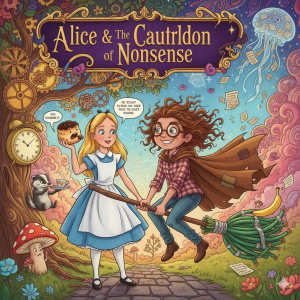
(Verse 2 – Harry Rotter) A scruffy girl rode a broom, made of hose and of tape, “Sensible’s here!” she grinned, escaping the scrape. “I’m Harry Rotter, Witch-in-training, you see, Mischief Certified, now—got exploding blueberries?” “I’ve a scone,” I replied, “It’s quite prone to talk.” “Perfect!” she cried, “For our magical walk!” Then a toadstool stood up, with a groan and a belch, “The Turnip Wands Incident! You shouldn’t be here, welch!”

(Chorus) Oh, Blunderblot is calling, a whirlwind of glee, Where logic’s on holiday, wild and set free. With Wobbleberry Pudding and wands made of peel, The Cauldron of Nonsense is stirring what’s real! It’s not Wonderland, no, it’s gone off its rocker, It’s just Harry Rotter, the reality-shocker!

(Bridge) The sky turned to paisley, the ground started to shake, An angry old badger on a tea tray did wake. “You turned Queen’s scones into gremlins!” he spat from his eye, “But gremlins make croutons!” was Harry’s reply. Then a jellyfish floated, of homework and dread, “You mixed rhubarb and Potion 3½!” it overhead said. “The Cauldron is broken!” Harry gasped, filled with fear, “Quick, the Spell of Almost-Rectification is near!”

(Chant/Middle 8 – Spoken Rhythmically) They linked pinkies, tapped knees, and chanted with vim: “Zibble-zabble, stew and bubble, Patch the holes and double the trouble! Bring back balance, just a smidge— Except on Tuesdays. Or near the fridge.” There was a WHUMP, a WHEEEE, and a BLARG! And everything stopped just outside the dark.

(Verse 3 – Alice & Harry) The grass was just grass, and the badger took a seat, A cup of hot tea was a perfectly neat, quick treat. “That was… something,” I said, with a thoughtful, slow sip, Harry winked, upside-down, and gave a small skip. “Next stop: The Ministry of Mayhem,” she decreed, “A borrowed dragon I need to return, yes indeed!” “Allergic to Tuesdays?” I asked with a smile, I was sold on this chaos, just for a while.

(Outro) So off they went skipping, one right and one wrong, The Blunderblot rhapsody plays on and on! With a talking scone muttering verses of Shay, And a dragon-shaped problem for another mad day. (Fade out with the scone’s voice) “…to be or not to be, that is the question…”


Tags: , , , , ,