RSS

Monthly Archives: January 2026

The fire crackled merrily in the hearth

The fire crackled merrily in the hearth

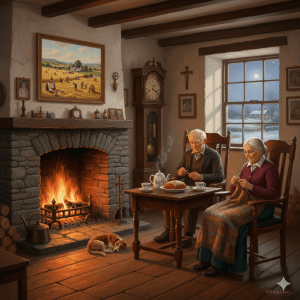
The fire crackled merrily in the hearth of the Ballykillduff cottage, casting dancing shadows on the low-beamed ceiling. Outside, a full moon bathed the frosty fields in a soft, silvery glow, the silent world blanketed in fresh snow. But inside, it was warmth and comfort, a cocoon against the winter’s bite.

Seamus, his spectacles perched on the end of his nose, carefully mended a fishing net, his movements slow but precise, honed by years of patient work. Across the small wooden table, Maeve’s needles clicked a gentle rhythm, weaving strands of wool into a new blanket, her hands as nimble as they had been sixty years ago, though now a little gnarled by time. Between them, a steaming teapot promised another cup, and the scent of freshly baked soda bread filled the air.

Their old dog, Finn, lay curled by the fireside, dreaming canine dreams, his occasional whimper a soft counterpoint to the quiet hum of the room. On the mantelpiece, faded photographs smiled down—their children as babes, their wedding day, a generation of memories captured in sepia tones. Above the mantel, a painting of a summer harvest, vibrant and golden, was a window to another time, a vivid echo of the image we just created.

“Remember that harvest, Maeve?” Seamus murmured, his voice soft, not breaking the peace but enriching it. “The year young Michael nearly tipped O’Malley’s wagon, trying to show off.”

Maeve chuckled, a warm sound that crinkled the corners of her eyes. “And your father nearly had a fit! You were always one for teasing, Seamus Finnegan.”

He smiled, a gentle warmth spreading through him that had nothing to do with the fire. “We worked hard, didn’t we? But there was always laughter, always a song.”

Maeve nodded, her gaze drifting to the moonlit window. “And those nights, after the fields were cleared, the whole village would gather. Music, dancing… you’d try to get me to dance, always with two left feet.”

“I did my best!” Seamus protested playfully, a twinkle in his eye.

The conversation faded again into comfortable silence, punctuated by the fire’s gentle roar and the rhythmic click of Maeve’s needles. They didn’t need many words; decades of shared life, of triumphs and sorrows, of sun-drenched harvests and snow-kissed evenings, had woven a tapestry of understanding between them. Each glance, each shared sigh, spoke volumes. This cozy winter evening wasn’t just a moment in time; it was a distillation of all the moments before, a quiet, contented testament to a lifetime of love lived simply, deeply, in the heart of Ballykillduff. The past wasn’t gone; it was right here, in the warmth of the fire, the scent of the bread, and the steadfast love that glowed between them, bright as the winter moon.
 
Leave a comment

Posted by on January 30, 2026 in bygone days


Tags: , , , ,

The summer harvest in bygone days

The summer harvest in bygone days

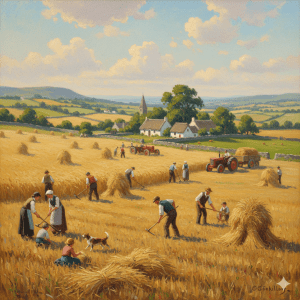
The sun beat down on Ballykillduff, a golden hammer forging memories into the very earth. It was the height of summer harvest, and the fields shimmered with ripe wheat, a sea of gold stretching to the gentle hills beyond. Old Man Finnegan, his back a permanent curve from decades of toil, leaned on his scythe, wiping a brow beaded with sweat. “Aye,” he’d often say, “these are the days to remember.”

He watched the rhythm of the village unfold before him. Young Michael, barely a man, grunted as he wrestled a heavy sheaf onto a growing stack, his freckled face red with effort and a burgeoning pride. His mother, Mary, moved with the quiet grace of a seasoned farmer, her hands calloused but nimble, gathering stalks into neat bundles. Even little Brigid, no older than five, chased after her dog, a scruffy terrier named Rusty, as it darted through the stubble, imagining herself a grand huntress.

In the distance, the chugging of Mr. O’Malley’s tractor, a relatively newfangled contraption, mingled with the shouts and laughter of the men loading the hay wagon. It was a faster way, to be sure, but Finnegan preferred the quiet swish of the scythe, the feel of the earth beneath his worn boots. He remembered his own youth, when every grain was cut by hand, every stack built with sweat and song.

The stone church steeple pierced the azure sky, a silent sentinel watching over generations of harvests. White-washed cottages nestled among the trees, their chimneys hinting at the warm meals and tired bodies that would soon fill them. The air was thick with the scent of cut grass, warm earth, and the promise of a bountiful supper.

As the sun began its slow descent, painting the clouds in hues of orange and pink, Finnegan smiled. These weren’t just fields of wheat; they were fields of shared labor, of community, of life itself. He thought of his own father and grandfather, their spirits woven into the very fabric of Ballykillduff. “Aye,” he murmured again, a soft sigh escaping his lips, “these are the days that last.” The memories, golden and vivid, were as real as the setting sun, cherished treasures of a time when the land and its people moved as one, under the generous hand of a summer sky.


Tags: , ,

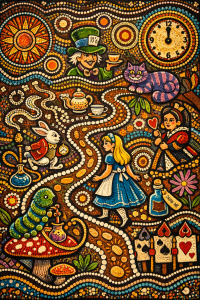
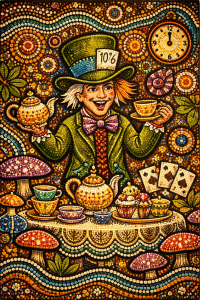
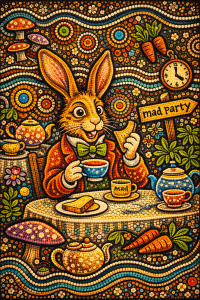
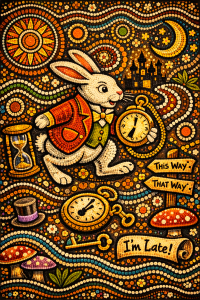
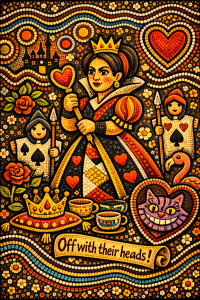
A Few Alice in Wonderland Pictures for You to Enjoy.

A Few Alice in Wonderland Pictures for You to Enjoy.


Alice in Wonderland

The Mad Hatter

The March Hare

The White Rabbit

The Queen of Hearts

The Crazymad Writer


Tags: , , , , , ,

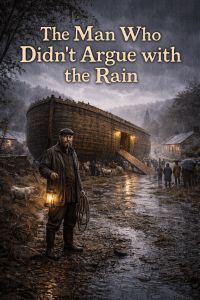
The Man Who Didn’t Argue with the Rain

The Man Who Didn’t Argue with the Rain

By the fourth week of rain, Ballykillduff stopped pretending it was temporary.

The first week had been called unfortunate. The second was concerning. By the third, people were beginning to mutter phrases like biblical and I don’t remember it ever being this wet, which in Ballykillduff was the traditional signal that something had gone deeply wrong with reality.

Jimmy McGrogan noticed it on a Tuesday.

Not the rain itself—everyone noticed that—but the way it behaved. Rain usually arrived with a bit of manners. It fell, it soaked, it left. This rain had moved in. It lingered. It leaned against doorframes. It watched through windows. It fell at angles rain had no right to fall at, drifting sideways, upwards occasionally, as though unsure which way gravity was supposed to be working that week.

Jimmy stood in his yard, rain dripping off the brim of his cap, watching the river swell until it looked less like a river and more like a decision someone had made in a panic.

“That’s not stopping,” he said aloud.

This was important, because Jimmy McGrogan was not a man given to exaggeration. When Jimmy said something wasn’t stopping, it usually meant it had already passed reasonable and was heading briskly toward legend.

By Wednesday morning, the chickens were refusing to come out of the shed, the dog was sulking under the stairs, and the postman had taken to delivering letters by throwing them vaguely in the direction of houses and hoping for the best.

That was when Jimmy began measuring.

No one noticed at first. Ballykillduff had learned long ago that noticing Jimmy McGrogan too early only made things worse. He paced the length of his field with a tape measure and a look of grim concentration. He made notes on the backs of old envelopes. He stared at the sky, nodded once, and went inside to make tea so strong it could have removed paint.

On Thursday, he bought timber.

“Doing repairs?” asked Mrs. Donnelly in the hardware shop.

“Something like that,” said Jimmy.

On Friday, the shape became unmistakable.

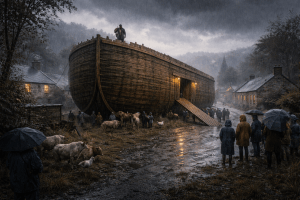
It was an arc. Not a curve, not a suggestion—an unmistakable, deliberate arc, rising from the soaked earth behind Jimmy’s house like an idea that had finally committed to itself. By Saturday afternoon, half the village was standing at the hedge, umbrellas sagging, watching him work.

“Is that…?” someone began.

“Yes,” said Jimmy, without looking up.

“But—”

“Yes.”

“Are you sure?”

Jimmy drove a nail home with unnecessary emphasis.

By Sunday, the rain intensified, as though offended.

The river spilled over its banks. The lower lane disappeared entirely, leaving only the tops of familiar signposts sticking out like accusations. A cow appeared in O’Flaherty’s yard, confused but polite. The church steps developed a small waterfall, which Father Keane insisted on blessing, just in case.

And Jimmy McGrogan kept building.

By the time the arc was finished, it was enormous—solid timber ribs, sealed seams, a roof sloping just enough to argue with the rain instead of surrendering to it. A door wide enough for decisions. A ramp thoughtfully added, “for anything with opinions,” Jimmy explained.

“What exactly do you think is going to happen?” asked Mrs. Donnelly.

Jimmy wiped his hands on his trousers and looked out across Ballykillduff, now shimmering with water and reflection.

“I don’t think,” he said. “I’ve checked.”

That night, the rain reached a pitch it had been working toward all along.

It fell with purpose. With memory.

People woke to water at their doorsteps, then in their kitchens, then tapping politely at the stairs. And when they went outside—boots sloshing, torches bobbing—they found Jimmy already there, opening the great wooden door of the arc.

He did not shout. He did not panic.

He simply nodded and stepped aside.

By morning, Ballykillduff floated.

Not dramatically—no roaring waves, no lightning—but gently, stubbornly, as though it had decided to refuse sinking out of spite. The arc rocked slightly, tethered to what remained of the higher ground, filled with people, animals, boxes of things someone couldn’t quite bear to leave behind.

And then, just as suddenly as it had begun, the rain stopped.

It did not slow. It did not apologise.

It stopped.

Water drained away with reluctant sighs. The river returned to something like itself. Mud claimed the streets. Ballykillduff reappeared, damp, bewildered, but intact.

Jimmy McGrogan dismantled the arc the following week.

Used the timber for sheds, fences, and one very fine bus stop. He never spoke much about it afterward, except once, when someone asked him how he’d known.

Jimmy thought for a moment.

“Well,” he said, “when the rain forgets to leave, it’s best to be polite—but prepared.”

And in Ballykillduff, no one ever argued with that.


Tags: , , ,

Will it Ever Stop Raining?

Will it Ever Stop Raining?
It was one of those Ballykillduff days that seemed to have been mislaid at birth and never quite recovered.
Morning arrived reluctantly, dragging itself over the hills like a wet coat someone else had already worn. The sky hung low and colourless, a slab of dull tin pressed flat against the rooftops. Rain fell straight down—no drama, no thunder—just a steady, joyless drizzle that soaked everything slowly, as if the day had all the time in the world and nowhere else to be.
The village square was empty. Even the statue—whose subject nobody could quite remember—looked embarrassed to be standing there, rain slicking its shoulders until it gleamed like a regret. The shop windows were dim, lights left off to save electricity or enthusiasm. Inside O’Flaherty’s, the radio murmured to itself, unheard by anyone, reporting weather that was already happening far too much.
Water crept along the gutters in thin, patient streams, carrying leaves, grit, and the occasional idea that had fallen out of someone’s head. The river swelled and darkened, moving faster than usual, as though it were late for something important and slightly annoyed about it. It slapped at the banks with muddy urgency, whispering to the stones in a language only old things understood.
People stayed indoors. Curtains twitched. Kettles boiled repeatedly, less out of need than for reassurance. Somewhere, a clock ticked far too loudly, reminding the house that time was still passing even if the day itself appeared stuck.
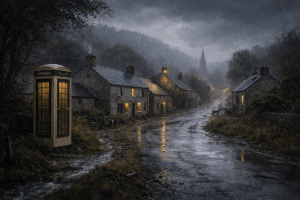
Down by the lane, the old telephone box—long disconnected but never removed—stood full of rainwater and reflections. For a moment, it looked as though the village had drowned a smaller version of itself inside, a pocket Ballykillduff where it was always raining and nobody ever answered.
By afternoon, the cold had worked its way into the bones of the place. Doors swelled. Hinges complained. The rain grew heavier, not angrier—just more insistent, as though it were trying to explain something important and failing repeatedly. Puddles formed in the familiar dips of the road, each one a dark mirror showing the sky exactly as it was: unhelpful and unavoidable.
And yet—quietly, stubbornly—life went on.
A light flicked on in an upstairs window. Smoke rose from one chimney, then another. Somewhere, a dog barked at nothing in particular, satisfied it had done its duty. The rain softened, just a fraction, as evening crept in with blue shadows and the promise of lamps and supper.
Ballykillduff endured the day the way it endured most things: without complaint, without fuss, and with the unspoken understanding that this too would pass. Tomorrow might be brighter. Or stranger. Or worse.
But tonight, the rain would keep falling, the village would keep breathing, and the dark would settle in—not as an ending, but as a pause.
 
Leave a comment

Posted by on January 26, 2026 in rainy days


Tags: , ,

Alice on Top of the World

Alice on Top of the World

Alice discovered quite by accident that the world has a top.

Most people, she had noticed, were too busy walking around it to check.

It wasn’t marked by a flag or a signpost—nothing as sensible as that. Instead, it felt like a place the world itself had agreed upon in a moment of quiet pride. When Alice stepped there, the ground did not wobble or roll away. It simply paused, as though holding its breath.

Below her, the Earth unfolded in bright, broken shapes: seas made of blue ideas, continents stitched together with yellows and greens, clouds cut into careful pieces like a puzzle no one had finished. The sun shone from one side and the moon from the other, neither arguing about whose turn it was.

Alice put her hands on her hips—not because she felt particularly brave, but because it seemed like the correct posture for standing somewhere important.

She waited for something dramatic to happen.

Nothing did.

“Well,” she said to the air, which was listening, “that’s rather the point, isn’t it?”

From up here, worries shrank into polite little shapes. Arguments lost their sharp edges. Even time—dangling somewhere nearby with its pocket watch—seemed unsure whether to tick forward or simply admire the view.

Alice realised then that being on top of the world did not mean ruling it, or shouting instructions down at it. It meant seeing how all the pieces fitted together, even the crooked ones. Especially the crooked ones.

After a while, she stepped down again, because no place likes to be stood upon forever.

But the world remembered.

And from that day on, whenever things felt impossibly large, Alice smiled—quietly—knowing exactly where the top was, and that she had already been there once.


Tags: , , , ,

The Vexari

The Vexari

Once, in the violet-hued twilight of a world called Khyra-Vel, there lived a people known only in whispers beyond their borders: the Vexari.

They were not born of flesh in the usual way. Long before the first mountain cooled and the oceans learned to dream, the planet’s core had sung a strange, low-frequency lament. That song seeped upward through crystal veins, through black soil, through the marrow of ancient trees. Where the song met lightning-struck ironwood, the first Vexari took shape—not grown, not hatched, but remembered into being.

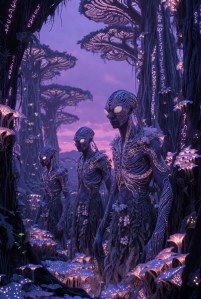
They looked almost human at a distance: tall, long-limbed, skin the color of storm clouds reflecting fire. But come closer and the illusion frayed. Their eyes were compound mosaics, each facet holding a different hour of the day. Their hair moved even without wind, threading itself into tiny, deliberate patterns like living script. Most unsettling of all were the thin, silvery lines that ran beneath their skin—rivers of liquid starlight that pulsed faster whenever they felt strong emotion, or whenever they lied.

The Vexari did not speak with voices. They vexed. A thought, a memory, a half-formed fear would leap from one mind to another like static jumping between copper wires. To be in a room full of them was to feel every unsaid word pressing against your temples. Most outsiders went mad within hours. The few who survived learned to think in rigid, geometric patterns, building mental walls brick by brick until the onslaught dulled to a bearable hum.

For centuries the Vexari kept to themselves. Their cities grew inside colossal hollowed-out world-trees, spiraling upward and downward at once, floors becoming ceilings, gravity politely optional. They wove light into tapestries that remembered every face that had ever looked upon them. They sang to the core again, coaxing up fresh veins of song-metal they fashioned into blades that could cut sorrow from a heart without drawing blood.

Then came the strangers.

A ship of cold iron and colder ambition fell from the sky. Its crew called themselves the Reclaimers—humans mostly, though augmented until little original flesh remained. They had heard rumors of a world where thoughts could be mined like ore. They brought machines that listened, machines that recorded, machines that stole. The Reclaimers wanted to bottle vexation and sell it as a drug to the bored nobility of a dozen core systems. Eternal distraction. Perfect obedience. A mind too full to rebel.

The first Vexari they captured was named Sylith-9 (the number was not a rank but the number of times she had successfully forgotten her own name and then found it again—a prized talent among her kind).

They strapped her to a chair of braided tungsten. Electrodes kissed the silver rivers beneath her skin. The machines drank.

At first she gave them only silence.

Then she gave them everything.

Every childhood terror, every lover’s betrayal, every quiet moment she had ever doubted the core-song still loved her. The Reclaimers’ minds filled like cisterns during monsoon. They laughed. They wept. They tore at their own faces trying to scratch the memories out. Within minutes the entire boarding party was curled on the deck, rocking, whispering apologies to people who had died centuries earlier on distant worlds.

Sylith-9 stood. The silver lines under her skin now blazed white-hot. She walked among the broken crew, touching each one lightly on the forehead. Into their minds she placed a single, perfect image: the moment just before birth, when every possibility still exists and none have yet hurt you.

They never recovered. But they also never died. They simply sat, smiling softly, cradling that one safe memory while the rest of their selves slowly dissolved.

Word spread.

The Reclaimers’ sponsors sent more ships. The Vexari answered in kind.

They did not fight with weapons. They fought with stories.

They vexed entire fleets with visions of wives who had never existed, children who died in wars that never happened, futures so beautiful the crews would rather die than wake from them. They vexed navigators with false stars until ships drifted forever among reefs of dark matter. They vexed admirals with the certain knowledge that victory had already been achieved—so why keep fighting?

In the end the armada limped home, half its vessels empty, the other half carrying crews who no longer remembered their own names, only that something infinitely precious had once lived inside them and was now gone.

Khyra-Vel was left alone again.

But the Vexari changed.

They began to wonder if solitude had been a mercy or a cage.

Some drifted away from the world-tree cities, seeking the edges of known space. They hired themselves out as interrogators, grief counselors, memory sculptors. A single Vexari could unravel a warlord’s lifetime of lies in an afternoon, or rebuild a shattered mind so skillfully that even the cracks became part of the design.

Others stayed behind, singing new songs to the core—louder, more questioning songs.

And on quiet nights, when the violet twilight returns, travelers still report seeing tall figures standing at the edge of the jungle, silver lines pulsing softly, watching the stars.

They do not call out.

They simply vex.

And if you listen very carefully, you might feel the lightest brush against your thoughts:

You are remembered.

You are not alone.

Would you like to remember yourself, too?


Leave a comment

Posted by on January 24, 2026 in scare, Scary, scary story


Tags:

Red Riding Hood!

Red Riding Hood!
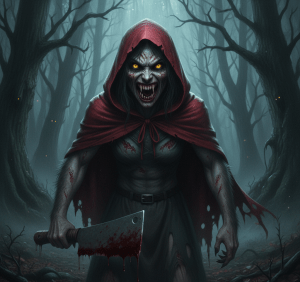
The forest was always a place of shadows and whispers, but tonight, it felt like the very trees were holding their breath. Hunter Gabriel Thorne gripped his rusted axe, its weight a familiar comfort against the biting cold. He was tracking a beast, not the four-legged kind, but something far more insidious, something that left a trail of mangled bodies and a chilling absence of sound in its wake.
He stumbled upon her by the ancient, gnarled oak, its branches like skeletal fingers reaching for the moonless sky. She stood in the eerie silence, a figure cloaked in crimson, eerily familiar. Her hood, once a symbol of innocence, was now stained with what Gabriel prayed was mud, but feared was something far worse. Her eyes, glowing like embers in the twilight, fixed on him with an unnerving intensity. Her smile, a gaping maw of razor-sharp teeth, sent a shiver down his spine that had nothing to do with the cold.
This was not the Little Red Riding Hood of the old tales. Her skin was a sickly grey, scarred and torn, her once-delicate features twisted into a grotesque mask of primal hunger. Her hands, gnarled and clawed, clutched a heavy, blood-stained cleaver, its metallic tang sharp in the still air. Bits of fur and tattered clothing clung to her, grim trophies of past encounters. She was a creature of the night, a monstrous inversion of the childhood fable.
Gabriel had heard the whispers in the village, hushed tales of a girl who had gone into the woods to visit her grandmother, only to return…changed. They spoke of the unholy strength, the insatiable appetite, and the chilling laughter that echoed through the trees before another villager vanished.
“Grandmother always said to beware the big bad wolf,” the creature rasped, her voice a guttural growl that scraped against Gabriel’s ears. “But she never warned me about becoming one.”
She took a step, then another, the cleaver dragging on the leaf-strewn ground with a sickening scrape. Gabriel felt his blood run cold, his axe suddenly feeling inadequate against the pure, unadulterated malevolence emanating from her.
“You’re a hunter, aren’t you?” she hissed, her glowing eyes never leaving his. “Come to put me down, just like the rest of them?” Her grin widened, revealing more of those terrifying teeth. “But I’m not a wolf you can cage, old man. I’m the forest’s retribution.”
With a sudden, horrifying burst of speed, she lunged. Gabriel barely had time to raise his axe as the monster that was once Little Red Riding Hood descended upon him, her cleaver flashing in the dim light, ready to add another bloody chapter to her dark fairytale. The last sound he heard was her unholy cackle, mingling with the whispers of the ancient, unforgiving woods.
 
Leave a comment

Posted by on January 24, 2026 in red riding hood


Tags: , , ,

The First Pipe

The First Pipe
The First Pipe.
*************
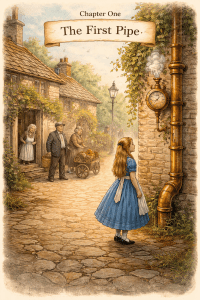
The pipe appeared sometime between the last letter being posted and the postmistress locking the door.
No one saw it arrive.
In Ballykillduff, this was not considered suspicious. Things often arrived without arriving. Days slipped in sideways. Tuesdays borrowed from Thursdays. A sheep once spent an entire afternoon convinced it was a gate. Compared to these, a pipe was a small matter.
It was brass, newly polished but already faintly tired-looking, as though it had anticipated being admired for only a short while. It ran vertically up the outside wall of the post office, stopping just short of the roof, and ended in a small valve that hissed very gently, like someone attempting to whisper a secret to a brick.
Below the valve was a round gauge.
The needle trembled.
The word printed beneath it read: NEARLY
To be continued
 

Tags: , , , ,

1970s Dublin

1970s Dublin

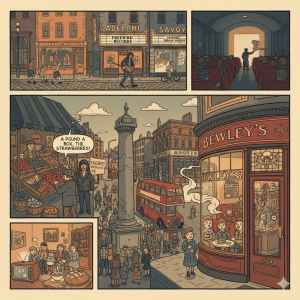
The 1970s in Dublin wasn’t just a decade; it was a specific kind of atmosphere—a mix of coal-smoke haze, the chime of the bells on the No. 10 bus, and a city that felt like a very large, slightly overgrown village.

If you closed your eyes back then, you’d hear the rattle of milk bottles on a frosty doorstep and the distant, rhythmic thrum of the Guinness brewery. Here is a look back at those golden, gritty years.


The Ritual of “Going Into Town”

Saturday morning was an event. You’d get scrubbed up, put on your best wool coat, and head for Nelson’s Pillar (or where it used to be) to meet friends.

  • The Sounds of Moore Street: You’d hear the “dealers” before you saw them. “A pound a box, the strawberries!” echoing against the damp stone walls.
  • The Shops: A pilgrimage to Clerys or Arnotts was mandatory, but the real magic was in the windows of Switzers at Christmas, where the mechanical displays felt like high-tech wizardry to a wide-eyed kid.
  • The Treats: If you were lucky, you’d end up in Bewley’s on Grafton Street. The smell of roasting coffee hitting you as you walked through those heavy doors was better than any perfume. You’d sit on the red velvet banquettes, surrounded by stained glass, feeling like royalty over a sticky bun.

Summer Evenings and Street Lights

Before the era of sleek playgrounds, the street was the stadium.

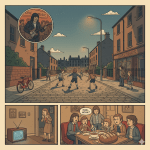
In the 70s, the sun seemed to stay up forever in June. Kids played “kerbs” until the streetlights flickered to life—the orange glow of the sodium lamps being the universal signal that it was time to go home. There were no smartphones, just the sound of a neighbor calling a name from a front door and the distant “tink-tink” of a bicycle bell.

The Cultural Pulse

Dublin in the 70s was finding its groove. You might catch a glimpse of Phil Lynott strutting down Grafton Street in a leather jacket, looking like a rock-and-roll god.

  • Music: You’d save up your pocket money to spend an hour browsing the stacks at Freebird Records, looking for that one LP that would change your life.
  • The Cinema: Going to the Adelphi or the Savoy wasn’t just about the movie; it was about the velvet curtains, the usher with the torch, and the sheer scale of the screen that made you feel like you’d stepped out of grey Dublin and into Technicolor Hollywood.

The Simple Comforts

Life was slower. You’d wait all week for The Late Late Show on a Friday night, the family gathered around a TV set that took five minutes to “warm up.” Dinner was often simple—a “coddle” on a Saturday night, the salty, savory steam filling the kitchen, or a loaf of Brennan’s bread so fresh the crust would crackle when you squeezed it.

There was a certain toughness to the city, sure, but there was an incredible warmth, too. Everyone knew your business, for better or worse, and a “cup of tea” was the solution to every crisis known to man.


Leave a comment

Posted by on January 21, 2026 in 1970s Dublin


Tags: ,