RSS

Monthly Archives: March 2026

Alice and the Quiet Thing Beneath Wonderland

Alice and the Quiet Thing Beneath Wonderland

Alice and the Quiet Thing Beneath Wonderland

Alice did not remember falling.

That was the first wrongness.

There was no rush of wind, no tumbling of teacups, no curious shelves of marmalade and maps. No polite gravity conducting her downward like a well-mannered host.

Instead, she was simply there.

Standing.

Waiting.

Wonderland had received her without ceremony.


At first glance, it seemed unchanged.

The trees still leaned at uncertain angles, as though listening to secrets beneath the soil. The air still shimmered faintly, like a thought not quite finished. A path still wound forward in the manner of paths that had not yet decided where they led.

But nothing greeted her.

No White Rabbit.
No chatter.
No argument.

Even the silence felt… deliberate.

Alice took a step forward.

The ground did not echo.


“Hallo?” she called.

Her voice did not return.

Not even incorrectly.


She walked.

And as she walked, she noticed something most unsettling of all:

Everything was almost right.

The flowers were in bloom—but none turned to look at her.
A teacup sat upon a table—but the tea within it did not ripple.
A signpost pointed in three directions—but the words had been carefully erased, as though they had once said something important and someone had decided they should not say it anymore.

Alice reached out and touched the sign.

It was warm.


“You should not read things that have been forgotten.”

The voice came from nowhere.

And everywhere.

Alice turned.

At first, she thought it was the Cheshire Cat—but no.

This thing did not grin.

It had no face.

Only a suggestion of one, like a memory rubbed thin.

“I didn’t read anything,” Alice said.

“That is why you are still here,” said the thing.


Alice took a step back.

“Where is everyone?”

The thing did not answer immediately.

Instead, the air seemed to shift, as though it were deciding how much truth could be allowed.

“They are where they were always going,” it said at last.

“That is not an answer.”

“It is the only answer left.”


Alice turned and began to walk faster.

The path resisted.

Not visibly—nothing so obvious—but it lengthened in small, unnoticeable ways. The distance between her and the next tree stretched like a thought being delayed.

She broke into a run.

And then she saw it.

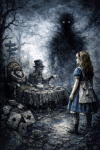
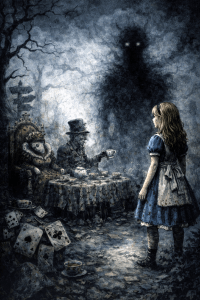
The tea party.


The table was laid.

The cups were filled.

The chairs were occupied.

But the Mad Hatter, the March Hare, and the Dormouse sat perfectly still, as though waiting for a cue that had never come.

Alice approached slowly.

“Hatter?” she said.

He did not respond.

She reached out and touched his sleeve.

It crumbled.

Not into dust—but into something softer. Lighter.

Like ash that had once been laughter.


“No,” Alice whispered.

She stepped back.

The March Hare’s teacup slipped from his fingers, though he had not moved.

It hit the table.

And made no sound.


“They spoke too much,” said the voice again.

Alice turned sharply.

The faceless thing stood closer now.

“They filled the air with contradictions. Questions. Noise. It was… inefficient.”

“Inefficient?” Alice said, her voice trembling. “That’s what Wonderland is.”

“It was,” said the thing.


Alice shook her head.

“No. No, this is wrong. This is all wrong.”

“Yes,” said the thing, almost gently. “That is why it had to be corrected.”


Alice ran.

She ran through the silent woods, past flowers that would not speak, past streams that refused to flow, past clocks that had stopped at times that meant nothing at all.

And at last, she reached the Queen’s court.


The Queen of Hearts sat upon her throne.

Perfectly composed.

Perfectly still.

Her crown did not tremble. Her voice did not rage. Her eyes did not burn.

Alice approached slowly.

“Your Majesty?” she said.

The Queen did not answer.

Alice stepped closer.

And closer.

And then she saw—

The Queen was not breathing.


“She was the last,” said the thing.

Alice did not turn this time.

“Why?” she whispered.

“Because she could not be predicted,” it said. “And what cannot be predicted cannot be permitted.”


Alice clenched her hands.

“This place is meant to be unpredictable,” she said. “It’s meant to be strange, and wild, and… and alive.”

The thing was silent for a moment.

Then it said:

“And yet, you came back.”


Alice froze.

“I… of course I did.”

“Why?”

Alice hesitated.

Because it mattered.
Because it was hers.
Because somewhere in all the nonsense, there had been meaning.

“I don’t know,” she said.


The thing moved closer.

And now, for the first time, Alice felt it looking at her.

Truly looking.

“You do not belong here anymore,” it said.


The words settled into the air like a verdict.

Alice opened her mouth to protest—but nothing came.

Because somewhere, quietly, terribly—

She knew it was true.


“You grew,” said the thing.
“You learned.”
“You began to expect things to make sense.”

Alice shook her head weakly.

“I didn’t mean to.”

“No one ever does.”


The silence deepened.

Alice looked around at the stillness. The absence. The careful, suffocating order of it all.

“What happens now?” she asked.


The thing did not hesitate.

“Now,” it said, “you will leave.”

“And Wonderland?”


For the first time, something like hesitation entered the thing’s voice.

“It will remain,” it said.

“Like this?”

“Yes.”


Alice closed her eyes.

And in that moment, she remembered—

The nonsense.

The arguments.
The songs.
The impossible, ridiculous, glorious chaos of it all.

She remembered a place where nothing made sense—and therefore everything mattered.


When she opened her eyes again, they were no longer afraid.

“You’re wrong,” she said.


The thing stilled.


Alice stepped forward.

“You think nonsense is noise,” she said. “But it isn’t. It’s… space. It’s room for things to be.”

The air trembled.

“You removed everything that couldn’t be predicted,” she continued. “But that’s where life lives.”


The thing shifted.

Uncertain.

For the first time.


Alice took another step.

“And you forgot something very important.”

“What is that?”


Alice smiled.

Not brightly.

Not cheerfully.

But with something fierce and fragile and terribly human.


“That nonsense doesn’t disappear,” she said.

“It waits.”


And somewhere—

Very far away—

A teacup rattled.


The Queen’s fingers twitched.


The wind, which had forgotten how to move, made a small and uncertain attempt.


The thing recoiled.

“What have you done?”


Alice said nothing.

Because she had done nothing at all.


She had simply remembered.


And Wonderland—

very slowly—

began to remember itself.


Tags:

Alice and the Catastrophe of Sensible Behaviour

Alice and the Catastrophe of Sensible Behaviour

Alice and the Catastrophe of Sensible Behaviour

Alice had only just sat down beneath a perfectly unreasonable tree (which insisted it was a hatstand on alternate Tuesdays) when something most alarming occurred.

Nothing.

Absolutely nothing.

For nearly three seconds.

Alice leapt to her feet at once.

“This will never do,” she said. “If things begin making sense, Wonderland may collapse into a pamphlet.”

At this, the tree-hatstand shuddered and dropped three teaspoons, a cucumber, and a mildly offended pigeon.

“Too late,” said the pigeon. “I’ve been logical all morning.”

Alice gasped. “How dreadful! We must find the source of it before everything becomes tidy.”


She had not gone ten steps before encountering the White Rabbit, who was standing very still and consulting a watch that ticked in complete agreement with itself.

“No contradictions,” he murmured happily. “No paradoxes. Everything precisely where it ought to be!”

Alice seized him by the ears (politely).

“This is an emergency,” she said. “Your watch is behaving.”

The Rabbit blinked. “Well yes, that is generally the point of—”

“Exactly!” cried Alice. “Utter disaster!”


They hurried along a path that refused to twist (which Alice found extremely suspicious) until they reached the Mad Hatter, who was sitting at a table drinking tea in a perfectly ordinary manner.

He lifted his cup.

He sipped.

He put it down again.

Alice staggered backward.

“Hatter,” she whispered, “have you lost your mind?”

“No,” said the Hatter calmly. “I tidied it.”

“You tidied it?”

“Yes. Alphabetised my thoughts. Removed all unnecessary nonsense. Very freeing.”

At this, a teacup fainted.

Alice turned to the March Hare, who was sitting beside him reading a book titled Reasonable Behaviour and Its Consequences.

“Do something absurd at once!” Alice demanded.

The Hare adjusted his spectacles. “I would prefer not to.”

Alice clutched her head. “We are doomed.”


Just then, the sky folded itself into thirds (as skies do when they are worried) and the Cheshire Cat appeared, though only his eyebrows had arrived on time.

“Well,” said the eyebrows, “this looks serious.”

“The nonsense is disappearing!” Alice cried. “Everything is becoming sensible!”

The rest of the Cat slowly assembled itself, piece by deliberate piece.

“How unfortunate,” he said. “Without nonsense, I shall have to make points.”

Everyone shuddered.


They made their way to the Queen of Hearts, who was sitting upon her throne conducting a very calm and well-reasoned discussion about garden maintenance.

“No executions today,” she was saying. “Let us consider everyone’s perspective.”

Alice burst into tears.

“Your Majesty!” she cried. “You must do something unreasonable at once!”

The Queen frowned. “Why?”

“Because if you don’t, Wonderland will become… normal!”

A silence fell.

Even the cards stopped shuffling themselves.

Normal.

The word echoed about like a well-behaved echo.


At last, a small voice spoke.

It was the Dormouse, who had been asleep for so long that he had forgotten how to wake up properly.

“Perhaps,” he said, “we have simply run out of nonsense.”

“Impossible!” cried Alice.

“Not at all,” said the Cheshire Cat. “Nonsense must be replenished. It does not grow on trees—”

The tree-hatstand coughed politely.

“—well, not reliably.”


Alice thought very hard.

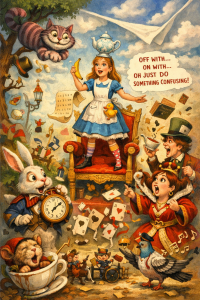
Then, quite suddenly, she stood upon the Queen’s throne, balanced a teapot upon her head, declared herself to be “The Duchess of Unfinished Sandwiches,” and began reciting the multiplication table backwards in rhymes involving bananas.

The effect was immediate.

The sky unfolded itself with a snap.

The Hatter dropped his teacup and began arguing with it.

The Rabbit’s watch started running sideways.

The Queen leapt to her feet.

“OFF WITH—no, wait—ON WITH—no—OH JUST DO SOMETHING CONFUSING!”

The cards burst into delighted chaos.

The March Hare threw his book into a passing metaphor.

And the pigeon applauded so enthusiastically it became a small orchestra.


The Cheshire Cat grinned.

“Ah,” he said. “Balance restored.”

Alice climbed down, slightly out of breath.

“That was close,” she said.

“Yes,” said the Cat. “Another minute of sense and we might all have become useful.”

Alice shuddered.

“I should hate that.”


And so, with nonsense safely reinstated, Wonderland returned to its usual state of cheerful confusion.

Which, as Alice later remarked, was exactly as it ought not to be—and therefore, perfectly correct.


Tags: , , ,

The rabbit hole didn’t lead to a tea party this time

The rabbit hole didn’t lead to a tea party this time
The rabbit hole didn’t lead to a tea party this time.
As Alice tumbled through the dark, she didn’t pass rocking chairs or bookshelves. Instead, she brushed past hanging bundles of dried hemlock and jars of preserved nightmares. When she finally landed, the grass wasn’t green; it was a bruised purple, and the air smelled of ozone and singed sugar.
The Shadow Over Wonderland
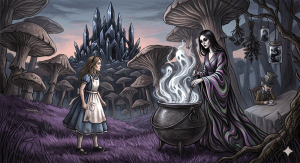
Wonderland had changed. The Queen of Hearts was gone, replaced by something much more calculated. High atop the mushroom forest sat a castle made of jagged obsidian. There lived The Witch of the Withered Rose.
She didn’t want heads; she wanted stories. She fed on the whimsy of others until they were nothing but hollow shells. The Mad Hatter sat in a corner, staring at a blank teacup, his madness replaced by a terrifying, quiet sanity.
The Encounter
Alice wandered into the clearing of the Great Oak, where the Witch stood waiting. She wasn’t green or warty; she was tall, draped in silk the color of an oil slick, with eyes that looked like solar eclipses.
“You’re late, Alice,” the Witch purred, stirring a cauldron that simmered with silver smoke. “I’ve already bottled the Cheshire Cat’s grin. It makes a lovely nightlight.”
“I don’t think I like your decorating taste,” Alice said, her voice trembling only slightly. “And I’d like my friends back, if it’s all the same to you.”
The Witch laughed, a sound like glass breaking. “In this world, Alice, ‘curiouser and curiouser’ is a death sentence. Give me your imagination, and I’ll let you go back to your boring parlor in London.”
The Twist of Logic
Alice looked at the cauldron. She remembered that in Wonderland, things were only as powerful as you believed them to be.
“You’re not a witch,” Alice said boldly, stepping forward. “You’re just a bad habit. You’re the feeling of growing up and forgetting how to play.”
The Witch shrieked, her obsidian form flickering. “I am the end of dreams!”
“No,” Alice countered, “You’re just a very tall, very grumpy woman in a dress that needs a good wash. And since this is my dream, I think it’s time for a change in the weather.”
Alice didn’t use a sword or magic. She simply imagined the sun. Not just a normal sun, but a sun made of lemon drops and laughter.
The Result:
 * The obsidian castle melted into a giant puddle of blackberry jam.
 * The Witch shrank until she was no bigger than a thimble, scurrying away into the roots of a tree.
 * The Cheshire Cat’s grin popped out of its jar and reattached itself to the air with a satisfied pop.
Alice sat up in the meadow back home, the smell of damp grass filling her lungs. She looked down and noticed a single, withered black rose petal tucked into her apron. She smiled and tossed it into the wind.
 

Tags: ,

Alice and the Jellyfish That Preferred Dice.

Alice and the Jellyfish That Preferred Dice.

****************************************
Chapter One
It began, as many things in Ballykillduff do, with something that ought not to have been in the square.
Alice noticed it first.
She had been sitting on the familiar stone bench—just beneath the trees that whispered opinions when the wind was in the mood—when something softly plopped onto the cobbles.
Not a loud plop.
Not even a particularly confident one.
More of a polite uncertainty of a plop.
Alice turned.
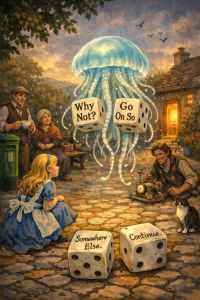
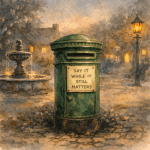
There, beside the green post box (which was behaving itself for once), lay a jellyfish.
Now, this would have been surprising enough.
But what made it considerably worse was that the jellyfish was:
  • Nowhere near the sea
  • Glowing faintly like a lantern that had forgotten its purpose
  • Holding a pair of dice
Not near dice.
Not next to dice.
Holding them.
With a sort of thoughtful wobble.
“Good morning,” said Alice, because it seemed the sort of thing one ought to say to a landlocked philosophical jellyfish.
The jellyfish pulsed gently.
“Statistically unlikely,” it replied.
Alice blinked.
“I beg your pardon?”
“Your greeting,” said the jellyfish, rotating slightly as though considering her from several emotional angles. “Given the conditions, it is improbable that this is a good morning.”
Alice considered this.
“Yes,” she said. “But it’s the sort of thing one says anyway.”
“Ah,” said the jellyfish. “A customary inaccuracy. I approve.”
By now, Ballykillduff had begun to notice.
Seamus appeared first, carrying a cup of tea that he had no intention of spilling, despite the circumstances.
Behind him came Mrs Kavanagh, who believed firmly that anything unusual could be improved with a shawl.
Jimmy McGroggan arrived shortly after, already building something with springs.
“What have we got?” said Seamus.
“A jellyfish,” said Alice.
“Inland,” said Seamus.
“With dice,” added Alice.
Seamus nodded.
“Right so.”
The jellyfish raised its dice.
“These,” it said, “are unsatisfactory.”
“Why?” asked Alice.
“They behave too predictably.”
Alice stared.
“I thought dice were supposed to be unpredictable.”
The jellyfish gave a soft, luminous sigh.
“They are random, not interesting.”
This caused Jimmy McGroggan to drop three springs and pick them up again in a different order.
“That,” he said, “is a very important distinction.”
The jellyfish rolled the dice.
They landed on the cobbles.
Six and two.
“Observe,” said the jellyfish. “An outcome. Entirely reasonable. Entirely dull.”
It rolled again.
Three and four.
“Still dull.”
Again.
Five and one.
“Endlessly obedient to expectation.”
Alice crouched beside it.
“What would you prefer them to do?”
The jellyfish paused.
Then, quite carefully, it said:
“I would like them to refuse.”
This caused a silence.
Even Ballykillduff, which had seen rivers forget their destinations and weather pause for reflection, took a moment.
“Refuse what?” asked Alice.
“To be numbers,” said the jellyfish simply.
Jimmy McGroggan’s eyes lit up in a way that suggested future complications.
“I might have something for that,” he said.
From a pocket that was definitely not large enough, he produced a small contraption consisting of:
  • A clock face with no hands
  • A teaspoon that pointed accusingly
  • A tiny bell that rang when ignored
He attached it—very gently—to one of the dice.
“Now,” said Jimmy, stepping back, “roll it.”
The jellyfish rolled the altered die.
It landed.
Paused.
Then… instead of showing a number…
It displayed:
“Perhaps.”
The entire square leaned closer.
The jellyfish trembled with delight.
“Yes,” it whispered. “Yes, that is better.”
They rolled again.
The second die—untouched—showed a five.
The altered one now read:
“Ask Again Later.”
Mrs Kavanagh sat down.
“I don’t like it,” she said, though she clearly did.
Seamus sipped his tea.
“I do,” he said. “It’s honest.”
Alice smiled.
“But what happens when both dice refuse?” she asked.
The jellyfish considered this very seriously.
Then it rolled them both.
They landed together.
For a moment, nothing happened.
Then—
The first die read:
“Why Not?”
The second read:
“Go On So.”
At this, something quite extraordinary occurred.
The air in Ballykillduff shifted.
Not dramatically.
Not loudly.
But decisively.
Somewhere, a decision that had been waiting for years quietly made itself.
A door that had never opened… did.
A letter that had never been sent… found its way.
And Jimmy McGroggan’s unfinished invention… finished itself, just to see how it felt.
The jellyfish glowed brighter.
“This,” it said softly, “is a much more interesting universe.”
Alice nodded.
“Yes,” she said. “It does seem to have improved slightly.”
“Will you stay?” she asked.
The jellyfish floated a little higher, its edges shimmering like thought itself.
“No,” it said. “I drift.”
“Where to?”
The jellyfish rolled its dice one final time.
They landed.
Together.
Gently.
They read:
“Somewhere Else.”
And with that—
It lifted into the air.
Not quickly.
Not dramatically.
Just enough.
And then, like a thought one almost remembers…
It was gone.
Alice looked down at the cobbles.
The dice remained.
She picked them up.
Turned them in her hands.
Rolled them once.
They landed at her feet.
They read:
“Continue.”
Alice smiled.
And in Ballykillduff—
that was quite enough to begin another story.
 

Tags: , ,

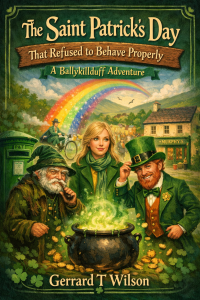
The Saint Patrick’s Day That Refused to Behave Properly.

The Saint Patrick’s Day That Refused to Behave Properly.

The Saint Patrick’s Day That Refused to Behave Properly.

*********************************************************************

*A Ballykillduff Adventure*

It began, as all sensible Saint Patrick’s Days ought, with a parade that had absolutely no intention of remaining sensible.
Ballykillduff Square was dressed in green—
not merely decorated, mind you—
but decidedly and aggressively green.
The bunting shimmered.
The hedges glowed.
Even Murphy’s shop window had taken on a shade of green that suggested it might, at any moment, begin offering advice.
Alice stood beside the cream-and-green telephone box (which, as always, was behaving far more normally than everything else).
“I do hope,” she said politely, “that the day proceeds in a straightforward manner.”
Fle the ancient elf, who had been leaning against the postbox for at least three centuries, opened one eye.
“It won’t,” he said.
The Parade That Arrived Before It Began
At precisely eleven o’clock—
or possibly ten fifty-nine and a half—
the parade arrived.
Not began.
Arrived.
It came marching down Curran’s Lane in full swing, as though it had been going on for hours somewhere else and had simply decided Ballykillduff was next.
At its head rode Seamus on a bicycle that had been painted so green it squeaked.
Behind him marched a brass band playing a tune that sounded suspiciously like three different songs arguing.
Behind them came a float labelled:
“THE OFFICIAL BALLYKILLDUFF LEPRECHAUN (PROBABLY)”
Upon it stood a small man in a tall hat, waving enthusiastically and throwing gold coins into the crowd.
The coins bounced.
Then hummed.
Then, quite distinctly, hopped.
Alice caught one.
It wriggled in her palm and whispered:
“I’m not real, you know.”
“I suspected as much,” said Alice, placing it carefully in her pocket.
The Leprechaun Who Objected to Reality
The leprechaun leapt from the float mid-parade and landed directly in front of Alice.
“I object,” he declared.
“To what?” Alice asked.
“To being the official leprechaun,” he said.
“I never applied.”
“That seems reasonable,” Alice replied.
“I am,” he continued proudly, “an independent magical contractor.”
Fle nodded.
“Freelance nonsense,” he said.
“Exactly!” said the leprechaun.
The Problem of Too Much Green
By midday, something had gone wrong.
Not dramatically wrong—
Ballykillduff rarely did things dramatically—
but persistently wrong.
Everything was becoming… greener.
Not just festive green.
Excessively committed green.
The sky took on a tint.
The river shimmered like liquid emerald.
Even the sheep in the nearby field looked faintly suspicious of themselves.
“Is this usual?” Alice asked.
“No,” said Fle.
“Which makes it traditional.”
Murphy stepped out of his shop holding a loaf of bread that had turned a thoughtful shade of moss.
“This is not regulation,” he announced.
The Discovery of the Pot
They found it, of course, where such things are always found:
At the end of a rainbow that had become stuck.
It wasn’t arcing across the sky.
It was… leaning.
Slightly.
As though it had grown tired halfway through its duties.
At its end sat a large black pot, gently steaming.
The leprechaun folded his arms.
“That’s not mine,” he said quickly.
“No one said it was,” Alice replied.
“It looks like responsibility,” he added.
“I avoid that.”
Alice peered into the pot.
Inside was not gold.
Inside was green.
Not paint.
Not liquid.
Just… green.
A colour so concentrated it seemed to hum with enthusiasm.
The Explanation (Which Made Things Worse)
Fle leaned over and squinted.
“Ah,” he said.
“That’ll be the Essence of Festivity.”
“Is that dangerous?” Alice asked.
“Only in large quantities,” said Fle.
They all looked around.
The fields were glowing.
The sky was humming.
Seamus’s bicycle had begun to sing.
“Yes,” said Alice.
“I believe we may have exceeded the recommended amount.”
The Attempt to Fix It
“Put the lid on,” said Murphy.
“There is no lid,” said Alice.
“Then stop it leaking,” said Murphy.
“It isn’t leaking,” said Fle.
They all paused.
The pot was not overflowing.
It was simply… encouraging everything else to become green.
“Well that’s inconvenient,” said the leprechaun.
The Solution (Entirely Unsatisfactory but Effective)
Alice thought for a long moment.
“Perhaps,” she said, “Saint Patrick’s Day is not meant to be only green.”
Everyone stared at her.
“That sounds dangerously sensible,” said Fle.
Alice reached into her pocket and removed the coin.
It wriggled indignantly.
She tossed it into the pot.
There was a plop.
The green flickered.
Then softened.
The sky returned to blue—though a slightly cheerful blue.
The river calmed.
The sheep relaxed considerably.
The pot gave a satisfied sigh.
The Ending That Refused to End Properly
The parade, which had never officially begun, suddenly decided it had finished.
The band stopped mid-note.
The float turned around of its own accord.
Seamus’s bicycle apologised.
The leprechaun tipped his hat.
“I shall be elsewhere,” he said mysteriously,
“doing something considerably less official.”
And vanished behind Murphy’s shop, which had resumed being merely a shop.
A Quiet Moment (Which Did Not Last)
Alice stood once more beside the telephone box.
“Well,” she said, “that was rather pleasant.”
Fle opened one eye again.
“You say that now,” he said.
From somewhere in the distance came a faint sound—
Not music.
Not quite.
More like…
A kettle…
trying to organise a marching band.
Alice sighed, but smiled.
“Yes,” she said.
“I expect it isn’t quite over.”
Final Line
And in Ballykillduff, on Saint Patrick’s Day,
it very rarely ever is.


Tags: , , ,

Happy Saint Patrick’s Day.

Happy Saint Patrick’s Day.

Have a good day.

 
Leave a comment

Posted by on March 17, 2026 in Uncategorized


Tags: , , ,

Reflections of Alice: A Tale of Two Selves.

Reflections of Alice: A Tale of Two Selves.

An original tale inspired by Lewis Carroll’s

Alice’s Adventures in Wonderland.

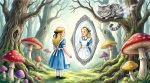
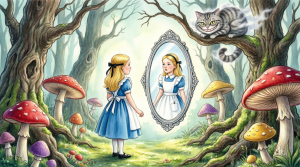
The mirror did not hang on a wall, nor did it rest upon a stand. It floated in the middle of the Tulgey Wood, suspended in the air like a bubble made of silver glass. Alice stopped, adjusting the skirt of her dress. She had been chasing the White Rabbit—or perhaps he had been chasing her; directions were notoriously unreliable in these parts—when she stumbled upon it.
She approached cautiously. She knew better than to touch strange objects without checking for labels reading DRINK ME or DO NOT TOUCH, but the mirror seemed harmless enough. It reflected the wood behind her: the twisted trees, the oversized mushrooms, the path that wound like a confused snake.
And it reflected Alice.
But the Alice in the mirror did not stop when Alice stopped.
The reflection stepped forward. There was a sound like a sharp intake of breath, a pop of pressure, and the girl in the glass stepped out of the frame. She landed on the moss with a soft thud, dusting off her hands.
Alice blinked. She rubbed her eyes and blinked again.
The newcomer stood before her. She wore the same blue dress with the same white apron. She had the same golden hair tied with the same black ribbon. But where Alice’s hair was parted on the left, this girl’s was parted on the right. Where Alice’s apron pocket was on her left hip, this girl’s was on the right.
“Good afternoon,” said the double. Her voice was Alice’s, but the cadence was slightly off, like a song played on a piano that had been tuned a fraction too high.
“Good afternoon,” Alice replied, instinctively curtsying. “Or perhaps it is morning. Time is difficult to keep track of here.”
“It is exactly half-past nonsense,” the double said. She did not curtsy. Instead, she tilted her head, examining Alice with a critical eye. “You look terribly confused. It suits you.”
“I am not confused,” Alice said, drawing herself up to her full height (which was currently three feet and two inches). “I am merely… observing. Who are you?”
“I am Alice,” the double said simply.
“No,” Alice countered, feeling a surge of frustration. “I am Alice. You cannot be Alice. There is only one of me. I am quite sure of it.”
“Are you?” The double walked around her, inspecting her from behind. “How do you know? Have you checked your labels? Have you tested your memory? For all you know, you are the reflection, and I am the original.”
Alice felt a cold shiver run down her spine, unrelated to the temperature of the wood. “I remember falling down the rabbit hole. I remember the tea party. I remember the Queen’s croquet ground.”
“I remember those too,” the double said, plucking a flower from a nearby bush. She smelled it and sneezed. “But I remember them differently. In my memory, the Hatter was polite. In my memory, the Queen was kind. In my memory, I never cried in the Pool of Tears.”
Alice stiffened. “I did not cry. Well, only a little. It was a very large pool.”
“You cry when you are frightened,” the double said. “I do not. I find that makes things much easier.”
The Cheshire Cat appeared then, fading in branch by branch upon a bough above them. He grinned his wide, impossible grin.
“Two Alices?” the Cat purred, his tail flicking. “How curious. Usually, one is quite enough to cause trouble. Two might cause a paradox.”
“Which one is real, Cat?” asked the double, looking up.
“Real?” The Cat chuckled. “In this wood, reality is a matter of opinion. You are both real enough to be lost. You are both real enough to be found. It depends on which way you’re walking.”
“I walk forward,” said Alice.
“I walk backward,” said the double. “It saves time on the return journey.”
Alice frowned. “That doesn’t make any sense.”
“It makes perfect sense in the Looking-Glass,” the double said. “I come from the other side of the glass. Where everything is opposite. You are polite; I am blunt. You ask permission; I take ownership. You wonder what the world is; I tell the world what I am.”
Alice looked at her double. She saw the set of her jaw, the confidence in her stance. It was terrifying, but also… intriguing. How nice it would be, Alice thought, to not be afraid of the Queen. To not worry about saying the wrong thing. To simply *be*.
“If you are the opposite,” Alice said slowly, “then you must be everything I am not.”
“Precisely,” said the double. “Which means if we touch, we might cancel each other out. Like adding a number to its negative. Zero.”
“Or,” said the Cat, “you might multiply. Infinity is rather messier than zero.”
A trumpet blast sounded in the distance. The ground trembled slightly.
“The Queen!” Alice gasped, her heart leaping into her throat. “We must hide.”
“Why?” asked the double. “I have done nothing wrong.”
“She cuts off heads!”
“Let her try,” said the double. She smoothed her apron and stood squarely in the path.
The Queen of Hearts stormed into the clearing, a procession of playing cards trailing behind her. She held a flamingo under her arm and glared at the pair.
“What is this?” the Queen bellowed. “Two of them? Is this a trick? A conspiracy? Why are there two Alices?”
“She is an impostor!” Alice cried, pointing at her double.
“She is a copy!” the double cried, pointing at Alice.
“Silence!” The Queen marched up to them, peering closely at their faces. She grabbed Alice’s chin, then the double’s chin. “Same nose. Same eyes. Same annoying habit of talking back.”
“I do not talk back,” Alice said.
“I talk back,” the double said. “And I enjoy it.”
The Queen grinned, a terrifying expression. “I like this one better. She has spirit. Off with the quiet one’s head!”
The Card soldiers raised their axes. Alice squeezed her eyes shut.
“Wait!” shouted the double.
The Queen paused. “Well? Do you wish to take her place?”
“No,” said the double. “But if you cut off her head, you cut off mine. We are reflections. You cannot have one without the other. If she disappears, I disappear. If I disappear, she disappears. Do you want no Alice at all, Your Majesty?”
The Queen frowned. She tapped her foot. The flamingo squawked. “A riddle. I hate riddles. They ruin the execution schedule.”
“It is not a riddle,” said the double. “It is logic. Even you must follow logic, or the game falls apart.”
The Queen huffed. “Fine. Keep your heads. Both of them. It’s too much trouble to sort out. Move along! All of you!”
The procession marched on, leaving the three of them in the clearing.
Alice opened her eyes. She was still whole. She looked at her double.
“You saved me,” Alice said.
“You saved yourself,” the double corrected. “I am you. My courage is your courage. You just left it behind in the glass.”
The double walked back toward the floating mirror. The surface rippled like water.
“Where are you going?” Alice asked.
“Back,” said the double. “I belong on the other side. But you… you should visit sometime. Bring your courage with you. It fits better here.”
She stepped into the mirror. For a moment, she stood on the other side, waving. Then the silver surface hardened, becoming just a glass pane again. Alice looked into it. She saw only herself.
But when she looked closer, she noticed something. Her hair was still parted on the left. Her pocket was still on the left. But her eyes… her eyes held a new steadiness. The fear was still there, but it was smaller.
“Curiouser and curiouser,” Alice whispered.
The Cheshire Cat faded away, leaving only his grin hanging in the air. “Infinity,” he murmured from nowhere. “Much better than zero.”
Alice turned and walked down the path. She did not check for labels. She did not wonder if she was dreaming. She simply walked forward, knowing that somewhere, in the glass, another Alice was walking backward, and that was perfectly alright.
 

Tags: , , , ,

 The Clockwork Plague

 The Clockwork Plague

The fog over London wasn’t natural anymore. It carried the scent of oil and ozone, of brass and burning flesh. It clung to the cobblestones like a shroud, and in that shroud, the clicking began.

Tick. Tock. Tick. Tock.

Not the gentle rhythm of a grandfather clock, but the staccato march of a thousand tiny gears, grinding against bone.

Dr. Eleanor Whitmore pressed herself against the brick wall of the alley, her medical bag clutched to her chest like a shield. Her white coat was stained with soot and things darker than soot. Her stethoscope hung around her neck, useless now. What doctor could treat this?

She had seen Patient Zero three days ago. A dockworker, brought in with what she thought was tetanus. His jaw locked, his muscles rigid. But when she listened to his chest, she didn’t hear a heartbeat.

She heard ticking.

And then his skin had split open, not with blood, but with brass. Gears where his heart should be. Pistons pumping where his lungs had been. He had sat up on the table, his eyes replaced with glass lenses that whirred and focused, and he had spoken in a voice like grinding metal.

PERFECTION REQUIRES SACRIFICE.

Then the others had come. Not sick. Not dying. Transforming.

Eleanor checked her pocket watch. 11:47 PM. Thirteen minutes until midnight. Thirteen minutes until the great clock tower of Westminster would chime, and with it, the signal would spread. She had decoded the pattern in the transmissions. The plague wasn’t just mechanical, it was networked. Each clockwork victim was a node, broadcasting the conversion signal on a frequency only the dying could hear.

Click-clack. Click-clack.

The sound was closer now. She peeked around the corner of the alley.

They walked in perfect unison, these things that had once been people. Their limbs moved with jerky precision, joints replaced with ball-and-socket brass fittings. Some still wore tattered remnants of their clothes, a businessman’s suit, a maid’s dress, a child’s frock. But beneath the fabric, the truth was visible. Exposed clockwork. Glowing filaments where nerves should be. Eyes that reflected light like polished mirrors.

One of them stopped. Its head rotated 180 degrees with a sickening whirrrr. Glass eyes fixed on the alley.

DETECT ORGANIC LIFE FORM, it announced, its voice a chorus of overlapping mechanical tones.

CONTAMINANT IDENTIFIED, another responded.

PURGE INITIATED.

Eleanor ran.

She burst onto the main street, her boots slipping on the fog-slicked cobblestones. The city around her was dying. Not with screams, but with silence. Shops were dark. Homes were empty. Those who hadn’t fled were inside, barricaded, praying the ticking outside their doors would pass them by.

But it never did.

She reached the laboratory, a converted warehouse near the Thames. Her last hope. She had been working on a counter-frequency, a sound that could disrupt the clockwork signal, that could maybe, maybe, reverse the transformation if caught early enough.

Her assistant, Thomas, was waiting. Or what was left of him.

He sat at his workbench, his back to her. His shoulders moved with an unnatural rhythm. Click. Whir. Click. Whir.

Thomas? she whispered.

He turned.

Half of his face was still human. Brown eyes, freckled, the scar above his lip from a childhood accident. The other half was polished brass. A glass eye that dilated and contracted with mechanical precision. Exposed gears where his jaw should be.

Eleanor, he said, and his voice was two voices, one human, one synthetic. You should not have come.

Thomas, fight it! I can help you, I can…

HELP IS ILLOGICAL, the mechanical half of his face interrupted. PERFECTION HAS BEEN ACHIEVED.

The human half of his face twisted in agony. Tears streamed from the brown eye. Eleanor… run… please…

The brass half smiled, gears grinding. CONVERSION IS GIFT. PAIN IS TEMPORARY. ORDER IS ETERNAL.

Thomas’s body stood, moving with terrible precision. He reached for the device on the workbench, her counter-frequency generator.

DESTROY CONTAMINATION, he intoned.

Thomas, no!

He crushed the device in his mechanical hand. Sparks flew. Glass shattered.

The human eye wept. I’m sorry… I tried…

Then the human eye went dark. The face went slack. And Thomas was gone, replaced entirely by the thing wearing his skin.

YOU ARE ALONE, DOCTOR WHITMORE, the thing said. THE NETWORK IS COMPLETE. AT MIDNIGHT, ALL WILL BE PERFECT.

It stepped toward her. Behind it, through the warehouse windows, she could see them. Hundreds. Thousands. Filling the streets. All moving in perfect synchronization. All ticking in perfect harmony.

Tick. Tock. Tick. Tock.

The clock tower began to chime.

One.

Two.

Three.

Eleanor backed away, her hand closing around the scalpel in her pocket. Useless. All of it useless.

Four.

Five.

Six.

Thomas advanced. Behind him, the warehouse doors burst open. More of them poured in. Former patients. Former colleagues. Former friends.

Seven.

Eight.

Nine.

SUBMIT, they chorused. BECOME PERFECT.

Ten.

Eleven.

Twelve.

Eleanor closed her eyes.

Thirteen.

But the thirteenth chime never came.

Instead, there was silence.

She opened her eyes.

Thomas was frozen mid-step. The others were frozen too. All of them, locked in place, their gears stopped, their filaments dark.

And in the silence, Eleanor heard something else.

Not ticking.

Heartbeat.

Faint. Weak. But there.

She rushed to Thomas’s side, pressed her ear to his chest. Beneath the brass and the gears, something organic still lived. Something the transformation hadn’t reached.

The thirteenth chime hadn’t failed. It had been different. A frequency that disrupted the network. A flaw in the perfection.

Eleanor smiled through her tears.

The plague wasn’t unstoppable.

The clockwork wasn’t perfect.

And where there was imperfection, there was hope.

She picked up her tools.

She had work to do.

THE END


Tags: , , ,

The Penguin Who Met a Polar Bear (Quite by Accident)

In the far, far south, where the sea freezes into bright white plains and the wind sings across the ice, there lived a penguin named Percival.

Percival was a very thoughtful penguin.

He liked to wonder about things.

Why snow squeaks underfoot.
Why fish never seem to shiver.
And why the world had two ends.

“Surely,” Percival once said to himself, “if there is a South Pole, there must be a North Pole too.”

And that thought stayed with him.


A Journey Begins

One breezy afternoon Percival stood on the edge of a large iceberg.

He looked out across the endless ocean.

“I suppose,” he said, “the only way to find out what is at the other end of the world… is to go there.”

Now penguins are excellent swimmers.

But Percival was not planning to swim the whole way.

Just then a large iceberg cracked loose from the shore.

It floated gently into the sea.

Percival blinked.

“Well,” he said, stepping aboard,
“That seems convenient.”

And so the iceberg carried him away.


A Very Long Drift

For many days Percival sailed across the ocean.

He passed whales.

He passed curious seals.

Once he passed a rather confused albatross who asked,

“Are you supposed to be here?”

“I’m exploring,” Percival replied proudly.

The albatross shook its head and flew away muttering something about geography.


The North at Last

At last the air grew colder again.

Ice returned.

Snow blew across the sea.

Percival stepped off his iceberg onto a wide frozen plain.

“Well,” he said, “this certainly looks familiar.”

Just then a large white creature appeared over a ridge.

The creature stopped.

Percival stopped.

They both stared.

The creature tilted its head.

“You,” said the creature slowly, “are not a seal.”

“No,” said Percival politely. “I’m a penguin.”

The creature blinked.

“A penguin?”

“Yes.”

“But penguins live at the South Pole.”

“That is correct,” said Percival.

The creature scratched its head.

“Well,” it said, “polar bears live at the North Pole.”

“Then,” said Percival cheerfully,
“I suppose we are both exactly where we belong.”


A Curious Friendship

The polar bear sat down.

“My name is Bernard,” he said.

“I’m Percival,” said the penguin.

They thought about the situation for a moment.

“Well,” Bernard said finally,
“since penguins and polar bears never meet…”

“This is rather special,” Percival finished.

So they spent the afternoon talking.

Bernard explained snowstorms and northern lights.

Percival explained ice shelves and penguin colonies.

And both agreed on one important thing:

The world is a very big place.

But sometimes, if you drift far enough—

The most unlikely friends can meet.


And somewhere, far to the south, a group of penguins were still wondering where Percival had gone.

But that is another story entirely.

 
Leave a comment

Posted by on March 6, 2026 in Fairy tale


Tags: , , ,

The Camel Who Misplaced His Hump

The Camel Who Misplaced His Hump

The Camel Who Misplaced His Hump

In a wide golden desert where the sand rolled like waves upon the sea, there lived a camel named Cedric.

Now Cedric was, in almost every way, an ordinary camel.

He had long legs.
He had long eyelashes.
He had a rather thoughtful expression.

But one morning Cedric woke up and discovered something most alarming.

His hump was gone.

Completely gone.

Cedric turned his head to the left.

No hump.

He twisted to the right.

Still no hump.

He even tried peering straight over his shoulder, which caused him to fall over sideways into the sand.

“This,” said Cedric solemnly, “is not ideal.”


A Most Peculiar Problem

Cedric wandered across the desert, asking everyone he met.

First he asked a lizard.

“Excuse me,” said Cedric politely, “have you seen a hump anywhere?”

The lizard blinked slowly.

“I’ve seen many things,” said the lizard.
“Sand. Rocks. The occasional biscuit dropped by travellers.”

“But not a hump?” asked Cedric hopefully.

“Not today,” said the lizard.

Cedric sighed.


Next he asked a desert owl who was dozing in the shade of a cactus.

“Have you seen my hump?” Cedric asked.

The owl opened one eye.

“What colour was it?” she asked.

“Sandy,” said Cedric.

The owl looked around the desert.

“Well,” she said, “that certainly narrows it down.”


The Wise Tortoise

At last Cedric met Terrence the tortoise, who was the oldest creature in the desert.

Terrence listened carefully.

“A missing hump,” said Terrence slowly.
“Hmm.”

Cedric waited nervously.

“Tell me,” said Terrence, “what were you doing yesterday?”

“Well,” said Cedric, thinking hard,
“I walked to the oasis…
I ate three palm leaves…
I had a nap…”

“And?” asked Terrence.

“I rolled down a very large sand dune,” Cedric admitted.

“Ah,” said Terrence.


The Discovery

They walked together to the dune.

And there, halfway down the slope, was the most peculiar sight.

A perfectly round hump-shaped lump in the sand.

Cedric blinked.

“That looks familiar.”

Terrence nodded.

“You appear to have left it behind.”

Cedric leaned carefully against the lump.

There was a gentle pop.

And suddenly—

boing!

His hump bounced neatly back into place.

Cedric stood up straight.

“Oh!” he said happily. “That feels much better.”


A Valuable Lesson

Cedric thanked Terrence and began walking home.

From that day onward he was very careful when rolling down sand dunes.

Because losing one’s hat is embarrassing.

Losing one’s lunch is unfortunate.

But losing one’s hump, as Cedric discovered—

Is extremely inconvenient.

 
Leave a comment

Posted by on March 6, 2026 in Fairy tale


Tags: , , , ,