
The Day the Postbox Refused Certain Letters
In Ballykillduff, the postbox had always been green, dependable, and mildly overlooked.
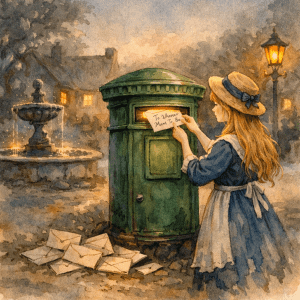
It stood beside the village square, not far from the fountain that sometimes remembered things before they happened, and within polite nodding distance of Mrs Flannery’s shop, where news was sold in equal measure with bread.
No one had ever thought much about the postbox.
Until the morning it began to think about them.
It started, as such things often do, with a small and easily dismissed inconvenience.
Mrs Flannery approached with a letter held between two fingers, as though it might yet change its mind.
“I’ve written to my sister,” she said aloud, because she often did that. “Perfectly reasonable. Perfectly timely.”
She slid the letter into the slot.
The postbox accepted it.
Then paused.
Then, with a quiet and distinctly deliberate motion…
returned it.
The envelope slipped back out, as neat as you please, and landed against her shoe.
Mrs Flannery frowned.
“Well now,” she said. “That’s… unnecessary.”
She tried again.
The postbox tried again.
The result was identical.
By mid-morning, the matter had gathered an audience.
Mr Hanrahan, who dealt in railway timings and therefore trusted systems, posted a form.
The postbox accepted it instantly.
“Functional,” he declared, with satisfaction.
A child posted a drawing of a duck wearing a hat.
The postbox hummed, a soft, approving sound, and swallowed it whole.
“Encouraging,” said Mrs Flannery, who was still holding her letter.
It was Mr Byrne the baker who noticed the sign.
“Ah now,” he said, squinting. “That wasn’t there yesterday.”
There, affixed just beneath the slot, in careful, looping handwriting, was a notice.
NO LETTERS OF REGRET
NO APOLOGIES WRITTEN TOO LATE
NO MESSAGES YOU SHOULD HAVE SAID YEARS AGO
The square fell into a thoughtful sort of silence.
“Well that’s ridiculous,” said Mrs Flannery.
And yet… she did not try to post the letter again.
By afternoon, the situation had worsened in a most peculiar way.
Letters that had been refused did not simply go home.
They lingered.
They gathered.
They rested against the base of the postbox, or perched along the fountain’s edge, or leaned thoughtfully against the green-painted bench.
And when the evening came…
they began to murmur.
Not loudly.
Not enough to cause alarm.
But enough that if one stood still—very still—and listened…
one might hear:
“I should have said it then…”
“It wasn’t meant like that…”
“I thought there would be more time…”
The square, which had always been a place of passing, became a place of pause.
Alice arrived just as the light began to soften.
She had been walking without particular direction, which in Ballykillduff often meant she arrived exactly where she was meant to be.
She regarded the postbox.
The sign.
The small congregation of unsent words.
And then, quite sensibly, she listened.
“Oh,” she said, after a moment.
“That’s rather clear.”
“What is?” asked Mr Hanrahan.
“It isn’t broken,” said Alice. “It’s being particular.”
“That’s worse,” said Mrs Flannery.
Alice walked slowly around the postbox, as though it might reveal something from the correct angle.
“It’s not refusing letters,” she said.
“It’s refusing timing.”
“I beg your pardon?” said Mr Byrne.
“These,” said Alice, gesturing gently to the scattered envelopes, “are all things meant for yesterday. Or last year. Or a moment that has already gone on without them.”
“Well that’s what letters are for,” said Mrs Flannery.
“Sometimes,” said Alice. “But not when they are trying to travel backwards.”
That night, the murmuring grew clearer.
Not louder.
But more certain.
The letters did not accuse.
They did not demand.
They simply… repeated themselves, as though waiting to be heard by the correct moment.
Which, unfortunately, had already passed.
The following morning, Ballykillduff was quieter than usual.
Not empty.
Not unhappy.
Just… aware.
Mrs Flannery opened her shop and said, to no one in particular:
“I should have told her I missed her.”
Then, after a pause, she added:
“I still do.”
Mr Byrne, weighing out flour, said:
“I was wrong about the oven.”
And then, after another pause:
“I know that now.”
Mr Hanrahan stood by the station and said:
“That wasn’t necessary. What I said.”
And though no one answered, the air itself seemed to acknowledge the effort.
Alice returned to the square carrying a single envelope.
It was plain.
Unaddressed, at first glance.
But as she turned it in her hands, the words revealed themselves—not written so much as decided.
To Whoever I Was Meant To Be
She considered the postbox.
The sign.
The quiet gathering of letters that no longer whispered quite so urgently.
“Well,” she said, “this doesn’t seem to belong to yesterday.”
She stepped forward and placed the envelope into the slot.
The postbox did not hesitate.
It accepted the letter.
Completely.
Without pause.
For a moment, nothing happened.
Which, in Ballykillduff, was often the beginning of something.
Over the next few days, the changes were small.
So small they might have gone unnoticed, had the village not been paying attention.
People spoke more.
Not loudly.
Not dramatically.
But at the right time.
A hand on a shoulder.
A word said before it became too late to say it easily.
A laugh shared instead of saved.
An apology given before it required a letter.
The pile of unsent letters grew thinner.
Not because they were posted.
But because they were no longer needed.
One morning, the sign changed.
No one saw it happen.
No one heard it being written.
But there it was, in the same careful hand:
SAY IT WHILE IT STILL MATTERS
The postbox returned to its usual stillness.
Green.
Dependable.
Mildly overlooked.
But from time to time, if one posted a letter that seemed… slightly delayed…
it might pause.
Just briefly.
As though considering.
And if you stood very quietly beside it—
not always, but sometimes—
you might hear a soft, thoughtful hum.
Not disapproving.
Not quite approving.
Just… attentive.
As though the postbox, having once learned the difference,
had no intention of forgetting it again.


 The Crazymad Writer Writes Again