RSS

Category Archives: steampunk

1897 Steampunk

1897 Steampunk
The year was 1897, but the world had already begun to forget the rules of time.
In the misty borderlands between the Black Forest and the Rhine, where the air smelled of coal smoke and lilacs, Captain Catherine Voss piloted her brass-and-copper beast down a forgotten lane no map had dared record. The machine beneath her hissed and sighed like a living thing, its boiler heart glowing cherry-red behind her shoulder. Steam curled from valves shaped like dragon heads; the headlamps burned with captured aether, casting gold pools across the mossy path.
Catherine’s gloved hands, black kid leather stitched with tiny brass gears, rested lightly on the rosewood wheel. Goggles pushed up into her wheat-gold hair revealed eyes the color of storm-lit steel. A scarlet silk scarf, the only softness in her ensemble, fluttered against the high collar of her flight jacket like a defiant flag.
She was running, though no one followed her yet.
Three nights ago, in the underground salons of New Augsburg, she had stolen the Heart of Chronos, a fist-sized ruby that pulsed with the stolen seconds of a thousand lives. The Guild of Horologists wanted it back. The Kaiser’s mechanized hounds wanted it for their master. Even the sky-pirates of the Zeppelinreich had put a bounty on her head high enough to buy a small kingdom.
None of them mattered.
Catherine needed the Heart for one reason only: to wind time backward exactly eleven years, six months, and nine days. To the morning she had left her little brother, Lukas, waving from the balcony of their father’s workshop. To the morning the sky cracked open and the first iron airships rained fire on the city below. To the morning she had been too late.
The road narrowed. Ancient oaks leaned overhead like conspirators. The automobile’s gauges trembled; the Heart, hidden inside a secret compartment beneath the seat, was singing to the engine, making the needles dance. She was close now—close to the ruined observatory on the hill where the veil between minutes grew thin.
A shadow passed over the moon. Catherine glanced up. A black airship, silent as an owl, drifted above the treetops, its searchlight sweeping the forest floor like the cold finger of fate.
She smiled, small and sharp.
“Let them come,” she whispered to the night, to the machine, to the ruby heart beating beneath her. “I have stolen time itself. A few more thieves won’t matter.”
She pressed the brass throttle forward. The dragon-valves screamed with delight. Steam roared. Wheels spun, biting earth, and the steam-car lunged into the darkness, carrying Captain Catherine Voss and every second she intended to take back toward the place where yesterday waited with open arms wide open.
The hunt was on, but time, for once, was on her side.
**************************************************************************************************************************
The forest ended as if someone had sliced it with a knife.
One heartbeat the oaks were clawing at the sky; the next, the steam-car burst into a clearing where moonlight pooled like spilled mercury. In the center rose the observatory: once a proud dome of iron and glass, now a broken crown of girders and star-shards. Vines had strangled the telescope; its brass barrel pointed at the heavens like an accusing finger.
Catherine killed the throttle. The engine coughed once, twice, then settled into a low, wounded growl. Silence rushed in, thick and listening.
She stepped down. The ruby (the Heart of Chronos) was warm against her ribs, wrapped in oil-cloth inside her jacket. It beat in time with her pulse now, faster, hungrier.
A rope ladder unrolled from the black airship overhead with a soft hiss. Black boots touched earth. Then another pair. Then six more. The Kaiser’s Nachtjäger, masked in burnished steel, goggles reflecting the moon like dead suns. Their leader carried a long rifle whose barrel was a coiled spring of clockwork.
“Captain Voss,” he called, voice muffled by the mask. “Return the Heart and you may yet keep your life.”
Catherine smiled the way a wolf smiles at a candle.
She drew the ruby. It flared, painting the clearing blood-red. Every gauge on the steam-car behind her leapt; needles slammed against their pins. The dragon-valves screamed open, venting white fire.
“I’m not here for my life,” she said. “I’m here for someone else’s.”
She slammed the Heart into the hollow brass socket her father had built into the observatory’s cracked pedestal eleven years ago (exactly eleven years, six months, nine days ago). The moment it seated, the ruined dome groaned. Gears long rusted began to turn. The great telescope swivelled downward until its lens stared straight at her like a blind glass eye.
Time tore.
The clearing rippled. Leaves ran backward along branches. The moon jittered across the sky in stuttering jumps. Catherine felt her hair lift from the ground as every second she had ever lived flashed past her in reverse.
She saw Lukas again: eight years old, waving from the balcony, mouth open in a shout she could no longer hear. Saw the first bomb fall. Saw herself running too late.
The Nachtjäger fired. Bullets hung in the air like lazy bees, caught between one heartbeat and the last.
Catherine reached into the tearing light and spoke the single word her father had carved beneath the pedestal the day he finished the machine:
“Stop.”
The world obeyed.
Everything froze: the airship, the soldiers, the ruby, the moon. Only Catherine could move. She walked through the suspended bullets to the place where her younger self stood on the burning street, coat aflame, screaming Lukas’s name.
She knelt. Took the child’s face (her own face, eleven years younger) in her gloved hands.
“I’m sorry,” she whispered. “I was late. But I’m here now.”
Tears cut clean paths through the soot on younger Catherine’s cheeks.
Behind her, the Heart cracked. A hairline fracture, then another. Time was not meant to be held in human hands.
Catherine felt the seconds she had stolen begin to burn. Her skin blistered with years. Hair grayed, then whitened. She aged a decade in a breath.
But she stayed.
She wrapped her arms around the terrified girl she had been and held her until the fire cooled, until the bombs never fell, until Lukas’s laughter echoed from the balcony once more.
When the Heart finally shattered, the clearing and observatory and airship and Nachtjäger all vanished like smoke. Catherine was left kneeling in an ordinary meadow under an ordinary moon.
She was old now (truly old), bones aching, breath rattling. The steam-car sat beside her, cold and silent, its boiler cracked forever.
In the distance, a boy and girl ran through long grass, chasing fireflies.
Catherine Voss closed her eyes and smiled.
She had paid every second she owned, and a few she didn’t.
It was enough.
*****************************
The meadow was quiet for a long time.
Long enough for dew soaked the hem of Catherine’s ruined coat.
Long enough for the first bird to mistake the silence for dawn and begin to sing.
She stayed on her knees, palms open on her thighs, feeling the years settle into her joints like lead shot. Her reflection in a puddle showed a woman of ninety, maybe a hundred: silver hair, parchment skin, eyes still the color of storm-lit steel but filmed now with the glaze of the very old.
The children’s laughter drifted farther away, swallowed by the trees.
Catherine tried to stand. Her legs refused. The price had been exact: every borrowed second repaid with interest. She had nothing left to spend.
She laughed once, dry and cracked, and the sound startled her. It had been years since she’d laughed without bitterness.
Then she heard footsteps behind her, soft on the grass.
A boy stood there. Eight years old. Freckles across his nose. A smear of engine grease on one cheek, exactly the way it had been that morning on the balcony.
Lukas.
He tilted his head, puzzled but not afraid. “Are you hurt, ma’am?”
Catherine’s throat closed. She tried to speak his name and could only manage a rasp.
Lukas stepped closer. In his small fist he held something that glinted: a single shard of ruby, no larger than a raindrop, still faintly warm.
“I found this by the old car,” he said. “It was glowing. Then it stopped. I thought maybe it belonged to you.”
He offered it.
Catherine stared at the shard. One heartbeat of stolen time left in the whole world, and it had found its way to him.
She closed his fingers gently over it.
“Keep it,” she whispered. “It’s very precious. One day, when someone you love needs a second chance… you’ll know what to do.”
Lukas frowned, sensing more than understanding. “Will I see you again?”
Catherine looked past him, toward the trees where the younger version of herself (barely seventeen, coat unburned, eyes still bright with impossible plans) was walking toward them, calling his name.
“No,” Catherine said, smiling so wide it hurt. “But she will.”
Lukas ran off to meet his sister.
Catherine watched them collide in a tangle of arms and laughter. She watched the girl (herself, untouched by fire or regret) ruffle his hair and scold him for wandering too far.
The sun rose properly then, gilding the meadow in ordinary gold.
Catherine lay back in the grass. The dew was cool against her neck. Above her, the sky was the soft, forgiving blue of a day that had never known iron airships.
She felt her heart slow, not with fear but with a vast, exhausted peace.
One last breath, tasting of lilacs and coal smoke.
And Captain Catherine Voss (thief of time, savior of one small boy, debtor finally repaid) let the morning take her.
Somewhere far away, a ruby shard pulsed once in a child’s pocket, keeping its promise for another day, another life.
But that is a different story.
This one ends here, in the quiet meadow, under the gentle sun, ends with an old woman smiling at the sky.
It ends exactly the way it was always meant to:
on time.
The End.

 
Leave a comment

Posted by on December 8, 2025 in steampunk, story


Tags:

The Silent Sentinel of the Ticking Clock

The Silent Sentinel of the Ticking Clock

Listen to this song here

Verse 1

High on the spine of the ancient wood,

Where the moss has seized what the clock understood.

A sapphire shadow, a shifting gray,

Watches the hours that refuse to sway.


Moonlight bleeds silver on gears of brass,

Reflected deep in the fractured glass.

He is the silence that follows the strike,

A perfect machine in the endless night.

Pre-Chorus

 The fog is his breath, the rust is his sign,

A whisper of maroon on the blue-gray line.

He measures the moment, the tension he keeps,

While the forest below is tangled in sleeps.

Chorus

Oh, the Clockwork Glare!

Two eyes of burning, molten gold.

He doesn’t count the seconds, he counts the souls.

A Steampunk Spectre on a sky of blue,

With metal wings where the dream slips through.

He holds the key, he turns the lock,

The silent sentinel of the ticking clock!

Verse 2


 The tiny butterflies, silver and frail,

Dance in the vapor beneath his veil.

A compass eye on his forehead set,

He knows the coordinates of what you regret.

The deep blue velvet of the cosmic swirl,

Just a backdrop for the cat of the world.

He’s not a protector, nor purely a threat,

He’s the moment you haven’t lived yet.

Pre-Chorus

(

The copper pipes wrap around his crown,

Pulling the moonlight to stream right down.

He gathers the whispers and files the screams,

The menacing architect of your darkest dreams.

Chorus

Oh, the Clockwork Glare!

Two eyes of burning, molten gold.

He doesn’t count the seconds, he counts the souls.

A Steampunk Spectre on a sky of blue,

With metal wings where the dream slips through.

He holds the key, he turns the lock,

The silent sentinel of the ticking clock!

Bridge


He sees the color you cannot name,

The blue that’s fueled by the fire of shame.

The gold in his vision, fragmented and deep,

A mirror to secrets the forest must keep.

Outro

 The clockwork glare…

The ticking, ticking…


Tags: , , ,

Steampunk Alice and the Clockwork Christmas

Steampunk Alice and the Clockwork Christmas

Alice and the Clockwork Christmas


The first thing Alice noticed that Christmas Eve was the sound of snowflakes ticking. They didn’t fall with gentle silence, but with a soft metallic ping, ping, ping, as if the air itself were made of cogs and springs.

“Now that’s quite impossible,” she said aloud, tilting her head back to catch one. It landed on her mitten and immediately began to spin like a tiny gear before melting into a puff of steam.

She stood at the edge of Steamhaven Square, where the lamps burned with a golden glow and wreaths of holly were hung not with ribbons but with copper wire. From every chimney, plumes of scented steam rose into the night—peppermint, cinnamon, and, most peculiar of all, plum pudding.

Her companion, a brass rabbit named Tock, twitched his metal whiskers and adjusted his top hat. “Best keep moving, Miss Alice,” he said. “Father Cogsworth’s time engine has gone haywire. The town’s running backward every half hour!”

Alice blinked. “Backward? How can Christmas come if time keeps reversing?”

“That’s just it!” said Tock, hopping ahead with a little click-click-clank. “If we don’t fix it, tomorrow will never arrive. No presents, no puddings, just Christmas Eve forever!”

They hurried toward the great Clock Tower, its giant hands whirring uncertainly, striking thirteen instead of twelve. Inside, the gears ground against each other like grumpy carolers out of tune.

Father Cogsworth himself, a portly man with soot-stained spectacles and a beard full of wire, was pacing about, muttering, “She’s jammed, she’s stuck, she’s lost her rhythm entirely!”

Alice curtsied politely. “Excuse me, sir. Might I be of some assistance?”

He looked at her, blinking behind his brass lenses. “A child? Oh, heavens, what could you possibly do?”

Alice smiled. “Why, ask the clock nicely, of course.”

Before anyone could stop her, she stepped up to the gleaming core of the tower, a mass of ticking gears, glowing valves, and a crystal heart pulsing faintly beneath a veil of frost. She laid her hand upon it.

“Now then,” she said gently, “you’ve been working very hard this year, haven’t you? All those seconds and minutes, turning and tocking and keeping everyone on time. But Christmas isn’t about being perfect, it’s about pausing long enough to enjoy the wonder of it.”

For a moment, nothing happened. Then the great clock gave a sigh, like a giant who’d finally stopped holding his breath. The gears slowed, steadied, and began to glow with a warm red-and-gold light.

Outside, the snow fell normally again, soft, shimmering, and quiet. The bells rang twelve, true and bright.

Tock’s eyes spun with delight. “You’ve done it, Miss Alice! You’ve unjammed time!”

Alice laughed. “I’ve only reminded it to take a rest. Even clocks deserve a holiday.”

When they stepped back into the square, the townsfolk were cheering. Children were sledding down the polished brass railings, shopkeepers handed out candied nuts, and steam-powered carolers puffed out notes shaped like stars.

Father Cogsworth presented Alice with a small, golden pocket watch. “A token of gratitude, my dear. It doesn’t tell time—it keeps memories. Open it whenever you wish to revisit tonight.”

Alice thanked him, slipped it into her apron, and looked to Tock. “Well then, what’s next on our adventure?”

The rabbit adjusted his cravat and grinned. “Hot cocoa at the Tea Engine, naturally.”

And as they strolled off together beneath the copper snow and lantern glow, the clock tower chimed again, not to mark the passage of time, but to celebrate that, for one night, everything in the world, mechanical or not. had found its perfect rhythm.

The End.


Tags: , , , ,

Alice in Steampunk Dalekland

Chapter One: The Clockwork Rabbit

Alice was minding her own business, which is the most dangerous occupation for a girl of her size and curiosity, because one’s own business has a wicked habit of becoming everyone else’s. She had laid out her tools upon the garden path—one honest screwdriver (which insisted it was quite respectable), a pair of tweezers (which took offense at everything), and a clockwork bird with its beak stuck slightly open as if it had been caught forever in the act of saying “Oh!” The roses wobbled about on their stems in a breeze that smelled faintly of coal and toast, and the daisies gave great, polite sneezes.

“Bless you,” said Alice, for she was a well-brought-up child, even when addressing flowers.

“Steam,” sniffed a daisy, quite dignified. “We are allergic to steam.”

“There is no steam,” said Alice, peering about. “Only sunshine and Sunday. If there were steam, I should see it, and if I saw it, I should surely say it.”

At which a discreet hiss sounded from under the azalea bush, and something somewhere went tick-tock, whirr-clank, hiss-puff!—the exact sort of reply that contradicts a person very rudely without saying a word. The roses coughed. The daisies sneezed again. Alice, being one who could not resist a noise that sounded like an argument between a kettle and a typewriter, put down the screwdriver and knelt in the flowerbed.

“I say,” she called into the dark. “Are you a mouse, a mole, or a machine?”

“None and all,” said a voice like a penny-farthing talking in its sleep. “Stand clear of the exhaust.”

Alice had just time to wonder if an exhaust was something you could trip over when the soil trembled and the bush erupted. Out burst a white blur with brass rivets, whiskers wired like telegraph lines, and a waistcoat stitched with gears that clicked themselves in a most improper fashion. It was the White Rabbit—only more so, as if someone had wound him up to a higher setting.

“You’re late!” he squeaked, and a valve near his collar let off an indignant toot. “Horribly, dreadfully, scandalously late!”

“For what?” said Alice, who did not at all like being told about her lateness, especially by a creature whose ears appeared to be tuned to the Foreign Stations.

“For the Invasion Tea, of course!” He tapped his breast, where a pocket watch had given up being merely a pocket watch and bolted itself to his ribs with a handsome row of screws. “The minutes are marching without permission! The seconds have staged a revolt! The hour has barricaded itself behind a samovar! Oh, oh!” He patted himself down as if he might find a spare minute in his pockets. “No time! Even less than that! Negative time!”

Do you want to find out what is negative time? Simply click on thje link, below, and enjoy.

https://thecrazymadwriter.com/alice-in-wonderland-stories/alice-in-steampunk-dalekland/


Tags: , , , , ,

Steampunk in Ballykillduff

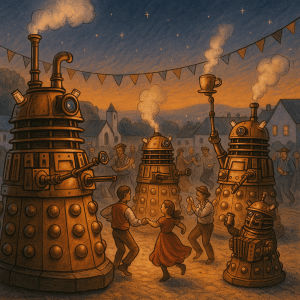
The Steampunk Daleks of Ballykillduff

Prologue: A Strange Copper Glow

On most Tuesdays in Ballykillduff, nothing more dramatic happens than the post landing in the wrong cottage and the weather deciding to be three kinds of rain at once. Mrs. O’Toole hangs out washing and scolds the sky. Old Seamus McGroggan studies his pipe as if it might tell him who ate the last custard cream. And young Mick—ambitious, daft, and acrobatic—tries to cycle backwards down the main street while balancing a loaf on his head. (It is, he insists, “training for the circus.”)

But on this particular Tuesday, at precisely half past eleven, a copper light spread over the village like someone had polished the clouds. The hens went quiet. The sheep froze mid-chew. Father O’Malley paused with the parish bell rope in his hand and whispered, “Saints preserve us.”

Then came the sounds:
HSSSSSS… CLANK-CLONK! WHOOOOMP-TCHAK! TOOT-TOOT!
Gears rattled. Pipes sighed. Something big exhaled steam with the weary dignity of a very old kettle.

Mrs. Byrne put down her shopping basket. “That’ll be the weather packing in for the year,” she said.

“Or the circus,” said Mick hopefully, wobbling.

A shadow rippled across the crossroads. And through the copper-coloured sky, down they came: brass-plated, rivet-studded, monocle-winked, stovepipe-hatted… Daleks.

“Ah,” said Seamus softly to his pipe, “we’re doomed so.”

The first of the strange machines landed with a THOONK that made the turf stacks shiver and the pub sign spin half a turn. Its dome lifted a fraction; a curl of steam puffed out like a sigh of satisfaction.
ATTEND!” wheezed a crisp, Victorian voice through a whistling grille. “THE AGE OF STEAM COMMENCES.

“Will it take cash,” Mrs. Byrne whispered, “or does it run on scones?”

The brass teapot-on-wheels swivelled its monocled eyestalk. “WE REQUIRE… TEA.

“Right,” said Mrs. O’Toole, squaring up. “That we can manage.”

And Ballykillduff held its breath.

Do you want to read more?

Click on the link, below, and enjoy.

Steampunk Daleks


Tags: , , , ,