RSS

Tag Archives: a new alice in wonderland story

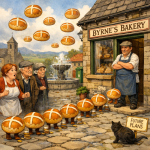
The Day the Hot Cross Buns Refused to Behave.

The Day the Hot Cross Buns Refused to Behave.

The Day the Hot Cross Buns Refused to Behave.

In Ballykillduff, there are certain things one may rely upon.
The post box is green.
The wind comes in sideways.
And on Good Friday, Mrs Flannery’s hot cross buns behave themselves.
Except, of course, for the year they didn’t.
It began, as all respectable disasters do, with a smell.
Not an ordinary smell—no, Ballykillduff had long ago grown accustomed to smells that suggested something mildly supernatural was occurring behind the butcher’s or under the bridge. This was a confident smell. A proud smell. A smell that marched down Main Street like it owned the place.
“Buns,” said Mr Byrne, the baker, stepping outside his shop and sniffing the air with professional concern. “Hot cross buns. And not mine.”
This was troubling. Mr Byrne’s buns were the official buns of Ballykillduff, having won the Annual Bun-Related Excellence Award three years running (and once by default when no one else remembered to bake any).
Mrs Flannery emerged from her shop just as the smell intensified.
“Do you smell that?” she asked.
“I do,” said Mr Byrne. “And I don’t like the tone of it.”
They followed the scent to the village square, where a small crowd had gathered around the fountain—the one that occasionally remembered things it hadn’t seen yet.
At first, no one spoke.
Then Jimmy McGroggan (who distrusted anything that rose, floated, or behaved optimistically) pointed upward.
“There,” he said. “Look.”
Hovering just above the fountain were buns.
Hot cross buns.
Not one or two, mind you—but dozens. They bobbed gently in the air like well-behaved balloons, each one perfectly golden, each one marked with a neat white cross, and each one—most suspiciously—steaming.
“Well,” said Mrs Flannery after a long pause. “That’s new.”
At precisely nine o’clock, the buns began to descend.
Now, in most villages, this would have caused panic. Screaming. Possibly the ringing of a bell.
In Ballykillduff, however, people simply stepped back slightly and allowed events to continue, as they generally did.
The buns landed neatly on the paving stones in a tidy arrangement that suggested either great intelligence or an alarming degree of organisation.
Then one of them bounced.
Just once.
A soft, polite bounce.
“Did you see that?” whispered someone.
Another bun rolled forward slightly, as if clearing its throat.
Then—quite without warning—the entire collection began to move.
They did not scatter.
That would have been understandable.
Instead, they arranged themselves into a queue.
A perfectly straight queue.
Facing Mr Byrne’s bakery.
Mr Byrne stared at them.
“I refuse,” he said firmly, “to be queued at by baked goods.”
The buns waited.
There was no pushing, no jostling, no attempt to skip ahead. If anything, they were more polite than the average Ballykillduff resident on a busy morning.
After a moment, the front bun gave a small hop forward and tapped—very gently—against the bakery door.
Tap.
Silence.
Tap tap.
Mr Byrne folded his arms.
“I’m not serving them,” he said.
“You might have to,” said Mrs Flannery. “They seem committed.”
The situation escalated when the buns began producing exact change.
No one saw where the coins came from.
They simply… appeared. Small, neat piles of coins sat beside each bun, as if they had always been there and everyone had just been too distracted to notice.
Jimmy McGroggan crouched down and examined one.
“Well,” he muttered, “at least they’re paying customers.”
Reluctantly, Mr Byrne opened the door.
The buns shuffled forward.
One by one, they entered the shop.
What followed has since been described (in the official village minutes) as “a most peculiar but orderly transaction.”
Each bun approached the counter.
Paused.
Then nudged its coins forward.
Mr Byrne, after a long internal debate about the collapse of reality, handed each bun… another bun.
“No refunds,” he added automatically.
The buns accepted this.
They turned.
And left.
By mid-morning, Ballykillduff had a new problem.
There were now twice as many buns.
Because each bun had purchased a bun.
And those buns, it appeared, were just as capable of independent thought as the original batch.
“They’re multiplying,” said Mrs Flannery.
“They’re investing,” corrected Jimmy.
By noon, the buns had formed committees.
There was a Bun for Queue Management.
A Bun for Fair Distribution.
And, somewhat ominously, a Bun for Future Planning.
The village grew uneasy.
It is one thing for buns to bounce.
It is quite another for them to organise.
The crisis reached its peak at half past two, when the buns held a meeting in the square.
Mr Byrne, Mrs Flannery, Jimmy McGroggan, and several concerned residents gathered at a safe and respectful distance.
The Bun for Future Planning rolled to the front.
It cleared its… crust.
Then, with great dignity, it tipped itself slightly forward.
And stopped.
Nothing happened.
“Is that it?” asked someone.
“I think so,” said Mr Byrne.
They waited.
The buns remained perfectly still.
Then, slowly—very slowly—the steam began to fade.
The warmth softened.
The bounce diminished.
And, one by one, the buns simply… became buns.
Ordinary buns.
Still. Quiet. Entirely uninterested in commerce or governance.
By evening, Ballykillduff had returned to normal.
Mostly.
Mr Byrne gathered the remaining buns and placed them carefully on a tray.
“Well,” he said, “they seem harmless now.”
“Are you going to sell them?” asked Mrs Flannery.
Mr Byrne paused.
He considered the events of the day.
The queues.
The coins.
The committees.
The brief but undeniable sense that he had been professionally outperformed by his own product.
“No,” he said firmly. “These are not for sale.”
“What will you do with them?”
Mr Byrne looked out at the village square, where everything was once again behaving in a reasonably predictable manner.
“I think,” he said slowly, “we shall eat them… quietly… and not discuss this ever again.”
And that is precisely what Ballykillduff did.
Except, of course, for one small detail.
The next morning, when Mr Byrne opened the bakery door, he found—neatly arranged on the counter—
A single coin.
And beside it…
One perfectly warm, very fresh hot cross bun.
Waiting its turn.
*************************************************************
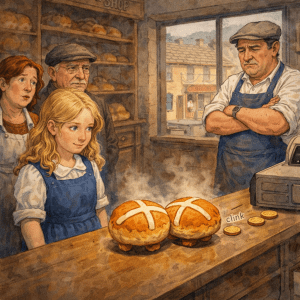
Epilogue — The Bun That Waited
The following morning in Ballykillduff arrived with its usual sense of mild uncertainty.
The post box was green (as expected).
The wind was sideways (as required).
And Mr Byrne opened his bakery door with the careful expression of a man who had been professionally challenged by baked goods and was not eager for a rematch.
There, upon the counter, sat the bun.
Neat. Warm. Patient.
And beside it—
A single coin.
Mr Byrne stared at it for a long time.
“Well,” he said at last, “we are not doing this again.”
“Doing what?” came a voice behind him.
He turned.
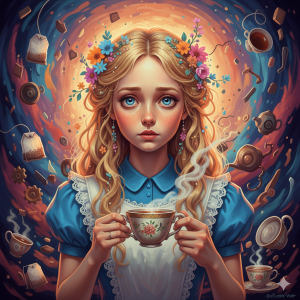
Standing in the doorway, brushing a stray lock of long blonde hair from her face, was a girl in a blue pinafore dress, looking at the bun with great interest.
“I’m fairly certain,” she said, stepping inside, “that this is the sort of thing one ought to investigate.”
Mr Byrne narrowed his eyes.
“You’re not from here.”
“No,” said Alice pleasantly. “But I do seem to arrive in places just as they begin to behave oddly. Or perhaps I arrive because they already have.”
She leaned closer to the bun.
It did not move.
But it did seem, in a way that was difficult to prove, to be waiting.
“For what?” asked Mr Byrne.
Alice considered this.
“For its turn,” she said.
“That’s what I was afraid of.”
Mrs Flannery appeared moments later, followed by Jimmy McGroggan, who had come prepared for disappointment and, if necessary, mild outrage.
“What’s the situation?” Jimmy asked.
Mr Byrne pointed.
“The situation,” he said, “is that we have a bun. A coin. And a sense of unfinished business.”
Jimmy squinted.
“It looks quiet enough.”
Alice smiled.
“Oh, things often do—right up until they aren’t.”
There was a pause.
The kind of pause Ballykillduff understood well.
A pause in which something might happen… or might decide not to… or might wait just long enough to be inconvenient.
Then, very gently—
The bun gave a small bounce.
Just once.
Jimmy stepped back.
“I knew it,” he said. “Optimism.”
The coin slid forward by the smallest imaginable distance.
Clink.
Mr Byrne closed his eyes.
“No committees,” he muttered. “No queues. No financial independence.”
Alice, however, looked delighted.
“Oh, I don’t think it wants all that again,” she said. “I think it only wants to see what happens next.”
“And what does happen next?” asked Mrs Flannery.
Alice straightened.
She looked at the bun.
Then at the coin.
Then at Mr Byrne.
“Well,” she said, very gently, “it’s paid.”
Mr Byrne hesitated.
He glanced at the shelves.
At the ovens.
At the quiet, perfectly ordinary buns that had returned to their proper, non-ambitious state.
Then he sighed.
“All right,” he said. “But just the once.”
He reached behind the counter and picked up a fresh hot cross bun.
He placed it carefully in front of the waiting one.
“There,” he said. “Transaction complete.”
The bun did not move immediately.
It seemed to consider the moment.
Then—
It nudged the new bun slightly.
As if acknowledging it.
As if passing something on.
And then—
It settled.
Perfectly still.
Entirely ordinary.
Alice watched this with great satisfaction.
“You see?” she said.
“No,” said Jimmy. “I don’t.”
“It didn’t want to multiply,” Alice explained. “It didn’t want to organise. It didn’t even want to queue.”
“What did it want, then?” asked Mrs Flannery.
Alice smiled.
“To finish.”
There was a quietness in the bakery then.
A soft, settled sort of quiet.
The kind that comes after something has made up its mind to stop being peculiar.
Mr Byrne looked at the two buns.
Then, cautiously, he picked one up.
It behaved.
He took a bite.
It was excellent.
“Well,” he said after a moment, “that’s that, then.”
Alice stepped back toward the door.
“Will you be staying?” asked Mrs Flannery.
Alice shook her head.
“No, I think not. Things seem to be concluding here.”
She paused.
Then added, with a thoughtful look toward the counter—
“Though one never knows when something might decide it hasn’t quite finished after all.”
Jimmy groaned.
“Don’t say that.”
And with that, Alice stepped out into Ballykillduff.
The wind caught her hair.
The village carried on.
And inside the bakery, everything remained exactly as it ought to be.
Except—
If you looked very closely—
You might notice, tucked just behind the till—
A second coin.
Waiting.
Not impatiently.
Just… patiently enough.
 

Tags: , , , , ,

Alice and the Catastrophe of Sensible Behaviour

Alice and the Catastrophe of Sensible Behaviour

Alice and the Catastrophe of Sensible Behaviour

Alice had only just sat down beneath a perfectly unreasonable tree (which insisted it was a hatstand on alternate Tuesdays) when something most alarming occurred.

Nothing.

Absolutely nothing.

For nearly three seconds.

Alice leapt to her feet at once.

“This will never do,” she said. “If things begin making sense, Wonderland may collapse into a pamphlet.”

At this, the tree-hatstand shuddered and dropped three teaspoons, a cucumber, and a mildly offended pigeon.

“Too late,” said the pigeon. “I’ve been logical all morning.”

Alice gasped. “How dreadful! We must find the source of it before everything becomes tidy.”


She had not gone ten steps before encountering the White Rabbit, who was standing very still and consulting a watch that ticked in complete agreement with itself.

“No contradictions,” he murmured happily. “No paradoxes. Everything precisely where it ought to be!”

Alice seized him by the ears (politely).

“This is an emergency,” she said. “Your watch is behaving.”

The Rabbit blinked. “Well yes, that is generally the point of—”

“Exactly!” cried Alice. “Utter disaster!”


They hurried along a path that refused to twist (which Alice found extremely suspicious) until they reached the Mad Hatter, who was sitting at a table drinking tea in a perfectly ordinary manner.

He lifted his cup.

He sipped.

He put it down again.

Alice staggered backward.

“Hatter,” she whispered, “have you lost your mind?”

“No,” said the Hatter calmly. “I tidied it.”

“You tidied it?”

“Yes. Alphabetised my thoughts. Removed all unnecessary nonsense. Very freeing.”

At this, a teacup fainted.

Alice turned to the March Hare, who was sitting beside him reading a book titled Reasonable Behaviour and Its Consequences.

“Do something absurd at once!” Alice demanded.

The Hare adjusted his spectacles. “I would prefer not to.”

Alice clutched her head. “We are doomed.”


Just then, the sky folded itself into thirds (as skies do when they are worried) and the Cheshire Cat appeared, though only his eyebrows had arrived on time.

“Well,” said the eyebrows, “this looks serious.”

“The nonsense is disappearing!” Alice cried. “Everything is becoming sensible!”

The rest of the Cat slowly assembled itself, piece by deliberate piece.

“How unfortunate,” he said. “Without nonsense, I shall have to make points.”

Everyone shuddered.


They made their way to the Queen of Hearts, who was sitting upon her throne conducting a very calm and well-reasoned discussion about garden maintenance.

“No executions today,” she was saying. “Let us consider everyone’s perspective.”

Alice burst into tears.

“Your Majesty!” she cried. “You must do something unreasonable at once!”

The Queen frowned. “Why?”

“Because if you don’t, Wonderland will become… normal!”

A silence fell.

Even the cards stopped shuffling themselves.

Normal.

The word echoed about like a well-behaved echo.


At last, a small voice spoke.

It was the Dormouse, who had been asleep for so long that he had forgotten how to wake up properly.

“Perhaps,” he said, “we have simply run out of nonsense.”

“Impossible!” cried Alice.

“Not at all,” said the Cheshire Cat. “Nonsense must be replenished. It does not grow on trees—”

The tree-hatstand coughed politely.

“—well, not reliably.”


Alice thought very hard.

Then, quite suddenly, she stood upon the Queen’s throne, balanced a teapot upon her head, declared herself to be “The Duchess of Unfinished Sandwiches,” and began reciting the multiplication table backwards in rhymes involving bananas.

The effect was immediate.

The sky unfolded itself with a snap.

The Hatter dropped his teacup and began arguing with it.

The Rabbit’s watch started running sideways.

The Queen leapt to her feet.

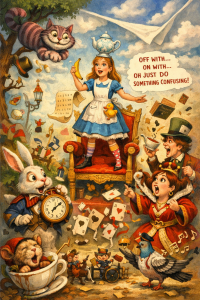
“OFF WITH—no, wait—ON WITH—no—OH JUST DO SOMETHING CONFUSING!”

The cards burst into delighted chaos.

The March Hare threw his book into a passing metaphor.

And the pigeon applauded so enthusiastically it became a small orchestra.


The Cheshire Cat grinned.

“Ah,” he said. “Balance restored.”

Alice climbed down, slightly out of breath.

“That was close,” she said.

“Yes,” said the Cat. “Another minute of sense and we might all have become useful.”

Alice shuddered.

“I should hate that.”


And so, with nonsense safely reinstated, Wonderland returned to its usual state of cheerful confusion.

Which, as Alice later remarked, was exactly as it ought not to be—and therefore, perfectly correct.


Tags: , , ,

Alice and the Jellyfish That Preferred Dice.

Alice and the Jellyfish That Preferred Dice.

****************************************
Chapter One
It began, as many things in Ballykillduff do, with something that ought not to have been in the square.
Alice noticed it first.
She had been sitting on the familiar stone bench—just beneath the trees that whispered opinions when the wind was in the mood—when something softly plopped onto the cobbles.
Not a loud plop.
Not even a particularly confident one.
More of a polite uncertainty of a plop.
Alice turned.
There, beside the green post box (which was behaving itself for once), lay a jellyfish.
Now, this would have been surprising enough.
But what made it considerably worse was that the jellyfish was:
  • Nowhere near the sea
  • Glowing faintly like a lantern that had forgotten its purpose
  • Holding a pair of dice
Not near dice.
Not next to dice.
Holding them.
With a sort of thoughtful wobble.
“Good morning,” said Alice, because it seemed the sort of thing one ought to say to a landlocked philosophical jellyfish.
The jellyfish pulsed gently.
“Statistically unlikely,” it replied.
Alice blinked.
“I beg your pardon?”
“Your greeting,” said the jellyfish, rotating slightly as though considering her from several emotional angles. “Given the conditions, it is improbable that this is a good morning.”
Alice considered this.
“Yes,” she said. “But it’s the sort of thing one says anyway.”
“Ah,” said the jellyfish. “A customary inaccuracy. I approve.”
By now, Ballykillduff had begun to notice.
Seamus appeared first, carrying a cup of tea that he had no intention of spilling, despite the circumstances.
Behind him came Mrs Kavanagh, who believed firmly that anything unusual could be improved with a shawl.
Jimmy McGroggan arrived shortly after, already building something with springs.
“What have we got?” said Seamus.
“A jellyfish,” said Alice.
“Inland,” said Seamus.
“With dice,” added Alice.
Seamus nodded.
“Right so.”
The jellyfish raised its dice.
“These,” it said, “are unsatisfactory.”
“Why?” asked Alice.
“They behave too predictably.”
Alice stared.
“I thought dice were supposed to be unpredictable.”
The jellyfish gave a soft, luminous sigh.
“They are random, not interesting.”
This caused Jimmy McGroggan to drop three springs and pick them up again in a different order.
“That,” he said, “is a very important distinction.”
The jellyfish rolled the dice.
They landed on the cobbles.
Six and two.
“Observe,” said the jellyfish. “An outcome. Entirely reasonable. Entirely dull.”
It rolled again.
Three and four.
“Still dull.”
Again.
Five and one.
“Endlessly obedient to expectation.”
Alice crouched beside it.
“What would you prefer them to do?”
The jellyfish paused.
Then, quite carefully, it said:
“I would like them to refuse.”
This caused a silence.
Even Ballykillduff, which had seen rivers forget their destinations and weather pause for reflection, took a moment.
“Refuse what?” asked Alice.
“To be numbers,” said the jellyfish simply.
Jimmy McGroggan’s eyes lit up in a way that suggested future complications.
“I might have something for that,” he said.
From a pocket that was definitely not large enough, he produced a small contraption consisting of:
  • A clock face with no hands
  • A teaspoon that pointed accusingly
  • A tiny bell that rang when ignored
He attached it—very gently—to one of the dice.
“Now,” said Jimmy, stepping back, “roll it.”
The jellyfish rolled the altered die.
It landed.
Paused.
Then… instead of showing a number…
It displayed:
“Perhaps.”
The entire square leaned closer.
The jellyfish trembled with delight.
“Yes,” it whispered. “Yes, that is better.”
They rolled again.
The second die—untouched—showed a five.
The altered one now read:
“Ask Again Later.”
Mrs Kavanagh sat down.
“I don’t like it,” she said, though she clearly did.
Seamus sipped his tea.
“I do,” he said. “It’s honest.”
Alice smiled.
“But what happens when both dice refuse?” she asked.
The jellyfish considered this very seriously.
Then it rolled them both.
They landed together.
For a moment, nothing happened.
Then—
The first die read:
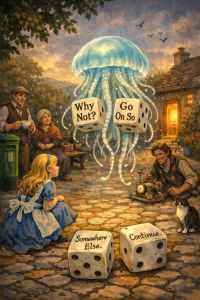
“Why Not?”
The second read:
“Go On So.”
At this, something quite extraordinary occurred.
The air in Ballykillduff shifted.
Not dramatically.
Not loudly.
But decisively.
Somewhere, a decision that had been waiting for years quietly made itself.
A door that had never opened… did.
A letter that had never been sent… found its way.
And Jimmy McGroggan’s unfinished invention… finished itself, just to see how it felt.
The jellyfish glowed brighter.
“This,” it said softly, “is a much more interesting universe.”
Alice nodded.
“Yes,” she said. “It does seem to have improved slightly.”
“Will you stay?” she asked.
The jellyfish floated a little higher, its edges shimmering like thought itself.
“No,” it said. “I drift.”
“Where to?”
The jellyfish rolled its dice one final time.
They landed.
Together.
Gently.
They read:
“Somewhere Else.”
And with that—
It lifted into the air.
Not quickly.
Not dramatically.
Just enough.
And then, like a thought one almost remembers…
It was gone.
Alice looked down at the cobbles.
The dice remained.
She picked them up.
Turned them in her hands.
Rolled them once.
They landed at her feet.
They read:
“Continue.”
Alice smiled.
And in Ballykillduff—
that was quite enough to begin another story.
 

Tags: , ,

The Day the Frost Blinked

The Day the Frost Blinked

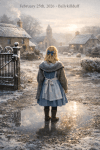
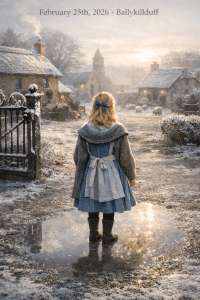
February 25th, 2026 — The Day the Frost Blinked

The frost arrived late.

It did not settle in the night as frost properly should, but wandered into Ballykillduff sometime after breakfast, looking faintly apologetic and extremely decorative.

Alice noticed it first on the gate.

At precisely eleven minutes past ten, the iron latch glittered.

At twelve minutes past ten, it stopped.

At thirteen minutes past ten, it glittered again.

“It’s blinking,” Alice said calmly, which is the sort of thing one must say calmly if one wishes to be believed.

The frost had begun appearing and disappearing in polite intervals — hedge, path, rooftop, sheep — as though winter were reconsidering its position.

Alice stepped into the square. Each time the frost shimmered into existence, the air grew crisp and silver; each time it vanished, the village returned to its damp February self.

“Make up your mind,” she advised the sky.

The sky, which had been undecided all month, hesitated once more — and then, with a soft sigh, allowed the frost to remain.

Not thick.

Not harsh.

Just enough to turn the puddles into mirrors.

Alice looked down and saw not her reflection, but a faint suggestion of spring standing just behind her shoulder.

“Ah,” she said.

The frost did not blink again.

And somewhere beneath the quiet silver crust of February 25th, something green made up its mind to begin.

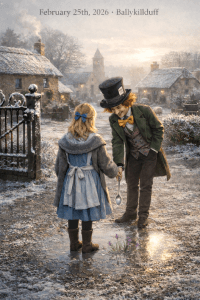
February 25th, 2026 — The Hat That Refused to Thaw

The frost had only just decided to behave itself in Ballykillduff when the sky coughed politely and produced a hat.

Not a rabbit.
Not a teacup.
Just a hat.

It fell with dignity, landed upright in the square, and waited.

Alice, who had already negotiated with blinking frost that morning, approached it cautiously.

The hat cleared its throat.

A moment later, the Mad Hatter unfolded himself out of it as though he had merely been stored there for convenience.

“Good morning!” he cried. “I’ve come for the Thawing!”

“We are not thawing,” Alice said firmly. “We are gently transitioning.”

“Ah,” said the Hatter, peering at the frost. “A hesitant season. Very dangerous. They tend to wobble.”

He removed a small silver teaspoon from his sleeve and began tapping the frost on the cobbles.

Ping.

A patch melted.

Ping.

A daisy appeared.

Ping.

A sheep sneezed and turned very briefly pink.

Alice caught his wrist before he could strike again.

“We’ve only just persuaded February to sit still,” she said. “If you start stirring it, we shall have daffodils arguing with snowflakes.”

The Hatter considered this gravely.

“Yes,” he agreed. “They never agree on colours.”

He placed the spoon back into his sleeve, stamped his hat once (which caused three crocuses to pop up apologetically), and looked at Alice with unusual sincerity.

“Very well. No mischief. Only observation.”

They stood together in the soft silver light, watching the frost hold its breath and spring wait its turn.

After several whole minutes of remarkable good behaviour, the Hatter leaned closer.

“Between ourselves,” he whispered, “March is terribly impatient.”

Then he folded neatly back into his hat.

The hat tipped itself.

And vanished.

The frost did not blink.

But somewhere beneath the cobbles, something giggled.


Tags: , , , ,

Alice on Top of the World

Alice on Top of the World

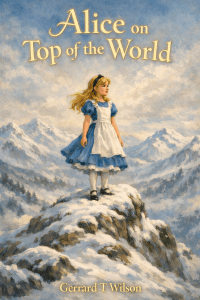
Alice discovered quite by accident that the world has a top.

Most people, she had noticed, were too busy walking around it to check.

It wasn’t marked by a flag or a signpost—nothing as sensible as that. Instead, it felt like a place the world itself had agreed upon in a moment of quiet pride. When Alice stepped there, the ground did not wobble or roll away. It simply paused, as though holding its breath.

Below her, the Earth unfolded in bright, broken shapes: seas made of blue ideas, continents stitched together with yellows and greens, clouds cut into careful pieces like a puzzle no one had finished. The sun shone from one side and the moon from the other, neither arguing about whose turn it was.

Alice put her hands on her hips—not because she felt particularly brave, but because it seemed like the correct posture for standing somewhere important.

She waited for something dramatic to happen.

Nothing did.

“Well,” she said to the air, which was listening, “that’s rather the point, isn’t it?”

From up here, worries shrank into polite little shapes. Arguments lost their sharp edges. Even time—dangling somewhere nearby with its pocket watch—seemed unsure whether to tick forward or simply admire the view.

Alice realised then that being on top of the world did not mean ruling it, or shouting instructions down at it. It meant seeing how all the pieces fitted together, even the crooked ones. Especially the crooked ones.

After a while, she stepped down again, because no place likes to be stood upon forever.

But the world remembered.

And from that day on, whenever things felt impossibly large, Alice smiled—quietly—knowing exactly where the top was, and that she had already been there once.


Tags: , , , ,

Alice on Top of the World

The Continuing Adventures of a Girl Named Alice


Tags: , ,

Alice in Wonderland and Beyond

Alice in Wonderland and Beyond

ENJOY


Tags: , ,

Alice in Wonderland

Alice in Wonderland

In realms of whimsy, softly spun,

A maiden drifts beneath a sun

Of petals grand, a blush-pink bloom,

Dispelling shadows, chasing gloom.


Her gown of blue, a gentle wave,

As golden tresses brightly rave

With blooms and beads, a floral crown,

She floats where dreams are upside-down.


Around her dance, in vibrant hue,

White-capped toadstools, fresh with dew.

Bright butterflies with wings so grand,

Flit through this most enchanted land.


And tiny birds, with wings so clear,

Whisper secrets to her ear.

A cosmic swirl, a starry night,

Embraces her in wondrous light.


A world of magic, soft and deep,

Where every fancy she can keep.

With serene gaze, she looks above,

Lost in a dream of endless love.


Tags: , ,

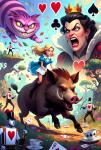
Alice and the Wild Boar of Wonderland

Alice and the Wild Boar of Wonderland

Alice and the Wild Boar of Wonderland:

The Director’s Cut (Now With 300% More Chaos)

Alice had returned to Wonderland for one reason: nostalgia. Big mistake.

The place had gone full corporate dystopia. The White Rabbit was now a crypto bro shilling “CarrotCoin,” the Mad Hatter ran an NFT tea party where every cup was a unique digital collectible worth exactly nothing, and the Queen of Hearts had rebranded as an influencer with the handle @OffWithTheirHeads69.

Worst of all, the Cheshire Cat had launched “GrinR,” Wonderland’s premier ride-sharing app. Slogan: “We vanish when you need us most.”

Alice tapped the app. Destination: Home.

Vehicle arriving: “Kevin the Boar – 4.9 stars (deducted 0.1 for chronic truffle addiction).”

Kevin arrived looking like a warthog that had lost a bet with a taxidermist. He wore a tiny saddle, a Bluetooth earpiece, and an expression that screamed, “I went to boar school for this?”

Alice climbed on. Kevin immediately side-eyed a glowing mushroom.

“Don’t even think about it,” Alice warned.

Kevin thought about it. Hard.

The ride began politely, past teacup gardens, under rainbow toadstools, until Kevin spotted the Holy Grail of truffles: a massive, glistening beauty sprouting right in the middle of the Queen’s private croquet lawn.

Kevin floored it.

“KEVIN, NO!” Alice screamed, clutching his mane as they bulldozed through a hedge maze like it was made of tissue paper.

Card soldiers dove left and right. One guard yelled, “License and registration!” only to be flattened into the shape of the two of clubs.

They skidded onto the croquet field just as the Queen was about to execute a flamingo for “unsportsmanlike squawking.”

Kevin launched himself at the truffle like a furry missile, uprooted it, and inhaled it in one obscene slurp. Then he let out a belch so powerful it parted the Queen’s wig, revealing a tattoo that read “Live, Laugh, Lob.”

The entire court froze.

The Queen’s face turned the color of a ripe tomato having a stroke.

“OFF WITH HIS TROTTERS!” she shrieked.

Alice, panicking, did the only thing she could think of: she pulled out her phone and fake-reviewed on the spot.

“Your Majesty, please! Kevin has 4.9 stars! He’s verified! He accepts tips in acorns!”

The Queen paused, mallet raised. “Reviews?”

Alice nodded frantically. “Read them yourself! ‘Best ride ever, 10/10 would be stampeded again.’ ‘Kevin took a shortcut through a caterpillar’s hookah lounge, legendary.’ ‘Only complaint: he ate my picnic.’”

Kevin, sensing an opportunity, turned on the charm. He sat. He gave paw. He even attempted a smile, which looked like a constipated bulldog discovering taxes.

The Queen lowered her mallet. “Fine. But he’s banned from my lawn. And someone get this pig a breath mint.”

As they trotted away, the Cheshire Cat materialized on Kevin’s head like a smug helmet.

“Not bad for a rookie driver,” he purred. “Next fare’s the Dormouse, he tips in half-eaten crumpets.”

Alice groaned. “Just get me out of here.”

Kevin suddenly braked. In the path ahead: a single, perfect truffle.

Alice glared. “Kevin. I swear to Lewis Carroll.”

Kevin looked back at her with big, innocent eyes.

Then he winked.

And floored it again.

Somewhere in the distance, the Queen’s scream echoed: “OFF WITH ALL OF THEM!”

Alice clung on for dear life, laughing in spite of herself.

Wonderland, it seemed, was exactly as mad as ever, just with worse customer service.


Tags: , , , ,

Alice and the Places That Think: Ballykillduff Wonderland

Alice and the Places That Think: Ballykillduff Wonderland

Prologue

Alice decided later that the most troubling part was not the sheep.

The sheep was troubling, certainly. It stood in the middle of the lane with the quiet confidence of something that knew it had always been there and always would be. Its wool was the colour of old clouds, its eyes were thoughtful, and around its neck hung a small wooden sign that read:

BACK SOON

Alice read it twice.

“I don’t think that’s how sheep work,” she said politely.

The sheep regarded her in silence, chewing in a manner that suggested deep consideration of the matter. Then it turned, quite deliberately, and began to walk away down the lane.

“Excuse me,” Alice called. “I think you’ve dropped your…”

The sheep did not stop.

Alice hesitated. She had been taught very firmly never to follow strange animals, especially those displaying written notices. But the lane itself seemed to lean after the sheep, curving gently, as if it preferred that direction. Even the hedges appeared to listen.

With a sigh that felt far older than she was, Alice followed.

The lane led her into Ballykillduff.

At least, that was what the sign said. It stood crookedly at the edge of the village, its letters faded and patched over, as though someone had changed their mind halfway through spelling it. Beneath the name, in much smaller writing, was a second line:

Population: Yes

Alice frowned.

The village looked entirely ordinary, which in her experience was often a bad sign. Stone cottages huddled together as if exchanging secrets. A postbox leaned sideways in what might have been exhaustion. Somewhere, a clock was ticking very loudly and very wrongly.

The sheep paused beside the postbox.

It did not look back. It did not need to.

The postbox cleared its throat.

“Letter?” it asked.

Alice jumped.

“I—no,” she said. “I mean, not yet.”

“Take your time,” said the postbox kindly. “We’ve plenty of it. Too much, if you ask me. It keeps piling up.”

The sheep nodded.

“I’m sorry,” Alice said carefully, “but could you tell me where I am?”

The postbox considered this. “Well now,” it said, “that depends. Where do you think you ought to be?”

“I don’t know,” Alice admitted.

“Ah,” said the postbox, sounding relieved. “Then you’re exactly right.”

The sheep turned at last and met Alice’s eyes. For a moment she had the strange feeling that it recognised her.

Then the ground beneath her boots gave a polite little sigh and began to sink.

Alice did not scream. She had learned by now that screaming rarely helped.

Instead, as Ballykillduff folded itself carefully over her like a story closing its covers, she wondered whether anyone at home would notice she was gone.

The sheep watched until she vanished completely.

Then it picked up its sign, turned it around, and hung it back around its neck.

BACK AGAIN.


Chapter One

In Which Alice Arrives Properly, Though Not Entirely on Purpose

Alice discovered that falling into Ballykillduff was not at all like falling into a hole.

There was no rushing wind, no spinning cupboards, no floating bookshelves or jars of marmalade. Instead, there was the distinct sensation of being lowered, as though the ground itself were doing its best to be polite about the whole affair.

The earth sighed again, thoughtfully, and then stopped.

Alice found herself standing upright on a narrow stone path, her boots perfectly clean, her hair only slightly rumpled, and her sense of direction completely missing.

Above her was a sky that could not quite decide what time it was. Clouds hovered in pale layers, some tinged with early morning pink, others sulking in late afternoon grey. A sun of modest ambition shone through the middle, as if unwilling to commit itself fully.

Ahead lay Ballykillduff.

Up close, it was even more ordinary than before. That, Alice felt, was the problem.

A row of cottages leaned together in a way that suggested ongoing conversation. Their windows blinked slowly, like eyes that had just woken up. Smoke curled from chimneys without any particular urgency, drifting sideways and then upwards as though reconsidering.

Alice took one careful step forward.

Nothing happened.

She took another.

Still nothing.

“Well,” she said to herself, “that is either very reassuring or extremely suspicious.”

A man appeared from nowhere in particular, which is to say he stepped out from behind a low stone wall that Alice was quite certain had not been there a moment earlier.

He was tall, thin, and wrapped in a long coat that had known many weathers and disagreed with all of them. In his hand he carried a pocket watch, which he examined with great seriousness.

He did not look at Alice.

“Oh dear,” he muttered. “Not yet. Definitely not yet.”

“Excuse me,” Alice said.

The man startled so badly that he nearly dropped the watch, which he caught just in time and then scolded.

“You shouldn’t do that,” he said to Alice. “Appearing suddenly.”

“I didn’t,” Alice replied. “You did.”

He considered this.

“Well,” he said at last, “we’ll call it a draw.”

He finally looked at her, his eyes sharp and kind and far too alert for someone who seemed permanently behind schedule.

“You’re early,” he said.

“Am I?” Alice asked.

“Oh yes,” he said firmly. “Or late. One of the two. We get very upset if people arrive exactly when they mean to.”

“What is your name?” Alice asked.

“Seamus Fitzgerald,” he said, consulting his watch again. “At least, that’s what it says here. And you are Alice.”

Alice blinked. “How do you know that?”

Seamus smiled apologetically. “You’ve been expected.”

“I have only just arrived,” Alice said.

“Yes,” Seamus agreed. “That’s what I mean.”

Before Alice could ask anything else, a bell rang.

It was not a loud bell, nor an urgent one. It sounded as though it had rung many times before and had learned not to get worked up about it.

Seamus gasped.

“Oh dear,” he said. “That will be Bridget.”

“Who is Bridget?” Alice asked.

Seamus was already walking away.

“You’ll see,” he said over his shoulder. “Everybody does.”

Alice followed him into the village.

As she did, she noticed that the houses were watching her now, not rudely, but with the quiet interest one might show a guest who had arrived without luggage and clearly intended to stay.

Somewhere behind her, the sheep coughed.

Alice did not turn around.

She had a feeling that once you began turning around in Ballykillduff, you might never stop.

And that, she suspected, was how the village liked it.

To read the rest of this story, click HERE – and enjoy


Tags: , , ,