An original tale inspired by Lewis Carroll’s
Alice’s Adventures in Wonderland.
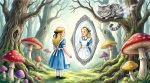
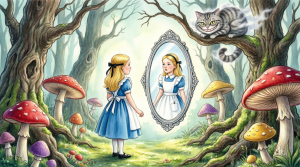
The mirror did not hang on a wall, nor did it rest upon a stand. It floated in the middle of the Tulgey Wood, suspended in the air like a bubble made of silver glass. Alice stopped, adjusting the skirt of her dress. She had been chasing the White Rabbit—or perhaps he had been chasing her; directions were notoriously unreliable in these parts—when she stumbled upon it.
She approached cautiously. She knew better than to touch strange objects without checking for labels reading DRINK ME or DO NOT TOUCH, but the mirror seemed harmless enough. It reflected the wood behind her: the twisted trees, the oversized mushrooms, the path that wound like a confused snake.
But the Alice in the mirror did not stop when Alice stopped.
The reflection stepped forward. There was a sound like a sharp intake of breath, a pop of pressure, and the girl in the glass stepped out of the frame. She landed on the moss with a soft thud, dusting off her hands.
Alice blinked. She rubbed her eyes and blinked again.
The newcomer stood before her. She wore the same blue dress with the same white apron. She had the same golden hair tied with the same black ribbon. But where Alice’s hair was parted on the left, this girl’s was parted on the right. Where Alice’s apron pocket was on her left hip, this girl’s was on the right.
“Good afternoon,” said the double. Her voice was Alice’s, but the cadence was slightly off, like a song played on a piano that had been tuned a fraction too high.
“Good afternoon,” Alice replied, instinctively curtsying. “Or perhaps it is morning. Time is difficult to keep track of here.”
“It is exactly half-past nonsense,” the double said. She did not curtsy. Instead, she tilted her head, examining Alice with a critical eye. “You look terribly confused. It suits you.”
“I am not confused,” Alice said, drawing herself up to her full height (which was currently three feet and two inches). “I am merely… observing. Who are you?”
“I am Alice,” the double said simply.
“No,” Alice countered, feeling a surge of frustration. “I am Alice. You cannot be Alice. There is only one of me. I am quite sure of it.”
“Are you?” The double walked around her, inspecting her from behind. “How do you know? Have you checked your labels? Have you tested your memory? For all you know, you are the reflection, and I am the original.”
Alice felt a cold shiver run down her spine, unrelated to the temperature of the wood. “I remember falling down the rabbit hole. I remember the tea party. I remember the Queen’s croquet ground.”
“I remember those too,” the double said, plucking a flower from a nearby bush. She smelled it and sneezed. “But I remember them differently. In my memory, the Hatter was polite. In my memory, the Queen was kind. In my memory, I never cried in the Pool of Tears.”
Alice stiffened. “I did not cry. Well, only a little. It was a very large pool.”
“You cry when you are frightened,” the double said. “I do not. I find that makes things much easier.”
The Cheshire Cat appeared then, fading in branch by branch upon a bough above them. He grinned his wide, impossible grin.
“Two Alices?” the Cat purred, his tail flicking. “How curious. Usually, one is quite enough to cause trouble. Two might cause a paradox.”
“Which one is real, Cat?” asked the double, looking up.
“Real?” The Cat chuckled. “In this wood, reality is a matter of opinion. You are both real enough to be lost. You are both real enough to be found. It depends on which way you’re walking.”
“I walk forward,” said Alice.
“I walk backward,” said the double. “It saves time on the return journey.”
Alice frowned. “That doesn’t make any sense.”
“It makes perfect sense in the Looking-Glass,” the double said. “I come from the other side of the glass. Where everything is opposite. You are polite; I am blunt. You ask permission; I take ownership. You wonder what the world is; I tell the world what I am.”
Alice looked at her double. She saw the set of her jaw, the confidence in her stance. It was terrifying, but also… intriguing. How nice it would be, Alice thought, to not be afraid of the Queen. To not worry about saying the wrong thing. To simply *be*.
“If you are the opposite,” Alice said slowly, “then you must be everything I am not.”
“Precisely,” said the double. “Which means if we touch, we might cancel each other out. Like adding a number to its negative. Zero.”
“Or,” said the Cat, “you might multiply. Infinity is rather messier than zero.”
A trumpet blast sounded in the distance. The ground trembled slightly.
“The Queen!” Alice gasped, her heart leaping into her throat. “We must hide.”
“Why?” asked the double. “I have done nothing wrong.”
“Let her try,” said the double. She smoothed her apron and stood squarely in the path.
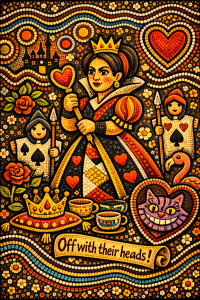
The Queen of Hearts stormed into the clearing, a procession of playing cards trailing behind her. She held a flamingo under her arm and glared at the pair.
“What is this?” the Queen bellowed. “Two of them? Is this a trick? A conspiracy? Why are there two Alices?”
“She is an impostor!” Alice cried, pointing at her double.
“She is a copy!” the double cried, pointing at Alice.
“Silence!” The Queen marched up to them, peering closely at their faces. She grabbed Alice’s chin, then the double’s chin. “Same nose. Same eyes. Same annoying habit of talking back.”
“I do not talk back,” Alice said.
“I talk back,” the double said. “And I enjoy it.”
The Queen grinned, a terrifying expression. “I like this one better. She has spirit. Off with the quiet one’s head!”
The Card soldiers raised their axes. Alice squeezed her eyes shut.
“Wait!” shouted the double.
The Queen paused. “Well? Do you wish to take her place?”
“No,” said the double. “But if you cut off her head, you cut off mine. We are reflections. You cannot have one without the other. If she disappears, I disappear. If I disappear, she disappears. Do you want no Alice at all, Your Majesty?”
The Queen frowned. She tapped her foot. The flamingo squawked. “A riddle. I hate riddles. They ruin the execution schedule.”
“It is not a riddle,” said the double. “It is logic. Even you must follow logic, or the game falls apart.”
The Queen huffed. “Fine. Keep your heads. Both of them. It’s too much trouble to sort out. Move along! All of you!”
The procession marched on, leaving the three of them in the clearing.
Alice opened her eyes. She was still whole. She looked at her double.
“You saved me,” Alice said.
“You saved yourself,” the double corrected. “I am you. My courage is your courage. You just left it behind in the glass.”
The double walked back toward the floating mirror. The surface rippled like water.
“Where are you going?” Alice asked.
“Back,” said the double. “I belong on the other side. But you… you should visit sometime. Bring your courage with you. It fits better here.”
She stepped into the mirror. For a moment, she stood on the other side, waving. Then the silver surface hardened, becoming just a glass pane again. Alice looked into it. She saw only herself.
But when she looked closer, she noticed something. Her hair was still parted on the left. Her pocket was still on the left. But her eyes… her eyes held a new steadiness. The fear was still there, but it was smaller.
“Curiouser and curiouser,” Alice whispered.
The Cheshire Cat faded away, leaving only his grin hanging in the air. “Infinity,” he murmured from nowhere. “Much better than zero.”
Alice turned and walked down the path. She did not check for labels. She did not wonder if she was dreaming. She simply walked forward, knowing that somewhere, in the glass, another Alice was walking backward, and that was perfectly alright.



 The Crazymad Writer Writes Again