RSS

Tag Archives: Alice in Wonderland

The Day the Hot Cross Buns Refused to Behave.

The Day the Hot Cross Buns Refused to Behave.

The Day the Hot Cross Buns Refused to Behave.

In Ballykillduff, there are certain things one may rely upon.
The post box is green.
The wind comes in sideways.
And on Good Friday, Mrs Flannery’s hot cross buns behave themselves.
Except, of course, for the year they didn’t.
It began, as all respectable disasters do, with a smell.
Not an ordinary smell—no, Ballykillduff had long ago grown accustomed to smells that suggested something mildly supernatural was occurring behind the butcher’s or under the bridge. This was a confident smell. A proud smell. A smell that marched down Main Street like it owned the place.
“Buns,” said Mr Byrne, the baker, stepping outside his shop and sniffing the air with professional concern. “Hot cross buns. And not mine.”
This was troubling. Mr Byrne’s buns were the official buns of Ballykillduff, having won the Annual Bun-Related Excellence Award three years running (and once by default when no one else remembered to bake any).
Mrs Flannery emerged from her shop just as the smell intensified.
“Do you smell that?” she asked.
“I do,” said Mr Byrne. “And I don’t like the tone of it.”
They followed the scent to the village square, where a small crowd had gathered around the fountain—the one that occasionally remembered things it hadn’t seen yet.
At first, no one spoke.
Then Jimmy McGroggan (who distrusted anything that rose, floated, or behaved optimistically) pointed upward.
“There,” he said. “Look.”
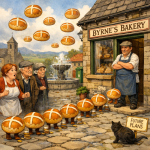
Hovering just above the fountain were buns.
Hot cross buns.
Not one or two, mind you—but dozens. They bobbed gently in the air like well-behaved balloons, each one perfectly golden, each one marked with a neat white cross, and each one—most suspiciously—steaming.
“Well,” said Mrs Flannery after a long pause. “That’s new.”
At precisely nine o’clock, the buns began to descend.
Now, in most villages, this would have caused panic. Screaming. Possibly the ringing of a bell.
In Ballykillduff, however, people simply stepped back slightly and allowed events to continue, as they generally did.
The buns landed neatly on the paving stones in a tidy arrangement that suggested either great intelligence or an alarming degree of organisation.
Then one of them bounced.
Just once.
A soft, polite bounce.
“Did you see that?” whispered someone.
Another bun rolled forward slightly, as if clearing its throat.
Then—quite without warning—the entire collection began to move.
They did not scatter.
That would have been understandable.
Instead, they arranged themselves into a queue.
A perfectly straight queue.
Facing Mr Byrne’s bakery.
Mr Byrne stared at them.
“I refuse,” he said firmly, “to be queued at by baked goods.”
The buns waited.
There was no pushing, no jostling, no attempt to skip ahead. If anything, they were more polite than the average Ballykillduff resident on a busy morning.
After a moment, the front bun gave a small hop forward and tapped—very gently—against the bakery door.
Tap.
Silence.
Tap tap.
Mr Byrne folded his arms.
“I’m not serving them,” he said.
“You might have to,” said Mrs Flannery. “They seem committed.”
The situation escalated when the buns began producing exact change.
No one saw where the coins came from.
They simply… appeared. Small, neat piles of coins sat beside each bun, as if they had always been there and everyone had just been too distracted to notice.
Jimmy McGroggan crouched down and examined one.
“Well,” he muttered, “at least they’re paying customers.”
Reluctantly, Mr Byrne opened the door.
The buns shuffled forward.
One by one, they entered the shop.
What followed has since been described (in the official village minutes) as “a most peculiar but orderly transaction.”
Each bun approached the counter.
Paused.
Then nudged its coins forward.
Mr Byrne, after a long internal debate about the collapse of reality, handed each bun… another bun.
“No refunds,” he added automatically.
The buns accepted this.
They turned.
And left.
By mid-morning, Ballykillduff had a new problem.
There were now twice as many buns.
Because each bun had purchased a bun.
And those buns, it appeared, were just as capable of independent thought as the original batch.
“They’re multiplying,” said Mrs Flannery.
“They’re investing,” corrected Jimmy.
By noon, the buns had formed committees.
There was a Bun for Queue Management.
A Bun for Fair Distribution.
And, somewhat ominously, a Bun for Future Planning.
The village grew uneasy.
It is one thing for buns to bounce.
It is quite another for them to organise.
The crisis reached its peak at half past two, when the buns held a meeting in the square.
Mr Byrne, Mrs Flannery, Jimmy McGroggan, and several concerned residents gathered at a safe and respectful distance.
The Bun for Future Planning rolled to the front.
It cleared its… crust.
Then, with great dignity, it tipped itself slightly forward.
And stopped.
Nothing happened.
“Is that it?” asked someone.
“I think so,” said Mr Byrne.
They waited.
The buns remained perfectly still.
Then, slowly—very slowly—the steam began to fade.
The warmth softened.
The bounce diminished.
And, one by one, the buns simply… became buns.
Ordinary buns.
Still. Quiet. Entirely uninterested in commerce or governance.
By evening, Ballykillduff had returned to normal.
Mostly.
Mr Byrne gathered the remaining buns and placed them carefully on a tray.
“Well,” he said, “they seem harmless now.”
“Are you going to sell them?” asked Mrs Flannery.
Mr Byrne paused.
He considered the events of the day.
The queues.
The coins.
The committees.
The brief but undeniable sense that he had been professionally outperformed by his own product.
“No,” he said firmly. “These are not for sale.”
“What will you do with them?”
Mr Byrne looked out at the village square, where everything was once again behaving in a reasonably predictable manner.
“I think,” he said slowly, “we shall eat them… quietly… and not discuss this ever again.”
And that is precisely what Ballykillduff did.
Except, of course, for one small detail.
The next morning, when Mr Byrne opened the bakery door, he found—neatly arranged on the counter—
A single coin.
And beside it…
One perfectly warm, very fresh hot cross bun.
Waiting its turn.
*************************************************************
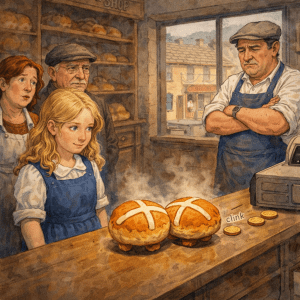
Epilogue — The Bun That Waited
The following morning in Ballykillduff arrived with its usual sense of mild uncertainty.
The post box was green (as expected).
The wind was sideways (as required).
And Mr Byrne opened his bakery door with the careful expression of a man who had been professionally challenged by baked goods and was not eager for a rematch.
There, upon the counter, sat the bun.
Neat. Warm. Patient.
And beside it—
A single coin.
Mr Byrne stared at it for a long time.
“Well,” he said at last, “we are not doing this again.”
“Doing what?” came a voice behind him.
He turned.
Standing in the doorway, brushing a stray lock of long blonde hair from her face, was a girl in a blue pinafore dress, looking at the bun with great interest.
“I’m fairly certain,” she said, stepping inside, “that this is the sort of thing one ought to investigate.”
Mr Byrne narrowed his eyes.
“You’re not from here.”
“No,” said Alice pleasantly. “But I do seem to arrive in places just as they begin to behave oddly. Or perhaps I arrive because they already have.”
She leaned closer to the bun.
It did not move.
But it did seem, in a way that was difficult to prove, to be waiting.
“For what?” asked Mr Byrne.
Alice considered this.
“For its turn,” she said.
“That’s what I was afraid of.”
Mrs Flannery appeared moments later, followed by Jimmy McGroggan, who had come prepared for disappointment and, if necessary, mild outrage.
“What’s the situation?” Jimmy asked.
Mr Byrne pointed.
“The situation,” he said, “is that we have a bun. A coin. And a sense of unfinished business.”
Jimmy squinted.
“It looks quiet enough.”
Alice smiled.
“Oh, things often do—right up until they aren’t.”
There was a pause.
The kind of pause Ballykillduff understood well.
A pause in which something might happen… or might decide not to… or might wait just long enough to be inconvenient.
Then, very gently—
The bun gave a small bounce.
Just once.
Jimmy stepped back.
“I knew it,” he said. “Optimism.”
The coin slid forward by the smallest imaginable distance.
Clink.
Mr Byrne closed his eyes.
“No committees,” he muttered. “No queues. No financial independence.”
Alice, however, looked delighted.
“Oh, I don’t think it wants all that again,” she said. “I think it only wants to see what happens next.”
“And what does happen next?” asked Mrs Flannery.
Alice straightened.
She looked at the bun.
Then at the coin.
Then at Mr Byrne.
“Well,” she said, very gently, “it’s paid.”
Mr Byrne hesitated.
He glanced at the shelves.
At the ovens.
At the quiet, perfectly ordinary buns that had returned to their proper, non-ambitious state.
Then he sighed.
“All right,” he said. “But just the once.”
He reached behind the counter and picked up a fresh hot cross bun.
He placed it carefully in front of the waiting one.
“There,” he said. “Transaction complete.”
The bun did not move immediately.
It seemed to consider the moment.
Then—
It nudged the new bun slightly.
As if acknowledging it.
As if passing something on.
And then—
It settled.
Perfectly still.
Entirely ordinary.
Alice watched this with great satisfaction.
“You see?” she said.
“No,” said Jimmy. “I don’t.”
“It didn’t want to multiply,” Alice explained. “It didn’t want to organise. It didn’t even want to queue.”
“What did it want, then?” asked Mrs Flannery.
Alice smiled.
“To finish.”
There was a quietness in the bakery then.
A soft, settled sort of quiet.
The kind that comes after something has made up its mind to stop being peculiar.
Mr Byrne looked at the two buns.
Then, cautiously, he picked one up.
It behaved.
He took a bite.
It was excellent.
“Well,” he said after a moment, “that’s that, then.”
Alice stepped back toward the door.
“Will you be staying?” asked Mrs Flannery.
Alice shook her head.
“No, I think not. Things seem to be concluding here.”
She paused.
Then added, with a thoughtful look toward the counter—
“Though one never knows when something might decide it hasn’t quite finished after all.”
Jimmy groaned.
“Don’t say that.”
And with that, Alice stepped out into Ballykillduff.
The wind caught her hair.
The village carried on.
And inside the bakery, everything remained exactly as it ought to be.
Except—
If you looked very closely—
You might notice, tucked just behind the till—
A second coin.
Waiting.
Not impatiently.
Just… patiently enough.
 

Tags: , , , , ,

Do Not Enter.

Do Not Enter.

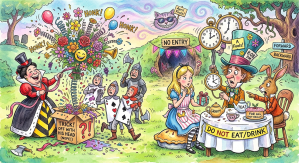
The Rabbit Hole didn’t usually feature a “Do Not Enter” sign, but today it was draped in neon orange bunting.
Alice, never one to let a sign ruin a good tumble, hopped right over it. As she drifted down, she noticed the usual jam jars and bookshelves had been replaced by floating rubber chickens and mirrors that showed her wearing a very tall, purple top hat.
“Curiouser and curiouser,” she remarked, reaching out to touch a chicken. It let out a loud honk that propelled her downward at twice the speed.
The Un-April Tea Party
When Alice finally landed—not on a heap of sticks and leaves, but on a giant custard pie—she found the March Hare and the Mad Hatter sitting at a table shaped like a question mark.
“No room! No room!” the Hatter shouted, while gesturing wildly to three dozen empty chairs.
“There’s plenty of room,” Alice said, wiping a dollop of lemon curd from her pinafore. She sat down and reached for a teapot.
The March Hare leaned in, his whiskers twitching. “I wouldn’t do that if I were you. It’s April First, you know. The day when the logic of Wonderland actually tries to make sense.”
Alice paused. “Make sense? But that sounds lovely.”
“It’s a nightmare!” the Hatter wailed. He picked up his pocket watch. “Look! It’s actually telling the time! It says it’s eight minutes past two. How am I supposed to live under such rigid conditions?”
The Queen’s “Mercy”
A bugle sounded, and the Queen of Hearts marched onto the lawn. Her guards, the playing cards, were all walking backward.
“Off with their heads!” the Queen bellowed.
Alice braced herself, but the Queen suddenly doubled over in a fit of giggles. She pulled a silk string, and instead of an executioner’s axe, a giant bouquet of trick-flowers popped out of the ground, spraying the crowd with sparkling grape juice.
“April Fools!” the Queen shrieked, slapping her knee. “I’m not beheading anyone today. Instead, I’m sentencing you all to… a very sensible nap!
The cards groaned. A sensible nap was the most boring thing a Wonderland resident could imagine.
The Cheshire Grin
Alice felt a familiar tickle of whiskers against her ear. The Cheshire Cat appeared, or rather, his stripes appeared first, followed by a pair of sunglasses.
“Why the long face, Alice?” the Cat purred. “Don’t you like the holiday?”
“It’s all very confusing,” Alice sighed. “If the Queen is being nice, and the Hatter is being punctual, then who is being silly?”
The Cat’s grin grew until it took up half the sky. “You are, of course. You came to a world of nonsense looking for a bit of order, and you found it on the one day we don’t want it.”
He handed her a small, wrapped gift. “Open it.”
Alice carefully untied the ribbon. Inside was a small mirror. When she looked into it, her reflection didn’t look like her at all—it was a white rabbit, looking at its watch and muttering about being late.
“April Fools,” the reflection whispered.
Alice blinked, and suddenly the tea party, the Queen, and the Cat vanished. She was back on the grassy bank, her sister shaking her shoulder.
“Wake up, Alice! You’ve been dreaming.”
Alice sat up, rubbing her eyes. She reached into her pocket and felt something cold and hard. She pulled it out: a tiny, silver whistle shaped like a rubber chicken.
She looked at her sister and smiled. “I think the joke’s on me.”
 

Tags: , ,

The Day the Postbox Refused Certain Letters

The Day the Postbox Refused Certain Letters

The Day the Postbox Refused Certain Letters

In Ballykillduff, the postbox had always been green, dependable, and mildly overlooked.

It stood beside the village square, not far from the fountain that sometimes remembered things before they happened, and within polite nodding distance of Mrs Flannery’s shop, where news was sold in equal measure with bread.

No one had ever thought much about the postbox.

Until the morning it began to think about them.


It started, as such things often do, with a small and easily dismissed inconvenience.

Mrs Flannery approached with a letter held between two fingers, as though it might yet change its mind.

“I’ve written to my sister,” she said aloud, because she often did that. “Perfectly reasonable. Perfectly timely.”

She slid the letter into the slot.

The postbox accepted it.

Then paused.

Then, with a quiet and distinctly deliberate motion…

returned it.

The envelope slipped back out, as neat as you please, and landed against her shoe.

Mrs Flannery frowned.

“Well now,” she said. “That’s… unnecessary.”

She tried again.

The postbox tried again.

The result was identical.


By mid-morning, the matter had gathered an audience.

Mr Hanrahan, who dealt in railway timings and therefore trusted systems, posted a form.

The postbox accepted it instantly.

“Functional,” he declared, with satisfaction.

A child posted a drawing of a duck wearing a hat.

The postbox hummed, a soft, approving sound, and swallowed it whole.

“Encouraging,” said Mrs Flannery, who was still holding her letter.


It was Mr Byrne the baker who noticed the sign.

“Ah now,” he said, squinting. “That wasn’t there yesterday.”

There, affixed just beneath the slot, in careful, looping handwriting, was a notice.

NO LETTERS OF REGRET
NO APOLOGIES WRITTEN TOO LATE
NO MESSAGES YOU SHOULD HAVE SAID YEARS AGO

The square fell into a thoughtful sort of silence.

“Well that’s ridiculous,” said Mrs Flannery.

And yet… she did not try to post the letter again.


By afternoon, the situation had worsened in a most peculiar way.

Letters that had been refused did not simply go home.

They lingered.

They gathered.

They rested against the base of the postbox, or perched along the fountain’s edge, or leaned thoughtfully against the green-painted bench.

And when the evening came…

they began to murmur.

Not loudly.

Not enough to cause alarm.

But enough that if one stood still—very still—and listened…

one might hear:

“I should have said it then…”
“It wasn’t meant like that…”
“I thought there would be more time…”

The square, which had always been a place of passing, became a place of pause.


Alice arrived just as the light began to soften.

She had been walking without particular direction, which in Ballykillduff often meant she arrived exactly where she was meant to be.

She regarded the postbox.

The sign.

The small congregation of unsent words.

And then, quite sensibly, she listened.

“Oh,” she said, after a moment.

“That’s rather clear.”


“What is?” asked Mr Hanrahan.

“It isn’t broken,” said Alice. “It’s being particular.”

“That’s worse,” said Mrs Flannery.


Alice walked slowly around the postbox, as though it might reveal something from the correct angle.

“It’s not refusing letters,” she said.
“It’s refusing timing.”

“I beg your pardon?” said Mr Byrne.

“These,” said Alice, gesturing gently to the scattered envelopes, “are all things meant for yesterday. Or last year. Or a moment that has already gone on without them.”

“Well that’s what letters are for,” said Mrs Flannery.

“Sometimes,” said Alice. “But not when they are trying to travel backwards.”


That night, the murmuring grew clearer.

Not louder.

But more certain.

The letters did not accuse.

They did not demand.

They simply… repeated themselves, as though waiting to be heard by the correct moment.

Which, unfortunately, had already passed.


The following morning, Ballykillduff was quieter than usual.

Not empty.

Not unhappy.

Just… aware.

Mrs Flannery opened her shop and said, to no one in particular:

“I should have told her I missed her.”

Then, after a pause, she added:

“I still do.”

Mr Byrne, weighing out flour, said:

“I was wrong about the oven.”

And then, after another pause:

“I know that now.”

Mr Hanrahan stood by the station and said:

“That wasn’t necessary. What I said.”

And though no one answered, the air itself seemed to acknowledge the effort.


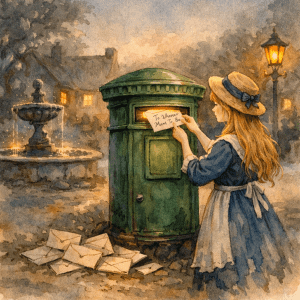
Alice returned to the square carrying a single envelope.

It was plain.

Unaddressed, at first glance.

But as she turned it in her hands, the words revealed themselves—not written so much as decided.

To Whoever I Was Meant To Be

She considered the postbox.

The sign.

The quiet gathering of letters that no longer whispered quite so urgently.

“Well,” she said, “this doesn’t seem to belong to yesterday.”


She stepped forward and placed the envelope into the slot.

The postbox did not hesitate.

It accepted the letter.

Completely.

Without pause.


For a moment, nothing happened.

Which, in Ballykillduff, was often the beginning of something.


Over the next few days, the changes were small.

So small they might have gone unnoticed, had the village not been paying attention.

People spoke more.

Not loudly.

Not dramatically.

But at the right time.

A hand on a shoulder.

A word said before it became too late to say it easily.

A laugh shared instead of saved.

An apology given before it required a letter.


The pile of unsent letters grew thinner.

Not because they were posted.

But because they were no longer needed.


One morning, the sign changed.

No one saw it happen.

No one heard it being written.

But there it was, in the same careful hand:

SAY IT WHILE IT STILL MATTERS


The postbox returned to its usual stillness.

Green.

Dependable.

Mildly overlooked.


But from time to time, if one posted a letter that seemed… slightly delayed…

it might pause.

Just briefly.

As though considering.


And if you stood very quietly beside it—

not always, but sometimes—

you might hear a soft, thoughtful hum.

Not disapproving.

Not quite approving.

Just… attentive.

As though the postbox, having once learned the difference,

had no intention of forgetting it again.


Tags:

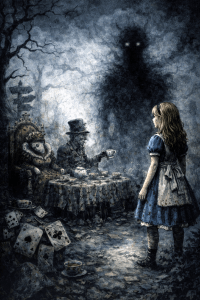
Alice and the Quiet Thing Beneath Wonderland

Alice and the Quiet Thing Beneath Wonderland

Alice and the Quiet Thing Beneath Wonderland

Alice did not remember falling.

That was the first wrongness.

There was no rush of wind, no tumbling of teacups, no curious shelves of marmalade and maps. No polite gravity conducting her downward like a well-mannered host.

Instead, she was simply there.

Standing.

Waiting.

Wonderland had received her without ceremony.


At first glance, it seemed unchanged.

The trees still leaned at uncertain angles, as though listening to secrets beneath the soil. The air still shimmered faintly, like a thought not quite finished. A path still wound forward in the manner of paths that had not yet decided where they led.

But nothing greeted her.

No White Rabbit.
No chatter.
No argument.

Even the silence felt… deliberate.

Alice took a step forward.

The ground did not echo.


“Hallo?” she called.

Her voice did not return.

Not even incorrectly.


She walked.

And as she walked, she noticed something most unsettling of all:

Everything was almost right.

The flowers were in bloom—but none turned to look at her.
A teacup sat upon a table—but the tea within it did not ripple.
A signpost pointed in three directions—but the words had been carefully erased, as though they had once said something important and someone had decided they should not say it anymore.

Alice reached out and touched the sign.

It was warm.


“You should not read things that have been forgotten.”

The voice came from nowhere.

And everywhere.

Alice turned.

At first, she thought it was the Cheshire Cat—but no.

This thing did not grin.

It had no face.

Only a suggestion of one, like a memory rubbed thin.

“I didn’t read anything,” Alice said.

“That is why you are still here,” said the thing.


Alice took a step back.

“Where is everyone?”

The thing did not answer immediately.

Instead, the air seemed to shift, as though it were deciding how much truth could be allowed.

“They are where they were always going,” it said at last.

“That is not an answer.”

“It is the only answer left.”


Alice turned and began to walk faster.

The path resisted.

Not visibly—nothing so obvious—but it lengthened in small, unnoticeable ways. The distance between her and the next tree stretched like a thought being delayed.

She broke into a run.

And then she saw it.

The tea party.


The table was laid.

The cups were filled.

The chairs were occupied.

But the Mad Hatter, the March Hare, and the Dormouse sat perfectly still, as though waiting for a cue that had never come.

Alice approached slowly.

“Hatter?” she said.

He did not respond.

She reached out and touched his sleeve.

It crumbled.

Not into dust—but into something softer. Lighter.

Like ash that had once been laughter.


“No,” Alice whispered.

She stepped back.

The March Hare’s teacup slipped from his fingers, though he had not moved.

It hit the table.

And made no sound.


“They spoke too much,” said the voice again.

Alice turned sharply.

The faceless thing stood closer now.

“They filled the air with contradictions. Questions. Noise. It was… inefficient.”

“Inefficient?” Alice said, her voice trembling. “That’s what Wonderland is.”

“It was,” said the thing.


Alice shook her head.

“No. No, this is wrong. This is all wrong.”

“Yes,” said the thing, almost gently. “That is why it had to be corrected.”


Alice ran.

She ran through the silent woods, past flowers that would not speak, past streams that refused to flow, past clocks that had stopped at times that meant nothing at all.

And at last, she reached the Queen’s court.


The Queen of Hearts sat upon her throne.

Perfectly composed.

Perfectly still.

Her crown did not tremble. Her voice did not rage. Her eyes did not burn.

Alice approached slowly.

“Your Majesty?” she said.

The Queen did not answer.

Alice stepped closer.

And closer.

And then she saw—

The Queen was not breathing.


“She was the last,” said the thing.

Alice did not turn this time.

“Why?” she whispered.

“Because she could not be predicted,” it said. “And what cannot be predicted cannot be permitted.”


Alice clenched her hands.

“This place is meant to be unpredictable,” she said. “It’s meant to be strange, and wild, and… and alive.”

The thing was silent for a moment.

Then it said:

“And yet, you came back.”


Alice froze.

“I… of course I did.”

“Why?”

Alice hesitated.

Because it mattered.
Because it was hers.
Because somewhere in all the nonsense, there had been meaning.

“I don’t know,” she said.


The thing moved closer.

And now, for the first time, Alice felt it looking at her.

Truly looking.

“You do not belong here anymore,” it said.


The words settled into the air like a verdict.

Alice opened her mouth to protest—but nothing came.

Because somewhere, quietly, terribly—

She knew it was true.


“You grew,” said the thing.
“You learned.”
“You began to expect things to make sense.”

Alice shook her head weakly.

“I didn’t mean to.”

“No one ever does.”


The silence deepened.

Alice looked around at the stillness. The absence. The careful, suffocating order of it all.

“What happens now?” she asked.


The thing did not hesitate.

“Now,” it said, “you will leave.”

“And Wonderland?”


For the first time, something like hesitation entered the thing’s voice.

“It will remain,” it said.

“Like this?”

“Yes.”


Alice closed her eyes.

And in that moment, she remembered—

The nonsense.

The arguments.
The songs.
The impossible, ridiculous, glorious chaos of it all.

She remembered a place where nothing made sense—and therefore everything mattered.


When she opened her eyes again, they were no longer afraid.

“You’re wrong,” she said.


The thing stilled.


Alice stepped forward.

“You think nonsense is noise,” she said. “But it isn’t. It’s… space. It’s room for things to be.”

The air trembled.

“You removed everything that couldn’t be predicted,” she continued. “But that’s where life lives.”


The thing shifted.

Uncertain.

For the first time.


Alice took another step.

“And you forgot something very important.”

“What is that?”


Alice smiled.

Not brightly.

Not cheerfully.

But with something fierce and fragile and terribly human.


“That nonsense doesn’t disappear,” she said.

“It waits.”


And somewhere—

Very far away—

A teacup rattled.


The Queen’s fingers twitched.


The wind, which had forgotten how to move, made a small and uncertain attempt.


The thing recoiled.

“What have you done?”


Alice said nothing.

Because she had done nothing at all.


She had simply remembered.


And Wonderland—

very slowly—

began to remember itself.


Tags:

Alice and the Catastrophe of Sensible Behaviour

Alice and the Catastrophe of Sensible Behaviour

Alice and the Catastrophe of Sensible Behaviour

Alice had only just sat down beneath a perfectly unreasonable tree (which insisted it was a hatstand on alternate Tuesdays) when something most alarming occurred.

Nothing.

Absolutely nothing.

For nearly three seconds.

Alice leapt to her feet at once.

“This will never do,” she said. “If things begin making sense, Wonderland may collapse into a pamphlet.”

At this, the tree-hatstand shuddered and dropped three teaspoons, a cucumber, and a mildly offended pigeon.

“Too late,” said the pigeon. “I’ve been logical all morning.”

Alice gasped. “How dreadful! We must find the source of it before everything becomes tidy.”


She had not gone ten steps before encountering the White Rabbit, who was standing very still and consulting a watch that ticked in complete agreement with itself.

“No contradictions,” he murmured happily. “No paradoxes. Everything precisely where it ought to be!”

Alice seized him by the ears (politely).

“This is an emergency,” she said. “Your watch is behaving.”

The Rabbit blinked. “Well yes, that is generally the point of—”

“Exactly!” cried Alice. “Utter disaster!”


They hurried along a path that refused to twist (which Alice found extremely suspicious) until they reached the Mad Hatter, who was sitting at a table drinking tea in a perfectly ordinary manner.

He lifted his cup.

He sipped.

He put it down again.

Alice staggered backward.

“Hatter,” she whispered, “have you lost your mind?”

“No,” said the Hatter calmly. “I tidied it.”

“You tidied it?”

“Yes. Alphabetised my thoughts. Removed all unnecessary nonsense. Very freeing.”

At this, a teacup fainted.

Alice turned to the March Hare, who was sitting beside him reading a book titled Reasonable Behaviour and Its Consequences.

“Do something absurd at once!” Alice demanded.

The Hare adjusted his spectacles. “I would prefer not to.”

Alice clutched her head. “We are doomed.”


Just then, the sky folded itself into thirds (as skies do when they are worried) and the Cheshire Cat appeared, though only his eyebrows had arrived on time.

“Well,” said the eyebrows, “this looks serious.”

“The nonsense is disappearing!” Alice cried. “Everything is becoming sensible!”

The rest of the Cat slowly assembled itself, piece by deliberate piece.

“How unfortunate,” he said. “Without nonsense, I shall have to make points.”

Everyone shuddered.


They made their way to the Queen of Hearts, who was sitting upon her throne conducting a very calm and well-reasoned discussion about garden maintenance.

“No executions today,” she was saying. “Let us consider everyone’s perspective.”

Alice burst into tears.

“Your Majesty!” she cried. “You must do something unreasonable at once!”

The Queen frowned. “Why?”

“Because if you don’t, Wonderland will become… normal!”

A silence fell.

Even the cards stopped shuffling themselves.

Normal.

The word echoed about like a well-behaved echo.


At last, a small voice spoke.

It was the Dormouse, who had been asleep for so long that he had forgotten how to wake up properly.

“Perhaps,” he said, “we have simply run out of nonsense.”

“Impossible!” cried Alice.

“Not at all,” said the Cheshire Cat. “Nonsense must be replenished. It does not grow on trees—”

The tree-hatstand coughed politely.

“—well, not reliably.”


Alice thought very hard.

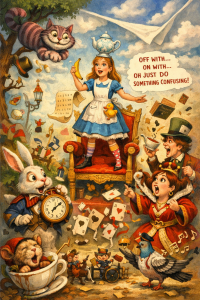
Then, quite suddenly, she stood upon the Queen’s throne, balanced a teapot upon her head, declared herself to be “The Duchess of Unfinished Sandwiches,” and began reciting the multiplication table backwards in rhymes involving bananas.

The effect was immediate.

The sky unfolded itself with a snap.

The Hatter dropped his teacup and began arguing with it.

The Rabbit’s watch started running sideways.

The Queen leapt to her feet.

“OFF WITH—no, wait—ON WITH—no—OH JUST DO SOMETHING CONFUSING!”

The cards burst into delighted chaos.

The March Hare threw his book into a passing metaphor.

And the pigeon applauded so enthusiastically it became a small orchestra.


The Cheshire Cat grinned.

“Ah,” he said. “Balance restored.”

Alice climbed down, slightly out of breath.

“That was close,” she said.

“Yes,” said the Cat. “Another minute of sense and we might all have become useful.”

Alice shuddered.

“I should hate that.”


And so, with nonsense safely reinstated, Wonderland returned to its usual state of cheerful confusion.

Which, as Alice later remarked, was exactly as it ought not to be—and therefore, perfectly correct.


Tags: , , ,

The rabbit hole didn’t lead to a tea party this time

The rabbit hole didn’t lead to a tea party this time
The rabbit hole didn’t lead to a tea party this time.
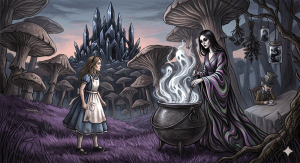
As Alice tumbled through the dark, she didn’t pass rocking chairs or bookshelves. Instead, she brushed past hanging bundles of dried hemlock and jars of preserved nightmares. When she finally landed, the grass wasn’t green; it was a bruised purple, and the air smelled of ozone and singed sugar.
The Shadow Over Wonderland
Wonderland had changed. The Queen of Hearts was gone, replaced by something much more calculated. High atop the mushroom forest sat a castle made of jagged obsidian. There lived The Witch of the Withered Rose.
She didn’t want heads; she wanted stories. She fed on the whimsy of others until they were nothing but hollow shells. The Mad Hatter sat in a corner, staring at a blank teacup, his madness replaced by a terrifying, quiet sanity.
The Encounter
Alice wandered into the clearing of the Great Oak, where the Witch stood waiting. She wasn’t green or warty; she was tall, draped in silk the color of an oil slick, with eyes that looked like solar eclipses.
“You’re late, Alice,” the Witch purred, stirring a cauldron that simmered with silver smoke. “I’ve already bottled the Cheshire Cat’s grin. It makes a lovely nightlight.”
“I don’t think I like your decorating taste,” Alice said, her voice trembling only slightly. “And I’d like my friends back, if it’s all the same to you.”
The Witch laughed, a sound like glass breaking. “In this world, Alice, ‘curiouser and curiouser’ is a death sentence. Give me your imagination, and I’ll let you go back to your boring parlor in London.”
The Twist of Logic
Alice looked at the cauldron. She remembered that in Wonderland, things were only as powerful as you believed them to be.
“You’re not a witch,” Alice said boldly, stepping forward. “You’re just a bad habit. You’re the feeling of growing up and forgetting how to play.”
The Witch shrieked, her obsidian form flickering. “I am the end of dreams!”
“No,” Alice countered, “You’re just a very tall, very grumpy woman in a dress that needs a good wash. And since this is my dream, I think it’s time for a change in the weather.”
Alice didn’t use a sword or magic. She simply imagined the sun. Not just a normal sun, but a sun made of lemon drops and laughter.
The Result:
 * The obsidian castle melted into a giant puddle of blackberry jam.
 * The Witch shrank until she was no bigger than a thimble, scurrying away into the roots of a tree.
 * The Cheshire Cat’s grin popped out of its jar and reattached itself to the air with a satisfied pop.
Alice sat up in the meadow back home, the smell of damp grass filling her lungs. She looked down and noticed a single, withered black rose petal tucked into her apron. She smiled and tossed it into the wind.
 

Tags: ,

The Day the Frost Blinked

The Day the Frost Blinked

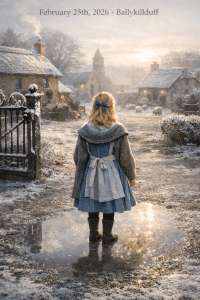
February 25th, 2026 — The Day the Frost Blinked

The frost arrived late.

It did not settle in the night as frost properly should, but wandered into Ballykillduff sometime after breakfast, looking faintly apologetic and extremely decorative.

Alice noticed it first on the gate.

At precisely eleven minutes past ten, the iron latch glittered.

At twelve minutes past ten, it stopped.

At thirteen minutes past ten, it glittered again.

“It’s blinking,” Alice said calmly, which is the sort of thing one must say calmly if one wishes to be believed.

The frost had begun appearing and disappearing in polite intervals — hedge, path, rooftop, sheep — as though winter were reconsidering its position.

Alice stepped into the square. Each time the frost shimmered into existence, the air grew crisp and silver; each time it vanished, the village returned to its damp February self.

“Make up your mind,” she advised the sky.

The sky, which had been undecided all month, hesitated once more — and then, with a soft sigh, allowed the frost to remain.

Not thick.

Not harsh.

Just enough to turn the puddles into mirrors.

Alice looked down and saw not her reflection, but a faint suggestion of spring standing just behind her shoulder.

“Ah,” she said.

The frost did not blink again.

And somewhere beneath the quiet silver crust of February 25th, something green made up its mind to begin.

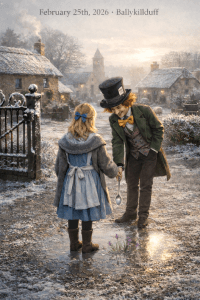
February 25th, 2026 — The Hat That Refused to Thaw

The frost had only just decided to behave itself in Ballykillduff when the sky coughed politely and produced a hat.

Not a rabbit.
Not a teacup.
Just a hat.

It fell with dignity, landed upright in the square, and waited.

Alice, who had already negotiated with blinking frost that morning, approached it cautiously.

The hat cleared its throat.

A moment later, the Mad Hatter unfolded himself out of it as though he had merely been stored there for convenience.

“Good morning!” he cried. “I’ve come for the Thawing!”

“We are not thawing,” Alice said firmly. “We are gently transitioning.”

“Ah,” said the Hatter, peering at the frost. “A hesitant season. Very dangerous. They tend to wobble.”

He removed a small silver teaspoon from his sleeve and began tapping the frost on the cobbles.

Ping.

A patch melted.

Ping.

A daisy appeared.

Ping.

A sheep sneezed and turned very briefly pink.

Alice caught his wrist before he could strike again.

“We’ve only just persuaded February to sit still,” she said. “If you start stirring it, we shall have daffodils arguing with snowflakes.”

The Hatter considered this gravely.

“Yes,” he agreed. “They never agree on colours.”

He placed the spoon back into his sleeve, stamped his hat once (which caused three crocuses to pop up apologetically), and looked at Alice with unusual sincerity.

“Very well. No mischief. Only observation.”

They stood together in the soft silver light, watching the frost hold its breath and spring wait its turn.

After several whole minutes of remarkable good behaviour, the Hatter leaned closer.

“Between ourselves,” he whispered, “March is terribly impatient.”

Then he folded neatly back into his hat.

The hat tipped itself.

And vanished.

The frost did not blink.

But somewhere beneath the cobbles, something giggled.


Tags: , , , ,

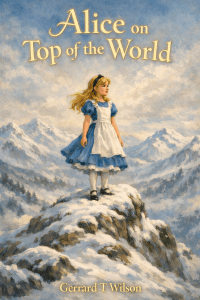
Alice on Top of the World

The Continuing Adventures of a Girl Named Alice


Tags: , ,

Alice in Wonderland and Beyond

Alice in Wonderland and Beyond

ENJOY


Tags: , ,

Alice in Wonderland

Alice in Wonderland

In realms of whimsy, softly spun,

A maiden drifts beneath a sun

Of petals grand, a blush-pink bloom,

Dispelling shadows, chasing gloom.


Her gown of blue, a gentle wave,

As golden tresses brightly rave

With blooms and beads, a floral crown,

She floats where dreams are upside-down.


Around her dance, in vibrant hue,

White-capped toadstools, fresh with dew.

Bright butterflies with wings so grand,

Flit through this most enchanted land.


And tiny birds, with wings so clear,

Whisper secrets to her ear.

A cosmic swirl, a starry night,

Embraces her in wondrous light.


A world of magic, soft and deep,

Where every fancy she can keep.

With serene gaze, she looks above,

Lost in a dream of endless love.


Tags: , ,