The Day the Hot Cross Buns Refused to Behave.
In Ballykillduff, there are certain things one may rely upon.
The post box is green.
The wind comes in sideways.
And on Good Friday, Mrs Flannery’s hot cross buns behave themselves.
The wind comes in sideways.
And on Good Friday, Mrs Flannery’s hot cross buns behave themselves.
Except, of course, for the year they didn’t.
It began, as all respectable disasters do, with a smell.
Not an ordinary smell—no, Ballykillduff had long ago grown accustomed to smells that suggested something mildly supernatural was occurring behind the butcher’s or under the bridge. This was a confident smell. A proud smell. A smell that marched down Main Street like it owned the place.
“Buns,” said Mr Byrne, the baker, stepping outside his shop and sniffing the air with professional concern. “Hot cross buns. And not mine.”
This was troubling. Mr Byrne’s buns were the official buns of Ballykillduff, having won the Annual Bun-Related Excellence Award three years running (and once by default when no one else remembered to bake any).
Mrs Flannery emerged from her shop just as the smell intensified.
“Do you smell that?” she asked.
“I do,” said Mr Byrne. “And I don’t like the tone of it.”
They followed the scent to the village square, where a small crowd had gathered around the fountain—the one that occasionally remembered things it hadn’t seen yet.
At first, no one spoke.
Then Jimmy McGroggan (who distrusted anything that rose, floated, or behaved optimistically) pointed upward.
“There,” he said. “Look.”
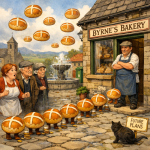
Hovering just above the fountain were buns.
Hot cross buns.
Not one or two, mind you—but dozens. They bobbed gently in the air like well-behaved balloons, each one perfectly golden, each one marked with a neat white cross, and each one—most suspiciously—steaming.
“Well,” said Mrs Flannery after a long pause. “That’s new.”
At precisely nine o’clock, the buns began to descend.
Now, in most villages, this would have caused panic. Screaming. Possibly the ringing of a bell.
In Ballykillduff, however, people simply stepped back slightly and allowed events to continue, as they generally did.
The buns landed neatly on the paving stones in a tidy arrangement that suggested either great intelligence or an alarming degree of organisation.
Then one of them bounced.
Just once.
A soft, polite bounce.
“Did you see that?” whispered someone.
Another bun rolled forward slightly, as if clearing its throat.
Then—quite without warning—the entire collection began to move.
They did not scatter.
That would have been understandable.
Instead, they arranged themselves into a queue.
A perfectly straight queue.
Facing Mr Byrne’s bakery.
Mr Byrne stared at them.
“I refuse,” he said firmly, “to be queued at by baked goods.”
The buns waited.
There was no pushing, no jostling, no attempt to skip ahead. If anything, they were more polite than the average Ballykillduff resident on a busy morning.
After a moment, the front bun gave a small hop forward and tapped—very gently—against the bakery door.
Tap.
Silence.
Tap tap.
Mr Byrne folded his arms.
“I’m not serving them,” he said.
“You might have to,” said Mrs Flannery. “They seem committed.”
The situation escalated when the buns began producing exact change.
No one saw where the coins came from.
They simply… appeared. Small, neat piles of coins sat beside each bun, as if they had always been there and everyone had just been too distracted to notice.
Jimmy McGroggan crouched down and examined one.
“Well,” he muttered, “at least they’re paying customers.”
Reluctantly, Mr Byrne opened the door.
The buns shuffled forward.
One by one, they entered the shop.
What followed has since been described (in the official village minutes) as “a most peculiar but orderly transaction.”
Each bun approached the counter.
Paused.
Then nudged its coins forward.
Mr Byrne, after a long internal debate about the collapse of reality, handed each bun… another bun.
“No refunds,” he added automatically.
The buns accepted this.
They turned.
And left.
By mid-morning, Ballykillduff had a new problem.
There were now twice as many buns.
Because each bun had purchased a bun.
And those buns, it appeared, were just as capable of independent thought as the original batch.
“They’re multiplying,” said Mrs Flannery.
“They’re investing,” corrected Jimmy.
By noon, the buns had formed committees.
There was a Bun for Queue Management.
A Bun for Fair Distribution.
And, somewhat ominously, a Bun for Future Planning.
The village grew uneasy.
It is one thing for buns to bounce.
It is quite another for them to organise.
The crisis reached its peak at half past two, when the buns held a meeting in the square.
Mr Byrne, Mrs Flannery, Jimmy McGroggan, and several concerned residents gathered at a safe and respectful distance.
The Bun for Future Planning rolled to the front.
It cleared its… crust.
Then, with great dignity, it tipped itself slightly forward.
And stopped.
Nothing happened.
“Is that it?” asked someone.
“I think so,” said Mr Byrne.
They waited.
The buns remained perfectly still.
Then, slowly—very slowly—the steam began to fade.
The warmth softened.
The bounce diminished.
And, one by one, the buns simply… became buns.
Ordinary buns.
Still. Quiet. Entirely uninterested in commerce or governance.
By evening, Ballykillduff had returned to normal.
Mostly.
Mr Byrne gathered the remaining buns and placed them carefully on a tray.
“Well,” he said, “they seem harmless now.”
“Are you going to sell them?” asked Mrs Flannery.
Mr Byrne paused.
He considered the events of the day.
The queues.
The coins.
The committees.
The brief but undeniable sense that he had been professionally outperformed by his own product.
“No,” he said firmly. “These are not for sale.”
“What will you do with them?”
Mr Byrne looked out at the village square, where everything was once again behaving in a reasonably predictable manner.
“I think,” he said slowly, “we shall eat them… quietly… and not discuss this ever again.”
And that is precisely what Ballykillduff did.
Except, of course, for one small detail.
The next morning, when Mr Byrne opened the bakery door, he found—neatly arranged on the counter—
A single coin.
And beside it…
One perfectly warm, very fresh hot cross bun.
Waiting its turn.
*************************************************************
Epilogue — The Bun That Waited
The following morning in Ballykillduff arrived with its usual sense of mild uncertainty.
The post box was green (as expected).
The wind was sideways (as required).
And Mr Byrne opened his bakery door with the careful expression of a man who had been professionally challenged by baked goods and was not eager for a rematch.
The wind was sideways (as required).
And Mr Byrne opened his bakery door with the careful expression of a man who had been professionally challenged by baked goods and was not eager for a rematch.
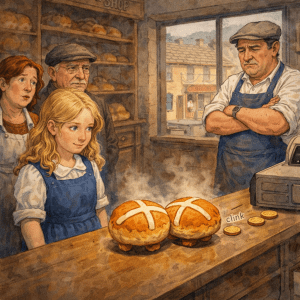
There, upon the counter, sat the bun.
Neat. Warm. Patient.
And beside it—
A single coin.
Mr Byrne stared at it for a long time.
“Well,” he said at last, “we are not doing this again.”
“Doing what?” came a voice behind him.
He turned.
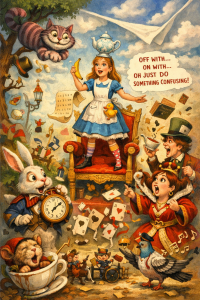
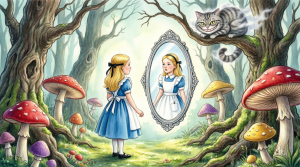
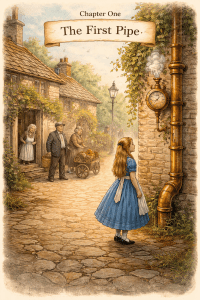
Standing in the doorway, brushing a stray lock of long blonde hair from her face, was a girl in a blue pinafore dress, looking at the bun with great interest.
“I’m fairly certain,” she said, stepping inside, “that this is the sort of thing one ought to investigate.”
Mr Byrne narrowed his eyes.
“You’re not from here.”
“No,” said Alice pleasantly. “But I do seem to arrive in places just as they begin to behave oddly. Or perhaps I arrive because they already have.”
She leaned closer to the bun.
It did not move.
But it did seem, in a way that was difficult to prove, to be waiting.
“For what?” asked Mr Byrne.
Alice considered this.
“For its turn,” she said.
“That’s what I was afraid of.”
Mrs Flannery appeared moments later, followed by Jimmy McGroggan, who had come prepared for disappointment and, if necessary, mild outrage.
“What’s the situation?” Jimmy asked.
Mr Byrne pointed.
“The situation,” he said, “is that we have a bun. A coin. And a sense of unfinished business.”
Jimmy squinted.
“It looks quiet enough.”
Alice smiled.
“Oh, things often do—right up until they aren’t.”
There was a pause.
The kind of pause Ballykillduff understood well.
A pause in which something might happen… or might decide not to… or might wait just long enough to be inconvenient.
Then, very gently—
The bun gave a small bounce.
Just once.
Jimmy stepped back.
“I knew it,” he said. “Optimism.”
The coin slid forward by the smallest imaginable distance.
Clink.
Mr Byrne closed his eyes.
“No committees,” he muttered. “No queues. No financial independence.”
Alice, however, looked delighted.
“Oh, I don’t think it wants all that again,” she said. “I think it only wants to see what happens next.”
“And what does happen next?” asked Mrs Flannery.
Alice straightened.
She looked at the bun.
Then at the coin.
Then at Mr Byrne.
“Well,” she said, very gently, “it’s paid.”
Mr Byrne hesitated.
He glanced at the shelves.
At the ovens.
At the quiet, perfectly ordinary buns that had returned to their proper, non-ambitious state.
Then he sighed.
“All right,” he said. “But just the once.”
He reached behind the counter and picked up a fresh hot cross bun.
He placed it carefully in front of the waiting one.
“There,” he said. “Transaction complete.”
The bun did not move immediately.
It seemed to consider the moment.
Then—
It nudged the new bun slightly.
As if acknowledging it.
As if passing something on.
And then—
It settled.
Perfectly still.
Entirely ordinary.
Alice watched this with great satisfaction.
“You see?” she said.
“No,” said Jimmy. “I don’t.”
“It didn’t want to multiply,” Alice explained. “It didn’t want to organise. It didn’t even want to queue.”
“What did it want, then?” asked Mrs Flannery.
Alice smiled.
“To finish.”
There was a quietness in the bakery then.
A soft, settled sort of quiet.
The kind that comes after something has made up its mind to stop being peculiar.
Mr Byrne looked at the two buns.
Then, cautiously, he picked one up.
It behaved.
He took a bite.
It was excellent.
“Well,” he said after a moment, “that’s that, then.”
Alice stepped back toward the door.
“Will you be staying?” asked Mrs Flannery.
Alice shook her head.
“No, I think not. Things seem to be concluding here.”
She paused.
Then added, with a thoughtful look toward the counter—
“Though one never knows when something might decide it hasn’t quite finished after all.”
Jimmy groaned.
“Don’t say that.”
And with that, Alice stepped out into Ballykillduff.
The wind caught her hair.
The village carried on.
And inside the bakery, everything remained exactly as it ought to be.
Except—
If you looked very closely—
You might notice, tucked just behind the till—
A second coin.
Waiting.
Not impatiently.
Just… patiently enough.





 The Crazymad Writer Writes Again