
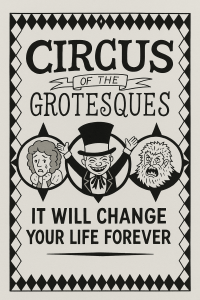
Circus of the Grotesques
It Will Change Your Life Forever
The poster arrived in Ballykillduff the way fog arrives on the bog road, quietly and all at once. It was there on the noticeboard outside the shop, on the lamppost by the bridge, tucked under pint glasses in The Giddy Goat. It even rode the back of a wandering sheep for a morning, the poor ewe plodding around with CIRCUS OF THE GROTESQUES flapping off her wool like a royal cape.
People said it was a prank of Jimmy McGroggan’s, or a stunt for the fête. Jimmy swore on his mother’s bottle-green statue of St. Jude that it was no such thing. “I would have used better paper,” he said, affronted. “And I would have spelled grotesques with exactly one more flourish.”
By Friday twilight, a striped tent stood in the meadow by the bridge, though no one had seen it go up. The stripes were not red and white, but black and pearl, and the pearl shimmered with a faint inner sea-light even as the evening darkened. There was a queue without a queue, people drifting toward the entrance as if they had always been walking there. A sign beside the flap read, in painted letters that looked still-wet:
ADMISSION: ONE MEMORY. NO REFUNDS.
“Ah now,” said Seamus Fitzgerald, veteran of mysteries and mistakes. “What would they want with memories?” He had a face that looked carved for curiosity and a wife who had given up trying to sand it smooth. Bridget stood beside him in her good cardigan, lips set, eyes sharp as clothespins. Around them, the village swelled and murmured. Children peered between elbows. The river wore the dusk like an old shawl.
A boy named Timmy Tilbert reached toward the sign. He was the sort who could not pass a gate without testing if it would open. The sign did not bite him, so he grinned, and that was that. The first people ducked into the tent.
Inside was not inside. Rows of mismatched chairs stretched further than the field itself. Lanterns floated without hooks. The air smelled of sugar and sawdust and something faintly metallic, like a tin whistle after a tune. A stage stood at the far end, a circle of lighter canvas with a ring of black salt around it, glittering like frost. The crowd sat. The tent filled and filled as if with tidewater.
The lights faded. A drum sounded once, and out stepped the ringmaster.
He had the look of a gentleman drawn by someone who had only listened to gossip about gentlemen: the coat a shade too long, the cuffs a shade too shiny, the smile too bright by half. His top hat was a fraction wider than the laws of taste permitted. When he bowed, it was a bow that made the whole tent feel it had been bowed to, personally and permanently.
“Welcome, Ballykillduff,” he said, and the echo of the village’s name went walking up into the dark of the roof. “Welcome, seekers of strangeness, patrons of the peculiar, connoisseurs of the crooked and the sublime. I am Doctor Vaude, and this is the Circus of the Grotesques. We will change your life forever.” He let the words dangle like bright knives. Then his tone softened. “To begin, I ask only that you sit, see, and remember what you can. What we take is only what you can spare.”
Seamus leaned toward Bridget. “What if they take the memory of me not washing the kettle?”
“You never washed the kettle,” Bridget said. “They would have to add that memory, not take it.”
A tinkling bell rang. The ringmaster raised his cane, and the first act stepped into the salted ring.
The Woman of Wax and Whispers
She wore a dress like a candle snuffed at midnight, and she moved as if balancing droplets. Every turn of her wrist left behind a shine. The lanterns lowered themselves in courtesy. When she danced, her skin softened and ran like honey, then firmed again, all while her eyes remained steady and deep as wells. She leaned toward those in front and whispered secrets, not hers but theirs. “You still have the key to the blue box,” she told a farmer, “and you keep it though the box is long burned.” “You pretended not to see him cry,” she told a grown daughter, “and you wished you had.”
With each whisper, a faint curl of smoke rose from her mouth and drifted toward the roof, where it vanished as if swallowed. People in the front row touched their hearts, their hands, their mouths. Some laughed, and then looked startled by the sound, as though it had come from a different throat.
When she finished, she made a small curtsey and a tiny flame on her fingertip winked out.
Doctor Vaude inclined his hat. “Every candle must melt to give its light,” he said. “Applause for Madame Tallow, the Woman of Wax and Whispers.”
The Gentleman Beast
He entered on a velvet leash he did not need, a looming figure with a mane like wheat in high summer. His tuxedo fit him as if it remembered an earlier body. His eyes were lion and man at once. He spoke in a voice that came from a long way off and also from beside your ear.
“Once,” he said, “I was handsome and admired and wanted more. I bought mirrors. I bought tragedy. I bought cruelty and paid no change. One morning I woke and found the animal I had been breeding in secret had taken the house. I asked for a refund. Life declined.”
He put a paw to his heart and bowed to the cheapest seats with the greatest grace. He then leaped a ring of fire and, for the brief gleam of midair, he was not a beast but a beautiful man again, face luminous, human, painfully so. The fire sighed when he landed. The audience sighed with it.
Bridget clapped, and clapped again, furiously wiping at one eye as if it had collected dust. Seamus squeezed her hand and did not make a remark, which was the most loving thing he could do.
The Clockwork Twins
A hush enfolded the tent. Two girls came in from opposite sides. They were identical up to the small freckle on the left edge of their lower lip, which both of them had somehow. Their skirts were made of pages torn from railway timetables. Tiny copper keys protruded from beneath their shoulder blades. With delicate hands they wound one another, and then they moved.
They danced in precise arcs that were more accurate than a clock but more gentle than a prayer. As they danced, the lanterns ticked. One twin, her name stitched white-on-black at her hem, Adéle sped up whenever the audience breathed. The other Ida slowed down whenever the audience blinked. The crowd tried not to breathe or blink. The tent filled with a human kind of blue. At the end the girls leaned cheek to cheek, and for a second each had no freckle, or both had two. Then they curtseyed, and their keys unwound with a sigh like wind through barley.
Doctor Vaude’s smile was almost tender. “They were born on a platform between two trains,” he said. “They missed their departure and arrived at their fate. Please save your applause for the pockets of time you will need on the way home.”
The Librarian of Unwritten Apologies
A thin fellow in a coat the color of hand-me-downs pushed a book trolley into the ring. The books were blank. He opened one, and the tent ruffled as if a bird had flown through it. “I keep all the apologies you meant to make,” he said mildly. “I am not the judge. I am the librarian. Judge yourselves as gently as you can.”
He set the books on a rope and walked across them like stepping stones, and as he stepped the pages filled with writing that rose and faded, rose and faded, a river of sorry. People in the crowd reached as if to snag a page and swallow it.
When he reached the far side, he turned. “The fine,” he said, “is small. Say the words aloud when you can, and mean them as much as you can.” He gave the crowd a little bow that looked like a folded note.
The Cook of Impossible Flavours
A wide woman with arms like rolling pins wheeled out a cart hung with boiling pots that never boiled over and frying pans that never burned. The smells that came from the cart were a memory of bread and the laughter of a first friend. “Taste,” she told the audience, “but be warned. It will cost you nothing at all, and that is its danger.”
She handed spoonfuls down the rows. People tasted “the day Granddad told me the secret joke,” “the time I nearly cheated but did not,” “the morning the rain knew my name.” Someone tasted “what I would have been,” and started to cry. She wiped the person’s tears with a clean square of linen and tucked it into her apron pocket as if it had always belonged there.
The Acrobat of Missing Steps
He walked up an invisible staircase that everyone somehow knew was there because everyone had used it, once. He slipped where the step was missing and did not fall because he had spent his life falling and had learned the trick of turning falling into a kind of strange flight. He landed where the step should have been. He put it back.
“Who here gave a memory?” Doctor Vaude called between acts. “Which one did you pay?”
“A birthday,” answered Seamus before Bridget could grip his sleeve. “My fifth. But sure I hardly remembered it.”
“Ah,” said the ringmaster. “Then it will hardly be missed.”
Seamus grinned, though a small, dry space had opened behind his ribs, not empty, not full, something like a pressed flower in a book you cannot quite name.
At the end of the first half, the lights rose and the tent rummaged itself into an interval. Trays of sugared things appeared. A set of paper birds fluttered around, landing on fingers to do sums, accept coins that were not coins, and leave receipts that were feathers. Seamus bought a twist of toffee for Bridget, who did not say thank you because she was thinking about whether she should have paid at all and whom she might be if she had not.
A girl stood near the aisle with a toffee apple like a small planet in her hand. Her name was Norah O’Dea, ten years old, a listener by nature and a laugher by vocation. She had the kind of eyes that made adults tell her too much and then gulp, and the kind of hands that mended other people’s kite strings without asking. She watched the paper birds. One landed on her wrist. She fed it a crumb of caramel. The bird bowed, and the caramel did not stick to its paper beak.
When the bell tinkled again, the audience drifted back. Someone hummed the hymn that is not in any hymnbook and always floats up just before miracles or trouble.
Doctor Vaude strode into the ring with his arms wide and his smile tuned to the exact frequency of attention. “For our second half,” he cried, “we offer transformations, translations, and the common magic of seeing what was there all along. And for our final act, we will require a volunteer.”
Bridget made a small sound, not unlike the sound a jam jar makes when it thinks about breaking. Seamus patted her knee. “It will be fine.”
Transformations
A woman stepped forward and took off her shadow like a coat. It ran around the ring on its own legs, then returned, a little breathless, and wrapped itself back around her ankles with an affection that looked like forgiveness. A man sang in a voice that made the lanterns grow taller, and when he stopped the lanterns were ashamed and shrank to their proper height. A boy took a deep breath and blew out a cloud of moths that turned to stars and then to freckles on his cheek.
Doctor Vaude clapped slowly, politely, as if his hands and the acts were doing business together. He turned to the crowd. “And now, a volunteer. No harm, I assure you. Only change. Only change.”
Silence is rarely complete. There is always the shiver of a sleeve, the soft slap of a jaw, the old whisper of a roof. In that not-quite-silence, Norah O’Dea lifted her sticky hand. “Me,” she said. A hundred whispers repeated me and wondered who had said it.
“Splendid,” said Doctor Vaude, and something brightened around him, and something dimmed.
Norah came down with a steady step. The ring of black salt glittered like a warning you pretend is a compliment. The ringmaster drew a circle on the canvas floor with a broken piece of chalk that never got shorter. “Stand there, my dear. Tell the people your name so your name will find its way home if it goes walking.”
“Norah O’Dea.”
“Very good. What would you like to be?”
Norah frowned. “I do not know.”
“A perfect answer,” said Doctor Vaude. “Let us begin.”
He spoke in a language that made Seamus itch and the paper birds rustle. The lanterns lifted. Norah blurred, like a swallow crossing a pane of glass. The blur thinned into a thread and then into a ribbon and then into a smile. It was the ringmaster’s smile. It fit her as if it had always been waiting for her, a coat taken in at the waist and let out at the hope.
People shifted uneasily. It is one thing to see marvels. It is another to see them reach out and swap hats with your neighbor.
Bridget stood up. “That is a child,” she said, not loudly, but with the sort of softness that quiets louder things.
Doctor Vaude tilted his head. “So she is,” he agreed. “For a while longer.”
Norah stood perfectly still, her new smile fixed, her eyes wide and glassy. Seamus remembered a small pair of hands at the shop door last winter, pushing in the wind for an old woman who was not quick. He remembered a laugh like a silver fork pinging on the counter. He remembered—he tried to remember—the girl’s birthday party last week, the cake, the candles, the song. His memory slid away from him like a fish through water.
“What did you take from her?” Seamus asked.
“Nothing,” Doctor Vaude said pleasantly. “We only moved things around. We are an agency of rearrangement.”
“The cost,” Bridget said. “There is always a cost.”
“The cost was paid at the door,” said Doctor Vaude. “One memory. No refunds.”
The audience’s murmur gathered itself into concern. But the tent itself seemed to lean toward the ringmaster. The tent itself was on his side.
Seamus stepped over the black salt, and the way the crowd sucked in its breath said he should not have done it. The circle did not stop him. He stood beside Norah. “Come on now,” he said, and put his hand out. “Let us go out and get air. There is a smell of tin in here.”
Norah did not move. Her hand did not move toward his. Her smile did not change. Only her eyes brightened with a thin shine of water.
Doctor Vaude’s own smile sharpened but did not grow. “I am very fond of the brave,” he said. “Bravery is such a practical spice.”
“What did you take?” Bridget asked again.
“What she could spare,” said the ringmaster. “The last layer of fear about becoming herself. I saved her the ache. You will thank me later.” He turned to the crowd. “There is always such resistance to ease, is there not? One final demonstration, then we will dismiss you kindly out into your permanent newness.”
He clicked his cane. The lanterns flipped to an unnatural white. The tent’s roof stretched upward like a held breath. The stage floor opened without opening, and from under the canvas rose the Mirror That Remembers Your Other Face.
It looked like a pond held on its side. It rippled as if it were alive and bored. Inside it, the faintest reflection of each spectator became sharper, the way a sentence sharpens as you near the end of it. People leaned forward. In the glass their mouths moved. Their reflections said things they had not said. Their reflections were things they had not been. A man saw himself with a child on his shoulders he had never had. A woman saw herself at the sea she had never visited. Bridget saw herself standing on a stage arguing with a ringmaster and winning.
“Careful now,” Seamus muttered. He took off his cap. He had not intended to, but his mother’s voice spoke up out of a cupboard in his brain and said, Take off your cap indoors when you are speaking to a mirror. He held the cap over the black salt. “If it is the price,” he said under his breath, “perhaps it can be paid back.”
Bridget heard him and grasped his wrist. “Do not you dare,” she said. “Not another memory. We will not play their game by their rules.”
A paper bird landed on Seamus’s shoulder. He felt the crackle of its weight. It pecked his ear as if to say: Different rules exist.
The Librarian of Unwritten Apologies wheeled his cart toward the ring’s edge and coughed. It was the cough you give in church when the priest has forgotten the second verse. Doctor Vaude glanced over with wide courtesy. The Librarian looked steadily back.
“Doctor,” he said, mild as rain, “there is a rule you have not mentioned.”
Doctor Vaude smiled wider. “There are many. Choose one.”
“The one about names,” said the Librarian. “If a name is called with love twice, and a third time with courage, the tent must hear it and consider it.”
The ringmaster waved his cane. “By all means, call.” His tone suggested a child trying to butter a thunderstorm.
Bridget did not wait. “Norah,” she said. “Norah O’Dea.” The name went out and hung like a bell swinging.
Seamus said it too, softly, as if coaxing a frightened dog from under a gate. “Norah.”
The tent waited. The ring tilted. The third call stuck in his throat like a bone. Seamus looked at Doctor Vaude’s eyes and saw patience in them, the patience of a hawk circling, and it made anger rise like tide. He shouted the name. “Norah!”
The tent heard.
The black salt hissed and rearranged itself into letters that spelled GO HOME and then, after a beat, IF YOU LIKE. Norah blinked. The smile slackened by a fraction. A tear came loose. It slid down, touched the edge of the circle, and fizzed like cider.
Doctor Vaude sighed as if inconvenienced by a minor traffic incident. “Very well. A little back-and-forth. It is good for the lungs. Child, you may choose. Stay, and learn our trade. Go, and be whoever you will, with one less splinter to pull out later.”
Norah’s eyes cleared. She looked up at Seamus and Bridget. At the crowd. At the ringmaster. “May I ask a question?” she said.
“Always allowed,” said Doctor Vaude.
“Do you pay for anything?”
He tilted his head. “Everything pays for everything. We are part of the economy of wonder. We take what can be spared and give what will be appreciated.”
Norah looked at her toffee apple, which had somehow not dripped. “I think you owe us a fairground game.”
The ringmaster blinked. “I beg your pardon?”
“A fairground game,” she said. “We paid at the door. You dazzled us. Now we deserve a chance to win back what we bought, the way my Da once won a goldfish that lived three years. The rules of circuses say so.”
No one knew if the rules of circuses did say so. But no one could swear they did not. The tent itself rustled in interest, as if learning a novelty. The paper birds fluttered up and wrote GAME in the air, letter by letter, and the letters burst into confetti and fell gently upon the ringmaster’s hat.
Doctor Vaude’s smile did not waver. “Very well. A game. Choose.”
Norah thought. Children think in lines that look like spirals to everyone else, but arrive more directly than most adult maps. “Riddles,” she said at last. “You ask one. Then I ask one. If we tie, we both win and lose a little. If I win, you give everyone back the part of their memory they can use. If you win, you may keep what you have taken, and also my toffee apple stick.”
Doctor Vaude looked at the stick as though it were a sceptre from a rival kingdom. “Agreed,” he said.
He stepped into the ring so the black salt whisper-crunched. He lifted his cane as if drawing a stave in the air, and notes appeared, little bright minnows hanging expectantly. “What is the thing,” he asked, “that everyone carries, that no one can lend, that grows lighter when it is shared and heavier when it is hidden?”
A murmur ran through the tent. Seamus mouthed sadness, then bread, then a pocket. Bridget squeezed his hand to stop the fidgets. Norah did not rush. She let the question settle around her like a coat and then stepped out of it.
“A story,” she said.
The notes flashed and turned into dandelion seeds that drifted up among the ropes. Doctor Vaude nodded once. “Well done. Your turn.”
Norah’s eyes went to the Librarian’s cart, to the wax woman’s cooling hand, to the clockwork twins standing with their cheeks together listening for the train. “What is the cost of a kindness that is not done?” she asked.
The ringmaster’s smile held steady. He did not speak for a time that felt like waiting for a verdict. He looked at the lanterns and then at the tent pole and then at his own hands, as if wondering if they had kept their receipt.
“The cost,” he said finally, “is a knot in the dark.” He inclined his head. “And interest.”
Norah nodded. “Then untie one.”
Doctor Vaude’s smile thinned. He twirled his cane once and tapped it against the canvas. Something invisible loosened. Somewhere in Ballykillduff, a small hardness in a small chest softened. Somewhere else, a hand reached for a phone it had not reached for in five years. The Librarian closed one blank book and shelved it. The Woman of Wax exhaled. The Gentleman Beast’s claws dimmed to nails.
“You have won,” said Doctor Vaude, and the tent shifted as if relieved of a coin in its shoe.
“What about our memories?” Seamus cried.
“Bring me your tickets,” said the ringmaster, and the paper birds swept down to snatch them from hands and hats and pockets. They fluttered above Doctor Vaude’s cane like a flock arguing which wire to sit on. He flicked the cane lightly and the tickets burst into ash, which rained on the people and smudged them with a soot that, when they brushed it away, left behind small bright scraps that fitted into the doors inside their minds and unlocked some of them.
Seamus blinked. He saw his fifth birthday. He saw his mother lifting him to blow out the candle on a small cake with sugar daisies. He saw his father’s ridiculous red paper hat, and his own determined cheeks. He also saw that his mother had been tired, and that his father had been worried about money, and that loving and worrying had been the same rope plaited differently. The memory did not come back as it had been. It had changed. It had grown up. He held Bridget’s hand and felt ashamed in a clean way, the kind that makes a man wash the kettle without being asked.
“Will it last?” Bridget asked Doctor Vaude softly, to his credit, because she could have shouted.
“The change? Yes,” he said. “The circus does not refurbish. It renovates.” He placed a hand on his chest. “We will keep a fee. We always do.”
“What fee?”
“You will see,” he said, and gave her a bow that acknowledged her as an equal opponent.
Norah looked up at him. “One more thing.”
“Ah,” he said. “Children and the one more thing.”
“You promised two things,” she said. “Change and forever. If you changed us, how do we know it will last forever?”
“You do not,” he said. “But forever is only ever a promise we tell the present to calm it down.” He looked, then, for the first time, a touch weary. “Go home, Norah O’Dea. Be whoever you will, with as many splinters as you can bear. Keep the stick.”
The tent applauded, which is a peculiar sound. The applause went around the circle and up into the ropes and back down again, as if the structure itself had hands. Norah bowed, very slightly, and went back to her place. The ringmaster tapped his cane, and the lights glided gently to brightness.
“Ladies and gentlemen,” he said, “Ballykillduff, brave and particular, you have been excellent. We thank you for your attention and your currency. When you leave, you will find the world arranged freshly but recognizably. Do not worry if your kitchen chairs are in a line across the garden. It will make sense by Tuesday. Please, mind your step on the way out. The step is there and not there, depending on whether you remember it.”
He bowed his deep bow. The troupe stepped forward to join him: Madame Tallow gleaming softly, the Gentleman Beast with a carnation tucked behind one ear, the Clockwork Twins holding hands with their keys at rest, the Librarian with his stack of blank books that did not feel blank, the Cook wiping an already clean ladle, the Acrobat balancing on the rope of a decision no one else could see.
They all bowed. The audience stood. The tent exhaled.
Outside, night had grown ripe. The moon seemed surprised to be there. The field was empty. The tent had gone between one breath and the next, leaving only pressed grass in a circle and a smell in the air like burnt sugar and old pennies. People looked at one another with the faces of people who have been baptized by the odd and are pretending it was a sprinkle.
Seamus and Bridget walked the lane home in a thoughtful quiet. “Will you be washing the kettle?” Bridget asked eventually.
“I believe I will,” Seamus said. “And also the cup. And possibly the past, though I will start with the kettle.”
“Good,” said Bridget, and slid her arm through his. “I remember your fifth birthday cake.”
“Do you?”
“I do now,” she said. “We licked the bowl on the back step. Your father put the dog’s hat on the priest.”
Seamus laughed aloud, and the laugh startled the hedges. They passed the O’Dea house. Inside, through the net curtains, they saw Norah set her toffee apple stick upright in a flowerpot like a flag.
“What do you think the fee is?” Seamus asked.
Bridget looked up. The stars seemed slightly rearranged, as if someone had decided that the Plough would be clearer if it were moved three finger-widths to the left. “We will have to live to find out,” she said. “That is the bargain anyway.”
In the days that followed, oddnesses revealed themselves the way recipes reveal the pinch of something you cannot name. People remembered what they had paid and what they had won. The shop bell, which had always rung once, started ringing twice, and everyone found the second ring companionable. The postman delivered a letter to a door that had been locked since ’98, and the person who opened it stood very straight and inhaled as if the air had forgiven her. A woman phoned a sister. A man mended a gate he had been kicking for years. The schoolchildren invented a playground game called librarians, which involved trying to outrun your apology. They were very fast.
And now and then, for weeks after, someone standing at the sink or the pub or the bus stop would see a long dark shape out of the corner of the eye, like the shadow of a tent, and turn, and there would be nothing, only the sense of canvas and music as a weather that had passed.
As for Norah O’Dea, she kept her toffee stick watered. After a while, a thin green shoot pushed out the top as if the wood had been waiting for permission. In spring it sprouted a single leaf shaped like a bell. When you tapped it, it made a tiny sound that meant change, and also meant forever, and nobody could quite say which.
On a rainy Sunday that hung low over the village, Norah lay on her belly on the rug and drew a poster in thick black ink. CIRCUS OF THE GROTESQUES, it read at the top, in letters that leaned into the wind. Beneath that she drew a wax woman, a lion in a tuxedo, two clockwork girls, a librarian’s cart, a cook with a cloud of smell, an acrobat stepping into the place where a stair should be, and a man in a too-bright smile holding a cane. Across the bottom she wrote: It changed our lives forever. No refunds necessary.
She pinned it to her wall. She went downstairs. At the sink, her mother stood with the phone tucked between shoulder and cheek, listening. “Yes,” her mother said to the voice on the line. “I am here. I am listening.” She smiled, a new smile that fit her face properly, a smile that did not belong to any ringmaster at all.
That night the wind shifted. Somewhere beyond the bog, a lantern went up on a pole and came down again. Somewhere farther still, in a town with a different name, people looked up as a black-and-pearl tent breathed itself into a field as if the field had dreamed it.
Inside the tent, Doctor Vaude placed a hand on the canvas and felt the pulse of the place. He looked at his troupe. He did not count their number aloud. He did not mention the shy, newly added figure already fitting in backstage, a little girl with steady eyes who had volunteered to teach the paper birds two new tricks and to check the chalk for truth.
He smiled. Perhaps it was a touch smaller than before. Perhaps it was exactly the same. He lifted his cane.
“Ladies and gentlemen,” he rehearsed under his breath. “Welcome, seekers of strangeness. We will change your life forever.”
Out on the road, an apology untied itself and walked away into the dark, lighter by the weight of a knot. In Ballykillduff, Seamus washed the kettle in circles, counterclockwise, and Bridget kissed the back of his neck in passing, and both of them pretended for a moment that this was how it had always been. And perhaps it had. It depends, as the ringmaster would say, on how you remember it.
No refunds. Plenty of change.







 The Crazymad Writer Writes Again