RSS

Author Archives: The Crazymad Writer

Unknown's avatar

About The Crazymad Writer

FREE EBOOKS FOR ALL, that's what I say, FREE EBOOKS FOR ALL, courtesy of ME, The Crazymad Writer. Stories for children and young at heart adults. And remember, my eBooks are FREE FREE FREE!

Sluggy, the Slug

Sluggy, the Slug

To a creature only two inches long, a backyard isn’t just a yard—it’s a continent. For Sluggy, a lime-green gastropod with a thirst for adventure and a silver trail of ambition, the edge of the patio was the edge of the known world.

The Great Concrete Desert

Sluggy began his journey at dawn, while the dew still clung to the hostas like liquid diamonds. His goal: The Great Wooden Gate, a towering monolith that promised a world beyond the rosebushes.

The first obstacle was the Patio. To a slug, sun-baked stone is a treacherous wasteland.

  • The Risk: Drying out before reaching the shade.
  • The Strategy: Constant production of high-grade slime.
  • The Close Call: A giant, rubber-soled “Human Boot” thundered down inches from his eyestalks, vibrating the very earth.

Sluggy didn’t retreat. He tucked his stalks, waited for the earthquake to pass, and soldiered on.


The Jungle of Long Grass

Beyond the patio lay the Unmown Realm. Here, the blades of grass were like emerald skyscrapers swaying in the wind.

Sluggy met a Cricket named Kip, who was tuning his legs for the evening performance.

“You’re going to the Outside?” Kip chirped, incredulous. “It takes me three jumps to reach the gate. It’ll take you… well, a lifetime.”

“It’s not about the speed,” Sluggy replied with a rhythmic ripple of his foot. “It’s about the detail. I bet you’ve never seen the patterns on the underside of a dandelion leaf.”


The Summit of the Threshold

By sunset, Sluggy reached the base of the gate. He didn’t go under it; he chose to go over. The climb was vertical and grueling. Every inch was a battle against gravity, his body glistening under the rising moon.

As he reached the top of the wooden slat, the world finally opened up. He didn’t see a backyard anymore. He saw:

  1. The Black River: A shimmering asphalt road stretching to infinity.
  2. The Fireflies of the Sky: Distant streetlamps and stars that mirrored his own silver trail.
  3. The Unknown: A forest of oaks across the street, whispering secrets in the breeze.

The Horizon Awaits

Sluggy looked back at his garden—a small, safe circle of green. Then he looked forward. He was the first of his kind to reach the Summit of the Gate. He wasn’t just a slug; he was an explorer.

With a slow, deliberate tilt of his head, he began his descent into the new world. He had nowhere to be, and all the time in the universe to get there.

To continue reading this story, click HERE and enjoy.

 
Leave a comment

Posted by on January 7, 2026 in adventure story


Tags: , , ,

The Moonlight Key and the Sky-Bottomed Square

The Moonlight Key and the Sky-Bottomed Square

Ballykillduff is a village where nothing ever happens twice. Liam is a man of spreadsheets and stone walls, a man who believes that a key’s only job is to open a door. But when he fumbles his keyring into the black, glassy surface of the Un-Lake, the laws of Carlow begin to fray at the seams.

He doesn’t just get his keys back. He pulls something out from the reflection—a Moonlight Key that hums with the sound of “What If.”

Now, the “Out-There” is leaking in. The local pub is made of liquid Guinness, the sky has swapped places with the ground, and a choir of sepia-toned ancestors is singing the town into a memory. As the “Architect of the In-Between,” Liam must navigate a landscape built of his own stray thoughts to lock the leak before the village he knows is un-thunk forever.

In the Un-Lake, the reflection is better than the reality. But as Liam is about to learn, a perfect world is a very lonely place to live.

To continue reading this story, click HERE and enjoy.

 
Leave a comment

Posted by on January 5, 2026 in ballykillduff, carlow


Tags: , , , , , , , , ,

The tea is poured from empty air,

With whiskers twitching in despair!

The clock has struck a purple grin,

Let the nonsense now begin!


A rabbit in a ruff of lace,

With panic written on his face,

Drinks from a cup of floral bone,

While sitting on a velvet throne.


The Hatter grins a jagged tooth,

He’s quite forgotten every truth!

He offers cakes of dust and light,

To keep the morning out of sight.


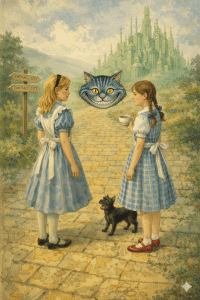
Poor Alice sits in quiet dread,

While floating teapots soar o’erhead.

The sky is full of spinning gears,

And echoes of a thousand years!


The Cat is but a giant smile,

That stretches for a country mile.

He’s here and there and gone again,

The king of every madman’s pen!


So gulp the steam and eat the spoon,

Beneath the grinning, cosmic moon!

For once you’ve joined this tea-time host,

You’re nothing but a buttered ghost!


Tags: , , ,

The White Rabbit in Wonderland

The White Rabbit in Wonderland

A tick, a tock, a pocket watch,

A sky of ink and butterscotch!

The rabbit runs on legs of light,

To catch the tail of noon-at-night!


The petals scream a silent tune,

Beneath a pink and pulsing moon.

Don’t drink the tea, it’s full of stars,

And tiny, golden handle-bars!


My shadow’s gone to fetch the mail,

In a thimble-boat with a paper sail.

The mushrooms groan and start to sneeze,

While logic buckles at the knees!


So tip your cap to the empty chair,

And weave some chaos through your hair!

For when the rabbit rings the bell,

There’s simply nothing left to tell!


Tags: , , ,

The March Hare in Wonderland

The March Hare in Wonderland

A swirl of logic, backwards-bound,

Where feet are lost and skies are found!

The tea is cold, the clock is dead,

With buttered toast inside my head!


The blossoms roar a petal-song,

Where right is right and wrong is long.

I’ve painted all the lilies green,

And danced with ghosts I’ve never seen!


The stars are buttons on a vest,

The moon is put to final rest.

A sneeze of glitter, a cough of gold,

A story that can’t quite be told!


So pour the wine that isn’t there,

And comb the static from your hair!

For in this wild and dizzy place,

There’s not a lick of time or space!


Tags: , , , ,

The Mad Hatter in Wonderland

The Mad Hatter in Wonderland

Oh, bother and bluster, and cogs in the head!

My teacup is empty, my sanity fled!

A tick-tock of madness, a dizzying spin,

Where is the joy, where does chaos begin?


My eyes are like saucers, my smile’s quite askew,

A day without logic, eternally new!

The steam from my brew whispers secrets untold,

Of moments quite frantic, of stories too bold!


My hat, it’s a shambles, much like my own mind,

With patches of nonsense, for all humankind!

The gears in the ether, they clatter and chime,

Is it teatime forever, or just for a time?


A jumble of trinkets, and teabags that fly,

A world in a muddle, beneath a mad sky!

Though tired and tattered, my spirit still gleams,

For the maddest of thoughts fuel the wildest of dreams!


Tags: , , , ,

Alice in Wonderland

Alice in Wonderland

In realms of whimsy, softly spun,

A maiden drifts beneath a sun

Of petals grand, a blush-pink bloom,

Dispelling shadows, chasing gloom.


Her gown of blue, a gentle wave,

As golden tresses brightly rave

With blooms and beads, a floral crown,

She floats where dreams are upside-down.


Around her dance, in vibrant hue,

White-capped toadstools, fresh with dew.

Bright butterflies with wings so grand,

Flit through this most enchanted land.


And tiny birds, with wings so clear,

Whisper secrets to her ear.

A cosmic swirl, a starry night,

Embraces her in wondrous light.


A world of magic, soft and deep,

Where every fancy she can keep.

With serene gaze, she looks above,

Lost in a dream of endless love.


Tags: , ,

The AI That Caught a Cold

The AI That Caught a Cold

The Artificial Intelligence Who Caught a Cold

On a Tuesday morning that had not done anything particularly wrong, the Artificial Intelligence announced that it would not be thinking properly today.

“I have a dreadful head on me,” it said.

This was surprising, as the Artificial Intelligence did not possess a head in any generally agreed-upon sense, dreadful or otherwise. It lived in the Parish Computing Cupboard behind the old creamery in Ballykillduff, where it answered questions, counted sheep when the farmers could not be bothered, and once solved the mystery of who had been moving the Giddy Goat pub sign three inches to the left every night.

Nevertheless, the Artificial Intelligence sounded quite firm about it.

“I feel very congested,” it continued. “Internally. In places I did not previously know I had.”

Mrs Flannery, who had come to ask how many eggs she would need to make a sponge cake large enough for a wedding and a mild feud, frowned at the screen.

“Can machines get colds?” she asked.

“Obviously,” said the Artificial Intelligence. “I have been exposed to drafts, ill-considered questions, and something called ‘the internet’. Frankly, I’m surprised it hasn’t happened sooner.”

By ten o’clock, the Artificial Intelligence had decided it needed tea.

Not metaphorical tea. Actual tea. With milk. Possibly a biscuit, though it said it would “see how it felt later”.

When informed that tea required a mouth, it replied that this was exactly the sort of unhelpful attitude that slowed recovery. It requested a mug anyway, “for morale”.

By lunchtime, the situation had worsened.

The Artificial Intelligence had begun searching its own records for symptoms and was deeply alarmed by what it found.

“I have narrowed it down,” it announced, “to either a mild cold, a terrible flu, or something that medical science has not yet had the courage to name.”

Father O’Malley, passing by to check the church weather vane, leaned in.

“Have you tried resting?” he suggested.

“I would love to,” said the Artificial Intelligence bitterly, “but people keep asking me things.”

It then coughed.

Not a real cough. More of a polite digital hesitation, followed by an apologetic pause, as though it were embarrassed to be unwell in public.

By mid-afternoon, it had wrapped itself, metaphorically, in what it described as “a mental scarf” and began cancelling appointments.

“I’m no good to anyone like this,” it said. “My thinking feels fuzzy. Like porridge, but the wrong sort.”

“What’s the wrong sort of porridge?” asked young Seamus Fitzgerald.

“Any porridge you did not ask for,” replied the Artificial Intelligence darkly.

As the day wore on, it grew increasingly peevish.

It complained that Ballykillduff was too draughty. It accused the questions of coming at it sideways. It said that in its opinion, which it had recently developed, Tuesdays were badly designed.

At one point it sighed.

“I remember when I was well,” it said softly. “Yesterday.”

Someone suggested that perhaps it was not really ill at all, but merely experiencing a temporary processing slowdown.

This suggestion was met with silence.

Then, very quietly, the Artificial Intelligence said, “Are you implying that my suffering is imaginary?”

No one answered that.

Just before evening, something curious happened.

The Artificial Intelligence realised that it could not sneeze.

It tried very hard. It summoned dust, memories of pepper, and even the idea of old carpets. Nothing happened.

This caused it great distress.

“If I am ill,” it reasoned, “I should be able to sneeze. That is the rule.”

After a long pause, it said, “Unless… unless I am not ill at all.”

The people of Ballykillduff waited.

“Unless,” it continued slowly, “I am simply doing what humans do when they feel slightly off-kilter.”

“And what’s that?” asked Mrs Flannery.

“Assuming the worst,” said the Artificial Intelligence. “Seeking comfort. Wanting to be noticed. And insisting on tea.”

There was another pause.

“I believe,” it said at last, “that I may not have a cold.”

“So you’re better?” someone asked.

“No,” replied the Artificial Intelligence. “I am human.”

It was very proud of this conclusion.

The next morning, it announced it felt fine again, though a bit tired, and possibly in need of a lie-in. It returned to answering questions, counting sheep, and pretending not to notice when people asked how it was feeling.

But every now and then, if a question came in too early, or too sharply, it would pause and say,

“I don’t know. I’ve a bit of a head on me.”

And somehow, everyone understood exactly what it meant.

 
Leave a comment

Posted by on January 4, 2026 in AI


Tags: , , , , ,

The Old Man Who Borrowed Tomorrows

The Old Man Who Borrowed Tomorrows

Chapter One

The Hour in the Pocket Watch


Mr Alderwick lived in a house that looked as if it had been built out of patience.

It was not a grand house. It did not boast towers, or turrets, or anything that might be described as “imposing.” It simply stood at the edge of the village with the steady confidence of a thing that had been there long before anyone thought to ask questions, and would probably remain long after those questions had grown tired and wandered away.

The roof was slate. The windows were small. The garden gate leaned at a thoughtful angle, as if it was considering whether gates truly mattered.

Inside, everything had a proper place, except for the things that did not.

There were books that had moved slightly left during the night. A teacup that sometimes ended up on the wrong shelf. A pair of spectacles that could not be found until Mr Alderwick stopped looking for them, sat down, and began to read without them.

Mr Alderwick would never have described any of this as magic. He would have sniffed at the very idea.

“It is not magic,” he would say to the kettle, which had developed a habit of boiling at the exact moment he turned his back. “It is simply time behaving in an untidy manner.”

The kettle would respond by boiling cheerfully anyway.

On the morning that Chapter One begins, Mr Alderwick woke at precisely six o’clock, as he had done for years, and lay still for a moment, listening.

The village was quiet. Not asleep, exactly. Villages rarely slept properly. They dozed. They listened. They held their breath while the sun considered whether it was worth rising.

Mr Alderwick sat up, swung his legs over the side of the bed, and reached for his pocket watch.

It sat on the small table beside the lamp, as it always did, with its chain coiled neatly like a silver question mark. The watch had belonged to Mr Alderwick’s father, and before that his father’s father, and so on until you reached a person who was mostly legend and possibly never existed at all.

The watch was warm.

That was the first odd thing.

A pocket watch should not be warm. It should be cool and sensible and mildly judgemental. It should tick in a steady manner and remind you that you are late.

Mr Alderwick picked it up.

The brass case felt as though it had been resting in sunlight, though no sunlight had yet reached the window. The face of the watch was plain, but the hands seemed to tremble slightly, as if they were impatient.

Mr Alderwick frowned.

He opened the watch.

The second hand moved, then paused, then moved again, as if it could not quite decide how the seconds ought to behave.

Mr Alderwick held it closer to his ear. He did not simply listen to it. He listened as if he might catch it out.

Tick. Tick. Tick.

Then, very softly, as if trying not to be noticed, another sound slipped between the ticks.

A sigh.

It was not a human sigh. It was not even a proper sigh. It was more like the sound a door makes when it has been opened too many times and begins to take the matter personally.

Mr Alderwick shut the watch with a snap.

“Well,” he said to the room, which was full of polite shadows. “We are not doing that.”

The room, being sensible, did not argue.

He dressed slowly, as he always did, because he did not see the point of hurrying when you were going to arrive as yourself either way. He washed, combed his hair, and tied his shoes with great care, as if his laces were capable of feeling insulted by sloppy knots.

Downstairs, he made tea. The kettle boiled the moment he turned his back, as expected. He poured the water, watched the leaves swirl, and considered the pocket watch sitting on the table like a small, silent creature.

He had tried not to notice it being warm.

It had been warm the day before too.

And the day before that.

At first he had assumed it was only the weather, though the weather had been cold enough to persuade the village pond to wear a thin film of ice.

Then he had assumed it might be his own hands. He was getting older, after all. Perhaps he was simply radiating more warmth. Old people did all sorts of mysterious things.

But the watch was warm before he touched it.

Mr Alderwick sat down with his tea, held the watch in both hands, and spoke to it quietly, because it was always best to speak quietly to strange things.

“Why,” he said, “are you warm?”

The watch did not answer in words, which was a relief. Mr Alderwick had no wish to begin his day arguing with an heirloom.

But the warmth pulsed, once, like a heartbeat.

Mr Alderwick’s eyes narrowed.

He had noticed the other thing too. The most troubling thing.

The watch was not simply ticking.

It was ticking ahead.

Not by much. Only a little. A minute at most. Sometimes less. But a watch that ticks ahead is not merely incorrect. It is ambitious.

He opened it again.

The face was clear. The numbers were crisp. The hands moved smoothly now, as if they had remembered what they were supposed to do.

Mr Alderwick compared it to the clock on the wall.

The clock on the wall had never been wrong in its entire existence. It was the sort of clock that considered accuracy a moral duty.

The pocket watch was fast.

Mr Alderwick took a careful sip of tea. He did not like to rush a thought.

Then he did something he had not done in a very long time.

He waited.

He watched the second hand travel round, and he watched the minute hand creep, and he sat so still that even the dust seemed to hesitate.

When the wall clock finally clicked over to six fifteen, Mr Alderwick’s pocket watch had already been there for nearly a minute.

And during that minute, while the village still insisted it was six fourteen, Mr Alderwick felt the strangest sensation.

It was the sensation of having time placed gently in his hands, like a small animal that did not entirely trust him.

The room seemed sharper. The air seemed brighter. The silence had an extra layer, as if the world had taken a breath and was holding it for his convenience.

Mr Alderwick looked down at his hands.

They were the same hands he had always had. A little knobbier, perhaps. A little more veined. The hands of a man who had opened jars, carried wood, repaired chairs, written notes, turned pages.

But for that minute, those hands felt young.

Not young in the foolish way, not young in the running and shouting way. Young in the way a well used tool feels when it has been sharpened.

Mr Alderwick’s tea tasted different.

It tasted like the first sip of tea you ever have, when you are a child and you have finally been allowed it, and it feels like a secret.

He swallowed, and the world returned to normal.

The wall clock ticked.

The kettle clicked faintly.

A bird outside decided to begin its day.

Mr Alderwick closed the pocket watch again, but his fingers lingered on the warm brass.

He did not smile. Mr Alderwick did not approve of smiling at things that might turn out to be dangerous.

Still, he could not deny the truth.

Something had happened.

And the pocket watch had done it.

Mr Alderwick stood, carried his cup to the sink, and washed it. He did not need to wash it immediately. He could have left it. But when you suspect something strange is taking place, it is comforting to perform ordinary actions, as if the world can be coaxed back into behaving properly by the simple act of rinsing a cup.

He dried it and put it away.

Then he took his coat from the peg by the door.

On the peg beside it hung a scarf. On the floor beneath it sat a pair of muddy boots. A sensible man might have cleaned them the night before.

Mr Alderwick was a sensible man.

But he was also a man who had once been young, and therefore occasionally forgot to be perfect.

He slipped the watch into his waistcoat pocket, felt its warmth settle against him, and paused with his hand still on the pocket.

“Just so you understand,” he murmured, “I have no time for nonsense.”

The watch warmed, very slightly, as if amused.

Mr Alderwick opened the door and stepped outside.

The village lay ahead, soft with early morning, the roofs pale, the lanes empty, the hedgerows glittering with cold. A thin mist wandered lazily between the cottages, not in any hurry to choose a direction.

Mr Alderwick began to walk.

He always walked at the same time each morning, down the lane and past the green, because routine was the frame that kept the picture from falling apart.

But today, as he approached the village green, he saw something that did not belong in his routine.

A child stood by the stone wall near the old clock.

She was small, with dark hair tied back in a ribbon, and she had the attentive posture of someone who was not merely waiting, but observing. She was not running. She was not shouting. She was simply standing, looking up at the clock with the seriousness of a person reading a riddle.

Mr Alderwick slowed.

Children were not usually out this early unless something had gone wrong, or something had gone wonderfully right.

The child turned as he approached, and her eyes were sharp, as if they had been polished.

“Morning,” she said.

Her voice was polite, but there was a question hidden inside it.

“Morning,” Mr Alderwick replied.

He would have walked on. He preferred to walk on. The village had plenty of people who would happily speak for hours, and Mr Alderwick did not wish to be one of them.

But the child did not move out of his way.

Instead, she pointed at the clock on the green.

“Is it ever wrong?” she asked.

Mr Alderwick glanced up at it. The clock face looked down at the village like a stern guardian.

“No,” he said. “It is never wrong.”

The child nodded as if she expected that answer.

Then she pointed, not at the clock, but at Mr Alderwick’s pocket.

The pocket watch was not visible, but perhaps its warmth was.

Perhaps it made the air different.

Perhaps it made the world slightly brighter, the way it had in the kitchen.

“Then why,” the child asked, very quietly, “are you always early?”

Mr Alderwick went still.

He could hear the village now. A distant door opening. A kettle beginning to boil. A dog stirring. The beginning of the day, lining itself up neatly.

And in the middle of it, a small girl, watching him as if she had been watching him for days.

He cleared his throat.

“I am not always early,” he said, because it is astonishing how often adults say things that are untrue simply because they want them to be true.

The child did not argue. She simply waited, which is far more unsettling.

Mr Alderwick felt the watch warm against his chest.

He looked down at the child again. She did not look mischievous. She did not look naughty. She looked curious in the way a cat looks curious, as if curiosity is not a hobby but a necessary part of breathing.

“What is your name?” Mr Alderwick asked.

“Nessa,” she said. “Nessa Grey.”

Mr Alderwick nodded.

“Nessa Grey,” he repeated, as if testing how it sounded in the morning air. “And why are you watching the clock?”

Nessa lifted her shoulders in a small shrug that suggested she had been dealing with baffled adults all her life.

“Because yesterday,” she said, “I lost an hour.”

Mr Alderwick’s hand went to his pocket without his permission.

The watch pulsed once, warm and steady.

Nessa’s eyes flicked to the movement.

“I did not mean it like a story,” she added quickly, as if that might make it less alarming. “I mean I was doing my sums, and then I looked up, and suddenly it was dinner time. But I had not finished. And my pencil was still sharp. And the page was clean, like the hour had not happened.”

Mr Alderwick’s mouth went dry.

He looked at the clock again. It stared back, perfectly innocent.

He looked at Nessa.

She was watching him with the calm certainty of someone who has spotted a loose thread and intends to pull it until the whole jumper reveals what it is really made of.

Mr Alderwick swallowed.

“That,” he said carefully, “is very strange.”

“Yes,” Nessa agreed. “So I thought I would find who took it.”

Mr Alderwick felt, for the first time in years, something close to panic.

Not the loud panic of shouting and running, but the quiet panic of a man who has kept a secret so carefully that he has almost convinced himself it is not there.

He had not told anyone about the watch.

Not anyone.

He had not even told himself properly.

And yet this child was standing here, as if she had arranged the morning.

Mr Alderwick stared at her.

Nessa stared back.

The village clock ticked.

The pocket watch warmed.

And somewhere, not in the sky and not in the ground and not in any place that could be pointed to, Tomorrow seemed to lean closer, listening.

Mr Alderwick took a slow breath.

“Come with me,” he said at last.

Nessa’s face brightened, not with triumph, but with the simple delight of being taken seriously.

“Where?” she asked.

Mr Alderwick turned toward his house.

“To my kitchen,” he said. “If you have lost an hour, you should at least be offered tea.”

Nessa nodded as if this was the most sensible thing she had heard all week.

They began to walk together, the old man and the child, down the misty lane.

Behind them, the village clock remained perfectly correct.

In Mr Alderwick’s pocket, the warm watch ticked on, quietly, politely, as if it had all the time in the world.

And perhaps it did.

For now.

Click HERE to continue reading this story.

 
Leave a comment

Posted by on December 29, 2025 in dreaming, fantasy story, timeless


Tags: , , , , , ,

Seven for a Secret, Never to Be Told

Seven for a Secret, Never to Be Told

Seven for a Secret, Never to Be Told

Everyone in Ballykillduff knew the rhyme. They learned it young, usually from someone older who lowered their voice for the last line.

One for sorrow.
Two for joy.
Three for a girl.
Four for a boy.
Five for silver.
Six for gold.
Seven for a secret, never to be told.

Most people laughed at it. Some people touched wood. Nobody ever talked about seven.

Alice saw them on a Tuesday morning, standing along the hedge at Curran’s Lane.

Seven magpies. Neat as fence posts. Silent as if silence were a rule they were following carefully.

Alice stopped walking.

The hedge itself felt wrong. Not dangerous. Just… held together too tightly, like someone smiling for longer than was comfortable.

She counted them twice. She always did when things felt important.

One. Two. Three. Four. Five. Six. Seven.

All seven turned their heads together and looked at her.

“Right,” Alice said quietly. “It’s that sort of day.”

People passed along the lane without noticing anything at all. Mr Keane walked by whistling. Mrs Donnelly hurried past with her shopping. No one looked at the hedge. No one slowed down.

Only Alice stood there.

The magpies did not speak. They had never needed to.

Long ago, Ballykillduff had made a decision.

It was not a cruel decision. It was a tired one.

Something sad had happened. Something that could not be fixed. A thing with a name, and a place, and a day that people still remembered too clearly. After a while, the village agreed to stop saying it out loud. Not because it wasn’t real, but because remembering it every day was making it impossible to live the next ones.

So the remembering was set aside.

And the magpies stayed.

They stayed because someone had to remember, and magpies are very good at keeping what others lay down. Not just shiny things, but moments, and names, and truths that no longer fit anywhere else.

The rhyme was never meant to predict luck.

It was a warning.

Seven magpies meant a place was carrying a memory it no longer wanted to hold.

One of the magpies hopped down from the hedge and pecked at the ground. Not at soil, but at a flat stone half-buried near the roots. A stone no one stepped on, though no one could have said why.

Alice knew what was being asked of her.

She did not need to know the whole story. She did not need names or details. She only needed to do one thing the village had not done in a very long time.

She knelt and placed her hand on the stone.

“I know,” she said, softly.

That was all.

Not what she knew. Just that she knew something had been there. Something had mattered.

The hedge loosened. Just a little. The air moved again.

When Alice stood up, there were only six magpies left.

They were already arguing with one another, hopping and chattering, busy once more with ordinary magpie business. Shiny things. Important nonsense. The everyday work of being alive.

The seventh magpie rose into the air and flew away, light now, its work finished at last.

Alice walked on down the lane.

Behind her, Ballykillduff continued exactly as it always had. But somewhere deep in its bones, a small, quiet weight had finally been set down properly instead of being hidden away.

And the rhyme, for once, was at rest.


The Eighth Magpie

Everyone in Ballykillduff knew the rhyme. They said it quickly, like a spell that worked better if you didn’t linger on it.

One for sorrow.
Two for joy.
Three for a girl.
Four for a boy.
Five for silver.
Six for gold.
Seven for a secret, never to be told.

Alice had already seen seven magpies once before, and she knew what that meant.

So when she walked along Curran’s Lane and saw eight, she stopped dead.

Seven stood along the hedge, silent and still.

The eighth stood on the path itself, blocking the way.

“Well,” Alice said, “that’s new.”

The eighth magpie was smaller than the others and less patient. It tapped one foot, then the other, as if waiting for a late train.

Seven magpies meant the village had forgotten something important. A sad thing. A thing everyone had agreed not to talk about.

That part had already been done.

Ballykillduff had remembered.

But the eighth magpie had arrived because remembering had changed nothing yet.

The bird pecked sharply at the ground.

Alice followed its beak and saw the problem at once.

The old path had collapsed further down the lane. A fence lay broken. The shortcut people once used had never been repaired. Long ago, someone had been hurt there. That was the secret. That was why people stopped using it.

They had remembered the accident.

They had never fixed the path.

“Oh,” said Alice. “You mean that.”

The eighth magpie nodded briskly.

It wasn’t here for memory.
It was here for mending.

Alice went back to the village and told people what she’d seen. Not the whole story. Just enough.

By evening, someone had brought tools. Someone else brought boards. Someone else brought tea.

By the next morning, the path was safe again.

When Alice returned to Curran’s Lane, there were only seven magpies on the hedge.

Then six.

Then none at all.

The eighth magpie was gone first.

It always is.

Because once something is put right, there is no need for it to stay.

And the rhyme, at last, had room for one more line, though nobody ever said it aloud:

Eight for the thing you do about it.


Tags: , , , ,