The Grasshopper and the Fly
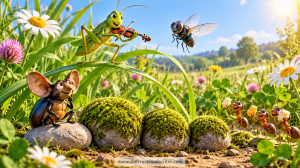
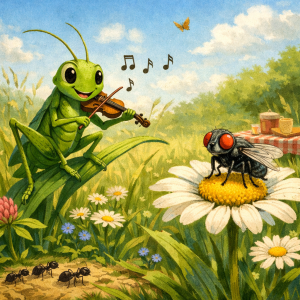
On a bright summer morning in a meadow that hummed gently with life, a grasshopper sat upon a tall blade of grass, playing the fiddle.
Now this was no ordinary grasshopper.
He played with such enthusiasm that the grass itself seemed to sway in time with the music.
Fiddle-dee-dee, fiddle-dee-dum,
went the bow as the grasshopper scraped out cheerful tunes for anyone who cared to listen.
A fly, who had been buzzing lazily through the warm air, happened to hear the music and landed on a nearby daisy.
“Good morning!” buzzed the fly.
“Good morning!” chirped the grasshopper, still fiddling away.
“Why are you making such a racket so early in the day?” asked the fly, tilting her head.
“It is not a racket,” said the grasshopper proudly. “It is music.”
“Well,” said the fly, “I prefer something a little quieter. But you do seem to be enjoying yourself.”
“I enjoy it greatly,” said the grasshopper. “Music makes the day brighter.”
The fly buzzed thoughtfully.
“I suppose that is true,” she admitted. “But you might consider doing something useful instead.”
“Useful?” said the grasshopper, lowering his fiddle.
“Yes,” said the fly. “I spend my time investigating things. Exploring. Visiting places. Finding interesting smells. It is very productive.”
“Productive?” asked the grasshopper.
“Certainly,” said the fly. “For instance, I discovered a magnificent jam sandwich on a picnic table yesterday.”
“That does sound interesting,” said the grasshopper politely.
“It was,” said the fly proudly. “And there were crumbs everywhere.”
The grasshopper considered this.
“Well,” he said at last, “that may be productive for you. But I believe music is useful too.”
“How?” asked the fly.
“Because,” said the grasshopper, lifting his fiddle again, “it makes people smile.”
Just then, a breeze drifted through the meadow.
The grass rustled.
The daisies nodded.
And a group of ants paused in their marching to listen.
The grasshopper began playing again.
Fiddle-dee-dee, fiddle-dee-dum.
The fly listened for a moment.
Then she buzzed gently in the air.
“You know,” she said, “that tune is rather pleasant.”
“Thank you,” said the grasshopper.
The fly hovered thoughtfully.
“I believe I shall stay and listen for a little while.”
And so she did.
For the rest of the morning the grasshopper played his fiddle, and the fly buzzed softly in time with the music.
And the meadow, which had already been a cheerful place, became just a little bit happier.
Which proves something rather important:
Even a fly who prefers jam sandwiches can enjoy a good tune on a sunny day.
The Grasshopper, the Fly and the Missing Music
The morning after their concert, the grasshopper climbed his favourite blade of grass, tucked his fiddle beneath his chin, and drew the bow across the strings.
Nothing happened.
He tried again. The bow moved. The strings trembled. But the meadow heard no music at all.
The fly landed on a daisy beside him.
“You’re playing very quietly today,” she said.
“I’m playing as loudly as I can.”
The fly listened. She heard the breeze, a bee arguing with a clover flower, and an ant dropping something heavy on his foot. She did not hear the fiddle.
“That is peculiar,” she said. “Play yesterday’s tune.”
The grasshopper played fiddle-dee-dee, fiddle-dee-dum. His feet tapped in time, but not a note reached the fly’s ears.
The ants gathered below. One of them had been looking forward to hearing the tune again. He stood with his lunch crumb in his hands, waiting for it to begin.
The grasshopper lowered his bow.
“Perhaps I’ve forgotten how.”
“You remembered every movement,” said the fly. “Let us find out where the sound has gone.”
They inspected the fiddle. The strings were sound, the little wooden body had no cracks, and the bow still smelled faintly of yesterday’s clover. The fly flew around it twice, then settled on the grasshopper’s shoulder.
“Play one note,” she said.
He did. The fly felt a tiny shiver beneath her feet.
“There!” she cried. “It is making music. Something is taking it before we can hear it.”
They followed the faint trembling down the blade of grass. At its foot sat a beetle with an enormous pair of ears. He had arranged four pebbles around himself and was smiling with his eyes closed.
The grasshopper played another note. The beetle’s left ear twitched.
“Excuse me,” said the fly. “Can you hear that fiddle?”
“Beautifully,” said the beetle. “I heard it yesterday too. I’ve been thinking about it all night.”
“Then why can nobody else hear it?”
The beetle opened his eyes and noticed the pebbles.
“Oh,” he said.
He had found them at dawn and placed them around his seat to make a comfortable little concert hall. Each pebble held a patch of soft, thick moss. The moss caught the fiddle’s vibrations as they travelled down the grass and swallowed them before they reached the meadow.
“I only wanted a good place to listen,” said the beetle, looking rather ashamed.
The grasshopper lifted one of the pebbles. The fly nudged another away. At once the grasshopper’s next note rang clear across the daisies.
The ant dropped his lunch crumb again.
“There it is!” he shouted.
The beetle began to move the remaining pebbles, but the grasshopper stopped him.
“Keep one for a seat,” he said. “You can listen beside us.”
So the beetle sat on his pebble, the ants retrieved their lunches, and the fly found a daisy with an excellent view. The grasshopper raised his bow and played the tune from beginning to end.
When he finished, the beetle clapped. The ants clapped too, though several were still holding crumbs. The fly buzzed the last few notes back to him.
“Did you enjoy investigating?” the grasshopper asked her.
“Very much,” said the fly. “We should do it again tomorrow.”
“I hope we shan’t need to.”
“Neither do I,” she said. “But I shall come and listen anyway.”