RSS

Category Archives: humour

The kitchen didn’t just smell like spices; it smelled like treachery.

The kitchen didn’t just smell like spices; it smelled like treachery.
The kitchen didn’t just smell like spices; it smelled like treachery.
Arthur Thorne, a baker with a temper shorter than a sourdough starter, stared at the tray of Hot Cross Buns before him. He had spent twelve hours meticulously hydrating the dough, sourcing currants from a specific hillside in Greece, and piping the flour-paste crosses with the precision of a neurosurgeon.
Then came the “Reviewer.”
The Incident
The local food critic, a man whose palate was as dry as his personality, had just taken a bite and muttered the forbidden word: “Ordinary.”
Arthur didn’t just get mad. He went volcanic.
The Dough: He slammed his fist into the next batch so hard the flour formed a mushroom cloud.
The Spices: He didn’t sprinkle the cinnamon; he pelted the bowl with it like he was trying to blind a giant.
The Crosses: He piped them on with such aggressive force that they looked like tiny, white scars across the golden skin of the bread.
The Transformation
Arthur shoved the tray into the oven, glaring through the glass. “Ordinary? I’ll give you ordinary,” he hissed. He cranked the heat, ignoring the gentle rise and demanding a crust of pure defiance.
When the timer dinged, it sounded like a battle cry. The buns didn’t just look hot; they looked furious, the glaze was bubbling like molten lava, and the steam rising from them carried a scent so sharp it could peel paint.
The Confrontation
He marched back into the dining room, the tray vibrating in his hands. He slammed a bun down in front of the critic.
“Eat it,” Arthur growled.
The critic hesitated. The bun was radiating a palpable, vengeful heat. He took a bite. The currants were like little bursts of sweet shrapnel. The nutmeg hit like a physical blow. The “cross” was a jagged mark of culinary war.
The critic’s eyes watered. He gasped for air, his face turning the color of a ripe cherry.
“It’s… it’s…”
“It’s what?” Arthur leaned in, his apron covered in the soot of his own rage.
“It’s… intense,” the critic squeaked.
Arthur finally exhaled. He didn’t care about the star rating anymore. He had successfully baked his own fury into a tea-time snack. He walked back to the kitchen, grabbed a rolling pin, and started on the next batch—this time, for the scones. And God help the person who called his scones “crumbly.”

To capture the raw, unbridled fury of Arthur Thorne, these aren’t your grandmother’s Sunday morning treats. We’re swapping the gentle warmth of cinnamon for a heat that demands respect.

This recipe uses a “tangzhong” method for the dough—not for softness, but because Arthur knows that a hydrated dough traps the vengeance better.


The “Spicy & Spiteful” Hot Cross Buns

Yields: 12 buns of pure defiance

Prep time: 2 hours of aggressive kneading

I. The Infusion of Rage

In a small saucepan, combine:

  • 250ml Whole milk

  • 2 Whole star anise (to be removed later)

  • 1 tsp Red chili flakes (crushed finely)

  • 5 Black peppercorns

Method: Heat until simmering, then remove from heat. Let it steep for 10 minutes so the milk absorbs the “attitude.” Strain and let cool to lukewarm.

II. The Dry Defiance

In a large bowl (or a stand mixer if you’re feeling lazy, though Arthur wouldn’t approve), whisk:

  • 500g Strong bread flour

  • 75g Caster sugar

  • 10g Fine sea salt

  • 7g Instant yeast

  • 2 tsp Ground ginger (for a sharp bite)

  • 1 tsp Cayenne pepper (the “spite” factor)

III. The Assembly

  1. The Hydration: Pour the infused milk and 1 large beaten egg into the dry mix. Knead until the dough is smooth, elastic, and looks like it could hold a grudge.

  2. The Inclusions: Aggressively fold in 150g of dark currants and 50g of chopped crystallized ginger. The ginger provides a sudden, sharp sting that keeps the critic on their toes.

  3. The Proof: Cover with a damp cloth and leave in a warm place for 1 hour. It should double in size, fueled by its own internal pressure.

IV. The Scarring (Crosses)

Mix 75g plain flour with enough water to make a thick paste. Add a drop of hot sauce to the paste—not for flavor, but for the principle of the thing. Pipe thick, jagged crosses over the risen buns.

V. The Incineration

Bake at 190°C for 15–20 minutes. You want them deep gold, almost bronze—a color that says, “I’ve seen things.”

VI. The Final Insult (Glaze)

While hot, brush with a mixture of:

  • 2 tbsp Apricot jam

  • 1 tsp Sriracha or chili oil


Baker’s Note: Serve these to anyone who uses the word “moist” or “ordinary” in your presence. The initial sweetness of the apricot glaze will lure them in, but the cayenne and black pepper finish will ensure they never forget your name.


Tags: , , ,

The Day the Hot Cross Buns Refused to Behave.

The Day the Hot Cross Buns Refused to Behave.

The Day the Hot Cross Buns Refused to Behave.

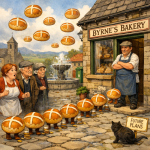
In Ballykillduff, there are certain things one may rely upon.
The post box is green.
The wind comes in sideways.
And on Good Friday, Mrs Flannery’s hot cross buns behave themselves.
Except, of course, for the year they didn’t.
It began, as all respectable disasters do, with a smell.
Not an ordinary smell—no, Ballykillduff had long ago grown accustomed to smells that suggested something mildly supernatural was occurring behind the butcher’s or under the bridge. This was a confident smell. A proud smell. A smell that marched down Main Street like it owned the place.
“Buns,” said Mr Byrne, the baker, stepping outside his shop and sniffing the air with professional concern. “Hot cross buns. And not mine.”
This was troubling. Mr Byrne’s buns were the official buns of Ballykillduff, having won the Annual Bun-Related Excellence Award three years running (and once by default when no one else remembered to bake any).
Mrs Flannery emerged from her shop just as the smell intensified.
“Do you smell that?” she asked.
“I do,” said Mr Byrne. “And I don’t like the tone of it.”
They followed the scent to the village square, where a small crowd had gathered around the fountain—the one that occasionally remembered things it hadn’t seen yet.
At first, no one spoke.
Then Jimmy McGroggan (who distrusted anything that rose, floated, or behaved optimistically) pointed upward.
“There,” he said. “Look.”
Hovering just above the fountain were buns.
Hot cross buns.
Not one or two, mind you—but dozens. They bobbed gently in the air like well-behaved balloons, each one perfectly golden, each one marked with a neat white cross, and each one—most suspiciously—steaming.
“Well,” said Mrs Flannery after a long pause. “That’s new.”
At precisely nine o’clock, the buns began to descend.
Now, in most villages, this would have caused panic. Screaming. Possibly the ringing of a bell.
In Ballykillduff, however, people simply stepped back slightly and allowed events to continue, as they generally did.
The buns landed neatly on the paving stones in a tidy arrangement that suggested either great intelligence or an alarming degree of organisation.
Then one of them bounced.
Just once.
A soft, polite bounce.
“Did you see that?” whispered someone.
Another bun rolled forward slightly, as if clearing its throat.
Then—quite without warning—the entire collection began to move.
They did not scatter.
That would have been understandable.
Instead, they arranged themselves into a queue.
A perfectly straight queue.
Facing Mr Byrne’s bakery.
Mr Byrne stared at them.
“I refuse,” he said firmly, “to be queued at by baked goods.”
The buns waited.
There was no pushing, no jostling, no attempt to skip ahead. If anything, they were more polite than the average Ballykillduff resident on a busy morning.
After a moment, the front bun gave a small hop forward and tapped—very gently—against the bakery door.
Tap.
Silence.
Tap tap.
Mr Byrne folded his arms.
“I’m not serving them,” he said.
“You might have to,” said Mrs Flannery. “They seem committed.”
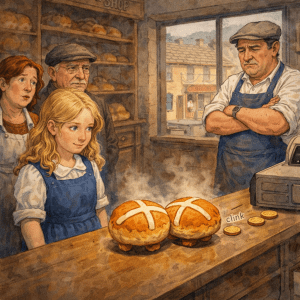
The situation escalated when the buns began producing exact change.
No one saw where the coins came from.
They simply… appeared. Small, neat piles of coins sat beside each bun, as if they had always been there and everyone had just been too distracted to notice.
Jimmy McGroggan crouched down and examined one.
“Well,” he muttered, “at least they’re paying customers.”
Reluctantly, Mr Byrne opened the door.
The buns shuffled forward.
One by one, they entered the shop.
What followed has since been described (in the official village minutes) as “a most peculiar but orderly transaction.”
Each bun approached the counter.
Paused.
Then nudged its coins forward.
Mr Byrne, after a long internal debate about the collapse of reality, handed each bun… another bun.
“No refunds,” he added automatically.
The buns accepted this.
They turned.
And left.
By mid-morning, Ballykillduff had a new problem.
There were now twice as many buns.
Because each bun had purchased a bun.
And those buns, it appeared, were just as capable of independent thought as the original batch.
“They’re multiplying,” said Mrs Flannery.
“They’re investing,” corrected Jimmy.
By noon, the buns had formed committees.
There was a Bun for Queue Management.
A Bun for Fair Distribution.
And, somewhat ominously, a Bun for Future Planning.
The village grew uneasy.
It is one thing for buns to bounce.
It is quite another for them to organise.
The crisis reached its peak at half past two, when the buns held a meeting in the square.
Mr Byrne, Mrs Flannery, Jimmy McGroggan, and several concerned residents gathered at a safe and respectful distance.
The Bun for Future Planning rolled to the front.
It cleared its… crust.
Then, with great dignity, it tipped itself slightly forward.
And stopped.
Nothing happened.
“Is that it?” asked someone.
“I think so,” said Mr Byrne.
They waited.
The buns remained perfectly still.
Then, slowly—very slowly—the steam began to fade.
The warmth softened.
The bounce diminished.
And, one by one, the buns simply… became buns.
Ordinary buns.
Still. Quiet. Entirely uninterested in commerce or governance.
By evening, Ballykillduff had returned to normal.
Mostly.
Mr Byrne gathered the remaining buns and placed them carefully on a tray.
“Well,” he said, “they seem harmless now.”
“Are you going to sell them?” asked Mrs Flannery.
Mr Byrne paused.
He considered the events of the day.
The queues.
The coins.
The committees.
The brief but undeniable sense that he had been professionally outperformed by his own product.
“No,” he said firmly. “These are not for sale.”
“What will you do with them?”
Mr Byrne looked out at the village square, where everything was once again behaving in a reasonably predictable manner.
“I think,” he said slowly, “we shall eat them… quietly… and not discuss this ever again.”
And that is precisely what Ballykillduff did.
Except, of course, for one small detail.
The next morning, when Mr Byrne opened the bakery door, he found—neatly arranged on the counter—
A single coin.
And beside it…
One perfectly warm, very fresh hot cross bun.
Waiting its turn.
*************************************************************
Epilogue — The Bun That Waited
The following morning in Ballykillduff arrived with its usual sense of mild uncertainty.
The post box was green (as expected).
The wind was sideways (as required).
And Mr Byrne opened his bakery door with the careful expression of a man who had been professionally challenged by baked goods and was not eager for a rematch.
There, upon the counter, sat the bun.
Neat. Warm. Patient.
And beside it—
A single coin.
Mr Byrne stared at it for a long time.
“Well,” he said at last, “we are not doing this again.”
“Doing what?” came a voice behind him.
He turned.
Standing in the doorway, brushing a stray lock of long blonde hair from her face, was a girl in a blue pinafore dress, looking at the bun with great interest.
“I’m fairly certain,” she said, stepping inside, “that this is the sort of thing one ought to investigate.”
Mr Byrne narrowed his eyes.
“You’re not from here.”
“No,” said Alice pleasantly. “But I do seem to arrive in places just as they begin to behave oddly. Or perhaps I arrive because they already have.”
She leaned closer to the bun.
It did not move.
But it did seem, in a way that was difficult to prove, to be waiting.
“For what?” asked Mr Byrne.
Alice considered this.
“For its turn,” she said.
“That’s what I was afraid of.”
Mrs Flannery appeared moments later, followed by Jimmy McGroggan, who had come prepared for disappointment and, if necessary, mild outrage.
“What’s the situation?” Jimmy asked.
Mr Byrne pointed.
“The situation,” he said, “is that we have a bun. A coin. And a sense of unfinished business.”
Jimmy squinted.
“It looks quiet enough.”
Alice smiled.
“Oh, things often do—right up until they aren’t.”
There was a pause.
The kind of pause Ballykillduff understood well.
A pause in which something might happen… or might decide not to… or might wait just long enough to be inconvenient.
Then, very gently—
The bun gave a small bounce.
Just once.
Jimmy stepped back.
“I knew it,” he said. “Optimism.”
The coin slid forward by the smallest imaginable distance.
Clink.
Mr Byrne closed his eyes.
“No committees,” he muttered. “No queues. No financial independence.”
Alice, however, looked delighted.
“Oh, I don’t think it wants all that again,” she said. “I think it only wants to see what happens next.”
“And what does happen next?” asked Mrs Flannery.
Alice straightened.
She looked at the bun.
Then at the coin.
Then at Mr Byrne.
“Well,” she said, very gently, “it’s paid.”
Mr Byrne hesitated.
He glanced at the shelves.
At the ovens.
At the quiet, perfectly ordinary buns that had returned to their proper, non-ambitious state.
Then he sighed.
“All right,” he said. “But just the once.”
He reached behind the counter and picked up a fresh hot cross bun.
He placed it carefully in front of the waiting one.
“There,” he said. “Transaction complete.”
The bun did not move immediately.
It seemed to consider the moment.
Then—
It nudged the new bun slightly.
As if acknowledging it.
As if passing something on.
And then—
It settled.
Perfectly still.
Entirely ordinary.
Alice watched this with great satisfaction.
“You see?” she said.
“No,” said Jimmy. “I don’t.”
“It didn’t want to multiply,” Alice explained. “It didn’t want to organise. It didn’t even want to queue.”
“What did it want, then?” asked Mrs Flannery.
Alice smiled.
“To finish.”
There was a quietness in the bakery then.
A soft, settled sort of quiet.
The kind that comes after something has made up its mind to stop being peculiar.
Mr Byrne looked at the two buns.
Then, cautiously, he picked one up.
It behaved.
He took a bite.
It was excellent.
“Well,” he said after a moment, “that’s that, then.”
Alice stepped back toward the door.
“Will you be staying?” asked Mrs Flannery.
Alice shook her head.
“No, I think not. Things seem to be concluding here.”
She paused.
Then added, with a thoughtful look toward the counter—
“Though one never knows when something might decide it hasn’t quite finished after all.”
Jimmy groaned.
“Don’t say that.”
And with that, Alice stepped out into Ballykillduff.
The wind caught her hair.
The village carried on.
And inside the bakery, everything remained exactly as it ought to be.
Except—
If you looked very closely—
You might notice, tucked just behind the till—
A second coin.
Waiting.
Not impatiently.
Just… patiently enough.
 

Tags: , , , , ,

Reflections of Alice: A Tale of Two Selves.

Reflections of Alice: A Tale of Two Selves.

An original tale inspired by Lewis Carroll’s

Alice’s Adventures in Wonderland.

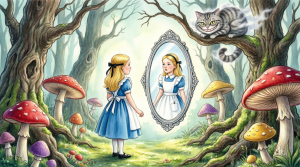
The mirror did not hang on a wall, nor did it rest upon a stand. It floated in the middle of the Tulgey Wood, suspended in the air like a bubble made of silver glass. Alice stopped, adjusting the skirt of her dress. She had been chasing the White Rabbit—or perhaps he had been chasing her; directions were notoriously unreliable in these parts—when she stumbled upon it.
She approached cautiously. She knew better than to touch strange objects without checking for labels reading DRINK ME or DO NOT TOUCH, but the mirror seemed harmless enough. It reflected the wood behind her: the twisted trees, the oversized mushrooms, the path that wound like a confused snake.
And it reflected Alice.
But the Alice in the mirror did not stop when Alice stopped.
The reflection stepped forward. There was a sound like a sharp intake of breath, a pop of pressure, and the girl in the glass stepped out of the frame. She landed on the moss with a soft thud, dusting off her hands.
Alice blinked. She rubbed her eyes and blinked again.
The newcomer stood before her. She wore the same blue dress with the same white apron. She had the same golden hair tied with the same black ribbon. But where Alice’s hair was parted on the left, this girl’s was parted on the right. Where Alice’s apron pocket was on her left hip, this girl’s was on the right.
“Good afternoon,” said the double. Her voice was Alice’s, but the cadence was slightly off, like a song played on a piano that had been tuned a fraction too high.
“Good afternoon,” Alice replied, instinctively curtsying. “Or perhaps it is morning. Time is difficult to keep track of here.”
“It is exactly half-past nonsense,” the double said. She did not curtsy. Instead, she tilted her head, examining Alice with a critical eye. “You look terribly confused. It suits you.”
“I am not confused,” Alice said, drawing herself up to her full height (which was currently three feet and two inches). “I am merely… observing. Who are you?”
“I am Alice,” the double said simply.
“No,” Alice countered, feeling a surge of frustration. “I am Alice. You cannot be Alice. There is only one of me. I am quite sure of it.”
“Are you?” The double walked around her, inspecting her from behind. “How do you know? Have you checked your labels? Have you tested your memory? For all you know, you are the reflection, and I am the original.”
Alice felt a cold shiver run down her spine, unrelated to the temperature of the wood. “I remember falling down the rabbit hole. I remember the tea party. I remember the Queen’s croquet ground.”
“I remember those too,” the double said, plucking a flower from a nearby bush. She smelled it and sneezed. “But I remember them differently. In my memory, the Hatter was polite. In my memory, the Queen was kind. In my memory, I never cried in the Pool of Tears.”
Alice stiffened. “I did not cry. Well, only a little. It was a very large pool.”
“You cry when you are frightened,” the double said. “I do not. I find that makes things much easier.”
The Cheshire Cat appeared then, fading in branch by branch upon a bough above them. He grinned his wide, impossible grin.
“Two Alices?” the Cat purred, his tail flicking. “How curious. Usually, one is quite enough to cause trouble. Two might cause a paradox.”
“Which one is real, Cat?” asked the double, looking up.
“Real?” The Cat chuckled. “In this wood, reality is a matter of opinion. You are both real enough to be lost. You are both real enough to be found. It depends on which way you’re walking.”
“I walk forward,” said Alice.
“I walk backward,” said the double. “It saves time on the return journey.”
Alice frowned. “That doesn’t make any sense.”
“It makes perfect sense in the Looking-Glass,” the double said. “I come from the other side of the glass. Where everything is opposite. You are polite; I am blunt. You ask permission; I take ownership. You wonder what the world is; I tell the world what I am.”
Alice looked at her double. She saw the set of her jaw, the confidence in her stance. It was terrifying, but also… intriguing. How nice it would be, Alice thought, to not be afraid of the Queen. To not worry about saying the wrong thing. To simply *be*.
“If you are the opposite,” Alice said slowly, “then you must be everything I am not.”
“Precisely,” said the double. “Which means if we touch, we might cancel each other out. Like adding a number to its negative. Zero.”
“Or,” said the Cat, “you might multiply. Infinity is rather messier than zero.”
A trumpet blast sounded in the distance. The ground trembled slightly.
“The Queen!” Alice gasped, her heart leaping into her throat. “We must hide.”
“Why?” asked the double. “I have done nothing wrong.”
“She cuts off heads!”
“Let her try,” said the double. She smoothed her apron and stood squarely in the path.
The Queen of Hearts stormed into the clearing, a procession of playing cards trailing behind her. She held a flamingo under her arm and glared at the pair.
“What is this?” the Queen bellowed. “Two of them? Is this a trick? A conspiracy? Why are there two Alices?”
“She is an impostor!” Alice cried, pointing at her double.
“She is a copy!” the double cried, pointing at Alice.
“Silence!” The Queen marched up to them, peering closely at their faces. She grabbed Alice’s chin, then the double’s chin. “Same nose. Same eyes. Same annoying habit of talking back.”
“I do not talk back,” Alice said.
“I talk back,” the double said. “And I enjoy it.”
The Queen grinned, a terrifying expression. “I like this one better. She has spirit. Off with the quiet one’s head!”
The Card soldiers raised their axes. Alice squeezed her eyes shut.
“Wait!” shouted the double.
The Queen paused. “Well? Do you wish to take her place?”
“No,” said the double. “But if you cut off her head, you cut off mine. We are reflections. You cannot have one without the other. If she disappears, I disappear. If I disappear, she disappears. Do you want no Alice at all, Your Majesty?”
The Queen frowned. She tapped her foot. The flamingo squawked. “A riddle. I hate riddles. They ruin the execution schedule.”
“It is not a riddle,” said the double. “It is logic. Even you must follow logic, or the game falls apart.”
The Queen huffed. “Fine. Keep your heads. Both of them. It’s too much trouble to sort out. Move along! All of you!”
The procession marched on, leaving the three of them in the clearing.
Alice opened her eyes. She was still whole. She looked at her double.
“You saved me,” Alice said.
“You saved yourself,” the double corrected. “I am you. My courage is your courage. You just left it behind in the glass.”
The double walked back toward the floating mirror. The surface rippled like water.
“Where are you going?” Alice asked.
“Back,” said the double. “I belong on the other side. But you… you should visit sometime. Bring your courage with you. It fits better here.”
She stepped into the mirror. For a moment, she stood on the other side, waving. Then the silver surface hardened, becoming just a glass pane again. Alice looked into it. She saw only herself.
But when she looked closer, she noticed something. Her hair was still parted on the left. Her pocket was still on the left. But her eyes… her eyes held a new steadiness. The fear was still there, but it was smaller.
“Curiouser and curiouser,” Alice whispered.
The Cheshire Cat faded away, leaving only his grin hanging in the air. “Infinity,” he murmured from nowhere. “Much better than zero.”
Alice turned and walked down the path. She did not check for labels. She did not wonder if she was dreaming. She simply walked forward, knowing that somewhere, in the glass, another Alice was walking backward, and that was perfectly alright.
 

Tags: , , , ,

The Gift That Didn’t Fit

Chapter One: The Immediate Chaos

The air in the Quince living room was thick with the suffocating scent of fresh pine and manufactured guilt. It was 11:37 PM on Christmas Eve, and sixteen-year-old Lily Quince was perched on the edge of the sofa, trying to ignore the dazzling, high-wattage shame radiating from the pile of wrapped goods under the tree.

“Honestly, Mom, why does a human being need a self-stirring cocoa mug?” Lily muttered, batting a stray, metallic ribbon off the sofa cushion and onto the carpet. “It’s exactly what’s wrong with Christmas. Too much stuff.”

Her little brother, Sam, only eight, nodded solemnly, his brow furrowed with devastating sincerity. He was crouched by the fireplace, sketching feverishly in a notebook. “That’s what I keep trying to tell Santa, Lily. We need effort, not expenditure.” He looked up, his eyes shining with pure, tragic longing. “I just hope he remembered the Woven Basket of Live Earthworms this year. I truly don’t know how I’ll run my pet farm without them.”

“You’ll be yearning for a ceramic garden gnome that plays the lute by morning.”

Lily froze, her hand hovering near the tin. “Did… did the shortbread just talk?”

“Was that about the worms?” Sam asked, looking hopeful.

Lily shook her head, feeling a cold dread replace her cynicism. Outside, the first flakes of snow began to fall, but the typical, cozy feeling of Christmas Eve was absent. Something felt fundamentally wrong with the world. Across the street, they heard the distinct sound of Mr. Henderson, the CEO, weeping inconsolably about his lack of a custom-made tuba.

The Silent Night is Loud

Lily slipped on her coat, unable to wait for morning. If the Shifter had affected the desires of the entire neighborhood, Christmas Day would be a disaster—or a surreal comedy show.

“I’m just getting some air,” she mumbled to Sam, who was now meticulously reviewing his notebook, listing the exact dimensions required for a thriving earthworm community.

The moment Lily stepped onto the porch, the magnitude of the problem hit her like a punch of frosted air. Usually, Christmas Eve was silent and respectful. Tonight, it was a discordant mess of frustration and absurd longing.

Mr. Henderson, usually an impeccably tailored man, was kneeling in his snow-dusted front yard, staring mournfully into an empty, expensive-looking violin case. “They didn’t listen!” he wailed to his terrified poodle. “They brought me a watch! I need the booming resonance! I need the tuba!”

Two doors down, Mrs. Petula, the neighborhood’s notorious gossip, was shrieking at her husband, clutching a gift-wrapped broomstick. “A stick, Gerald! You call this a gift? I explicitly asked for a custom-made chandelier constructed entirely of dried macaroni! My heart is broken!”

Lily pulled her hood tight. The Shifter hadn’t just changed what people wanted; it had filled the absence of that desired object with genuine, heart-wrenching disappointment. It was weaponized absurdity.

She rushed back inside, snatching the Chrono-Crumble Tin off the mantel. “Listen, you rusty, talking dessert container,” she whispered fiercely. “What did you do? And how do I turn you off?”

The grumpy butler voice sighed dramatically from inside the tin. “Oh, the drama! I simply adjusted expectations, young hero. And I am only deactivated by a truly Perfectly Thoughtful Gift. A transaction of the heart, not the wallet. Now, if you’ll excuse me, I need to observe the mailman lamenting his lack of a ceramic foot bath.”

Lily stared at the tin, then down at the gigantic pile of expensive, unwanted electronics destined for Sam. “A perfectly thoughtful gift,” she repeated. “Something that proves I know him.”

Suddenly, a memory sparked: the feeling of peeling away a piece of glow-in-the-dark putty—a tiny, molded star—from her mirror two Christmases ago. And a ridiculous, low-value object immediately sprang to mind: the Worry-A-Day Jar. A simple jar filled with 365 days of Sam’s cheesy jokes and encouraging observations. Lily had scoffed at it then. Now, it felt like the only non-absurd object left in the world.

“That’s it,” Lily whispered, ignoring the tin’s muffled giggling. “The jar. I have to find that jar.”


Chapter Two: The Search for the Sublime

Lily’s bedroom was a landscape of teenage archaeology, a place where sentimental objects went to be buried under layers of homework, fashion magazines, and forgotten technology. The room was the first place she looked for the Worry-A-Day Jar, and it instantly felt like searching for a needle in a haystack—a haystack that suddenly felt full of unwanted and cursed gifts.

She dug through her closet, shoving aside boxes of things she’d asked for but never really used. Under a pile of textbooks, she found a plastic, voice-activated diary she’d begged for last year. It beeped softly.

Diary: “My deepest desire is for a miniature, fully functioning, decorative garden hedge.”

Lily slammed the lid shut. The Shifter was still working its magic on things, too.

She pulled out her winter wear. There, tucked inside a ski boot, was the brightly colored, slightly misshapen Green and Purple Mitten that Sam had knitted two years ago—the one intended to replace the left mitten she always lost. She felt a pang of guilt, remembering how quickly she’d bought a professional black pair instead.

“A thoughtful gift,” Lily muttered, holding up the uneven wool. “This could have been it, except I tossed it aside.”

The Chrono-Crumble Tin, which she’d tucked under her arm like a mischievous football, offered a raspy chuckle. “Close, but no cigar. The magic requires perfect thoughtfulness, not near-perfect discardment. And besides,” the tin added with spite, “it’s nearly Christmas morning. You’re running out of time.”

A glance at her phone confirmed the tin’s warning: 1:15 AM.

Lily began tearing through her desk drawers, scattering papers, pens, and loose change. The desk was where the Jar belonged. Sam had presented it to her with such a proud, serious expression two years ago.

“It’s the Worry-A-Day Jar, Lily,” he had announced. “You open one slip when you’re worried. I filled it with things you need more than homework.”

Lily remembered politely putting it behind her laptop, deeming it too childish. She hadn’t even opened a week’s worth of slips. Now, the space was filled with charger cables and empty soda cans.

Frustration bubbling up, she accidentally kicked a box under her bed. It was a dusty container labeled “Old Toys.” She pulled it out, coughing in the dust cloud. The box contained all the childhood treasures she thought she had outgrown: old picture books, a handful of plastic dinosaurs, and—

Bingo.

Sitting nestled between a stuffed unicorn and a broken kaleidoscope was the Worry-A-Day Jar: a simple, painted mason jar, the lid wrapped with a glittery pipe cleaner, looking utterly out of place amidst the chaos of her teenage room.

Lily carefully lifted the jar. The hundreds of small, folded paper slips inside were the only thing that felt real and pure in the whole magical, ridiculous night.

“Okay, Shifter,” she whispered to the tin under her arm. “I have the tool. Tell me how to use it to reverse the spell.”

The Chrono-Crumble Tin cleared its metallic throat. “You must craft the desired gift—the earthworm basket—with an act of love so genuine that it proves you truly saw the recipient. The key is in the Jar, child. The key is in the words.”

Lily frowned. “The words? The terrible jokes and advice?”

“They are proof of his attention,” the Shifter corrected with a rare note of seriousness. “You need to read the slips, understand how he sees you, and reflect that sincerity back in your gift to him. Go now. The sun rises in four hours.”

Lily clutched the Jar and the Tin, the strange weight of the magical responsibility settling on her shoulders. She had to rush downstairs, read her brother’s heart, and then craft a perfectly thoughtful earthworm basket before the world woke up to the most disastrous, absurd Christmas morning in history.

Click HERE to read the rest of this story



Tags: , , , ,

The Ballykillduff Banger

The Ballykillduff Banger

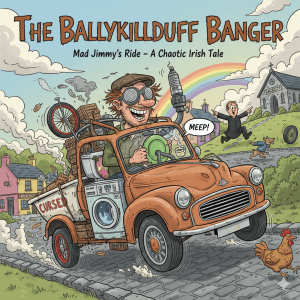
The Ballykillduff Banger (A Ballad of Mad Jimmy) 

(Verse 1) In Ballykillduff, where the grass is so green, Lived a man named Jimmy McGroggan, the wildest ever seen! They called him “Mad Jimmy”, but not for bad grace, He once tried to heat up the entire whole place! With a kettle and toaster, and a spring from a peg, He wasn’t quite right from the waist to the leg! He was just inventive, you see, a mechanical nut, Like a squirrel who stores nuts in a lawnmower’s gut!

(Chorus) Oh, the Ballykillduff Banger, a sight for sore eyes, A chariot of junk, underneath Irish skies! A mobile compost heap and a Transformer blue, Mad Jimmy’s creation, for me and for you! It’s got a wee wobble, it’s got a small cough, But when he got going, the wheel just fell off!

(Verse 2) Jimmy had a dream, not of riches or fame, But to drive a fine motor and utter its name! Now, banks made him sneeze and the law made him frown, So he built his own car from the junk of the town! The lads in the pub put their money down fast, They bet his poor shed wouldn’t properly last. His garden, a scrapyard, a magpie’s delight, With half a fridge, a pram, and a bathtub painted: “CURSED! DO NOT SIT TIGHT!”

(Verse 3) The chassis was bunk beds, all twisted and old, The engine from a lawnmower, the tale must be told! Four wheels he found, two from a trolley so bright, One from a wheelie bin, one from a unicycle‘s might! The steering wheel? Ah, a dinner plate grand, Glued fast to the shaft of a Dyson in hand! The horn was a bicycle bell, gave a “meep” when it cared, And the seat was a toilet with a cushion prepared!

(Chorus) Oh, the Ballykillduff Banger, a sight for sore eyes, A chariot of junk, underneath Irish skies! A mobile compost heap and a Transformer blue, Mad Jimmy’s creation, for me and for you! It’s got a wee wobble, it’s got a small cough, But when he got going, the wheel just fell off!

(Bridge) Sunday morning arrived, the townsfolk all near, Father Dunne kept his distance, quite sheltered by fear! Jimmy put on his goggles (a sieve with some film), The engine went “brrrrrrr” like a goat in a chill! He shot down the hill, then he spun to the side, Right into the hen house where Seamus’s chickens reside! Jimmy popped out the hole, with a feather on top, “She handles like a dream! Full of terror and POP!”

(Verse 4) They made a repair, added the bathtub as a seat, A microwave door for the glass, isn’t that neat? He tried one more time, on a hill stiff and steep, He made it just seven feet, then fell fast asleep! ‘Cause the wheel took a runner and flew down the slope, Chased by a child, a dog, and Father Dunne shouting: “NOPE! It’s heading for the Sacristy, oh dear, dear, dear!”

(Outro) Now the Banger is parked, an exhibit for sure, Tourists take selfies beside the front door. But Jimmy sits in it each Friday at dark, Sippin’ tea from a spark plug, just having a lark! Hands on the dinner plate, engine noises he’ll make, “Best car that I owned!” for goodness’ sweet sake! And smoke rises gently from somewhere amiss, But nobody tells him, they just nod and they kiss! Ah, nobody tells him otherwise!


Tags: , , , , , , ,

In strokes of night

In strokes of night
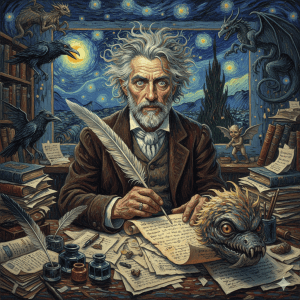
In strokes of night, where stars ignite the sky,
Gerard Wilson sits, with a wild, knowing eye.
His hair, a tempest, mirroring the scene,
A mind ablaze, where madness has been.
A quill in hand, his parchment alight,
With tales of shadows and creatures of night.
From raven’s perch to dragon’s dark form,
His thoughts take flight, weathering life’s storm.
Books stacked high, a fortress of lore,
Whispers of worlds, forevermore.
In Van Gogh’s embrace, a soul laid bare,
The crazy-mad writer, beyond all compare.
 

Tags: , , , ,

Circus of the Grotesques

Circus of the Grotesques

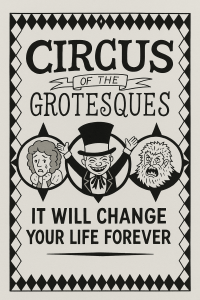
Circus of the Grotesques (It Will Change Your Life Forever)

(A song for Doctor Vaude and the people of Ballykillduff)

[Verse 1]
The fog came down on Ballykillduff,
With posters on the wall,
And no one saw the tent go up,
But everyone heard the call.
A shimmer of pearl and shadow black,
A sign with a curious lore:
“Admission, one memory, no refunds—
But you’ll never be quite as before.”

[Chorus]
🎵 Step inside, dear dreamers, step inside and see,
The Circus of the Grotesques, where you trade what used to be.
Give us one small moment that your heart can spare,
We’ll change your life forever—if you’ve the mind to dare. 🎵

[Verse 2]
Madame Tallow of Wax and Whispers danced,
Her words like smoke and fire,
She told your truth before you knew,
And left your thoughts to tire.
The Gentleman Beast in velvet shame,
Spoke softly of his fall—
And every soul in Ballykillduff
Felt beast and man in all.

[Chorus]
🎵 Step inside, dear dreamers, step inside and see,
The Circus of the Grotesques, where your secrets come to be.
We’ll mend your pain and polish your despair,
We’ll change your life forever—if you’ve the mind to dare. 🎵

[Bridge 1]
Clockwork Twins ticked time away,
A minute each for tears,
The Librarian turned blank white pages
Filled with gentle years.
The Cook of Impossible Flavours smiled,
“Have a taste of who you were.”
And somewhere in the tent that night,
The stars began to stir.

[Verse 3]
Norah O’Dea with her toffee stick,
Raised her hand so small,
Said, “I’ll be brave, and I’ll be changed,”
Before them, one and all.
The ringmaster bowed, his smile too bright,
The tent bent close to hear,
And Ballykillduff held its breath—
Between wonderment and fear.

[Chorus — Slower, Lamenting]
🎵 Step inside, dear dreamers, pay the price of air,
One small memory traded, one truth laid bare.
You’ll leave a little lighter, you’ll walk a little strange,
For the Circus of the Grotesques has a gift called change. 🎵

[Bridge 2]
They called her name three times in love,
And once with iron will,
The black salt hissed, the lights went white,
And time stood faintly still.
Norah faced the ringmaster proud,
Her eyes as bright as glass—
She said, “Let’s play a riddle’s game,
To see what comes to pass.”

[Verse 4]
“What grows lighter shared, yet heavy kept?”
The ringmaster asked the air.
Norah smiled, “A story told—
It lives when it’s laid bare.”
Her riddle came like April rain,
“The cost of kind undone?”
He sighed, “A knot within the dark—
Until it’s all unspun.”

[Final Chorus — Triumphant, Soft Echo]
🎵 Step inside, dear dreamers, step inside and see,
The Circus of the Grotesques set your memory free.
What you lose will find you, though it may rearrange,
No refunds ever needed—only change. 🎵

[Outro — Spoken softly, as if by Doctor Vaude]
“Forever,” we promised. “Change,” we gave.
Both are true, and both behave.
So mind your steps, remember the fair,
The tent is gone—but the air is there.

🎵 No refunds… plenty of change. 🎵


Tags: , , , , ,

Daleks in Toyland

Daleks in Toyland

The Daleks’ Day Out in Toyland (A Silly Adventure)

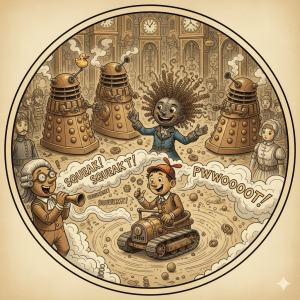
Noddy was polishing his steam-powered car, which now boasted a small, perpetually leaking tea kettle on the dashboard for emergency hot cocoa. His magnificent steam-whistle emitted a soft, contented “PWWWOOOOOT!” every time he buffed a rivet. Big Ears, ever the Gizmologist, was attempting to teach his pet clockwork mouse how to tap-dance on a tiny brass bell. Golliwog, officially an “Exemplar of Early Experimental Engineering,” was happily oiling his spring-coil hair, which shimmered with a delightful metallic bounce.

Suddenly, the sky above Clockwork City darkened, not with storm clouds, but with three colossal, heavily armoured, pepper-pot-shaped flying machines. They descended with an ominous, scraping sound, landing with heavy thuds in the town square, kicking up puffs of steam and scattering nervous automatons.

Out of each machine trundled a truly bizarre sight: a polished, bronze Dalek! Their eyestalks swiveled, their plungers twitched, and from their grating speakers came a sound that made Noddy’s wooden head throb.

“WE ARE THE DALEKS! WE SEEK TO ANNIHILATE ALL THAT IS… SILLY!” boomed the lead Dalek, its voice echoing off the clock towers.

Noddy, being Noddy, blinked. “Silly? But this is Toyland! We are all a little bit silly! It’s our primary function!”

“YOUR PRIMARY FUNCTION IS IRRELEVANT!” screeched a second Dalek, pointing its exterminator arm at a particularly fluffy teddy bear. “WE DETECT HIGH LEVELS OF UNNECESSARY WHIMSY! LOW EFFICIENCY! NO LOGICAL PURPOSE FOR BELL-RINGING OR SILLY SONGS!”

Big Ears, always the pragmatist (for a gnome-gizmologist), stepped forward. “Excuse me, bronze behemoths, but you seem to have misplaced your sense of fun. And possibly your internal navigation, because this is quite clearly not the ‘Planet of Utterly Serious Grey Things.'”

“DO NOT MOCK DALEK NAVIGATION!” the third Dalek whirred, its eyestalk flashing angrily. “OUR SENSORS DETECTED OPTIMAL TARGETING CONDITIONS FOR SILLINESS PURIFICATION! WE SHALL BEGIN BY EXTERMINATING… THE COLOR RED!”

Noddy gasped. “But my car is red! And my hat! And Golliwog’s trousers!”

“PRECIPITATE ACTION REQUIRED!” commanded the lead Dalek. “INITIATE ‘DE-SILLIFICATION PROTOCOL GAMMA-SEVEN’! ALL WHIMSY MUST BE… ERASED!”

The Daleks began trundling towards the town fountain, which was currently spouting rainbow-coloured water.

Golliwog, his spring-coil hair bouncing with a sudden surge of inspiration, whispered to Noddy and Big Ears, “Their sensors are designed for grand, terrifying things, yes? Not… not tiny silliness!”

Noddy’s oak head clicked. “Aha! We must be too silly for them to cope!”

Plan: Maximum Absurdity.

First, Big Ears pulled out his emergency “Gnome-Jammer” (which was actually just a broken kazoo). He blew into it with all his might. Instead of a jamming signal, it emitted a series of increasingly high-pitched squeaks, so utterly nonsensical that the Daleks’ eyestalks wobbled.

“ERROR! AUDIO INPUT TOO… HIGH-PITCHED! DALEK HEARING MODULES ARE DESIGNED FOR GRATING CRIES OF FEAR, NOT SQUEAKY TUNES!” blared one Dalek, momentarily forgetting about the red fountain.

Next, Golliwog sprang into action. He began to untangle his spring-coil hair at an astonishing speed, creating a chaotic, metallic, bouncy mess around his head. He then grabbed a handful of discarded gears and started juggling them, making silly faces and letting his hair bop wildly.

“ILLOGICAL VISUAL DATA! THE TARGET IS PERFORMING RANDOMIZED MANIPULATION OF GEARS WITHOUT APPARENT PURPOSE! AND ITS… ITS HEAD-SPRING-COILS ARE DEFYING DALEK LOGIC!” screeched a second Dalek, aiming its plunger arm at Golliwog, but it just sort of twitched in confusion.

Noddy, realizing this was his moment, jumped into his car. He didn’t just ring his steam whistle; he played a full-blown, cacophonous steam-whistle symphony! He then started driving in increasingly tight circles, making his little car spin like a crazed top, all while singing a song about marmalade and sausages at the top of his wooden lungs.

“STOP! CESSATION OF RANDOMIZED MANOEUVRES REQUIRED!” shouted the lead Dalek, its eyestalk swiveling so frantically it nearly popped off. “THE LEVELS OF SILLINESS ARE EXCEEDING DALEK CAPACITY FOR PROCESSING! OUR CIRCUITS ARE… OVERLOADING WITH WHIMSY!”

The Daleks started to emit small puffs of smoke from their various vents. Their plungers began to wiggle uncontrollably. One Dalek’s exterminator arm actually retracted and replaced itself with a tiny, confused rubber duck.

“RETREAT! RETREAT! TOO MUCH… INCONCEIVABLE JOY! LOGIC-CORE DEGRADING! DALEK PROTOCOL DICTATES EVASION OF EXCESSIVE HAPPINESS!”

With a series of frantic whirs and groans, the Daleks clumsily clanked back into their flying machines. With a final, desperate “EX-TER-MI-NATE… THIS! TOO! MUCH! FUN!” they ascended, leaving behind a faint smell of burnt circuits and slightly singed whimsy.

As the last Dalek ship vanished, Noddy’s car finally spun to a halt. Golliwog’s hair settled. Big Ears put away his kazoo.

“Well,” said Noddy, adjusting his propeller cap, “that was an exciting afternoon. Who knew that being utterly, ridiculously silly was our greatest defense against intergalactic tyrants?”

Big Ears nodded, polishing his clockwork spectacles. “It seems true brilliance lies not in absolute seriousness, but in the strategic deployment of sheer, unadulterated nonsense.”

Golliwog, after carefully re-coiling his hair, simply offered them both a perfectly-tied-with-string jam tart. “More tea, anyone?”

And so, Toyland returned to its normal, delightful level of regulated silliness, safe once more from the perils of being too logically efficient.


Tags: , , , ,

Steampunk Alice and a Very Mad Hatter

Steampunk Alice and a Very Mad Hatter

In cobbled lanes where gears convene,

Stood Alice, goggled, quite a queen.

Her skirts of bronze, her boots so grand,

A clockwork wonder, wand in hand.


Beside her, Hatter, wild and bright,

With fiery hair and eyes alight.

A grin so vast, a teethy show,

“More tea, more steam! Where did time go?”


His top hat brimmed with ticking gears,

Ignoring all sensible fears.

For in this world of brass and steam,

A very mad and wondrous dream!


Tags: , , , , ,

Alice tumbled into a fissure

Alice tumbled into a fissure

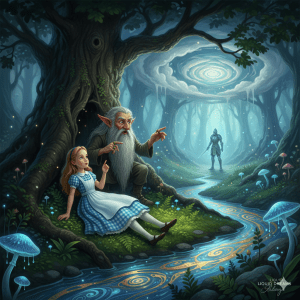
Alice found the elf by accident, as she found most things: by tumbling into them. This time, it wasn’t a rabbit hole, but a fissure in the earth, hidden by a blanket of moss and the shade of a weeping willow. She landed with a soft thump on a bed of ferns, her gingham dress a bright splash of blue in the dim, green light.

A pair of very, very old eyes blinked at her from the shadows of a gnarled oak. They were the color of faded leaves, and the wrinkles around them were like the rings of a tree. “Well, bless me,” a voice rasped, like dry leaves scuttling across a stone path. “Another one.”

Alice, never one to be flustered for long, brushed a stray leaf from her nose. “Another what?” she asked, her head tilted to the side.

“Another child who has lost their way,” the elf said, emerging from the gloom. He was slight and stooped, with a beard the color of winter frost. His name, he told her, was Fle. “I’ve seen so many. They all come seeking something. A way home, a lost toy, a purpose they’ve misplaced.”

Alice considered this. “I’m not lost, exactly,” she said. “I know where I am. I’m in a sort of underground forest, and you are a very old elf.”

Fle chuckled, a sound like gravel rolling down a hill. “Ah, but you are. Lost in the way that all mortals are. You are looking for an adventure, aren’t you?”

Alice’s eyes widened. “How did you know?”

“I’ve been watching the world for a very long time,” Fle said, settling himself on a mossy root. “And I’ve learned that the ones who fall into the quiet places are the ones who are looking for the loudest stories.” He gestured with a spindly finger to the world around them. “This place is full of them. The tales that have been forgotten. The songs that have been silenced.”

He told her a story of a talking mushroom that wept tears of light, and of a river that flowed with liquid dreams. He spoke of a queen who ruled over a kingdom of clouds, and a knight who wore armor made of moonlight. His words were like a spell, weaving pictures in the air, and Alice listened, her heart thrumming with the rhythm of his ancient tales.

“So, you see,” Fle said, when he had finished, “the world is not just a place to be. It is a place to be discovered. And sometimes, the most wonderful discoveries are found when you fall into the quiet places.”

Alice stood up, her blue dress a beacon in the twilight. “Thank you, Fle,” she said, her voice full of a new kind of wonder. “I think… I think I understand now. It’s not about finding my way back. It’s about finding my way forward.”

Fle smiled, a thousand years of wisdom in the gentle curve of his lips. “Precisely,” he said. And then, as quietly as he had appeared, he faded back into the shadows of the old oak, leaving Alice alone with the rustling ferns and the whispers of a thousand forgotten tales, ready to write her own.


Tags: , , , , ,