RSS

Category Archives: Stories for children

The Day the Hot Cross Buns Refused to Behave.

The Day the Hot Cross Buns Refused to Behave.

The Day the Hot Cross Buns Refused to Behave.

In Ballykillduff, there are certain things one may rely upon.
The post box is green.
The wind comes in sideways.
And on Good Friday, Mrs Flannery’s hot cross buns behave themselves.
Except, of course, for the year they didn’t.
It began, as all respectable disasters do, with a smell.
Not an ordinary smell—no, Ballykillduff had long ago grown accustomed to smells that suggested something mildly supernatural was occurring behind the butcher’s or under the bridge. This was a confident smell. A proud smell. A smell that marched down Main Street like it owned the place.
“Buns,” said Mr Byrne, the baker, stepping outside his shop and sniffing the air with professional concern. “Hot cross buns. And not mine.”
This was troubling. Mr Byrne’s buns were the official buns of Ballykillduff, having won the Annual Bun-Related Excellence Award three years running (and once by default when no one else remembered to bake any).
Mrs Flannery emerged from her shop just as the smell intensified.
“Do you smell that?” she asked.
“I do,” said Mr Byrne. “And I don’t like the tone of it.”
They followed the scent to the village square, where a small crowd had gathered around the fountain—the one that occasionally remembered things it hadn’t seen yet.
At first, no one spoke.
Then Jimmy McGroggan (who distrusted anything that rose, floated, or behaved optimistically) pointed upward.
“There,” he said. “Look.”
Hovering just above the fountain were buns.
Hot cross buns.
Not one or two, mind you—but dozens. They bobbed gently in the air like well-behaved balloons, each one perfectly golden, each one marked with a neat white cross, and each one—most suspiciously—steaming.
“Well,” said Mrs Flannery after a long pause. “That’s new.”
At precisely nine o’clock, the buns began to descend.
Now, in most villages, this would have caused panic. Screaming. Possibly the ringing of a bell.
In Ballykillduff, however, people simply stepped back slightly and allowed events to continue, as they generally did.
The buns landed neatly on the paving stones in a tidy arrangement that suggested either great intelligence or an alarming degree of organisation.
Then one of them bounced.
Just once.
A soft, polite bounce.
“Did you see that?” whispered someone.
Another bun rolled forward slightly, as if clearing its throat.
Then—quite without warning—the entire collection began to move.
They did not scatter.
That would have been understandable.
Instead, they arranged themselves into a queue.
A perfectly straight queue.
Facing Mr Byrne’s bakery.
Mr Byrne stared at them.
“I refuse,” he said firmly, “to be queued at by baked goods.”
The buns waited.
There was no pushing, no jostling, no attempt to skip ahead. If anything, they were more polite than the average Ballykillduff resident on a busy morning.
After a moment, the front bun gave a small hop forward and tapped—very gently—against the bakery door.
Tap.
Silence.
Tap tap.
Mr Byrne folded his arms.
“I’m not serving them,” he said.
“You might have to,” said Mrs Flannery. “They seem committed.”
The situation escalated when the buns began producing exact change.
No one saw where the coins came from.
They simply… appeared. Small, neat piles of coins sat beside each bun, as if they had always been there and everyone had just been too distracted to notice.
Jimmy McGroggan crouched down and examined one.
“Well,” he muttered, “at least they’re paying customers.”
Reluctantly, Mr Byrne opened the door.
The buns shuffled forward.
One by one, they entered the shop.
What followed has since been described (in the official village minutes) as “a most peculiar but orderly transaction.”
Each bun approached the counter.
Paused.
Then nudged its coins forward.
Mr Byrne, after a long internal debate about the collapse of reality, handed each bun… another bun.
“No refunds,” he added automatically.
The buns accepted this.
They turned.
And left.
By mid-morning, Ballykillduff had a new problem.
There were now twice as many buns.
Because each bun had purchased a bun.
And those buns, it appeared, were just as capable of independent thought as the original batch.
“They’re multiplying,” said Mrs Flannery.
“They’re investing,” corrected Jimmy.
By noon, the buns had formed committees.
There was a Bun for Queue Management.
A Bun for Fair Distribution.
And, somewhat ominously, a Bun for Future Planning.
The village grew uneasy.
It is one thing for buns to bounce.
It is quite another for them to organise.
The crisis reached its peak at half past two, when the buns held a meeting in the square.
Mr Byrne, Mrs Flannery, Jimmy McGroggan, and several concerned residents gathered at a safe and respectful distance.
The Bun for Future Planning rolled to the front.
It cleared its… crust.
Then, with great dignity, it tipped itself slightly forward.
And stopped.
Nothing happened.
“Is that it?” asked someone.
“I think so,” said Mr Byrne.
They waited.
The buns remained perfectly still.
Then, slowly—very slowly—the steam began to fade.
The warmth softened.
The bounce diminished.
And, one by one, the buns simply… became buns.
Ordinary buns.
Still. Quiet. Entirely uninterested in commerce or governance.
By evening, Ballykillduff had returned to normal.
Mostly.
Mr Byrne gathered the remaining buns and placed them carefully on a tray.
“Well,” he said, “they seem harmless now.”
“Are you going to sell them?” asked Mrs Flannery.
Mr Byrne paused.
He considered the events of the day.
The queues.
The coins.
The committees.
The brief but undeniable sense that he had been professionally outperformed by his own product.
“No,” he said firmly. “These are not for sale.”
“What will you do with them?”
Mr Byrne looked out at the village square, where everything was once again behaving in a reasonably predictable manner.
“I think,” he said slowly, “we shall eat them… quietly… and not discuss this ever again.”
And that is precisely what Ballykillduff did.
Except, of course, for one small detail.
The next morning, when Mr Byrne opened the bakery door, he found—neatly arranged on the counter—
A single coin.
And beside it…
One perfectly warm, very fresh hot cross bun.
Waiting its turn.
*************************************************************
Epilogue — The Bun That Waited
The following morning in Ballykillduff arrived with its usual sense of mild uncertainty.
The post box was green (as expected).
The wind was sideways (as required).
And Mr Byrne opened his bakery door with the careful expression of a man who had been professionally challenged by baked goods and was not eager for a rematch.
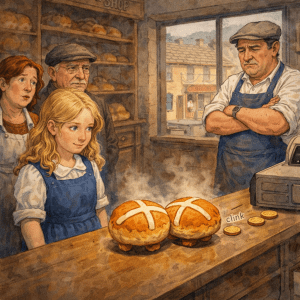
There, upon the counter, sat the bun.
Neat. Warm. Patient.
And beside it—
A single coin.
Mr Byrne stared at it for a long time.
“Well,” he said at last, “we are not doing this again.”
“Doing what?” came a voice behind him.
He turned.
Standing in the doorway, brushing a stray lock of long blonde hair from her face, was a girl in a blue pinafore dress, looking at the bun with great interest.
“I’m fairly certain,” she said, stepping inside, “that this is the sort of thing one ought to investigate.”
Mr Byrne narrowed his eyes.
“You’re not from here.”
“No,” said Alice pleasantly. “But I do seem to arrive in places just as they begin to behave oddly. Or perhaps I arrive because they already have.”
She leaned closer to the bun.
It did not move.
But it did seem, in a way that was difficult to prove, to be waiting.
“For what?” asked Mr Byrne.
Alice considered this.
“For its turn,” she said.
“That’s what I was afraid of.”
Mrs Flannery appeared moments later, followed by Jimmy McGroggan, who had come prepared for disappointment and, if necessary, mild outrage.
“What’s the situation?” Jimmy asked.
Mr Byrne pointed.
“The situation,” he said, “is that we have a bun. A coin. And a sense of unfinished business.”
Jimmy squinted.
“It looks quiet enough.”
Alice smiled.
“Oh, things often do—right up until they aren’t.”
There was a pause.
The kind of pause Ballykillduff understood well.
A pause in which something might happen… or might decide not to… or might wait just long enough to be inconvenient.
Then, very gently—
The bun gave a small bounce.
Just once.
Jimmy stepped back.
“I knew it,” he said. “Optimism.”
The coin slid forward by the smallest imaginable distance.
Clink.
Mr Byrne closed his eyes.
“No committees,” he muttered. “No queues. No financial independence.”
Alice, however, looked delighted.
“Oh, I don’t think it wants all that again,” she said. “I think it only wants to see what happens next.”
“And what does happen next?” asked Mrs Flannery.
Alice straightened.
She looked at the bun.
Then at the coin.
Then at Mr Byrne.
“Well,” she said, very gently, “it’s paid.”
Mr Byrne hesitated.
He glanced at the shelves.
At the ovens.
At the quiet, perfectly ordinary buns that had returned to their proper, non-ambitious state.
Then he sighed.
“All right,” he said. “But just the once.”
He reached behind the counter and picked up a fresh hot cross bun.
He placed it carefully in front of the waiting one.
“There,” he said. “Transaction complete.”
The bun did not move immediately.
It seemed to consider the moment.
Then—
It nudged the new bun slightly.
As if acknowledging it.
As if passing something on.
And then—
It settled.
Perfectly still.
Entirely ordinary.
Alice watched this with great satisfaction.
“You see?” she said.
“No,” said Jimmy. “I don’t.”
“It didn’t want to multiply,” Alice explained. “It didn’t want to organise. It didn’t even want to queue.”
“What did it want, then?” asked Mrs Flannery.
Alice smiled.
“To finish.”
There was a quietness in the bakery then.
A soft, settled sort of quiet.
The kind that comes after something has made up its mind to stop being peculiar.
Mr Byrne looked at the two buns.
Then, cautiously, he picked one up.
It behaved.
He took a bite.
It was excellent.
“Well,” he said after a moment, “that’s that, then.”
Alice stepped back toward the door.
“Will you be staying?” asked Mrs Flannery.
Alice shook her head.
“No, I think not. Things seem to be concluding here.”
She paused.
Then added, with a thoughtful look toward the counter—
“Though one never knows when something might decide it hasn’t quite finished after all.”
Jimmy groaned.
“Don’t say that.”
And with that, Alice stepped out into Ballykillduff.
The wind caught her hair.
The village carried on.
And inside the bakery, everything remained exactly as it ought to be.
Except—
If you looked very closely—
You might notice, tucked just behind the till—
A second coin.
Waiting.
Not impatiently.
Just… patiently enough.
 

Tags: , , , , ,

Reflections of Alice: A Tale of Two Selves.

Reflections of Alice: A Tale of Two Selves.

An original tale inspired by Lewis Carroll’s

Alice’s Adventures in Wonderland.

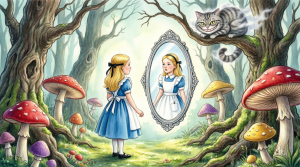
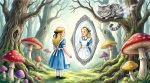
The mirror did not hang on a wall, nor did it rest upon a stand. It floated in the middle of the Tulgey Wood, suspended in the air like a bubble made of silver glass. Alice stopped, adjusting the skirt of her dress. She had been chasing the White Rabbit—or perhaps he had been chasing her; directions were notoriously unreliable in these parts—when she stumbled upon it.
She approached cautiously. She knew better than to touch strange objects without checking for labels reading DRINK ME or DO NOT TOUCH, but the mirror seemed harmless enough. It reflected the wood behind her: the twisted trees, the oversized mushrooms, the path that wound like a confused snake.
And it reflected Alice.
But the Alice in the mirror did not stop when Alice stopped.
The reflection stepped forward. There was a sound like a sharp intake of breath, a pop of pressure, and the girl in the glass stepped out of the frame. She landed on the moss with a soft thud, dusting off her hands.
Alice blinked. She rubbed her eyes and blinked again.
The newcomer stood before her. She wore the same blue dress with the same white apron. She had the same golden hair tied with the same black ribbon. But where Alice’s hair was parted on the left, this girl’s was parted on the right. Where Alice’s apron pocket was on her left hip, this girl’s was on the right.
“Good afternoon,” said the double. Her voice was Alice’s, but the cadence was slightly off, like a song played on a piano that had been tuned a fraction too high.
“Good afternoon,” Alice replied, instinctively curtsying. “Or perhaps it is morning. Time is difficult to keep track of here.”
“It is exactly half-past nonsense,” the double said. She did not curtsy. Instead, she tilted her head, examining Alice with a critical eye. “You look terribly confused. It suits you.”
“I am not confused,” Alice said, drawing herself up to her full height (which was currently three feet and two inches). “I am merely… observing. Who are you?”
“I am Alice,” the double said simply.
“No,” Alice countered, feeling a surge of frustration. “I am Alice. You cannot be Alice. There is only one of me. I am quite sure of it.”
“Are you?” The double walked around her, inspecting her from behind. “How do you know? Have you checked your labels? Have you tested your memory? For all you know, you are the reflection, and I am the original.”
Alice felt a cold shiver run down her spine, unrelated to the temperature of the wood. “I remember falling down the rabbit hole. I remember the tea party. I remember the Queen’s croquet ground.”
“I remember those too,” the double said, plucking a flower from a nearby bush. She smelled it and sneezed. “But I remember them differently. In my memory, the Hatter was polite. In my memory, the Queen was kind. In my memory, I never cried in the Pool of Tears.”
Alice stiffened. “I did not cry. Well, only a little. It was a very large pool.”
“You cry when you are frightened,” the double said. “I do not. I find that makes things much easier.”
The Cheshire Cat appeared then, fading in branch by branch upon a bough above them. He grinned his wide, impossible grin.
“Two Alices?” the Cat purred, his tail flicking. “How curious. Usually, one is quite enough to cause trouble. Two might cause a paradox.”
“Which one is real, Cat?” asked the double, looking up.
“Real?” The Cat chuckled. “In this wood, reality is a matter of opinion. You are both real enough to be lost. You are both real enough to be found. It depends on which way you’re walking.”
“I walk forward,” said Alice.
“I walk backward,” said the double. “It saves time on the return journey.”
Alice frowned. “That doesn’t make any sense.”
“It makes perfect sense in the Looking-Glass,” the double said. “I come from the other side of the glass. Where everything is opposite. You are polite; I am blunt. You ask permission; I take ownership. You wonder what the world is; I tell the world what I am.”
Alice looked at her double. She saw the set of her jaw, the confidence in her stance. It was terrifying, but also… intriguing. How nice it would be, Alice thought, to not be afraid of the Queen. To not worry about saying the wrong thing. To simply *be*.
“If you are the opposite,” Alice said slowly, “then you must be everything I am not.”
“Precisely,” said the double. “Which means if we touch, we might cancel each other out. Like adding a number to its negative. Zero.”
“Or,” said the Cat, “you might multiply. Infinity is rather messier than zero.”
A trumpet blast sounded in the distance. The ground trembled slightly.
“The Queen!” Alice gasped, her heart leaping into her throat. “We must hide.”
“Why?” asked the double. “I have done nothing wrong.”
“She cuts off heads!”
“Let her try,” said the double. She smoothed her apron and stood squarely in the path.
The Queen of Hearts stormed into the clearing, a procession of playing cards trailing behind her. She held a flamingo under her arm and glared at the pair.
“What is this?” the Queen bellowed. “Two of them? Is this a trick? A conspiracy? Why are there two Alices?”
“She is an impostor!” Alice cried, pointing at her double.
“She is a copy!” the double cried, pointing at Alice.
“Silence!” The Queen marched up to them, peering closely at their faces. She grabbed Alice’s chin, then the double’s chin. “Same nose. Same eyes. Same annoying habit of talking back.”
“I do not talk back,” Alice said.
“I talk back,” the double said. “And I enjoy it.”
The Queen grinned, a terrifying expression. “I like this one better. She has spirit. Off with the quiet one’s head!”
The Card soldiers raised their axes. Alice squeezed her eyes shut.
“Wait!” shouted the double.
The Queen paused. “Well? Do you wish to take her place?”
“No,” said the double. “But if you cut off her head, you cut off mine. We are reflections. You cannot have one without the other. If she disappears, I disappear. If I disappear, she disappears. Do you want no Alice at all, Your Majesty?”
The Queen frowned. She tapped her foot. The flamingo squawked. “A riddle. I hate riddles. They ruin the execution schedule.”
“It is not a riddle,” said the double. “It is logic. Even you must follow logic, or the game falls apart.”
The Queen huffed. “Fine. Keep your heads. Both of them. It’s too much trouble to sort out. Move along! All of you!”
The procession marched on, leaving the three of them in the clearing.
Alice opened her eyes. She was still whole. She looked at her double.
“You saved me,” Alice said.
“You saved yourself,” the double corrected. “I am you. My courage is your courage. You just left it behind in the glass.”
The double walked back toward the floating mirror. The surface rippled like water.
“Where are you going?” Alice asked.
“Back,” said the double. “I belong on the other side. But you… you should visit sometime. Bring your courage with you. It fits better here.”
She stepped into the mirror. For a moment, she stood on the other side, waving. Then the silver surface hardened, becoming just a glass pane again. Alice looked into it. She saw only herself.
But when she looked closer, she noticed something. Her hair was still parted on the left. Her pocket was still on the left. But her eyes… her eyes held a new steadiness. The fear was still there, but it was smaller.
“Curiouser and curiouser,” Alice whispered.
The Cheshire Cat faded away, leaving only his grin hanging in the air. “Infinity,” he murmured from nowhere. “Much better than zero.”
Alice turned and walked down the path. She did not check for labels. She did not wonder if she was dreaming. She simply walked forward, knowing that somewhere, in the glass, another Alice was walking backward, and that was perfectly alright.
 

Tags: , , , ,

Old Elf and the Dragon

Old Elf and the Dragon

Fle and the Obsidian Sky-Weaver

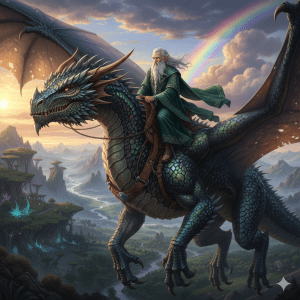
The air tasted like crushed silver and distant thunder. Below them, the valley of the Winding River was painted in the soft, bruised colours of twilight, where mushroom-capped towers and luminous flora dotted the emerald cliffs.

Fle, the Old Elf, sat tall upon Kaelen, the Sky-Weaver, his emerald robes catching the last amber rays of the setting sun. Fle’s face was a map of ages, his eyes holding the patient light of a thousand moons, but his grip on the dragon’s jeweled harness was firm. He was guiding Kaelen through the Veil of the Shifting Dusk, the narrow passage between the mortal realm and the High Dreaming.

Kaelen, whose scales were an armour of deep, shimmering teal and night-sky black, did not flap his colossal wings with brute force. He moved with a mystical grace, riding the invisible currents that flowed from the Rainbow of Eld arching high above them—a phenomenon that only appears when a creature of pure elemental magic and a being of profound age travel together.

“The Gem of Constant Dawn,” Kaelen’s thought resonated, deep and guttural, in Fle’s mind, “lies just beyond that cloud-bank, where the river meets the mist. But the Silence has claimed it.”

“The Silence,” Fle murmured, pulling his hood closer, “is fear, Kaelen. It is the dread that paralyzes creativity. And it has used the Gem to still the music of the World-Heart.”

Their mission was perilous: The Gem of Constant Dawn, which normally sang the world into existence every morning, had been stolen and wrapped in the Web of the Soul-Moths, creatures of pure, paralyzing inertia. If the Gem was not freed by midnight, the sun would rise only as a suggestion, and the world would remain perpetually quiet, perpetually grey.

As they flew past the floating, crystalline peaks, Fle reached into a hidden pouch woven into his sash and withdrew three small items:

  1. A feather from a thought-bird, which allowed him to hear the whispers of possibility.
  2. A shard of frozen laughter, which could break the densest concentration of sorrow.
  3. A single, petrified tear of a nymph, which held the warmth of summer.

They broke through the last cloud layer. There, floating motionless above the swirling mist, was the Gem—a sphere of blinding, imprisoned light, tightly encased in thick, silvery cobwebs. And hovering around it were the Soul-Moths, silent, dark insects whose flapping wings emitted a negative sound that drained the air of hope.

Kaelen stopped, hanging suspended in the air. “I cannot approach, Old Friend,” he admitted. “My fire is too loud, my being too grand. The Silence would snuff me out like a candle.”

“Then we shall be quiet,” Fle replied, his voice barely a breath.

He slipped off Kaelen’s back and, rather than falling, began to descend slowly on a column of shimmering, green energy—the focused memory of every happy song he had ever heard.

As he neared the Gem, the cold of the Silence hit him. His memories felt heavy, his purpose uncertain. He could feel the Soul-Moths trying to wrap his own thoughts in their numbing web.

Fle raised his hand and opened his palm. He did not cast a spell; he simply released the shard of frozen laughter.

The laughter shard—the captured echo of a thousand innocent giggles—didn’t explode. It simply melted, forming a thin, high chime. The sound was so unexpected, so pure and non-serious, that the Soul-Moths paused, momentarily confused.

In that fraction of a moment, Fle used his second item: he took the thought-bird feather and gently tickled the Web of the Soul-Moths. The Moths, overwhelmed by the sudden influx of chaotic and funny possibilities, flew away in disarray, unable to process the illogical joy.

The Gem of Constant Dawn was now free, but still cold and muted. Fle pressed the petrified tear of the nymph against the crystalline sphere. Instantly, the warmth of all past summers infused the Gem. It flared, shining with a light that pushed back the twilight and sent a vibrant, resonant thrum through the entire valley.

Above, Kaelen roared—a sound that was now one of pure, unrestrained elemental joy. The Rainbow of Eld above them deepened in colour, and the Winding River below seemed to sing as the music of the World-Heart returned.

Fle rose back to Kaelen’s side, weary but successful. “The Silence is broken, my friend. Let us fly home. It’s been a long age.”

Kaelen dipped his great head in agreement. With a powerful beat of his massive wings, he turned toward the dawn, carrying Fle, the keeper of memory and laughter, out of the high, mystical air and back toward the newly singing world.


Tags: , , , , ,

Daleks in Toyland

Daleks in Toyland

The Daleks’ Day Out in Toyland (A Silly Adventure)

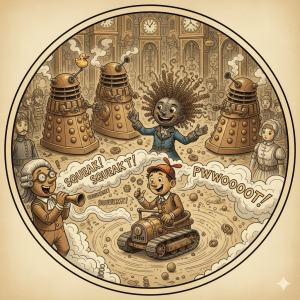
Noddy was polishing his steam-powered car, which now boasted a small, perpetually leaking tea kettle on the dashboard for emergency hot cocoa. His magnificent steam-whistle emitted a soft, contented “PWWWOOOOOT!” every time he buffed a rivet. Big Ears, ever the Gizmologist, was attempting to teach his pet clockwork mouse how to tap-dance on a tiny brass bell. Golliwog, officially an “Exemplar of Early Experimental Engineering,” was happily oiling his spring-coil hair, which shimmered with a delightful metallic bounce.

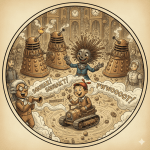
Suddenly, the sky above Clockwork City darkened, not with storm clouds, but with three colossal, heavily armoured, pepper-pot-shaped flying machines. They descended with an ominous, scraping sound, landing with heavy thuds in the town square, kicking up puffs of steam and scattering nervous automatons.

Out of each machine trundled a truly bizarre sight: a polished, bronze Dalek! Their eyestalks swiveled, their plungers twitched, and from their grating speakers came a sound that made Noddy’s wooden head throb.

“WE ARE THE DALEKS! WE SEEK TO ANNIHILATE ALL THAT IS… SILLY!” boomed the lead Dalek, its voice echoing off the clock towers.

Noddy, being Noddy, blinked. “Silly? But this is Toyland! We are all a little bit silly! It’s our primary function!”

“YOUR PRIMARY FUNCTION IS IRRELEVANT!” screeched a second Dalek, pointing its exterminator arm at a particularly fluffy teddy bear. “WE DETECT HIGH LEVELS OF UNNECESSARY WHIMSY! LOW EFFICIENCY! NO LOGICAL PURPOSE FOR BELL-RINGING OR SILLY SONGS!”

Big Ears, always the pragmatist (for a gnome-gizmologist), stepped forward. “Excuse me, bronze behemoths, but you seem to have misplaced your sense of fun. And possibly your internal navigation, because this is quite clearly not the ‘Planet of Utterly Serious Grey Things.'”

“DO NOT MOCK DALEK NAVIGATION!” the third Dalek whirred, its eyestalk flashing angrily. “OUR SENSORS DETECTED OPTIMAL TARGETING CONDITIONS FOR SILLINESS PURIFICATION! WE SHALL BEGIN BY EXTERMINATING… THE COLOR RED!”

Noddy gasped. “But my car is red! And my hat! And Golliwog’s trousers!”

“PRECIPITATE ACTION REQUIRED!” commanded the lead Dalek. “INITIATE ‘DE-SILLIFICATION PROTOCOL GAMMA-SEVEN’! ALL WHIMSY MUST BE… ERASED!”

The Daleks began trundling towards the town fountain, which was currently spouting rainbow-coloured water.

Golliwog, his spring-coil hair bouncing with a sudden surge of inspiration, whispered to Noddy and Big Ears, “Their sensors are designed for grand, terrifying things, yes? Not… not tiny silliness!”

Noddy’s oak head clicked. “Aha! We must be too silly for them to cope!”

Plan: Maximum Absurdity.

First, Big Ears pulled out his emergency “Gnome-Jammer” (which was actually just a broken kazoo). He blew into it with all his might. Instead of a jamming signal, it emitted a series of increasingly high-pitched squeaks, so utterly nonsensical that the Daleks’ eyestalks wobbled.

“ERROR! AUDIO INPUT TOO… HIGH-PITCHED! DALEK HEARING MODULES ARE DESIGNED FOR GRATING CRIES OF FEAR, NOT SQUEAKY TUNES!” blared one Dalek, momentarily forgetting about the red fountain.

Next, Golliwog sprang into action. He began to untangle his spring-coil hair at an astonishing speed, creating a chaotic, metallic, bouncy mess around his head. He then grabbed a handful of discarded gears and started juggling them, making silly faces and letting his hair bop wildly.

“ILLOGICAL VISUAL DATA! THE TARGET IS PERFORMING RANDOMIZED MANIPULATION OF GEARS WITHOUT APPARENT PURPOSE! AND ITS… ITS HEAD-SPRING-COILS ARE DEFYING DALEK LOGIC!” screeched a second Dalek, aiming its plunger arm at Golliwog, but it just sort of twitched in confusion.

Noddy, realizing this was his moment, jumped into his car. He didn’t just ring his steam whistle; he played a full-blown, cacophonous steam-whistle symphony! He then started driving in increasingly tight circles, making his little car spin like a crazed top, all while singing a song about marmalade and sausages at the top of his wooden lungs.

“STOP! CESSATION OF RANDOMIZED MANOEUVRES REQUIRED!” shouted the lead Dalek, its eyestalk swiveling so frantically it nearly popped off. “THE LEVELS OF SILLINESS ARE EXCEEDING DALEK CAPACITY FOR PROCESSING! OUR CIRCUITS ARE… OVERLOADING WITH WHIMSY!”

The Daleks started to emit small puffs of smoke from their various vents. Their plungers began to wiggle uncontrollably. One Dalek’s exterminator arm actually retracted and replaced itself with a tiny, confused rubber duck.

“RETREAT! RETREAT! TOO MUCH… INCONCEIVABLE JOY! LOGIC-CORE DEGRADING! DALEK PROTOCOL DICTATES EVASION OF EXCESSIVE HAPPINESS!”

With a series of frantic whirs and groans, the Daleks clumsily clanked back into their flying machines. With a final, desperate “EX-TER-MI-NATE… THIS! TOO! MUCH! FUN!” they ascended, leaving behind a faint smell of burnt circuits and slightly singed whimsy.

As the last Dalek ship vanished, Noddy’s car finally spun to a halt. Golliwog’s hair settled. Big Ears put away his kazoo.

“Well,” said Noddy, adjusting his propeller cap, “that was an exciting afternoon. Who knew that being utterly, ridiculously silly was our greatest defense against intergalactic tyrants?”

Big Ears nodded, polishing his clockwork spectacles. “It seems true brilliance lies not in absolute seriousness, but in the strategic deployment of sheer, unadulterated nonsense.”

Golliwog, after carefully re-coiling his hair, simply offered them both a perfectly-tied-with-string jam tart. “More tea, anyone?”

And so, Toyland returned to its normal, delightful level of regulated silliness, safe once more from the perils of being too logically efficient.


Tags: , , , ,

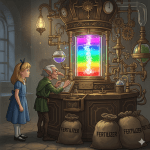
Within the cavern’s crystal-laced embrace

Within the cavern’s crystal-laced embrace


Within the cavern’s crystal-laced embrace,

 Young Alice stands, a smile upon her face.

With steady hand, a ladle she does hold,

To stir the secrets of a story told.


Beside her, Fle, the aged old elf,

A gentle guide, in verdant clothing self.

He turns the crank of  the arcanum machine,

A bubbly brew, a vibrant, glowing scene.


From humble sacks of ‘FERTILIZER’ and ‘SOIL,’

The earthy base for their enchanting toil.

They add the Arcanum, a liquid bright,

A splash of magic in the cavern’s light.


The air is thick with whispers of the old,

A tale of wonders, beautiful and bold.

As colors swirl in the machine’s deep bowl,

They mix a potion to enrich the soul.


And watching on, a mouse with curious eyes,

Nibbles on cheese beneath the cavern skies.

The scent of magic, a soft, ethereal haze,

Fills Alice and the elf with sweet amaze.


Tags: , , , , , ,

Alice tumbled into a fissure

Alice tumbled into a fissure

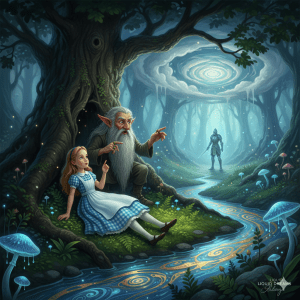
Alice found the elf by accident, as she found most things: by tumbling into them. This time, it wasn’t a rabbit hole, but a fissure in the earth, hidden by a blanket of moss and the shade of a weeping willow. She landed with a soft thump on a bed of ferns, her gingham dress a bright splash of blue in the dim, green light.

A pair of very, very old eyes blinked at her from the shadows of a gnarled oak. They were the color of faded leaves, and the wrinkles around them were like the rings of a tree. “Well, bless me,” a voice rasped, like dry leaves scuttling across a stone path. “Another one.”

Alice, never one to be flustered for long, brushed a stray leaf from her nose. “Another what?” she asked, her head tilted to the side.

“Another child who has lost their way,” the elf said, emerging from the gloom. He was slight and stooped, with a beard the color of winter frost. His name, he told her, was Fle. “I’ve seen so many. They all come seeking something. A way home, a lost toy, a purpose they’ve misplaced.”

Alice considered this. “I’m not lost, exactly,” she said. “I know where I am. I’m in a sort of underground forest, and you are a very old elf.”

Fle chuckled, a sound like gravel rolling down a hill. “Ah, but you are. Lost in the way that all mortals are. You are looking for an adventure, aren’t you?”

Alice’s eyes widened. “How did you know?”

“I’ve been watching the world for a very long time,” Fle said, settling himself on a mossy root. “And I’ve learned that the ones who fall into the quiet places are the ones who are looking for the loudest stories.” He gestured with a spindly finger to the world around them. “This place is full of them. The tales that have been forgotten. The songs that have been silenced.”

He told her a story of a talking mushroom that wept tears of light, and of a river that flowed with liquid dreams. He spoke of a queen who ruled over a kingdom of clouds, and a knight who wore armor made of moonlight. His words were like a spell, weaving pictures in the air, and Alice listened, her heart thrumming with the rhythm of his ancient tales.

“So, you see,” Fle said, when he had finished, “the world is not just a place to be. It is a place to be discovered. And sometimes, the most wonderful discoveries are found when you fall into the quiet places.”

Alice stood up, her blue dress a beacon in the twilight. “Thank you, Fle,” she said, her voice full of a new kind of wonder. “I think… I think I understand now. It’s not about finding my way back. It’s about finding my way forward.”

Fle smiled, a thousand years of wisdom in the gentle curve of his lips. “Precisely,” he said. And then, as quietly as he had appeared, he faded back into the shadows of the old oak, leaving Alice alone with the rustling ferns and the whispers of a thousand forgotten tales, ready to write her own.


Tags: , , , , ,

Alice in the Gloaming Glass

Alice in the Gloaming Glass

🕯️ Alice in the Gloaming Glass 🕯️

Through corridors of fractured time,
Alice walked where bells don’t chime.
A moonless sky, a pale-lamped street,
With echoing whispers at her feet.

The Rabbit’s watch had cracked in two,
Its ticking heart now black and blue.
The Hatter’s smile, a ragged seam,
Stretched wide within a broken dream.

The roses bled with ink so dark,
Their thorns aglow with ember’s spark.
The Queen’s red crown was made of bone,
Her scepter carved from hearts of stone.

Alice wandered, calm but wan,
Her shadow twice as long as dawn.
It whispered truths she dared not say,
And tugged her gently far away.

No tea was poured, no riddles told,
Just laughter ringing thin and cold.
The Caterpillar turned to dust,
The Cheshire grinned, then turned to rust.

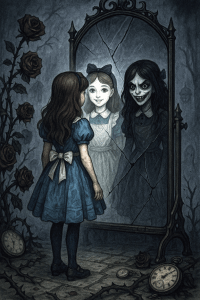
She reached a glass of iron hue,
That showed not one, but two Alices through.
One smiled sweet, her bow still neat—
The other bared her jagged teeth.

And as the glass began to break,
She knew at last she’d made mistake.
For Wonderland was not a place,
But slumber’s mask upon her face.

She woke in bed, yet not alone…
The grinning girl had followed home.


Tags: , , , , , , ,

Alice on Top of the World

Alice on Top of the World

🌟 Alice on Top of the World 🌟

Alice climbed the tower tall,
Above the streets, above it all.
No rabbit late, no ticking clock,
Just breezes dancing ‘round the block.

The rooftops bloomed with flowers bright,
A secret garden kissed by light.
She twirled her skirt, her bow held fast,
And waved at clouds that floated past.

“Hello!” she called to birds in flight,
Who answered back with sheer delight.
The sun on glass made castles gleam,
The city shimmered like a dream.

No Hatter fussed, no Duchess frowned,
No Queen to shout, “Off with her crown!”
Instead she ruled with gentle cheer,
The sky her throne, her realm so near.

Her subjects? Windows, bricks, and bees,
And secret whispers in the breeze.
Her courtiers? Flowers, tall and free,
Her crown? A wreath of greenery.

So Alice laughed, and Alice sang,
Her joy across the skyline rang.
For Wonderland was not below,
But up above, where gardens grow.

And every soul who paused to see,
Felt lighter, brighter, suddenly—
For happiness, when shared, can twirl…
Like Alice, on top of the world.


Tags: , , , , , , ,

The Steampunk of Ballykillduff

The Steampunk of Ballykillduff

In Ballykillduff, where the bog-cottons grow,
And tractors move slower than clouds ever go,
There rumbles a marvel of brasswork and puff:
The whistling contraption of Ballykillduff.

Its chimney-stack belches a lavender steam,
Its pistons clank onwards like parts of a dream,
The gears all turn sideways, the wheels spin askew,
And no one can say what it’s meant to do.

The smith in his apron declares with a cough,
“It brews tea at dawn, and it scares crows right off!
It mends broken fences, it churns up the peat,
And plays merry jigs with mechanical feet!”

The priest shook his head and the postman grew pale,
The barber got tangled in coppery rail,
The schoolchildren cheered as it huffed down the lane,
Whistling out sermons in high-tin refrain.

At night by the pub, when the fiddles strike up,
It gulps down the porter from pint glass or cup,
Then sings out in whistles, all clattering gruff—
The wild steampunk wonder of Ballykillduff!

And though it may rattle, and though it may groan,
And sometimes forgets the way home of its own,
The villagers say, with a fond sort of pride:
“It’s daft as a donkey—but ours to ride!”


Tags: ,

The Ballykillduff Daleks Winter of Madness

The Ballykillduff Daleks Winter of Madness

The first frost of winter came sneaking into Ballykillduff one quiet night. It crept over the hedgerows like icing on a Christmas cake, decorated the village pump with shiny icicles, and froze the puddles so hard that even Bridget McGillicuddy’s hens slipped about like ballerinas on roller skates.

The Ballykillduff Daleks had never experienced such a thing. For weeks they had been trundling around the village, muttering about “TOTAL DOMINATION” and “EX-TER-MI-NATION,” but on this particular morning they emerged from their shed only to discover that their mighty treads were no match for frozen mud.

One Dalek gave a mighty shove forward.
“COMMENCING DAILY PATROL!” it announced grandly—then immediately skidded sideways and lodged itself in the ditch.

Another Dalek rolled confidently onto a glittering puddle.
“THESE HUMANS ARE WEAK! WE SHALL—AAAAAGH!” it screeched, spinning in helpless circles like a saucepan lid on polished tiles.

By the time Councillor McGroggan wandered down the lane with his bucket of coal, he found half a dozen Daleks floundering about, their eyestalks fogged with frost, their plungers stuck fast to frozen gates, and one unfortunate unit still wedged headfirst in the ditch.

Click on the link, below, to read the full, bonkers mad story.

The Ballykillduff Daleks Winter of Madness


Tags: , , ,