RSS

Tag Archives: ballykillduff

The fire crackled merrily in the hearth

The fire crackled merrily in the hearth

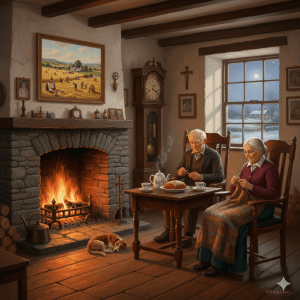
The fire crackled merrily in the hearth of the Ballykillduff cottage, casting dancing shadows on the low-beamed ceiling. Outside, a full moon bathed the frosty fields in a soft, silvery glow, the silent world blanketed in fresh snow. But inside, it was warmth and comfort, a cocoon against the winter’s bite.

Seamus, his spectacles perched on the end of his nose, carefully mended a fishing net, his movements slow but precise, honed by years of patient work. Across the small wooden table, Maeve’s needles clicked a gentle rhythm, weaving strands of wool into a new blanket, her hands as nimble as they had been sixty years ago, though now a little gnarled by time. Between them, a steaming teapot promised another cup, and the scent of freshly baked soda bread filled the air.

Their old dog, Finn, lay curled by the fireside, dreaming canine dreams, his occasional whimper a soft counterpoint to the quiet hum of the room. On the mantelpiece, faded photographs smiled down—their children as babes, their wedding day, a generation of memories captured in sepia tones. Above the mantel, a painting of a summer harvest, vibrant and golden, was a window to another time, a vivid echo of the image we just created.

“Remember that harvest, Maeve?” Seamus murmured, his voice soft, not breaking the peace but enriching it. “The year young Michael nearly tipped O’Malley’s wagon, trying to show off.”

Maeve chuckled, a warm sound that crinkled the corners of her eyes. “And your father nearly had a fit! You were always one for teasing, Seamus Finnegan.”

He smiled, a gentle warmth spreading through him that had nothing to do with the fire. “We worked hard, didn’t we? But there was always laughter, always a song.”

Maeve nodded, her gaze drifting to the moonlit window. “And those nights, after the fields were cleared, the whole village would gather. Music, dancing… you’d try to get me to dance, always with two left feet.”

“I did my best!” Seamus protested playfully, a twinkle in his eye.

The conversation faded again into comfortable silence, punctuated by the fire’s gentle roar and the rhythmic click of Maeve’s needles. They didn’t need many words; decades of shared life, of triumphs and sorrows, of sun-drenched harvests and snow-kissed evenings, had woven a tapestry of understanding between them. Each glance, each shared sigh, spoke volumes. This cozy winter evening wasn’t just a moment in time; it was a distillation of all the moments before, a quiet, contented testament to a lifetime of love lived simply, deeply, in the heart of Ballykillduff. The past wasn’t gone; it was right here, in the warmth of the fire, the scent of the bread, and the steadfast love that glowed between them, bright as the winter moon.

 
Leave a comment

Posted by on January 30, 2026 in bygone days


Tags: , , , ,

The Man Who Didn’t Argue with the Rain

The Man Who Didn’t Argue with the Rain

By the fourth week of rain, Ballykillduff stopped pretending it was temporary.

The first week had been called unfortunate. The second was concerning. By the third, people were beginning to mutter phrases like biblical and I don’t remember it ever being this wet, which in Ballykillduff was the traditional signal that something had gone deeply wrong with reality.

Jimmy McGrogan noticed it on a Tuesday.

Not the rain itself—everyone noticed that—but the way it behaved. Rain usually arrived with a bit of manners. It fell, it soaked, it left. This rain had moved in. It lingered. It leaned against doorframes. It watched through windows. It fell at angles rain had no right to fall at, drifting sideways, upwards occasionally, as though unsure which way gravity was supposed to be working that week.

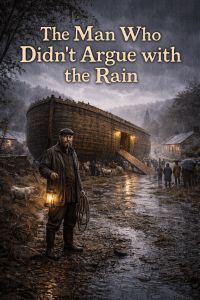
Jimmy stood in his yard, rain dripping off the brim of his cap, watching the river swell until it looked less like a river and more like a decision someone had made in a panic.

“That’s not stopping,” he said aloud.

This was important, because Jimmy McGrogan was not a man given to exaggeration. When Jimmy said something wasn’t stopping, it usually meant it had already passed reasonable and was heading briskly toward legend.

By Wednesday morning, the chickens were refusing to come out of the shed, the dog was sulking under the stairs, and the postman had taken to delivering letters by throwing them vaguely in the direction of houses and hoping for the best.

That was when Jimmy began measuring.

No one noticed at first. Ballykillduff had learned long ago that noticing Jimmy McGrogan too early only made things worse. He paced the length of his field with a tape measure and a look of grim concentration. He made notes on the backs of old envelopes. He stared at the sky, nodded once, and went inside to make tea so strong it could have removed paint.

On Thursday, he bought timber.

“Doing repairs?” asked Mrs. Donnelly in the hardware shop.

“Something like that,” said Jimmy.

On Friday, the shape became unmistakable.

It was an arc. Not a curve, not a suggestion—an unmistakable, deliberate arc, rising from the soaked earth behind Jimmy’s house like an idea that had finally committed to itself. By Saturday afternoon, half the village was standing at the hedge, umbrellas sagging, watching him work.

“Is that…?” someone began.

“Yes,” said Jimmy, without looking up.

“But—”

“Yes.”

“Are you sure?”

Jimmy drove a nail home with unnecessary emphasis.

By Sunday, the rain intensified, as though offended.

The river spilled over its banks. The lower lane disappeared entirely, leaving only the tops of familiar signposts sticking out like accusations. A cow appeared in O’Flaherty’s yard, confused but polite. The church steps developed a small waterfall, which Father Keane insisted on blessing, just in case.

And Jimmy McGrogan kept building.

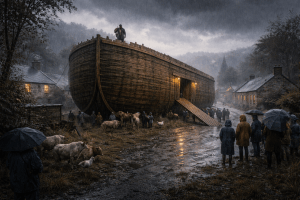
By the time the arc was finished, it was enormous—solid timber ribs, sealed seams, a roof sloping just enough to argue with the rain instead of surrendering to it. A door wide enough for decisions. A ramp thoughtfully added, “for anything with opinions,” Jimmy explained.

“What exactly do you think is going to happen?” asked Mrs. Donnelly.

Jimmy wiped his hands on his trousers and looked out across Ballykillduff, now shimmering with water and reflection.

“I don’t think,” he said. “I’ve checked.”

That night, the rain reached a pitch it had been working toward all along.

It fell with purpose. With memory.

People woke to water at their doorsteps, then in their kitchens, then tapping politely at the stairs. And when they went outside—boots sloshing, torches bobbing—they found Jimmy already there, opening the great wooden door of the arc.

He did not shout. He did not panic.

He simply nodded and stepped aside.

By morning, Ballykillduff floated.

Not dramatically—no roaring waves, no lightning—but gently, stubbornly, as though it had decided to refuse sinking out of spite. The arc rocked slightly, tethered to what remained of the higher ground, filled with people, animals, boxes of things someone couldn’t quite bear to leave behind.

And then, just as suddenly as it had begun, the rain stopped.

It did not slow. It did not apologise.

It stopped.

Water drained away with reluctant sighs. The river returned to something like itself. Mud claimed the streets. Ballykillduff reappeared, damp, bewildered, but intact.

Jimmy McGrogan dismantled the arc the following week.

Used the timber for sheds, fences, and one very fine bus stop. He never spoke much about it afterward, except once, when someone asked him how he’d known.

Jimmy thought for a moment.

“Well,” he said, “when the rain forgets to leave, it’s best to be polite—but prepared.”

And in Ballykillduff, no one ever argued with that.


Tags: , , ,

Will it Ever Stop Raining?

Will it Ever Stop Raining?
It was one of those Ballykillduff days that seemed to have been mislaid at birth and never quite recovered.
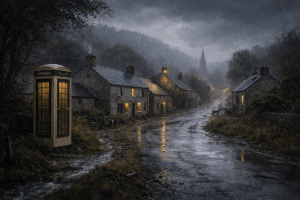
Morning arrived reluctantly, dragging itself over the hills like a wet coat someone else had already worn. The sky hung low and colourless, a slab of dull tin pressed flat against the rooftops. Rain fell straight down—no drama, no thunder—just a steady, joyless drizzle that soaked everything slowly, as if the day had all the time in the world and nowhere else to be.
The village square was empty. Even the statue—whose subject nobody could quite remember—looked embarrassed to be standing there, rain slicking its shoulders until it gleamed like a regret. The shop windows were dim, lights left off to save electricity or enthusiasm. Inside O’Flaherty’s, the radio murmured to itself, unheard by anyone, reporting weather that was already happening far too much.
Water crept along the gutters in thin, patient streams, carrying leaves, grit, and the occasional idea that had fallen out of someone’s head. The river swelled and darkened, moving faster than usual, as though it were late for something important and slightly annoyed about it. It slapped at the banks with muddy urgency, whispering to the stones in a language only old things understood.
People stayed indoors. Curtains twitched. Kettles boiled repeatedly, less out of need than for reassurance. Somewhere, a clock ticked far too loudly, reminding the house that time was still passing even if the day itself appeared stuck.
Down by the lane, the old telephone box—long disconnected but never removed—stood full of rainwater and reflections. For a moment, it looked as though the village had drowned a smaller version of itself inside, a pocket Ballykillduff where it was always raining and nobody ever answered.
By afternoon, the cold had worked its way into the bones of the place. Doors swelled. Hinges complained. The rain grew heavier, not angrier—just more insistent, as though it were trying to explain something important and failing repeatedly. Puddles formed in the familiar dips of the road, each one a dark mirror showing the sky exactly as it was: unhelpful and unavoidable.
And yet—quietly, stubbornly—life went on.
A light flicked on in an upstairs window. Smoke rose from one chimney, then another. Somewhere, a dog barked at nothing in particular, satisfied it had done its duty. The rain softened, just a fraction, as evening crept in with blue shadows and the promise of lamps and supper.
Ballykillduff endured the day the way it endured most things: without complaint, without fuss, and with the unspoken understanding that this too would pass. Tomorrow might be brighter. Or stranger. Or worse.
But tonight, the rain would keep falling, the village would keep breathing, and the dark would settle in—not as an ending, but as a pause.
 
Leave a comment

Posted by on January 26, 2026 in rainy days


Tags: , ,

Plungers, Potatoes & Paddy’s Pub

Plungers, Potatoes & Paddy’s Pub

In the misty backroads of Ballykillduff, County Carlow, where the sheep outnumber the people and the only traffic jam is when Mrs. O’Leary’s cow decides to have a lie-down in the middle of the R726, something very peculiar happened one Tuesday.

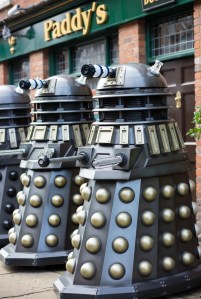
A meteorite the size of a small tractor crashed into Farmer Murphy’s best potato field. Everyone expected radioactive spuds or at least a good story for the pub. Instead, out crawled three very confused Daleks.

They looked around, eyestalks swivelling like malfunctioning windscreen wipers.

“WHERE ARE WE?” screeched the first one, voice echoing across the hedges.

“SCANNING… LOCATION: BALLYKILLDUFF… IRELAND… POPULATION: MOSTLY SHEEP AND OLD MEN WHO SMELL OF TURF.”

“THIS IS NOT SKARO,” the second one muttered. “THE DOCTOR HAS TRICKED US AGAIN.”

The third Dalek, who had clearly landed on his plunger, wobbled sideways. “MY PLUNGER IS STUCK IN A COW PAT. THIS IS UNACCEPTABLE.”

They decided to conquer the village. Standard procedure.

First stop: Paddy’s pub.

They burst through the door (well, the first one did; the other two got wedged in the frame because Daleks aren’t great with narrow Irish doorways).

“EXTERMINATE ALL HUMANS!”

Old Paddy at the bar looked up from his pint. “Ah, would ye look at that. The circus is in town early this year.”

The Daleks swivelled their domes menacingly.

“YOU WILL OBEY THE DALEKS!”

Paddy took a slow sip. “Sure, lads, ye’re grand. But if ye’re here to conquer, ye’ll need to join the queue. The taxman got here first.”

The Daleks tried to exterminate the dartboard. The darts bounced off their casings and stuck in the ceiling. The regulars started a sweepstake on how long it would take for the “metal lads” to get stuck in the bog.

Next, they rolled down to the local GAA pitch, where the Ballykillduff Junior B team was training. The Daleks declared the pitch their new “Dalek Empire”.

The team captain, a lad called Seamus who once tackled a bullock for fun, eyed them. “Ye’re taking up the whole goalmouth. Move over, or I’ll bury ye under the subs’ bench.”

“WE ARE DALEKS! WE DO NOT MOVE FOR INFERIOR LIFE FORMS!”

Seamus shrugged, grabbed a hurley, and gave the lead Dalek a gentle tap. The Dalek spun like a top, arms flailing, and ploughed straight into the goal net. The net wrapped around it like a Christmas present gone wrong.

“EMERGENCY! EMERGENCY! I AM ENTANGLED IN… NET!”

The other two Daleks tried to help, but ended up tangled too. Soon the whole team was using them as makeshift goalposts. The score ended 12-0, with the Daleks credited as “assists”.

By evening, the Daleks were in the village hall, surrounded by grannies knitting and children painting them with hurling club colours (green and gold, naturally). One granny had even stuck a tiny Aran jumper over the eyestalk.

“THIS IS NOT CONQUEST,” the lead Dalek whimpered.

“IT IS… COMMUNITY SERVICE.”

In the end, the Daleks didn’t conquer Ballykillduff. Ballykillduff conquered them.

They still live there, in a shed behind Murphy’s pub. They help with the silage (their plungers are surprisingly good at lifting bales), and every Christmas they perform a nativity play where they play the Three Wise Men. (The baby Jesus is a suspiciously shiny sheep.)

And if you ever drive through Ballykillduff on a quiet night, you might hear a faint, metallic voice drifting across the fields:

“EXTERMINATE… THE MIDGES!”

Because even Daleks can’t handle an Irish summer.

Here are some properly terrible, Dalek-flavoured dad jokes for you:

  1. Why did the Dalek go to therapy? It had too many suppressed exterminate feelings.
  2. What do you call a Dalek who’s really into gardening? A plant-exterminator.
  3. Why don’t Daleks play hide and seek? Because good luck hiding when your battle cry is “EX-TER-MI-NATE!”
  4. How do Daleks flirt? “You will be my valentine… OR YOU WILL BE EXTERMINATED.”
  5. What’s a Dalek’s favourite type of music? Heavy metal… specifically anything with a lot of grinding and screaming.
  6. Why was the Dalek terrible at stand-up comedy? Every punchline ended with “AND THEN YOU WILL BE EXTERMINATED!”
  7. What did the Dalek say when it stubbed its plunger? “THIS IS PAIN! PAIN IS NOT ACCEPTABLE!”
  8. Why did the Dalek fail his driving test? He kept shouting “OBEY THE HIGHWAY CODE!” at pedestrians.
  9. How do Daleks pay for things? With extermination credits. (Cash is inferior.)
  10. What’s the difference between a Dalek and a bad date? The Dalek only wants to exterminate you after one drink.

Which one made you groan the loudest? 😄

 
Leave a comment

Posted by on January 21, 2026 in carlow story, dalek story


Tags: , ,

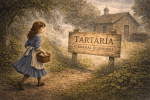
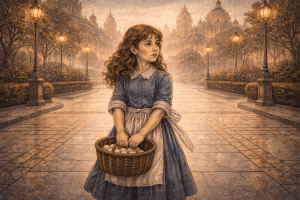
Alice in Tartaria

Alice in Tartaria

Alice in the Magical Square of Tartaria


Ballykillduff is a village that thinks quietly.

Lanes hesitate. Grass leans when it should not. Things happen just slightly to the side of where they are supposed to be. Alice has lived there long enough to know this, and just long enough not to question it.

So when a crease appears in the air behind the Old Creamery, and a place called Tartaria slips sideways into existence, Alice is the only one who notices — and the only one who understands that some places survive by being remembered badly.

Tartaria is a civilisation that vanished by behaving too well. Now it endures in a state of almost compound memory: misremembered, misfiled, and dangerously unfinished. Maps argue. Councils disagree. Scholars from Outside begin asking sensible questions — the most dangerous kind of all.

As Alice moves between Ballykillduff and Tartaria, she discovers that memory is not passive, certainty is a trap, and being understood may be far worse than being forgotten. Worse still, Tartaria begins to misremember her.

To save both worlds, Alice must learn how to remember wrongly on purpose — without doing it too well.

Alice in Ballykillduff and the Almost-Remembered Tartaria is a whimsical, quietly unsettling fantasy in the tradition of Lewis Carroll: a story about places that think, truths that refuse to settle, and the peculiar courage it takes to remain unfinished.

To read this new story click on the link below.

Click HERE – and enjoy


Tags: , , ,

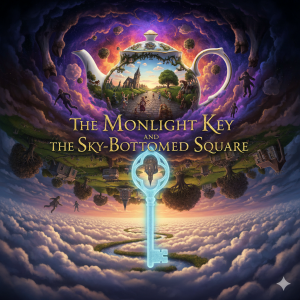
The Moonlight Key and the Sky-Bottomed Square

The Moonlight Key and the Sky-Bottomed Square

Ballykillduff is a village where nothing ever happens twice. Liam is a man of spreadsheets and stone walls, a man who believes that a key’s only job is to open a door. But when he fumbles his keyring into the black, glassy surface of the Un-Lake, the laws of Carlow begin to fray at the seams.

He doesn’t just get his keys back. He pulls something out from the reflection—a Moonlight Key that hums with the sound of “What If.”

Now, the “Out-There” is leaking in. The local pub is made of liquid Guinness, the sky has swapped places with the ground, and a choir of sepia-toned ancestors is singing the town into a memory. As the “Architect of the In-Between,” Liam must navigate a landscape built of his own stray thoughts to lock the leak before the village he knows is un-thunk forever.

In the Un-Lake, the reflection is better than the reality. But as Liam is about to learn, a perfect world is a very lonely place to live.

To continue reading this story, click HERE and enjoy.

 
Leave a comment

Posted by on January 5, 2026 in ballykillduff, carlow


Tags: , , , , , , , , ,

Seven for a Secret, Never to Be Told

Seven for a Secret, Never to Be Told

Seven for a Secret, Never to Be Told

Everyone in Ballykillduff knew the rhyme. They learned it young, usually from someone older who lowered their voice for the last line.

One for sorrow.
Two for joy.
Three for a girl.
Four for a boy.
Five for silver.
Six for gold.
Seven for a secret, never to be told.

Most people laughed at it. Some people touched wood. Nobody ever talked about seven.

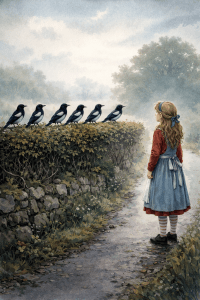
Alice saw them on a Tuesday morning, standing along the hedge at Curran’s Lane.

Seven magpies. Neat as fence posts. Silent as if silence were a rule they were following carefully.

Alice stopped walking.

The hedge itself felt wrong. Not dangerous. Just… held together too tightly, like someone smiling for longer than was comfortable.

She counted them twice. She always did when things felt important.

One. Two. Three. Four. Five. Six. Seven.

All seven turned their heads together and looked at her.

“Right,” Alice said quietly. “It’s that sort of day.”

People passed along the lane without noticing anything at all. Mr Keane walked by whistling. Mrs Donnelly hurried past with her shopping. No one looked at the hedge. No one slowed down.

Only Alice stood there.

The magpies did not speak. They had never needed to.

Long ago, Ballykillduff had made a decision.

It was not a cruel decision. It was a tired one.

Something sad had happened. Something that could not be fixed. A thing with a name, and a place, and a day that people still remembered too clearly. After a while, the village agreed to stop saying it out loud. Not because it wasn’t real, but because remembering it every day was making it impossible to live the next ones.

So the remembering was set aside.

And the magpies stayed.

They stayed because someone had to remember, and magpies are very good at keeping what others lay down. Not just shiny things, but moments, and names, and truths that no longer fit anywhere else.

The rhyme was never meant to predict luck.

It was a warning.

Seven magpies meant a place was carrying a memory it no longer wanted to hold.

One of the magpies hopped down from the hedge and pecked at the ground. Not at soil, but at a flat stone half-buried near the roots. A stone no one stepped on, though no one could have said why.

Alice knew what was being asked of her.

She did not need to know the whole story. She did not need names or details. She only needed to do one thing the village had not done in a very long time.

She knelt and placed her hand on the stone.

“I know,” she said, softly.

That was all.

Not what she knew. Just that she knew something had been there. Something had mattered.

The hedge loosened. Just a little. The air moved again.

When Alice stood up, there were only six magpies left.

They were already arguing with one another, hopping and chattering, busy once more with ordinary magpie business. Shiny things. Important nonsense. The everyday work of being alive.

The seventh magpie rose into the air and flew away, light now, its work finished at last.

Alice walked on down the lane.

Behind her, Ballykillduff continued exactly as it always had. But somewhere deep in its bones, a small, quiet weight had finally been set down properly instead of being hidden away.

And the rhyme, for once, was at rest.

The Eighth Magpie

Everyone in Ballykillduff knew the rhyme. They said it quickly, like a spell that worked better if you didn’t linger on it.

One for sorrow.
Two for joy.
Three for a girl.
Four for a boy.
Five for silver.
Six for gold.
Seven for a secret, never to be told.

Alice had already seen seven magpies once before, and she knew what that meant.

So when she walked along Curran’s Lane and saw eight, she stopped dead.

Seven stood along the hedge, silent and still.

The eighth stood on the path itself, blocking the way.

“Well,” Alice said, “that’s new.”

The eighth magpie was smaller than the others and less patient. It tapped one foot, then the other, as if waiting for a late train.

Seven magpies meant the village had forgotten something important. A sad thing. A thing everyone had agreed not to talk about.

That part had already been done.

Ballykillduff had remembered.

But the eighth magpie had arrived because remembering had changed nothing yet.

The bird pecked sharply at the ground.

Alice followed its beak and saw the problem at once.

The old path had collapsed further down the lane. A fence lay broken. The shortcut people once used had never been repaired. Long ago, someone had been hurt there. That was the secret. That was why people stopped using it.

They had remembered the accident.

They had never fixed the path.

“Oh,” said Alice. “You mean that.”

The eighth magpie nodded briskly.

It wasn’t here for memory.
It was here for mending.

Alice went back to the village and told people what she’d seen. Not the whole story. Just enough.

By evening, someone had brought tools. Someone else brought boards. Someone else brought tea.

By the next morning, the path was safe again.

When Alice returned to Curran’s Lane, there were only seven magpies on the hedge.

Then six.

Then none at all.

The eighth magpie was gone first.

It always is.

Because once something is put right, there is no need for it to stay.

And the rhyme, at last, had room for one more line, though nobody ever said it aloud:

Eight for the thing you do about it.
 

Tags: , , , ,

The Troll

The Troll
The Troll of Ballykillduff Bridge
********************************
Everyone in Ballykillduff knew the bridge, though nobody quite agreed on how long it had been there. Some said it had grown out of the river one night like a thought nobody remembered thinking. Others claimed Jimmy McGroggan once tried to repair it and the bridge repaired him instead.
But what everyone did agree on was this:
there was a troll living underneath it.
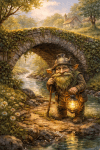
His name was Mosskin O’Grumble, and he was a very polite troll with extremely poor manners.
Mosskin lived in a snug hollow beneath the bridge, furnished with a teapot that never stopped dripping, three boots that were not a pair between them, and a chair that sighed whenever anyone sat on it. His beard was thick with moss, his coat smelled faintly of river stones, and his hat had once been a kettle before it decided it preferred being worn.
Each morning, Mosskin poked his head out of the shadows and called in his loudest, trolliest voice,
“WHO GOES OVER MY BRIDGE?”
This caused mild inconvenience, as the people of Ballykillduff went over the bridge all the time.
“Morning, Mosskin,” called Bridget, carrying her shopping.
“It’s only me,” said Seamus, for the third time that day.
“Oh,” Mosskin muttered, disappointed. “I was hoping for someone new.”
You see, Mosskin was meant to demand tolls. That was the rule. Troll rules were very old and written in ink that smelled of damp. Unfortunately, nobody in Ballykillduff ever had the right sort of toll.
One offered him a button.
Another offered a joke that didn’t quite work.
Once, Father Donnelly accidentally gave him a blessing, which caused Mosskin to glow faintly and hum hymns whenever it rained.
Mosskin accepted everything solemnly and stored it all in a jam jar labelled TOLLS (IMPORTANT).
The trouble began on a Tuesday, which in Ballykillduff is widely considered an unreliable day.
That morning, the river stopped.
It did not freeze. It did not dry up. It simply decided it had gone far enough and sat still, like a sulking child.
The bridge creaked uneasily.
“This will not do,” the bridge murmured.
Mosskin poked the river with a stick.
“Have you tried moving?” he asked.
The river refused to answer.
By lunchtime, the village had gathered. Jimmy McGroggan arrived with a machine involving springs, levers, and optimism. Bridget brought sandwiches. Someone suggested asking the bridge nicely.
At last, Mosskin climbed up onto the bridge itself, clearing his throat in a way that startled several beetles.
“I am the Troll of Ballykillduff Bridge,” he announced, surprised by how important it sounded. “And I declare that something is wrong.”
“I am tired,” said the bridge. “People cross me without noticing. The river forgets to sing. Everyone rushes.”
Mosskin thought very hard. This caused a small puff of steam to rise from his ears.
“Well,” he said slowly, “perhaps you need a proper toll.”
“But we haven’t any money,” Seamus said.
“Good,” Mosskin replied. “Money is rarely the right thing.”
That evening, the villagers lined up at the bridge. One by one, they crossed more slowly than usual.
They offered small, strange things.
A promise, spoken carefully.
A regret, folded neatly.
A story remembered from childhood.
A song hummed badly but honestly.
Mosskin collected each offering and, instead of placing them in his jam jar, gently set them into the river.
And the river began to move again.
Not quickly. Not sensibly.
But with the soft, happy sound of something remembering itself.
As dusk settled, the villagers drifted home. Mosskin remained beneath the bridge, listening.
The water flowed. The stones no longer sighed. The bridge stood a little taller, pleased in the quiet way old things prefer.
Mosskin sat on his sighing chair and looked at his jam jar. It felt lighter now, though it was fuller than it had ever been.
Only then did he understand.
Nobody had crossed the bridge in a hurry. They had slowed. They had looked down at the water. They had touched the stone. Some had even spoken to the bridge itself, which made it warm all through.
“All this time,” Mosskin murmured, “I thought I was guarding the bridge.”
But the bridge had never needed guarding.
It had only wanted to be noticed.
So now, when someone crosses the bridge at dusk and pauses without knowing why, they may hear a voice from below, warm and grateful, carried gently by the water.
“Thank you,” it says.
“Thank you for noticing.”
And the bridge, the river, and the village of Ballykillduff go on working properly again, as they always do, once someone remembers to pay attention.
 
Leave a comment

Posted by on December 28, 2025 in ballykillduff, carlow, troll


Tags: , , , ,

The Ballykillduff Daleks’ Christmas Catastrophe

The Ballykillduff Daleks’ Christmas Catastrophe

The Ballykillduff Daleks’ Christmas Catastrophe

In the misty hills of rural Ireland, nestled in the tiny hamlet of Ballykillduff (population: 47 humans, 12 sheep, and one very confused postman), something extraordinary happened one snowy Christmas Eve.

It all started when a battered Dalek saucer, fleeing a botched invasion of the North Pole (they’d mistaken Santa’s elves for a rebel Time Lord faction), crash-landed in Paddy O’Connor’s turnip field. The impact was spectacular: turnips flew like cannonballs, sheep scattered in terror, and the saucer buried itself nose-first in the mud, looking like a giant metallic pepper pot that had lost a fight with a bog.

Out glided the survivors: the Ballykillduff Daleks. There were five of them, led by Supreme Dalek Seamus (he’d reprogrammed himself with a dodgy Irish accent after scanning too many RTE broadcasts during atmospheric entry). His platoon included:

– Dalek Bridget, the strategist (obsessed with tea breaks).
– Dalek Mick, the engineer (always fixing things with duct tape and prayers).
– Dalek Siobhan, the scout (who kept exclaiming “Jaysus!” instead of “Exterminate!”).
– And little Dalek Paddy Jr., the newest model, fresh from the factory and still figuring out his plunger arm.

Their mission? Original plan: EX-TER-MIN-ATE all non-Dalek life in the galaxy. New plan, after the crash fried their navigation circuits: Conquer Ballykillduff and turn it into the new Dalek Empire headquarters. Why? Because it had a pub.

On Christmas Eve, the villagers were gathered in O’Leary’s Pub for the annual céilí, singing carols, pouring Guinness, and arguing over whether mince pies needed brandy butter. Suddenly, the door burst open (well, more like glided open menacingly), and in rolled the Daleks.

“EX-TER-MIN-ATE! EX-TER-MIN-ATE THE IN-FE-RI-OR HU-MANS!” screeched Seamus.

The pub went silent. Then old Mrs. Murphy, three sheets to the wind, squinted and said, “Ah, sure lookit the fancy dress! Are ye from the panto in Tralee?”

Dalek Bridget trundled forward. “WE ARE THE DA-LEKS! YOU WILL O-BEY!”

Father Kelly, mid-pint, raised an eyebrow. “Daleks, is it? Ye look like ye could use a bit of Christmas spirit. Come in out of the cold, lads. Have a hot whiskey.”

The Daleks hesitated. Their hate circuits buzzed confusedly. Hot whiskey? What was this sorcery?

Before they could blast anyone, little Paddy Jr. spotted the Christmas tree in the corner, twinkling with fairy lights. His eyestalk widened. “WHAT… IS… THAT… SHINY… THING?”

“It’s a tree, ye daft pepper pot,” laughed Tommy the barman. “Decorated for Christmas. Presents underneath and all.”

Presents? The Daleks had never heard of such a thing. Their programming only included domination, extermination, and occasional civil wars.

Seamus demanded: “EX-PLAIN THIS… PRES-ENT… CON-CEPT!”

The villagers, sensing an opportunity (and being Irish), decided to humor the invaders. They wrapped up random pub items: a pint glass for Seamus, a packet of Tayto crisps for Bridget, a hurley stick for Mick (he could use it as a weapon upgrade), and for Siobhan, a woolly jumper knitted by Mrs. Murphy.

Paddy Jr. got a selection box of chocolates. He plunged his plunger into it experimentally. Chocolate smeared his dome. “THIS… IS… SU-PE-RI-OR… TO… SLIME… NUT-RI-ENTS!”

Chaos ensued. The Daleks, for the first time in their genocidal history, experienced joy. Bridget started demanding “MORE TEA! MORE TEA!” Mick rigged the fairy lights to his gunstick, creating a disco Dalek effect. Siobhan attempted Irish dancing, spinning wildly and knocking over tables while yelling “REEL-EX-TER-MIN-ATE!”

Seamus tried to maintain order: “WE MUST NOT… SUC-CUMB… TO… HU-MAN… EMO-TIONS!” But then someone handed him a slice of Christmas pudding soaked in Jameson. One bite, and his voice modulator slurred: “HAP-PY… CHRIST-MAS… TO… ALL…”

By midnight, the Ballykillduff Daleks were caroling (badly): “We wish you a merry EX-TER-MIN-ATE… We wish you a merry EX-TER-MIN-ATE…” The villagers joined in, teaching them “The Fields of Athenry” instead.

Come Christmas morning, the Daleks’ saucer was fixed (Mick used parts from a tractor), but they couldn’t bring themselves to leave. Seamus declared: “BALLY-KILL-DUFF… IS… NOW… PRO-TECT-ED… BY… DA-LEKS! ANY… IN-VA-DERS… WILL… BE… EX-TER-MIN-A-TED… AND… OF-FER-ED… A… PINT!”

And so, every Christmas since, the Ballykillduff Daleks return. They guard the village from misfortune, demand tribute in the form of Guinness and tayto, and host the wildest céilí in Ireland. Tourists come from miles around to see the glittering, plunger-waving pepper pots dancing under the mistletoe.

Because even the most hateful beings in the universe can’t resist a proper Irish Christmas. Sláinte!


Tags: , ,

The Silver Needle

The Silver Needle

The Silver Needle

The North Wind did not blow; it exhaled, a long, shivering breath that flattened the dead grass of the meadow. Then came the Quiet.

I arrived in the lungs of the night. I am the Frost, the silent architect, the silver needle that sews the world shut.

I began at the edge of the pond. I am not like the Snow, who is heavy and loud, smothering the earth under a white wool blanket. I am delicate. I moved across the surface of the water, knitting a skin of glass so thin that the fish below looked up and saw a sky made of diamonds.

I climbed the stalks of the sleeping hemlock. I turned the spider’s web—a discarded, messy thing—into a lace veil fit for a ghost. I moved with a mathematician’s precision, tracing the jagged rim of every fallen oak leaf, outlining their veins in crushed pearls.

I found a discarded iron spade leaning against a stone wall. To the humans, it was rust and cold metal. To me, it was a canvas. I grew a forest of ferns across its blade, silver fronds that would never see the sun, for the sun is my executioner.

Near the Haroldstown stones, I found a small wooden birdhouse, empty and forgotten. I did not enter. Instead, I feathered the roof with a thousand tiny daggers of ice, pointing toward the stars.

The world was now a museum of stillness. No twig snapped. No breath was drawn. I had turned the unruly, muddy earth into a kingdom of crystal geometry. I sat upon the world, cold and perfect, waiting for the first grey light of the dawn to turn my silver into gold, knowing that as soon as I was most beautiful, I would vanish.

I am the ghost of the water. I am the memory of the cold. And for one night, I held the earth perfectly still.


Tags: , , , ,