RSS

Tag Archives: ghost

The Whispering Knoll of Tullow

The Whispering Knoll of Tullow

The Whispering Knoll of Tullow

Just east of the Tullow Show Grounds, where the land rises sharply towards the older, quieter fields, stood a low hill known locally as Tír na gCnámh—the Hill of Bones. It wasn’t bones from battle, but from the ancient rock of the earth itself, protruding like the elbows of a giant. Every year, during the last week of August, when the ground was trampled by prize cattle and the air rang with the cacophony of the fairground rides, the knoll would grow restless.

The locals said the knoll was home to Ailbhe, a solitary, centuries-old member of the Aos Sí (the Irish Fair Folk) who resented the noise, the electric lights, and the yearly parking chaos that encroached upon her ancient domain.

Our story belongs to young Cillian, a lad of seventeen who earned good money helping the farmers set up their marquees. It was late on the final night of the Show. Rain had hammered the tents all day, and now a thick, unnatural mist—the kind the old men called the “Show Fog”—had rolled in, suffocating the last of the fairground lights.

Cillian had volunteered to take the day’s cash box, secured in a heavy leather satchel, back to the committee office in the town centre. To avoid the swampy roads, he had to take the shortcut: straight over Tír na gCnámh.

“Mind your steps, boy,” warned the security guard, glancing nervously at the hill. “And don’t you talk to any shadows up there. They’re listening tonight.”

Cillian, being seventeen, scoffed but kept his mouth shut. He started the climb, the weight of the satchel pulling at his shoulder. As soon as he crossed the low stone wall marking the knoll’s boundary, the sound of the Show Grounds vanished. Not faded—vanished. The frantic pop music, the generator hum, the distant shouts—all replaced by an immense, breathing silence.

The fog on the knoll was different, too. It didn’t just obscure the view; it played tricks with the light. The mist ahead seemed to part, revealing brief, tantalizing glimpses of things that should not be: a line of stone markers that weren’t there a second ago, and a flickering, cold flame that burned without fuel.

“It’s just the fog, Cillian,” he muttered, clutching the satchel tighter.

He had walked about fifty yards when the ground beneath his feet began to shift. It wasn’t a landslide; it was a rhythmic, almost deliberate heave, as though the whole knoll were drawing a deep breath. He lost his footing, dropping to his knees.

Suddenly, a sound arose that made his blood run cold: the sweet, unearthly melody of a tin whistle, played so perfectly it seemed to carve the air. It was coming from a clump of gorse bushes just ahead.

Then, the voice spoke. It was clear and cool, like water running over granite.

“You walk on our ceiling, little mortal. You bring the stink of diesel and the bleating of the hungry machines to the door of my home. And you carry a weight of ill-gotten gains.”

Cillian stammered, “N-not ill-gotten! It’s for the prize fund! The best barley, the fastest sheep…”

A figure coalesced from the fog near the gorse bush. It was Ailbhe, the spirit of the knoll. She wasn’t terrifying, but unbearably sad and beautiful. She wore a dress woven from mist and moss, and her hair was the colour of wet turf.

“The barley is good, yes,” Ailbhe sighed, the sound echoing like the movement of old leaves. “But the rush! The noise! It tears the sleep from the earth.” She gestured towards the Show Grounds, and a dark shadow, cold and vast, momentarily blotted out the flickering neon sign of the funfair below.

“I won’t disturb you again, I promise!” Cillian begged, scrambling to his feet.

Ailbhe paused, her deep eyes studying him. “You are the one who leaves the single silver shilling by the gatepost before the setup begins. You think I do not notice the small sacrifice, the tribute to the old courtesy?”

Cillian’s heart pounded. He always left one silver coin from his first day’s pay at the base of the knoll before the Show started—a superstitious habit taught to him by his grandmother.

“Because of that,” Ailbhe whispered, “I will let you pass. But the hill demands payment for the disturbance.”

With a swift, silent movement, she reached out. Cillian braced, expecting her to grab the satchel. Instead, her cool, dry fingers brushed his earlobe.

“Payment accepted,” she murmured, and stepped back into the gorse bush. The whistle melody soared once more, wrapping the knoll in music.

Cillian didn’t wait. He ran down the hill, crashing through the final hedge and onto the muddy perimeter road.

Only when he reached the main road did he notice the satchel was still heavy, the cash intact. He stumbled into the town office and threw the bag onto the desk.

“What happened to your ear?” the committee man asked, handing Cillian his fee.

Cillian touched his earlobe. There, hanging from a thin, almost invisible chain, was a single, tiny, perfectly formed dewdrop of amber, glittering like polished honey.

He never told anyone what he saw on the knoll, but he knew Ailbhe had taken her payment: a lock of hair, preserved in amber, ensuring that a piece of him would always belong to the Hill of Bones. And every August, Cillian always remembered to leave two silver shillings by the gatepost. He preferred to keep his appointments with the Fair Folk.

 
Leave a comment

Posted by on November 11, 2025 in ghost, tullow


Tags: , , ,

The Watcher of the Cracks

The Watcher of the Cracks

The air in the Wasteland of the Forgotten didn’t move; it pressed, thick with the dust of ages and the silence of the long-dead. This was the domain of Malak, the Watcher.

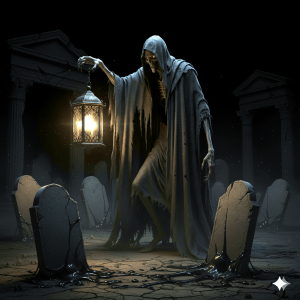
Malak was less a creature and more a convergence of dread, draped in rags the color of grave-soil. His face was a hollowed skull, his eyes two pinpricks of yellow hunger. In his skeletal hand, he held a lantern—an antique cage of pitted brass, whose light was an impossible, warm amber. It was the only light in the infinite black, and it was the problem.

His sole, unending task was to patrol the endless, cracked earth. The cracks weren’t from drought; they were fissures in reality. Beneath the crumbling crust lay the Before, and the things that still squirmed there longed for the air, for a taste of the thin, weary world Malak occupied.

The weirdness wasn’t the monster, but the light. Malak wasn’t lighting his own way; he was illuminating the cracks. And every time the warm glow fell upon a particularly deep, vibrating fissure, he had to stop. He’d bring the lantern close, its heat making the dust shimmer, and listen.

Tap. Tap-tap.

The sound was like a tiny, insistent knuckle-rapping on glass. It was the sound of something from the Before—something with too many limbs and no real shape—testing the barrier. Malak’s duty was horrifyingly simple: if the tapping was too quick, too loud, or if the amber light caught a sudden, glistening wetness oozing up, he had to feed the crack.

Slowly, agonizingly, he would lower his lamp, not snuffing it, but placing it gently over the most active fissure. The tap-tapping would cease, replaced by a sucking sound, and the light—the precious, warm, only light—would dim, then flicker, then be gone. The thing below had consumed the illumination, the hope, of the little flame.

Then, Malak would remain in the absolute dark, his skull tilted, waiting. After an eternity that might have been a minute, a tiny, fresh flicker would reignite inside the empty brass cage. A new spark, a new life, drawn from the sheer, unending need for a Watcher. And Malak would lift the lamp, its amber glow illuminating the next set of cracks, and continue his patrol, knowing that eventually, he would have to feed the light away again.

He was the guardian of the dark, and the perpetual sacrifice of the light.

The Ledger of Ash and Stone

The figure known only as the Scribe of Silence (the lantern-bearer) had a singular, maddening realization: the cracks in the ground were not new. They were the seams of an ancient wound, and the things that crawled out of them had a disturbing habit.

The ruined tombstones scattered across the cracked plain were the first victims. They weren’t merely weathered by time; they had been scoured. Malak, the Scribe, knew the process well, for it was his fault.

A thousand years ago, this was a proud, vast necropolis, a fortress of memory. When the Great Tear first opened, spewing forth the Grave-Flesh—amorphous, hungry, and impossibly patient—the people fled. The priests tried to seal the Tear with prayer. The warriors tried with steel. Malak, then a common grave-tender, watched them all fail.

The Grave-Flesh did not eat bodies. It ate identity.

When it spilled out, it crept onto the grandest mausoleums, the tallest pillars, and the most lovingly carved headstones. It covered the stone like a damp, black mold. Where it lingered, the names disappeared. The dates vanished. The sentimental epitaphs—Beloved Father, True Friend, Eternal Rest—were polished away until the stone was blank and cold.

The crumbled tombstones in the image are the ones the Grave-Flesh has finished feeding on. They are smooth, faceless wreckage, the stone equivalent of a man’s mind wiped clean.

Malak’s curse is that he was the last one alive, forced to watch the final, agonizing erasure of his own people. His lantern’s light is not a guide, but a warning beacon he must shine only on the new cracks. He is searching for any stone that still carries an inscription, an old mark, or a piece of a forgotten name.

His fear is that one day, he will turn his lantern’s gaze upon the shattered remnants of the necropolis and find that not a single stone bears a mark, leaving the Wasteland perfectly, horribly, clean—the final triumph of the Grave-Flesh. And when the memories are all gone, Malak knows, he will be next.

 
Leave a comment

Posted by on October 28, 2025 in Horror, scare, Scary


Tags: , , , , ,

A Tale of County Carlow

A Tale of County Carlow


The Woman on the Dolmen

A Tale of County Carlow

It was in the late summer of the year 1848 that I made my visit to the town of Tullow in the county of Carlow. My business there, though of a trifling and unromantic nature, afforded me the opportunity of passing several days amidst scenery that, if not grand in the manner of the Wicklow mountains, yet possessed a certain sober charm which spoke to the imagination in a more secret, and therefore more lasting, fashion.

The Barrow river meandered with an easy grace; the hedgerows were thick with bramble and honeysuckle; and in the quiet of the evening one might hear the calling of corncrakes from the meadows. I took lodgings in a modest inn not far from the market square, and soon discovered that my host was a man of much conversation and a relish for recounting tales of the district. It was he who first directed my attention to Haroldstown Dolmen, that curious relic of forgotten antiquity, standing solitary in a field between Tullow and Carlow town.

“You’ll see it if you take the back road,” said he, pouring me a glass of the local cider. “A great flat stone balanced upon others, like a table set for giants. Some say it’s but the burial place of kings long turned to dust.” Here he leaned closer, lowering his voice with a relish, “others say it is a doorway. And once in a while, sir, the dead themselves will come out to sit upon it.”

I laughed lightly, as travellers often do when hearing the superstitions of a countryside not their own. Yet I made a note to visit this monument, for I confess I am not insensible to the charm of old stones and the whisperings they provoke.

Two evenings later, when the weather was clear and the sky washed with a mellow gold, I set out upon the road he had indicated. The hedges on either side were high, and the hum of bees was still in the air, though the day had begun to cool. I walked for some time before the road turned, and then suddenly it came into view.

There, in the middle of a wide, low field, stood the dolmen. A capstone of enormous weight lay supported upon uprights, casting a shadow long and black upon the grass. The field was otherwise empty, save for a scatter of nettles near the gate and the distant silhouettes of sheep against the horizon. It was a place of uncommon stillness, and I confess I paused at the gate, uncertain whether to proceed.

It was then I heard it—the faintest thread of music. At first I thought it the sound of some shepherd’s pipe carried on the wind. But no: it was not a rustic air, nor yet a jig or reel. It was a note of a harp, clear and pure, rising and falling with a solemnity that chilled me. And following that a voice!

The voice was of a woman, and such a voice I had never heard before nor since. It sang not in words that I could discern, but in tones that seemed to touch the very marrow of my bones. Sweet, mournful, tender yet with a power that shook the air like the tolling of a bell. I was drawn forward, step by step, until I stood at the edge of the field.

Upon the dolmen lay a woman, as though in careless repose. Her hair was of a deep red, falling about her shoulders like a mantle of fire. She wore a gown of green velvet that glimmered in the low light. Her arms were raised slightly, her pale hands outstretched as if to shape the air through which her song flowed.

Beside her, in the grass, was a man. He sat upon an ordinary chair, such as one might find in a parlour, though how it had come there I cannot imagine. His face was thin, his complexion ghastly pale, and his eyes fixed with an unnatural solemnity upon the strings of the harp which his hands commanded. His aspect was of one who performed not for pleasure, but by some inexorable compulsion.

The sight held me immobile. The woman’s gaze, though her eyes were half-closed in her song, seemed nevertheless to rest upon me. The harpist did not look up. The music rose, wound itself about me, and I felt my breath catch.

Then the woman ceased her singing, and the harpist let his fingers fall silent. The hush that followed was more terrible than the sound itself. Slowly, the woman turned her head. Her eyes, green as glass, clear as water, met mine.

“You hear us,” she said. Her voice was low, but carried across the distance without effort. “Most do not.”

I could not reply.

She rose then from the dolmen, her long gown trailing like mist. Yet I swear, and would swear upon any book, that the moss upon which she had lain bore no impress of her form, no trace of disturbance.

The harpist lifted his face. His expression was grave, and I observed with a start that the chair upon which he sat was sunken deep into the soil, though the ground about it was hard and dry. He struck a single string, one sharp, brittle note, and in that instant the dolmen itself seemed to shudder.

The woman advanced a step, her eyes never leaving mine. “Come closer,” she whispered. “Every ear that hears our song is chosen. We need one more voice.”

At this, some dreadful instinct awoke within me. My whole being revolted at her invitation, yet my limbs moved of their own accord, one step into the field, then another. The grass seemed higher than before, the nettles hemming me in, though I had not marked them so thickly when I entered.

I do not know how long I stood thus, poised between compulsion and terror. But suddenly a cloud passed across the setting sun, and a shadow fell. In that dimness I found strength, turned, and stumbled back through the gate to the road.

Behind me, as I fled, the music began again. This time it was sweeter, more coaxing, filled with sorrow, as though the very air grieved at my departure. Yet I did not look back. I ran until the roofs of Tullow were in sight, and the sound was lost in the ordinary bustle of the town.

When at last I returned to my lodging, I found my host waiting. He looked at me keenly and said, “So, you have been to Haroldstown.”

I could not answer him. I had no wish to speak of what I had seen, nor indeed could I have put it into plain words without doubting my own senses.

But in the nights that followed, as I lay awake in my chamber, I thought I heard, faint and far, the trembling of a harp string, and a woman’s voice calling in tones of sweetness and despair.

It is now many years since that evening. I have never returned to Haroldstown, nor do I intend to. Yet sometimes, when summer fades and the wind carries the scent of nettles and cut grass, I hear again the echo of that song. And then I wonder what would have become of me had I taken one step more, and placed my hand upon the dolmen’s cold stone.


Leave a comment

Posted by on September 29, 2025 in county carlow, dolmen


Tags: , , , , ,

Witches, werewolves, ghosts, and ghouls

Witches, werewolves, ghosts, and ghouls
Love to frighten little fools.
I’m not frightened! No, not me!
But is t, t, there a ghost behind of me?

free eBook downloads


Tags: , , ,

Ghost House

I dwell in a lonely house I know
That vanished many a summer ago,
And left no trace but the cellar walls,
And a cellar in which the daylight falls,
And the purple-stemmed wild raspberries grow.
.
O’er ruined fences the grape-vines shield
The woods come back to the mowing field;
The orchard tree has grown one copse
Of new wood and old where the woodpecker chops;
The footpath down to the well is healed.
.
I dwell with a strangely aching heart
In that vanished abode there far apart
On that disused and forgotten road
That has no dust-bath now for the toad.
Night comes; the black bats tumble and dart;
.
The whippoorwill is coming to shout
And hush and cluck and flutter about:
I hear him begin far enough away
Full many a time to say his say
Before he arrives to say it out.
.
It is under the small, dim, summer star.
I know not who these mute folk are
Who share the unlit place with me—
Those stones out under the low-limbed tree
Doubtless bear names that the mosses mar.
.
They are tireless folk, but slow and sad,
Though two, close-keeping, are lass and lad,—
With none among them that ever sings,
And yet, in view of how many things,
As sweet companions as might be had.

……………..

 
Leave a comment

Posted by on October 30, 2014 in Halloween, poems, Scary


Tags: , ,

I want to eat your brains

I want to eat your brains

I want to eat your brains,

That’s what I said,

I want to eat your brains,

Until you are dead.

I am a zombie; it’s what I do,

Eating brains all night through.

**********

In the morning,

When I’ m nice and full,

Of lovely brains and blood, so cool,

I will go to bed and sleep it off,

Until the evening when I’ll want some more.

**********

Ghost House

by Robert frost

I dwell in a lonely house I know
That vanished many a summer ago,
And left no trace but the cellar walls,
And a cellar in which the daylight falls,
And the purple-stemmed wild raspberries grow.

*

O’er ruined fences the grape-vines shield
The woods come back to the mowing field;
The orchard tree has grown one copse
Of new wood and old where the woodpecker chops;
The footpath down to the well is healed.

*

I dwell with a strangely aching heart
In that vanished abode there far apart
On that disused and forgotten road
That has no dust-bath now for the toad.
Night comes; the black bats tumble and dart.

*

The whippoorwill is coming to shout
And hush and cluck and flutter about:
I hear him begin far enough away
Full many a time to say his say
Before he arrives to say it out.

*

It is under the small, dim, summer star.
I know not who these mute folk are
Who share the unlit place with me—
Those stones out under the low-limbed tree
Doubtless bear names that the mosses mar.

*

They are tireless folk, but slow and sad,
Though two, close-keeping, are lass and lad,—
With none among them that ever sings,
And yet, in view of how many things,
As sweet companions as might be had.

 
1 Comment

Posted by on October 8, 2014 in Halloween


Tags: , , , ,

Shadow People video

Shadow People

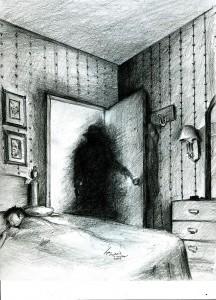
The Shadow People are supernatural shadow-like humanoid figures that, according to believers, are seen flickering on walls and ceilings in the viewer’s peripheral vision. They are often reported moving with quick, jerky movements, and quickly disintegrate into walls or mirrors. They are believed to be evil and aggressive in nature, although a few people consider them to be a form of guardian angel.

In 2010, the apparitions were described as one of the most regularly reported paranormal phenomena in the United States. This is attributed to occasional reports on the Coast to Coast AM show, where paranormal researcher Heidi Hollis has been interviewed several times on the subject of shadow people. Hollis believes that shadow people have always existed, that they feed upon emotions of fear, and that they can be repelled by thinking positively. Others believe that shadow people may be the extra-dimensional inhabitants of another universe.
The stories of shadow people have been compared to those of the Raven Mocker, a witch from Cherokee Indian mythology who sometimes appears as a shadowy phantom, and the Islamic Djinn.

Several scientific principles can be used to explain reports of apparitional experiences such as shadow people. These include sleep paralysis, illusions, or hallucinations brought on by physiological or psychological circumstances, drug use or side effects of medication, and the interaction of external agents on the human body. Another reason that could be behind the illusion is sleep deprivation, which may lead to hallucinations.

“Sleep Paralysis” is a phenomenon in which people, either when falling asleep or wakening, temporarily experience an inability to move. More formally, it is a transition state between wakefulness and rest characterized by complete muscle atonia (muscle weakness). It can occur at sleep onset or upon awakening, and it is often associated with terrifying visions (e.g. an intruder in the room), to which one is unable to react due to paralysis. It is believed a result of disrupted REM sleep, which is normally characterized by complete muscle atonia that prevents individuals from acting out their dreams. Sleep paralysis has been linked to disorders such as narcolepsy, migraines, anxiety disorders, and obstructive sleep apnea; however, it can also occur in isolation. When linked to another disorder, sleep paralysis commonly occurs in association with the neuromuscular disorder narcolepsy.

***********************

 
Leave a comment

Posted by on May 13, 2014 in Shadow People


Tags: ,

Shadow People

A shadow person (also known as a shadow figure, shadow being or black mass, is believed by skeptics to be a type of hallucination where the subject perceives a patch of shadow in their peripheral vision to be a living, humanoid figure. However, paranormal researcher Heidi Hollis has expressed the belief that shadow people are malevolent supernatural entities.

A number of religions, legends, and belief systems describe shadowy spiritual beings or supernatural entities such as shades of the underworld, and various shadowy creatures have long been a staple of folklore and ghost stories.

Several physiological and psychological conditions can account for reported experiences of shadow people. These include sleep paralysis, illusions, or hallucinations brought on by physiological or psychological circumstances, drug use or side effects of medication, and the interaction of external agents on the human body. Another reason that could be behind the illusion is sleep deprivation, which may lead to hallucinations.

Heidi Hollis’ appearances on the Coast to Coast AM late night radio radio talk show helped popularize modern beliefs in shadow people. Hollis described them as dark silhouettes with human shapes and profiles that flicker in and out of peripheral vision, and claimed that people had reported the figures attempting to “jump on their chest and choke them”. She believes they can be repelled by invoking “the name of Jesus”.

Although participants in online discussion forums devoted to paranormal and supernatural topics describe them as menacing, other believers and paranormal authors do not agree that shadow people are either evil, helpful, or neutral, and some even speculate that shadow people may be the extra-dimensional inhabitants of another universe. Some paranormal investigators and authors such as Chad Stambaugh claim to have recorded images of shadow people on video.

Shadow people feature in two episodes of ITV paranormal documentary series Extreme Ghost Stories, where they are described as “black masses”.

*******************************

sparkClick HERE to visit my online book shop,

where you can purchase my eBooks

**********

I DON’T CARE WHAT YOU CALL ME

AS LONG AS YOU ENJOY READING MY STORIES.


Tags: , , ,

Shadow People?

stories for children and adults

I heard a sound by my bedside last night,

I heard a strange sound; I got such a fright.

As something passed by me deep in the night,

I heard a faint sound; did it want my poor life?

**********

I made not a sound; I was still, in such fright,

As I lay in bed in the deep of the night,

I could hear it close by, how I longed for the light.

What was the dark thing probing the night?

**********

An evil black form, a shadowy sight,

Began to rise slowly in front of my eyes.

As I lay in bed on my left-hand side,

The dark, wicked thing rose slowly into sight.

**********

I could move not a muscle; I was frozen in fright,

As the dark frightful vision continued in height,

Till it’s malevolent eyes were almost in sight.

Only then did I close mine, despite the dark night.

**********

I knew it was wicked, evil personified,

That he wanted my sight, the light of my life.

I closed my eyes; shut them tight as the night.

Evading the Grim Reaper’s deathly cold scythe.

**********

Finally, eventually, when I opened my eyes,

I thought it was gone, departed my side,

But it was still there, though lower this time,

Starting beginning to rise over again.

**********

How could I be free from the terrible beast,

That wanted my soul, my heart and my peace?

Perhaps, if I kept my eyes firmly closed,

It might give up and leave me alone.

**********

So I closed my eyes, though still in such fright,

And I prayed that I’d last out the night.

Although its Dark Presence was close to my brow,

I kept my eyes shut so it wouldn’t bother me now.

**********

The Darkness and danger passed from me that night,

It vanished, departed, left my bedside.

I rolled over, so comfy, lulled back into nod,

Till the next time it happened it was just me and my God.

A note: This happened to me on several occasions when I was young.

******************************

sparkClick HERE to visit my online book shop,

where you can purchase my eBooks

**********


I DON’T CARE WHAT YOU CALL ME

AS LONG AS YOU ENJOY READING MY STORIES.


Tags: , , , , ,

A New Christmas Carol

A New Christmas Carol

by Arthur Machen


Scrooge was undoubtedly getting on in life, to begin with. There is no doubt whatever about that.

Ten years had gone by since the spirit of old Jacob Marley had visited him, and the Ghosts of Christmas Past, Christmas Present, and Christmas Yet to Come had shown him the error of his mean, niggardly, churlish ways, and had made him the merriest old boy that ever walked on ‘Change with a chuckle, and was called “Old Medlar” by the young dogs who never reverenced anybody or anything.

And, not a doubt of it, the young dogs were in the right. Ebenezer Scrooge was a meddler. He was always ferreting about into other peoples’ business; so that he might find out what good he could do them. Many a hard man of affairs softened as he thought of Scrooge and of the old man creeping round to the countinghouse where the hard man sat in despair, and thought of the certain ruin before him.

“My dear Mr. Hardman,” old Scrooge had said, “not another word. Take this draft for thirty thousand pounds, and use it as none knows better. Why, you’ll double it for me before six months are out.”

He would go out chuckling on that, and Charles the waiter, at the old City tavern where Scrooge dined, always said that Scrooge was a fortune for him and to the house. To say nothing of what Charles got by him; everybody ordered a fresh supply of hot brandy and water when his cheery, rosy old face entered the room.

It was Christmastide. Scrooge was sitting before his roaring fire, sipping at something warm and comfortable, and plotting happiness for all sorts of people.

“I won’t bear Bob’s obstinacy,” he was saying to himself—the firm was Scrooge and Cratchit now—”he does all the work, and it’s not fair for a useless old fellow like me to take more than a quarter share of the profits.”

A dreadful sound echoed through the grave old house. The air grew chill and sour. The something warm and comfortable grew cold and tasteless as Scrooge sipped it nervously. The door flew open, and a vague but fearful form stood in the doorway.

“Follow me,” it said.

Scrooge is not at all sure what happened then. He was in the streets. He recollected that he wanted to buy some sweetmeats for his little nephews and nieces, and he went into a shop.

“Past eight o’clock, sir,” said the civil man. “I can’t serve you.”

He wandered on through the streets that seemed strangely altered. He was going westward, and he began to feel faint. He thought he would be the better for a little brandy and water, and he was just turning into a tavern when all the people came out and the iron gates were shut with a clang in his face.

“What’s the matter?” he asked feebly of the man who was closing the doors.

“Gone ten,” the fellow said shortly, and turned out all the lights.

Scrooge felt sure that the second mince-pie had given him indigestion, and that he was in a dreadful dream. He seemed to fall into a deep gulf of darkness, in which all was blotted out.

When he came to himself again it was Christmas Day, and the people were walking about the streets.

Scrooge, somehow or other, found himself among them. They smiled and greeted one another cheerfully, but it was evident that they were not happy. Marks of care were on their faces, marks that told of past troubles and future anxieties. Scrooge heard a man sigh heavily just after he had wished a neighbor a Merry Christmas. There were tears on a woman s face as she came down the church steps, all in black.

“Poor John!” she was murmuring. “I am sure it was the wearing cark of money troubles that killed him. Still, he is in heaven now. But the clergyman said in his sermon that heaven was only a pretty fairy tale.” She wept anew.

All this disturbed Scrooge dreadfully. Something seemed to be pressing on his heart.

“But,” said he, “I shall forget all this when I sit down to dinner with Nephew Fred and my niece and their young rascals.”

It was late in the afternoon; four o’clock and dark, but in capital time for dinner. Scrooge found his nephew’s house. It was as dark as the sky; not a window was lighted up. Scrooge’s heart grew cold.

He knocked and knocked again, and rang a bell that sounded as faint and far as if it had rung in a grave.

At last a miserable old woman opened the door for a few inches and looked out suspiciously.

“Mr. Fred?” said she. “Why, he and his missus have gone off to the Hotel Splendid, as they call it, and they won’t be home till midnight. They got their table six weeks ago! The children are away at Eastbourne.”

“Dining in a tavern on Christmas day!” Scrooge murmured. “What terrible fate is this? Who is so miserable, so desolate, that he dines at a tavern on Christmas day? And the children at Eastbourne!”

The air grew misty about him. He seemed to hear as though from a great distance the voice of Tiny Tim, saying “God help us, every one!”

Again the Spirit stood before him. Scrooge fell upon his knees.

“Terrible Phantom!” he exclaimed. “Who and what are thou? Speak, I entreat thee.”

“Ebenezer Scrooge,” replied the Spirit in awful tones. “I am the Ghost of the Christmas of 1920. With me I bring the demand note of the Commissioners of Income Tax!”

Scrooge’s hair bristled as he saw the figures. But it fell out when he saw that the Apparition had feet like those of a gigantic cat.

“My name is Pussyfoot. I am also called Ruin and Despair,” said the Phantom, and vanished.

With that Scrooge awoke and drew back the curtains of his bed.

“Thank God!” he uttered from his heart. “It was but a dream!”

THE END


Tags: , , , , , , , ,