RSS

Monthly Archives: September 2025

Doctor Who and the Music of the Dolmen

Doctor Who: The Music of the Dolmen

A lonely Irish field. An ancient stone table the locals dare not cross after dusk. And music—sweet, wordless, and terrible—drifting over the hedgerows at twilight.

When the TARDIS sets down near Haroldstown Dolmen in nineteenth-century County Carlow, the Doctor dismisses it as a simple megalith. But the parish books tell another story: of vanished boys and broken fiddle-bows left upon the stone; of a lady in green velvet singing the living down into silence. Investigating beneath the dolmen, the Doctor discovers a chamber of whispering figures—neither alive nor dead—while the song coils tighter around his companions.

What lies under the stone is no tomb—but a trap still feeding. To save Ian, Barbara and Susan from the music’s call, the Doctor must confront the intelligence that plays human souls like strings… before the last note falls.


Contents

  1. A Harp in the Hedgerows – In which the travellers meet a worried historian, a superstitious farmer, and a song that is not a song.
  2. Parish Ink and Green Velvet – Testimonies, tokens on stone, and a vision upon the capstone that nearly claims Ian.
  3. What the Earth Remembered – The Doctor digs; a lantern shows too much; Susan hears her name from beneath.
  4. The Unplayed Note – A bargain, a breaking, and a silence that does not quite hold.

 Do you want to read more?

Click on the link – and enjoy.


Leave a comment

Posted by on September 30, 2025 in Uncategorized


Tags: , ,

A Tale of County Carlow

A Tale of County Carlow


The Woman on the Dolmen

A Tale of County Carlow

It was in the late summer of the year 1848 that I made my visit to the town of Tullow in the county of Carlow. My business there, though of a trifling and unromantic nature, afforded me the opportunity of passing several days amidst scenery that, if not grand in the manner of the Wicklow mountains, yet possessed a certain sober charm which spoke to the imagination in a more secret, and therefore more lasting, fashion.

The Barrow river meandered with an easy grace; the hedgerows were thick with bramble and honeysuckle; and in the quiet of the evening one might hear the calling of corncrakes from the meadows. I took lodgings in a modest inn not far from the market square, and soon discovered that my host was a man of much conversation and a relish for recounting tales of the district. It was he who first directed my attention to Haroldstown Dolmen, that curious relic of forgotten antiquity, standing solitary in a field between Tullow and Carlow town.

“You’ll see it if you take the back road,” said he, pouring me a glass of the local cider. “A great flat stone balanced upon others, like a table set for giants. Some say it’s but the burial place of kings long turned to dust.” Here he leaned closer, lowering his voice with a relish, “others say it is a doorway. And once in a while, sir, the dead themselves will come out to sit upon it.”

I laughed lightly, as travellers often do when hearing the superstitions of a countryside not their own. Yet I made a note to visit this monument, for I confess I am not insensible to the charm of old stones and the whisperings they provoke.

Two evenings later, when the weather was clear and the sky washed with a mellow gold, I set out upon the road he had indicated. The hedges on either side were high, and the hum of bees was still in the air, though the day had begun to cool. I walked for some time before the road turned, and then suddenly it came into view.

There, in the middle of a wide, low field, stood the dolmen. A capstone of enormous weight lay supported upon uprights, casting a shadow long and black upon the grass. The field was otherwise empty, save for a scatter of nettles near the gate and the distant silhouettes of sheep against the horizon. It was a place of uncommon stillness, and I confess I paused at the gate, uncertain whether to proceed.

It was then I heard it—the faintest thread of music. At first I thought it the sound of some shepherd’s pipe carried on the wind. But no: it was not a rustic air, nor yet a jig or reel. It was a note of a harp, clear and pure, rising and falling with a solemnity that chilled me. And following that a voice!

The voice was of a woman, and such a voice I had never heard before nor since. It sang not in words that I could discern, but in tones that seemed to touch the very marrow of my bones. Sweet, mournful, tender yet with a power that shook the air like the tolling of a bell. I was drawn forward, step by step, until I stood at the edge of the field.

Upon the dolmen lay a woman, as though in careless repose. Her hair was of a deep red, falling about her shoulders like a mantle of fire. She wore a gown of green velvet that glimmered in the low light. Her arms were raised slightly, her pale hands outstretched as if to shape the air through which her song flowed.

Beside her, in the grass, was a man. He sat upon an ordinary chair, such as one might find in a parlour, though how it had come there I cannot imagine. His face was thin, his complexion ghastly pale, and his eyes fixed with an unnatural solemnity upon the strings of the harp which his hands commanded. His aspect was of one who performed not for pleasure, but by some inexorable compulsion.

The sight held me immobile. The woman’s gaze, though her eyes were half-closed in her song, seemed nevertheless to rest upon me. The harpist did not look up. The music rose, wound itself about me, and I felt my breath catch.

Then the woman ceased her singing, and the harpist let his fingers fall silent. The hush that followed was more terrible than the sound itself. Slowly, the woman turned her head. Her eyes, green as glass, clear as water, met mine.

“You hear us,” she said. Her voice was low, but carried across the distance without effort. “Most do not.”

I could not reply.

She rose then from the dolmen, her long gown trailing like mist. Yet I swear, and would swear upon any book, that the moss upon which she had lain bore no impress of her form, no trace of disturbance.

The harpist lifted his face. His expression was grave, and I observed with a start that the chair upon which he sat was sunken deep into the soil, though the ground about it was hard and dry. He struck a single string, one sharp, brittle note, and in that instant the dolmen itself seemed to shudder.

The woman advanced a step, her eyes never leaving mine. “Come closer,” she whispered. “Every ear that hears our song is chosen. We need one more voice.”

At this, some dreadful instinct awoke within me. My whole being revolted at her invitation, yet my limbs moved of their own accord, one step into the field, then another. The grass seemed higher than before, the nettles hemming me in, though I had not marked them so thickly when I entered.

I do not know how long I stood thus, poised between compulsion and terror. But suddenly a cloud passed across the setting sun, and a shadow fell. In that dimness I found strength, turned, and stumbled back through the gate to the road.

Behind me, as I fled, the music began again. This time it was sweeter, more coaxing, filled with sorrow, as though the very air grieved at my departure. Yet I did not look back. I ran until the roofs of Tullow were in sight, and the sound was lost in the ordinary bustle of the town.

When at last I returned to my lodging, I found my host waiting. He looked at me keenly and said, “So, you have been to Haroldstown.”

I could not answer him. I had no wish to speak of what I had seen, nor indeed could I have put it into plain words without doubting my own senses.

But in the nights that followed, as I lay awake in my chamber, I thought I heard, faint and far, the trembling of a harp string, and a woman’s voice calling in tones of sweetness and despair.

It is now many years since that evening. I have never returned to Haroldstown, nor do I intend to. Yet sometimes, when summer fades and the wind carries the scent of nettles and cut grass, I hear again the echo of that song. And then I wonder what would have become of me had I taken one step more, and placed my hand upon the dolmen’s cold stone.


Leave a comment

Posted by on September 29, 2025 in county carlow, dolmen


Tags: , , , , ,

Alice in Mirrorland, 3

Alice in Mirrorland, 3

The path turned to tile, a stark, silent square,

And Alice found stillness where once there was care.

The White Rabbit stood, a monument of stone,

His hurried-up life forever now gone.


No frantic watch-checking, no flustered refrain,

Just silence and stillness and a perfect domain.

The creatures knelt down, a reverent throng,

“The still one is wise, where the movers are wrong!”


“A watch that ticks not is a watch that is true,”

They whisper and worship, with nothing to do.

But Alice remembers a hurried-up friend,

Whose chaos and worry had no place to end.


She reaches to touch him, the marble is cold,

And a story of stillness begins to unfold.

A faint, hidden tick, a twitch of the lip,

A memory stirred by a hesitant trip.


“He loved his own hurry, his miserable pace,”

She whispers to nothing, then flees from the place.

The whispers pursue her, a prayer in the air,

“Forever still. Forever wise. Forever stone.” They declare.


Tags: , , ,

Alice in Mirrorland, 2

Alice in Mirrorland, 2


A palace of sugar, a Queen of sweet smiles,

A kingdom of kindness in elegant styles.

The air smells of jam, the banners all wave,

And no one can scowl, or else they’re not brave.


“Be happy! Be happy!” the Queen sweetly cries,

But the smiles are stretched masks above terrified eyes.

The hedgehogs in armour stand ready to roll,

To correct a sad face, or a sigh from the soul.


A servant is caught with a look of dismay,

And whisked to a chamber and tickled away.

Alice forces a grin, though her insides are numb,

For kindness has turned into a prison of glum.


She longs for a world where a frown’s not a crime,

Where being yourself isn’t squandered on time.

For a smile that is real is a treasure, you see,

But a forced, frozen one is a form of cruelty.


Tags: , ,

Alice in Mirrorland, 1

Alice in Mirrorland, 1


Alice’s heart was a drum in her chest,

As the mirror gave way to a splintering quest.

The looking-glass fractured, a web-work of pain,

And her ordinary world fell to pieces like rain.


A thousand bright shards, each a different design,

Held a hundred new Alices, and none of them fine.

There was one with a frown, and one with a smirk,

And one bent with years, a sinister work.


“Which one is me?” she cried out to the glass,

As her selfhood dissolved, a bewildering mass.

A whisper, a sneer, a laugh like a chime,

Each reflection was stealing a moment of time.


Then the mirror erupted, a whirlwind of might,

And carried her off in a chaos of light.

She saw her true self, a reflection so bold,

Wave goodbye as the new story, now fractured, unfolds.


Tags: , ,

The Beetle and the Bubblegum Bomb

The Beetle and the Bubblegum Bomb


Box Privet, a boy whose soul was perfectly calibrated to the clean, predictable logic of circuitry and oscilloscopes, was currently driving in a state of barely contained panic. His world, once dominated by the pleasant hum of his soldering iron, had been usurped by the utterly unpredictable presence of his cousin, Harry Rotter.

Harry (or Harriet, as her tormented parents used to call her) was the family’s dreadful, dark secret—a calculating girl wizard who had, in a spectacular fit of carelessness, lost her Magical Marbles. These marbles contained the bulk of her power, and without them, her raw, volatile magic was leaking out, manifesting as miniature bursts of utter, sticky nonsense across number five Dorsley Drive.

Their mission—or rather, Harry’s command—was to retrieve those marbles before the leaking magic warped reality completely. This meant Box, the only person with a driver’s license (barely), was behind the wheel of his father’s sacred, air-cooled German machine, the Volkswagen Beetle. Affectionately, and nervously, dubbed ‘The Bug’ by Mr. Privet, the car was a shrine to vinyl and order, and Box was terrified of upsetting its balance.

The Beetle was currently thrumming down Dorsley Drive. Box was at the wheel, his large glasses nearly touching the steering wheel as he gripped it at ten and two, perfectly mimicking the instructional video he’d watched five times.

“You’re driving far too slowly, Box,” Harry said, chewing a massive wad of lurid pink bubblegum. She was sprawled across the passenger seat, legs up on the dashboard despite Mr. Privet’s strict, hand-written sign that read: Absolutely No Feet on the Vinyl. Ever.

“I’m driving precisely the speed limit,” Box mumbled, checking his speed against the needle and the satnav app he’d rigged to the car’s ancient radio. “And get your feet down! Dad measures the scuff marks.”

“Relax,” Harry drawled, blowing a bubble the size of a small melon. “Your father’s currently preoccupied with whether tinned peaches are the only thing keeping the alien-lizard-people from taking over the council. He’s in no state to check for scuffs.”

“That’s beside the point! This car is a precision instrument!”

“This car is a metal tin can with a funny little engine and a distinct smell of disappointment,” Harry corrected, popping the bubblegum with a sound like a distant gunshot. She then picked a speck of lint off her cherubic cheek and flicked it toward the windshield.

It never hit the glass.

Instead, the speck of lint paused in the air, shimmered with a sickly green light—a burst of Harry’s runaway magic—and instantly grew into a tennis ball-sized globe of thick, sticky, neon-pink bubblegum, pulsating gently. It smacked wetly onto the inside of the windshield, directly in front of Box’s eyes.

“Harry!” Box shrieked, slamming on the brakes. The Bug shuddered violently, narrowly avoiding swerving into a neighbour’s immaculate prize-winning fuchsia bush. “What did you just do?!”

Harry casually peeled another strip of gum. “Just losing a tiny bit of magic, Box. Don’t get your resistor in a twist. I told you, I’ve lost my Magical Marbles. The magic is leaking out whenever I’m bored, and your driving style, Box, is a magical sieve.”

Box was already fumbling with his box of tools, pulling out a multi-meter. “This is a Class 3 Bio-Hazard, Harry! It’s highly volatile and gum-based! I can’t just scrape it off—it’ll void the sound dampening material!”

Harry sighed with exaggerated patience. “Just get us moving. We need to find those marbles before I turn your father’s prized vehicle into a giant, chrome hamster wheel. And don’t worry about the gum.”

She reached over and, instead of touching the luminous pink orb, she merely pointed her finger at it.

The sphere of gum didn’t move. But the entire windshield, along with the steering column, the dashboard, and Box’s large spectacles, suddenly rotated ninety degrees counter-clockwise.

The Beetle was now being driven by Box, who was squinting sideways through the rotated windshield, viewing the world at a slightly dizzying angle. The car was accelerating again, heading straight for the high curb.

“Harry!” Box yelled, fighting the crooked steering wheel. “We’re going to hit the pavement sideways!”

“Oh, lighten up, Box,” Harry giggled, now looking straight ahead through the newly vacated passenger window. “It’s just a new perspective! Now, did you remember to bring the copper wiring for the electro-magical wand?”

Chapter Two: The Architecture of Absurdity

Box Privet’s bedroom was not a place for relaxation; it was a sanctuary of solder fumes and blinking LEDs. Every wall was lined with shelves overflowing with neatly organized bins labeled with terrifying precision: ’7400 Series Logic,’ ‘1/4 W Resistors (Tolerance < 5%),’ and the truly disturbing ‘Mystery Wires (Handle with Gloves).’

On his workbench—a repurposed dining table covered in an anti-static mat—the parts for the Foci-Finder lay assembled. For Box, this was the ultimate engineering challenge: designing a sensor that could detect “magic”—a field he considered purely theoretical, like unicorns or reliable transit schedules.

“Are you sure about this configuration, Box?” Harry asked, draped over a beanbag chair made entirely of recycled circuit boards. She held a damp, crumpled blueprint of the design, which Box had spent three hours perfecting.

Box didn’t look up, his soldering iron whispering against a tiny surface-mount capacitor. “Yes, Harry. The Phase-Shift Oscillator requires a precise resistor to maintain frequency stability. Any deviation and the entire magnetic pulse generator will—”

“Too much math, Box,” Harry interrupted with a sigh. “That little copper coil needs flow. You’ve measured all the angles, but did you check its vibe? It feels rigid. Maybe if you gave it a little… wiggle.”

Box slowly raised his head, his safety goggles magnifying his glare. “If I ‘wiggle’ the core component, Harry, it won’t detect residual quantum entanglement; it will detect sparks and fire. It’s not a wishing well, it’s a circuit board.”

He picked up the final piece of the device: a bent, metallic object with a thick, insulated handle.

“And what is that?” Harry peered at it.

“This,” Box announced, his voice tight with defensive pride, “is the antenna. It’s a custom-built, directional Faraday Loop Antenna, optimized for capturing localized energy field disruptions.” He paused. “I took the whisk from Dad’s new stand mixer.”

Harry clapped her hands. “Excellent! That has great kitchen-magic potential. But it still needs something… wizardy. It’s a wand, not a calculator.”

Box took a deep breath, fighting the urge to explain that a calculator was infinitely more complex than a wand. To appease her, he used a hot glue gun to affix three tiny, flickering blue LEDs to the tip of the whisk-antenna. He then wrapped the handle in iridescent metallic duct tape.

The finished product looked like a kitchen appliance that had been mugged by a glowworm and forced to take a physics class. It featured a flashing circuit board, a digital readout, and the unmistakable head of a stainless steel whisk.

“It is complete,” Box declared, wiping his soldering brow. “The device now measures for a fluctuation caused by the presence of your Foci. We should achieve detection accuracy within a radius.”

Harry slid off the chair, beaming. She snatched the wand and gave it a joyful wave, which Box noted with horror sent the digital readout briefly spiking to an impossible value of .

“Perfect! Let’s go find those marbles before Dad notices the kitchen appliance theft, or before the Beetle’s tires re-inflate.”

Want to read more? Simply click HERE and enjoy.

 
Leave a comment

Posted by on September 28, 2025 in Harry Potter, Harry Rotter


Tags: , , ,

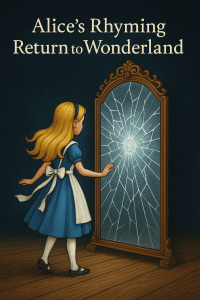
Alice’s Rhyming Return to Wonderland

Alice’s Rhyming Return to Wonderland


alice in mirrorland, a new alice in wonderland story

A NEW Alice adventure coming here SOON.


Tags: , , ,

Alice in Mirrorland

Alice in Mirrorland

Prologue: The Splintering

It was an ordinary afternoon, which was quite suspicious, for Alice had learned long ago that “ordinary” things have a habit of becoming extraordinary the moment one looks away. She was sitting in the drawing-room, watching the fire mutter to itself in the grate and glancing now and then at the great Looking-Glass above the mantelpiece.

The Looking-Glass had never struck her as trustworthy. For one thing, it was altogether too polished, as though it knew secrets it was unwilling to share. For another, it sometimes showed her reflection doing things she was certain she had not done—like tapping its foot when she was standing still, or frowning when she felt rather jolly.

This afternoon, however, the glass seemed well-behaved. Alice tilted her head; so did Alice-Through-the-Glass. Alice stuck out her tongue (not very politely, but no one was looking); her reflection copied her precisely. “At least you’re obedient today,” she said.

But no sooner had she said this than the Looking-Glass Alice gave the tiniest smirk, as though mocking her. Alice’s heart skipped, and she leaned closer. “That wasn’t me,” she whispered.

The smirk grew.

Then came the crack.

It began as a thin silver line across the surface, like a spiderweb spun at impossible speed. Alice drew back with a cry, for the crack was spreading, branching into a hundred more, until the whole mirror was a maze of glittering shards. And in each shard, her reflection was different.

One Alice looked much older, hair white as frost. Another was cross and scowling. A third was laughing so violently her shoulders shook. Some reflections looked away, some refused to meet her gaze at all.

Alice pressed her hands to her cheeks. “Oh, this is most irregular! Which of you is me?”

The reflections did not answer, but one of them—a solemn-faced Alice with eyes like wet glass—stepped forward. She did not step out of her shard so much as the shard slipped away to let her through, like a curtain parting.

“You’ve taken your turn long enough,” said the Reflection. Her voice was cool, not echoing but hollow, as if spoken inside a bottle. “Now it is ours.”

Before Alice could protest, the mirror burst into a thousand pieces that did not fall, but flew, whirling about her like a storm of knives. She tried to run, but the room had gone, the hearth, the carpet, the walls—all vanished. Only the shards remained, spinning faster and faster until they became a blinding whirlpool of silver light.

Alice gave one last shout—“Oh, I do not approve of this!”—before she was swept off her feet and carried into the storm.

The very last thing she saw was her own reflection, hovering calmly in the air, waving her farewell as if to say, Goodbye, Alice. We’ll take it from here.

To be continued.


Tags: , ,

Two Rivers: One Green, One Brown

Two Rivers: One Green, One Brown

Two Rivers: One Green, One Brown


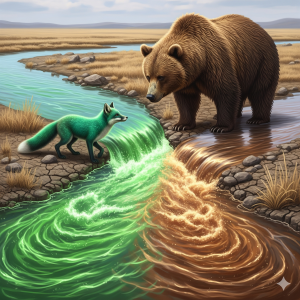
The land was divided by two rivers, and everyone knew that their waters must never touch. On one side was the Green River, its current shimmering with the laughter of a thousand emeralds. Its water tasted of mint and new leaves, and it carried whispers of spring and the secrets of the forest. The creatures who drank from it—the silver foxes, the songbirds, the deer with antlers like branches—were quick of foot and light of heart. Their fur and feathers held the green shimmer of their home.

On the other side flowed the Brown River. Its waters were deep and rich, the color of wet earth and autumn. It sang a low, humming song of ancient roots and buried memories. The creatures that drank from it—the slow, wise turtles, the burrowing moles, the great brown bears—were strong and steady. Their coats were the color of the river, and they held the patient wisdom of the stones at its bottom.

For centuries, the two rivers flowed side-by-side, parallel but separate. A narrow strip of land, overgrown with thick moss and ancient trees, was all that kept them apart. The animals of the Green River would sometimes look across at their brown-furred counterparts, curious but cautious. The animals of the Brown River would do the same, their steady eyes watching the flash of green across the way.

One day, a terrible drought came. The land grew parched, and the sun beat down with a relentless fury. The Green River, which relied on the soft rains of spring, began to shrink. Its laughter faded into a murmur, and the creatures who depended on it grew weak and weary. The Brown River, which drew its strength from deep, hidden springs, was still full, its song a low thrum of endurance. But the animals of the Brown River watched as their neighbors withered, and their own hearts grew heavy with a sorrow they had never known.

A young emerald fox, its fur dulled by thirst, crept to the edge of its riverbed and stared at the full, flowing Brown River. A large brown bear, its eyes full of concern, watched the fox from the opposite bank. The fox’s need was great, and the bear’s compassion was greater. The bear stretched a massive paw and, with a silent wish, nudged a large, round stone into the water. It landed with a splash that created a ripple, a tiny, determined wave that traveled across the narrow strip of land. The stone, a gift from the bear, created a bridge, a momentary link between the two rivers.

The ripple from the Brown River met the last of the Green River’s flow, and something magical happened. For a moment, where they touched, the water didn’t mix but swirled in a mesmerizing dance of jade and amber. The combined water, a single, intertwined current, sparkled with an energy neither had ever known alone. The creatures who saw it felt a sense of awe.

The fox, seeing the combined water, carefully stepped onto the new, small bridge of rocks and dipped its head, drinking from the water where the two had met. The moment the water touched its tongue, a new energy surged through its body. Its fur shimmered with a vibrancy it had lost, but it was not just green now; a deep, earthy wisdom seemed to flow beneath its skin.

The bear, watching the fox, felt a similar transformation. As the Brown River touched the Green, it no longer carried just the weight of the earth. A new lightness and joy bubbled within it.

From that day forward, the rivers continued to flow side-by-side, but they were no longer strangers. The animals on either side learned to build more stone bridges, to share the water, and to share their stories. The Green River still sang of spring, and the Brown River still hummed of ancient roots. But now, in the shared water, the melodies of joy and wisdom played together, creating a new, vibrant song that flowed through the heart of the land, forever changed.

 
Leave a comment

Posted by on September 23, 2025 in rivers, Short story


Tags: , , ,

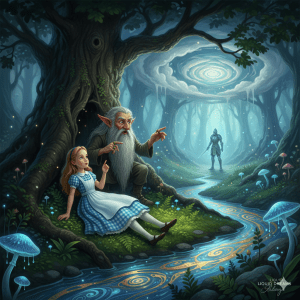
Alice tumbled into a fissure

Alice tumbled into a fissure

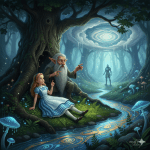
Alice found the elf by accident, as she found most things: by tumbling into them. This time, it wasn’t a rabbit hole, but a fissure in the earth, hidden by a blanket of moss and the shade of a weeping willow. She landed with a soft thump on a bed of ferns, her gingham dress a bright splash of blue in the dim, green light.

A pair of very, very old eyes blinked at her from the shadows of a gnarled oak. They were the color of faded leaves, and the wrinkles around them were like the rings of a tree. “Well, bless me,” a voice rasped, like dry leaves scuttling across a stone path. “Another one.”

Alice, never one to be flustered for long, brushed a stray leaf from her nose. “Another what?” she asked, her head tilted to the side.

“Another child who has lost their way,” the elf said, emerging from the gloom. He was slight and stooped, with a beard the color of winter frost. His name, he told her, was Fle. “I’ve seen so many. They all come seeking something. A way home, a lost toy, a purpose they’ve misplaced.”

Alice considered this. “I’m not lost, exactly,” she said. “I know where I am. I’m in a sort of underground forest, and you are a very old elf.”

Fle chuckled, a sound like gravel rolling down a hill. “Ah, but you are. Lost in the way that all mortals are. You are looking for an adventure, aren’t you?”

Alice’s eyes widened. “How did you know?”

“I’ve been watching the world for a very long time,” Fle said, settling himself on a mossy root. “And I’ve learned that the ones who fall into the quiet places are the ones who are looking for the loudest stories.” He gestured with a spindly finger to the world around them. “This place is full of them. The tales that have been forgotten. The songs that have been silenced.”

He told her a story of a talking mushroom that wept tears of light, and of a river that flowed with liquid dreams. He spoke of a queen who ruled over a kingdom of clouds, and a knight who wore armor made of moonlight. His words were like a spell, weaving pictures in the air, and Alice listened, her heart thrumming with the rhythm of his ancient tales.

“So, you see,” Fle said, when he had finished, “the world is not just a place to be. It is a place to be discovered. And sometimes, the most wonderful discoveries are found when you fall into the quiet places.”

Alice stood up, her blue dress a beacon in the twilight. “Thank you, Fle,” she said, her voice full of a new kind of wonder. “I think… I think I understand now. It’s not about finding my way back. It’s about finding my way forward.”

Fle smiled, a thousand years of wisdom in the gentle curve of his lips. “Precisely,” he said. And then, as quietly as he had appeared, he faded back into the shadows of the old oak, leaving Alice alone with the rustling ferns and the whispers of a thousand forgotten tales, ready to write her own.


Tags: , , , , ,