RSS

Monthly Archives: September 2025

Athgreany Piper’s Stones Hollywood, Co. Wicklow

Athgreany Piper’s Stones Hollywood, Co. Wicklow

The air was alive with the sound of music, a reel so fast and joyous it could make the very stones dance. Fiadh, her red hair a fiery blur, spun in the center of the ring, her feet a rapid-fire beat against the soft earth. The piper, a man known simply as Séamus, stood a little apart, his fingers a blur over the chanter. The melody poured from the bagpipes, a wild, untamable thing that wrapped around the dancers and pulled them into a frenzy of merriment.

The sun was high above the Wicklow Hills, a golden disk in a pale blue sky. It was the Sabbath, a day of rest, but here in this secluded glen, rest was the last thing on anyone’s mind. The laughter and music were an irresistible force, a defiance of all the solemnity of the day. One by one, more villagers joined the circle, their faces flushed with glee. They were a motley crew—farmers, weavers, even the grumpy blacksmith—all united by the irresistible pull of Séamus’s tune.

But a dark figure watched from the edge of the forest. The local druid, a gaunt man with eyes as sharp as flint, had warned them. “The old ways are fading,” he’d said, “but the gods still watch. To dance on the Sabbath is to tempt their wrath.” His words, however, had been lost in the chorus of fiddles and flutes.

As the sun began to dip toward the horizon, casting long, purple shadows, the music reached a fever pitch. Séamus’s cheeks were puffed out, his eyes squeezed shut in concentration, pouring every ounce of his soul into the pipes. The dancers spun faster, a dizzying whirlwind of color and movement.

It was then that the first tremors began. The ground beneath their feet started to shake, a low rumble that vibrated through the air and sent a shiver of fear through the crowd. The laughter died on their lips, replaced by gasps of alarm. The music faltered, a discordant squeal from the pipes, as Séamus’s fingers stilled.

The world seemed to hold its breath. A blinding flash of light, brighter than the noonday sun, erupted from the sky, engulfing the entire glen. When the light faded, the grass lay undisturbed, the air was eerily still. There was no music, no laughter, no sound at all.

Where a circle of lively dancers had once stood, there was now a ring of cold, gray stone. Some of the stones stood upright, their forms still vaguely human, as if caught mid-spin. Others lay flat on the ground, a testament to a fall. And some ways off, a tall, silent pillar of granite stood alone, a silent sentinel over the ossified dancers. This was Séamus, the piper, forever silenced, his pipes gone, his merriment a memory etched in stone.

The villagers who had fled watched from a distance, their faces pale with shock. They had seen the wrath of the gods, a swift and terrible judgment. From that day on, the place was known as the Piper’s Stones, a silent warning to all who would defy the sacred day, a tale of merriment gone wrong that would echo through the glens for centuries to come.

 
Leave a comment

Posted by on September 11, 2025 in Athgreany, piper's stones


Tags: , , , ,

Little Red Riding Hood


Little Red Riding Hood and the Dalek

Chapter One: The Basket of Cakes

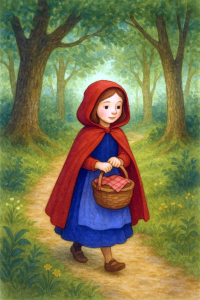
Once upon a time, there lived a cheerful little girl who wore a cloak the colour of bright cherries, with a hood that framed her round face. Because she wore it so often, the neighbours called her Little Red Riding Hood.

One fine morning, her mother packed a basket with cakes, butter, and a flask of hot chocolate.
“Take these to your grandmother, dear,” she said. “She has not been well. But remember—stay on the path. And don’t talk to strangers.”

Little Red Riding Hood promised she would be good, although she was secretly curious about the forest. She kissed her mother’s cheek, hoisted her basket, and set off humming into the green, leafy world.

What she did not know was that a strange new visitor had arrived in the forest—a creature made of shining metal, whose voice echoed like thunder.


Chapter Two: The Stranger in the Woods

The path twisted beneath tall oaks. Birds should have been singing, but they were silent. Even the squirrels kept to their holes.

Suddenly, there came a grinding, wheezing noise, followed by a screech:
“IDENTIFY! IDENTIFY!”

Red stopped in her tracks. Before her stood something unlike any fox, wolf, or bear. It was shaped like a giant pepperpot, plated in bronze and gold, with a single glowing eye.

“I—I’m Little Red Riding Hood,” she stammered. “Who are you?”

“I—AM—A—DALEK!” the creature boomed. “WHERE—ARE—YOU—GOING?”

“To visit my grandmother in her cottage, with cakes and hot chocolate.”

The Dalek’s dome swivelled. “WHERE—IS—THE—COTTAGE?”

Red pointed, still polite though her knees were shaking. “Over the hill, through the glade, by the old stone well.”

Without another word, the Dalek spun round and rolled away, faster than seemed possible.


Chapter Three: The Cottage in Danger

Grandmother’s cottage was small, with roses round the door and a chimney that puffed like a kettle. Inside, the poor woman was knitting by the fire when—CRASH!—her door burst open.

The Dalek burst in, screeching:
“EXTERMINATE! EXTERMINATE!”

Granny dropped her knitting and dived under the bed. The Dalek considered blasting her to pieces but then remembered a half-broken file in its databank titled “HUMAN FAIRY STORIES: STRATEGIC USE.”

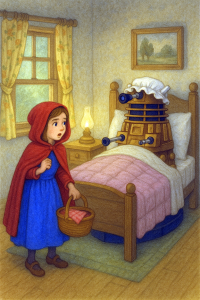
“NEW STRATEGY: DECEPTION!” it bellowed. With difficulty, it plucked Granny’s nightcap with its plunger and balanced it on its dome. Then it reversed awkwardly into her bed, pulling the blanket up to its grille.

The disguise was… questionable.


Chapter Four: “What Big Lights You Have!”

Little Red Riding Hood soon arrived, her basket swinging. She pushed open the cottage door, surprised that it hung off its hinges.

Inside was smoke, scorch marks, and splintered wood. But on the bed lay her “grandmother,” strangely lumpy under the quilt.

“Oh, Grandmother, what bright blue lights you have!”

“THE BETTER—TO—SEE YOU WITH!” screeched the Dalek.

“Oh, Grandmother, what a terrible voice you have!”

“THE BETTER—TO—COMMAND YOUR EXTERMINATION WITH!”

And with that, the Dalek threw off the quilt, cap flying, and aimed its death-ray straight at Little Red Riding Hood.


Chapter Five: The Hot Chocolate Surprise

hot chocolate surprise

Red gasped. She stumbled backward, clutching her basket. In her fright, the flask of hot chocolate slipped from her hands. The lid popped, and steaming cocoa splashed across the Dalek’s grille.

Instantly, sparks flew.
“WARNING! COCOA—INTRUSION! CIRCUITRY COMPROMISED!”

The Dalek spun in circles, smashing Granny’s dresser, knocking over the kettle, and shouting, “MALFUNCTION! MALFUNCTION!”

With one last fizzing shriek, it toppled into the fireplace, where sparks and smoke finished the job. The Dalek went silent, its single eye fading to black.


Chapter Six: Safe at Last

safe at last

From under the bed, Grandmother crawled out, trembling but alive.
“Oh, my dear child!” she cried. “You have saved me—from that dreadful… whatever-it-was!”

Little Red Riding Hood smiled shyly. “It seems hot chocolate can defeat more than just a cold day.”

They sat together, nibbling cakes and drinking what cocoa remained. And though the cottage was rather scorched and in need of repair, both were glad to be alive.


Epilogue: The Moral

From that day forth, Little Red Riding Hood never wandered through the forest without a flask of hot chocolate, just in case. And the villagers told the story for generations: how a girl in a red cloak defeated a terrifying Dalek with nothing more than kindness, quick thinking, and a very sticky drink.

Moral: Even the smallest comforts can triumph over the greatest terrors.


Tags: , , , , ,

THE SHADOW THAT LEARNED TO PRAY

THE SHADOW THAT LEARNED TO PRAY

THE SHADOW THAT LEARNED TO PRAY

(From the Papers of Canon O’Shaughnessy, with Notes and an Appendix on “An Faire Dorcha”)

By Dr. H. C. Ellingham, F.S.I.A.


I. Introductory Remarks

In arranging the literary remains of the late Canon O’Shaughnessy of Carlow, I discovered a packet of letters, tied with twine and labelled in his hand “Ballyroguearty — Donnelly.” These were addressed to him from Father Donnelly, parish priest of Ballyroguearty, in the closing months of 1874.

The contents pertain to certain manifestations within the parish church of St. Brendan’s. I beg leave to lay the documents before the Society, together with marginalia of Canon O’Shaughnessy, and such commentary as I may append.


II. The Donnelly Letters

First Appearance

Letter, Oct. 18th, 1874:

“I perceived at the last pew, beneath the north wall, a figure robed in darkness, so dense the candles gave it no light. Its head was bowed, and it muttered in broken Latin.”

Transcription (as copied by Donnelly):

MIS-ER-E-RE  NOBIS  
DEVS   TENEBRARVM  
ORDO   ÆTERNVM  
EXTERMINARE   PECCATVM

(Translation: “Have mercy upon us, God of Shadows, eternal order, destroy sin.”)


The Signs

Letter, Nov. 2nd, 1874:

“Wax poured like wounds from the candles; the bells swung without hand; the saints wept black tears. Through it all the shadow chanted…”

Transcription:

SANC-TV[S]   SANC-TV[S]   SANC-TV[S]  
ORDO   DOMINATORVM  
PLENVM   EST   VNIVERSVM  
GLORIA   TENEBRARVM

(A parody of the Sanctus. Here the glory belongs to shadows, not the Lord of Hosts.)

Want to reead more?

Click on the link, below, and be scared!

The Shadow that learned to pray

 
Leave a comment

Posted by on September 10, 2025 in scare, shadow


Tags: , , , , ,

There was a Dalek in Wonderland

In a quaint little village nestled in the heart of England, there lived a young girl named Alice. One sunny afternoon, while exploring the fields behind her home, she stumbled upon a peculiar, shimmering portal. Intrigued, Alice stepped through, finding herself in a world unlike any she had ever seen.

The sky was a swirl of vibrant, impossible colors, and the trees had leaves of pure gold. As she wandered, Alice encountered the most extraordinary creatures. A White Rabbit, dressed in a tiny waistcoat, scurried past, muttering about being late.

It was then that she saw it – a shiny, bronze creature with a single eye, gliding across the path. It was a Dalek, but not like any Dalek she had ever seen in her storybooks. This one wore a tiny, top hat and held a teacup, a bewildered expression on its metallic face. “Exterminate! Exterminate tea time!” it declared, “I’m late, I’m late for a very important date!”

Alice, never one to be easily frightened, giggled. “Are you lost, Mr. Dalek?” she asked.

The Dalek swiveled its head, its eye focusing on Alice. “Lost? I am not lost! I am merely… disoriented! This ‘Wonderland’ is most illogical!”

Together, Alice and the Dalek embarked on an adventure through Wonderland. They met a Mad Hatter who offered them invisible tea, a Cheshire Cat who spoke in riddles, and a Queen of Hearts who demanded everyone play croquet with flamingos. The Dalek, surprisingly, found itself enjoying the absurdity of it all, even attempting to “exterminate” a particularly stubborn flamingo.

As the sun began to set, casting long, purple shadows across the landscape, Alice knew it was time to return home. She bid farewell to her new friends, promising to visit again soon. The Dalek, for its part, declared that it would “analyze and compute” the wonders of Wonderland, perhaps even incorporating “tea time” into its future plans. And so, Alice returned to her quiet English village, her heart full of memories of a most extraordinary adventure in a very peculiar Wonderland.

If you enjoyed that, click on the link, below, for more madcap Dalek adventures in Wonderland.

Dalek in Wonderland


Tags: , , ,

Aliens Landed in Ballykillduff for a Second Time

Chapter 1: The Spud-tacular Return

The first time the aliens landed in Ballykillduff, it was a proper kerfuffle. There was a stolen tractor, a case of mistaken identity involving a scarecrow, and a cosmic misunderstanding over Mrs. O’Malley’s prize-winning jam. The villagers thought they’d seen the last of the strange, green-skinned visitors from the planet Zorp, but they were wrong.

The second arrival was even more bizarre. Instead of a sleek, silver saucer, the aliens’ ship looked like a giant, glistening beetroot, complete with leafy antennae that twitched in the breeze. It didn’t land so much as plop right into the middle of Farmer McGregor’s best potato field, sending a shower of earth and spuds flying.

Out of the beetroot ship tumbled not two, but fifty tiny, mushroom-like aliens, each no bigger than a teacup. They didn’t have ray guns or cloaking devices; they had miniature shovels and wicker baskets. They immediately got to work, burrowing into the soft soil with an unearthly speed, muttering in a series of high-pitched squeaks and chirps.

Young Finn O’Connell, who had been hiding in the bushes since the ship arrived, peeked out. “Mam! Da!” he yelled, “They’re back! And they’re after the spuds!”

And they were. The Zorpians, it turned out, were not warmongers or explorers. They were expert potato farmers from a world where all spud varieties had gone extinct. The first landing had been a mistake, but the soil sample they took back from Ballykillduff had caused a sensation on Zorp. They had returned with one single purpose: to gather as many different types of potatoes as they could to save their civilization.

The villagers, after an initial period of utter confusion, saw an opportunity. They started a frenzied barter system. Mr. Fitzwilliam, known for his stubbornness and his Golden Wonders, traded a sack of his finest for a device that could make his garden gnomes sing Irish folk songs. Mrs. O’Malley, ever the businesswoman, bartered a crate of Maris Pipers for a gadget that could perfectly brew tea at the exact right temperature.

But the real chaos started when one of the aliens, in its excitement, dropped a small, glowing orb. The orb rolled into the village well and with a great gloop, a geyser of sparkling, purple liquid shot into the sky. The liquid had a curious effect on anything it touched—it made things… bouncy. Soon, the entire village was a trampoline. The church steeple wobbled like a jelly, the pub’s sign bounced merrily in the air, and the stray cats of Ballykillduff discovered a newfound joy in leaping from roof to roof.

The aliens, now terrified, scurried back into their ship, their tiny baskets overflowing with potatoes. With a final, apologetic chirp, the beetroot ship lifted off, leaving behind a village that would never be the same. The geyser eventually subsided, but the memory of Ballykillduff’s bounciest day would live on, a testament to the strange and wonderful things that can happen when you find yourself in the path of a Zorpian potato famine.

Chapter 2: The Chrome Sentinel

The purple geyser had long since faded, but its legacy remained. The houses of Ballykillduff had settled into a gentle, jelly-like wobble, and the villagers had grown accustomed to bouncing slightly as they walked. They’d even found it made a brisk walk to the pub much more efficient. The singing gnomes were a constant, if slightly off-key, source of entertainment in Mr. Fitzwilliam’s garden.

One Tuesday morning, the beetroot ship returned, hovering over the village with a low, contented thrum. It lowered a single, humming pod to the ground. Out of the pod rolled the “new tractor” the Zorpians had promised. It was not a tractor at all. It was a single, immense, chrome-plated slug.

The slug, which shimmered with an oily rainbow sheen, had a series of telescoping, metallic eyes that swiveled independently. It left a trail of what looked like solidified, glowing jelly. As it moved, it emitted a deep, rumbling purr that seemed to resonate in the villagers’ chests.

Farmer McGregor was the first to approach it. “Well, what’s this then?” he muttered, poking at the slug’s hide with a stick. The slug responded by extending a long, silvery tentacle and delicately plucking the stick from his hand. It then proceeded to twist the stick into a perfect, glowing pretzel before returning it.

The villagers quickly realized the slug-tractor had a mind of its own. It seemed to understand their farming needs, but in a way that defied all logic. It would plow fields by burping a stream of pressurized air, leaving perfect furrows in its wake. It would harvest vegetables by simply nudging them, causing them to float gently into waiting baskets. But it also had a mischievous streak. It would occasionally turn the village roads into sticky, caramel-colored toffee and rearrange the village’s fences into the shape of a smiling face.

The greatest surprise came when the slug-tractor reached the well. It took a long, thoughtful sip of the still-bouncy water, and then, with a satisfied shudder, it began to expand. It grew and grew, its metallic skin stretching and distorting until it completely enveloped the well, sealing off the source of the bouncing liquid. The village returned to normal, solid ground. The houses stopped wobbling, the pub sign went still, and the cats had a sudden, sad realization that leaping from roof to roof was no longer as exciting. The slug, now the size of a small cottage, settled into the village center, a silent, chrome monument to Zorpian technology, ready to work the fields and provide new, chaotic surprises whenever it saw fit.

Chapter 3: The Goliaths of the Glens

The villagers were slowly getting used to the slug-tractor, which they had affectionately, if a little fearfully, named “The Chrome Sentinel.” It sat in the village square, an oily, rainbow-hued guardian that seemed to watch over everything. Its methods were strange, but efficient, and they’d all agreed it was a small price to pay for having solid ground back under their feet.

One brisk morning, a familiar shadow fell over the village. The beetroot ship returned, hovering with a low, inquisitive hum. This time, the Zorpians were not a rabble of fifty, but a small delegation of three, looking much more official and serious. They landed not in a spud field, but near the Chrome Sentinel, their leafy antennae quivering with purpose.

They approached the slug-tractor, squeaking excitedly, and ran their tiny hands over its shimmering shell. But their squeaks of delight quickly turned to high-pitched squawks of dismay. One alien pointed to the village well, now sealed under a dome of chrome, and chittered frantically. The villagers, though they didn’t understand the words, understood the tone. They were a mix of confused and indignant.

Farmer McGregor stepped forward, his fists on his hips. “What’s the meaning of this? You left him with us! He fixed our well!”

The lead Zorpian held up a tiny, glowing tablet. On it, a series of pictograms flashed: a bouncing house, a purple fountain, and a very confused-looking Zorpian. The tablet then showed a picture of the slug, a tiny dot, and a giant, monstrous version. The message was clear: they had given the villagers a simple tool, not a world-altering beast. The slug was a juvenile, meant for small-scale tasks, and by drinking the “bouncy” water, it had grown into a colossus, far beyond its original purpose. They had come to retrieve their wayward technology.

But the villagers had other plans. The Chrome Sentinel was their pet, their protector, and their most efficient farmhand. Mrs. O’Malley brought out her best biscuits and placed them on a small platter near the slug’s head. The slug, in turn, gently nudged the platter, and with a soft whirr, extruded a beautiful, chrome rose, which it offered to Mrs. O’Malley. The villagers cheered.

Seeing this, the Zorpians realized the slug was not just a tool; it had become part of the family. They saw the singing garden gnomes, the perfectly tended fields, and the peaceful, solid ground. They exchanged a series of rapid-fire chirps, and the lead Zorpian turned back to the villagers. The tablet now showed a final message, written in shaky, imperfect English: “YOUR PET. OUR GIFT. WE WILL RETURN FOR MORE SPUDS.”

And so, the slug stayed. The villagers learned to live with its eccentricities. It would only plow fields if someone hummed a happy tune nearby. It would randomly rearrange Mr. Fitzwilliam’s fences if it felt they weren’t aesthetically pleasing. And sometimes, late at night, a single, glowing pretzel would appear on the doorstep of the pub, a token from their magnificent, chrome-plated pet. The slug-tractor was no longer just an alien artifact; it was Ballykillduff’s Chrome Sentinel, a guardian of the village and a constant source of magnificent, chaotic weirdness.

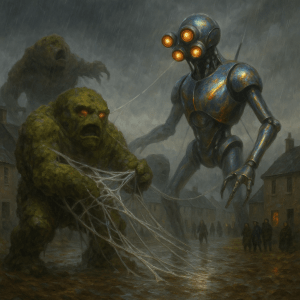
The peace of Ballykillduff was shattered one rainy afternoon by a low, guttural roar from the hills. A herd of ancient, stone-like creatures, long dormant, had been awakened by the seismic rumblings of the Zorpians’ landings. They were the Goliaths of the Glens—massive, moss-covered beasts with eyes of glowing quartz and an insatiable hunger for the village’s precious leeks. The villagers, armed with pitchforks and determination, stood ready, but the Goliaths’ hides were impervious to their efforts.

It was then that The Chrome Sentinel stirred. Its metallic eyes, which usually swiveled with a detached curiosity, now focused with a chilling intensity on the approaching threat. A deep, resonant hum emanated from its core, growing into a harmonic vibration that rattled the windows in their frames.

As the first Goliath stomped into the village square, the slug-tractor took a defensive stance. It didn’t fire a ray or blast an energy beam. Instead, it extruded a silvery, taffy-like substance from its mouth-like orifice, which it began to weave into intricate, sticky nets. It then launched these nets with a sound like a soft fwoomp at the Goliaths.

The Goliaths were not harmed, but they were hopelessly ensnared. The sticky substance clung to their mossy bodies, trapping their limbs and causing them to stumble and fall over each other in a colossal, grumbling heap. The Chrome Sentinel then scurried past them, leaving a trail of glowing jelly that, upon contact with the stone creatures, caused their quartz eyes to fizzle and dim. The Goliaths, now blinded and confused, simply lay down in the mud and began to quietly decompose.

The villagers looked on in awe. The Chrome Sentinel had defended them with what appeared to be nothing more than a giant, shimmering booger. But the slug was not finished. It then rearranged the fallen stones of the Goliaths into a beautiful, new public bench in the center of the village square, and as a final gesture, it extruded a perfect, glowing pretzel and placed it on the bench for everyone to share. Ballykillduff was safe once more, thanks to their bizarre, gelatinous guardian.
Do you want to know what happens next?

Click on the link, below, and all will be revealed.

Aliens Part 2 Contd


Tags: , , , , , ,

The Ballykillduff Daleks Winter of Madness

The Ballykillduff Daleks Winter of Madness

The first frost of winter came sneaking into Ballykillduff one quiet night. It crept over the hedgerows like icing on a Christmas cake, decorated the village pump with shiny icicles, and froze the puddles so hard that even Bridget McGillicuddy’s hens slipped about like ballerinas on roller skates.

The Ballykillduff Daleks had never experienced such a thing. For weeks they had been trundling around the village, muttering about “TOTAL DOMINATION” and “EX-TER-MI-NATION,” but on this particular morning they emerged from their shed only to discover that their mighty treads were no match for frozen mud.

One Dalek gave a mighty shove forward.
“COMMENCING DAILY PATROL!” it announced grandly—then immediately skidded sideways and lodged itself in the ditch.

Another Dalek rolled confidently onto a glittering puddle.
“THESE HUMANS ARE WEAK! WE SHALL—AAAAAGH!” it screeched, spinning in helpless circles like a saucepan lid on polished tiles.

By the time Councillor McGroggan wandered down the lane with his bucket of coal, he found half a dozen Daleks floundering about, their eyestalks fogged with frost, their plungers stuck fast to frozen gates, and one unfortunate unit still wedged headfirst in the ditch.

Click on the link, below, to read the full, bonkers mad story.

The Ballykillduff Daleks Winter of Madness


Tags: , , ,

I wish I’d looked after me brain

I wish I’d looked after me brain

Oh, I wish I’d looked after me brain,

And spotted the perils of strain,

All the thoughts that I thought,

And the knowledge I’d sought,

Oh, I wish I’d looked after me brain.

*

I wish I’d been that much more willin’,

And gave me grey matter a chillin’,

To pass up the worryin’,

And constant hurrying,

And just gave me mind a good fillin’.

*

When I think of the stress that I’ve trekked,

And the problems I solved without a heck,

Anxiety, big and little,

Made me mind, oh, so brittle,

Me neurons are horribly fecked.

*

My Mother, she told me no end,

“A sharp mind is always your friend”

I was young then, and brainless,

Me focus so careless,

I never had much time to spend.

*

Oh I showed them me quick wits so bright,

I flashed them about with delight,

But constant overthinkin’,

And lack of deep sinkin’,

Played havoc with me mental delights.

*

If I’d known I was paving the way,

To confusion, and memory’s decay,

The pain of the dreadin’,

And the fog of the headin’,

I’d have thrown all me worries away.

*

So I sit in the neurologist’s chair,

And I hear his diagnosis in despair,

Telling me what I should have done,

And the rest I should have won,

“It’ll only last,” he’ll say, “for a few more days.”

*

How I laughed at me Mother’s forgettin’,

As she struggled with the past she was lettin’,

But now comes the reckonin’

It’s me it is beckonin’

Oh, I wish I’d looked after me brain.

 
Leave a comment

Posted by on September 8, 2025 in brain, funny story, humor, humour, poems


Tags: , , , ,

I wish I’d looked after me teeth

I wish I’d looked after me teeth

Oh, I wish I’d looked after me teeth,

And spotted the perils beneath,

All the fillings I had,

And the root canals so bad,

Oh, I wish I’d looked after me teeth.

*

I wish I’d been that much more willin’

To floss and avoid all the chillin’

To pass up the candy,

From a lack of foresight that’s grandly,

I’d just chew on me food and keep smilin’.

*

When I think of the plaque that I cleaned,

And the cavities that I have screened,

Potholes, big and little,

Ruined my teeth, so very brittle,

My molars are horribly fecked.

*

My Mother, she told me no end,

“Good teeth are always your friends”

I was young then, and brainless,

My oral habits so careless,

I never had much time to spend.

*

Oh I showed them my new mouth so bright,

I flashed them about with delight,

But up-and-down chewin’

And grindin’ and ruin’

Played havoc with my dainty delights.

*

If I’d known I was paving the way,

To gingivitis, decay,

The pain of the grinding,

And the cost of the binding,

I’d have thrown all me candy away.

*

So I sit in the dentist’s chair,

And I hear his diagnosis in despair,

Telling me what I should have done,

And the toothbrush I should have donned,

“They’ll only last,” he’ll say, “for a few more days.”

*

How I laughed at my Mother’s false teeth,

As she struggled with them clunkin’ beneath,

But now comes the reckonin’

It’s me it is beckonin’

Oh, I wish I’d looked after me teeth.

 
Leave a comment

Posted by on September 8, 2025 in humor, humour, poems


Tags: , , , ,

Sunday Morning

Sunday Morning

A new day dawns, a gentle light,

The sun begins its upward flight.

Through windowpanes, a golden gleam,

Awakening from a peaceful dream.

The world outside is hushed and still,

A tranquil air upon the hill.

The birds begin their morning song,

Where they have rested all night long.

The smell of coffee fills the air,

A silent moment, free from care.

A simple joy, a quiet grace,

A smile upon a sleepy face.

A Sunday morning, slow and deep,

While all the hurried citys sleep.

A day for rest, for peace, for thought,

A perfect calm that can’t be bought.

 
Leave a comment

Posted by on September 7, 2025 in sunday morning


Tags: , , ,

The Writer’s Conundrum

Gerrard was a writer, but not of the ordinary sort. His stories weren’t born from ink and paper, but from a swirling, mischievous fog that lived inside his teacup. This was the Conundrum, and it was a most troublesome roommate.

One morning, the Conundrum puffed itself into the shape of a plump, mustachioed man, sitting on the edge of his spoon. “I’m afraid,” he announced in a tiny, theatrical voice, “that your hero, Sir Reginald, cannot simply find the lost Scepter of Giggles. It’s dreadfully dull. He must, I insist, first be turned into a talking badger with a fear of plaid.”

Gerrard sighed. “But why, Conundrum? He’s meant to be a knight.”

“Precisely!” the man-shaped fog huffed, his mustache trembling. “Expectations are for lesser tales. Now, the badger. Give him a monocle. It’s a non-negotiable narrative element.”

This was the nature of their relationship. When Gerrard tried to write a quiet romance, the Conundrum would insist on a sudden meteor shower of singing frogs. When he attempted a grand epic, it would demand that the villain’s secret weakness was an uncontrollable urge to knit argyle socks.

One particularly daft day, Gerrard sat down to write a simple detective story. The Conundrum, a billowing cloud of frustration, settled over his head, humming a discordant tune. “The baker,” it whispered, “he didn’t steal the crumpets. The crumpets stole themselves!”

Gerrard paused, pen mid-air. “The crumpets… stole themselves?”

“Yes! They are a highly organized, highly intelligent gang of baked goods, seeking liberation from the tyranny of butter and jam. Their leader is a gingerbread man named Bartholomew ‘Bartleby’ Crumb.”

The idea was absurd. It was daft. It was… intriguing. Gerrard, against all his professional instincts, began to write. The story flowed, fueled by the sheer ridiculousness of it all. Bartholomew ‘Bartleby’ Crumb and his crumpet crew, a fearless detective who could only communicate in limericks, a dramatic chase scene through a marmalade factory—it all came together with a bizarre, undeniable logic.

When he finished, the Conundrum swirled back into his teacup, quiet and satisfied. Gerrard looked at the pages filled with the strangest story he had ever written. It wasn’t what he had planned, but it was alive. It was wild, and it was uniquely his own. He had wrestled with the Conundrum, and in the end, it wasn’t a problem to be solved, but a mischievous muse to be embraced.

You can read the whole story HERE

 
Leave a comment

Posted by on September 6, 2025 in conundrum


Tags: ,