RSS

Author Archives: The Crazymad Writer

Unknown's avatar

About The Crazymad Writer

FREE EBOOKS FOR ALL, that's what I say, FREE EBOOKS FOR ALL, courtesy of ME, The Crazymad Writer. Stories for children and young at heart adults. And remember, my eBooks are FREE FREE FREE!

The Air is Screaming

The air is a screaming cyan and gold,
Where whiskers of madness are fiercely unrolled!
The Hatter’s hat spins, a chaotic cyclone,
His eyes like two clocks, ticking wildly alone!
The Hare beats a drum on a teapot quite cracked,
Yelling, “NO ROOM! NO ROOM!” and can never track back.
The Queen’s face is purple—a temper-tantrum hue—
“OFF WITH THEIR HEADS! And your teacups too!”
Alice, she stands in the whirling Van Gogh,
Her ribbons are snapping, a frantic bow!
The Caterpillar smokes ’til the canvas turns green,
A dizzying, madcap, and glorious scene!
Swirl, swirl, goes the paint, like a turbulent ocean,
Lost is all reason, logic, and motion!
The White Rabbit weeps, for he’s utterly lost,
In this masterpiece maelstrom, whatever the cost!
 

Tags: , , ,

In strokes of night

In strokes of night
In strokes of night, where stars ignite the sky,
Gerard Wilson sits, with a wild, knowing eye.
His hair, a tempest, mirroring the scene,
A mind ablaze, where madness has been.
A quill in hand, his parchment alight,
With tales of shadows and creatures of night.
From raven’s perch to dragon’s dark form,
His thoughts take flight, weathering life’s storm.
Books stacked high, a fortress of lore,
Whispers of worlds, forevermore.
In Van Gogh’s embrace, a soul laid bare,
The crazy-mad writer, beyond all compare.
 

Tags: , , , ,

The Silent Sentinel of the Ticking Clock

The Silent Sentinel of the Ticking Clock

Listen to this song here

Verse 1

High on the spine of the ancient wood,

Where the moss has seized what the clock understood.

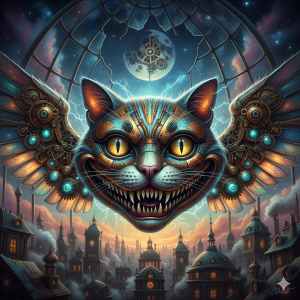
A sapphire shadow, a shifting gray,

Watches the hours that refuse to sway.


Moonlight bleeds silver on gears of brass,

Reflected deep in the fractured glass.

He is the silence that follows the strike,

A perfect machine in the endless night.

Pre-Chorus

 The fog is his breath, the rust is his sign,

A whisper of maroon on the blue-gray line.

He measures the moment, the tension he keeps,

While the forest below is tangled in sleeps.

Chorus

Oh, the Clockwork Glare!

Two eyes of burning, molten gold.

He doesn’t count the seconds, he counts the souls.

A Steampunk Spectre on a sky of blue,

With metal wings where the dream slips through.

He holds the key, he turns the lock,

The silent sentinel of the ticking clock!

Verse 2


 The tiny butterflies, silver and frail,

Dance in the vapor beneath his veil.

A compass eye on his forehead set,

He knows the coordinates of what you regret.

The deep blue velvet of the cosmic swirl,

Just a backdrop for the cat of the world.

He’s not a protector, nor purely a threat,

He’s the moment you haven’t lived yet.

Pre-Chorus

(

The copper pipes wrap around his crown,

Pulling the moonlight to stream right down.

He gathers the whispers and files the screams,

The menacing architect of your darkest dreams.

Chorus

Oh, the Clockwork Glare!

Two eyes of burning, molten gold.

He doesn’t count the seconds, he counts the souls.

A Steampunk Spectre on a sky of blue,

With metal wings where the dream slips through.

He holds the key, he turns the lock,

The silent sentinel of the ticking clock!

Bridge


He sees the color you cannot name,

The blue that’s fueled by the fire of shame.

The gold in his vision, fragmented and deep,

A mirror to secrets the forest must keep.

Outro

 The clockwork glare…

The ticking, ticking…


Tags: , , ,

Lyra – the Keeper of the Woods

Lyra – the Keeper of the Woods

The ancient clock tower, its gears long seized by moss and ivy, stood as a stoic witness to centuries of the forest’s slumber and waking. Perched precariously on its time-worn hands, a raccoon with an unusually tall top hat meticulously polished a small, brass monocle. He was Bartholomew, the Keeper of Sundials and Whispers, and he rarely missed a moment in the life of the one who floated through the perpetual twilight.

Her name was Lyra. Or perhaps it wasn’t. Names, like time, held little sway in her realm. She was the consciousness of the Gloaming Woods, the shimmering breath that stirred the leaves of the ancient oaks, the faint hum within the glowing mushrooms. Tonight, as many nights, Lyra drifted along the meandering path that led deeper into her domain, her emerald gown trailing like mist over the mossy ground. In her outstretched hand, a small orb of swirling, cerulean light pulsed softly, a concentration of the forest’s dreaming energy.

Bartholomew clicked his tongue, a tiny, almost inaudible sound. “She’s weaving again,” he muttered, adjusting his monocle. “A new dream, perhaps? Or mending an old thread?”

Lyra wasn’t weaving in the traditional sense. She was mending the subtle tears in the forest’s tapestry – a forgotten lullaby of a long-extinct bird, the memory of a sunbeam that once kissed a particular fern, the echo of laughter from children who had strayed too close to the boundary centuries ago. Each thread was a spark of light, gathered and re-infused into the very fabric of the woods.

Tonight, a particularly insistent flicker caught her attention. It was the memory of a small, hidden spring, whose waters had once pulsed with a forgotten magic. Over time, the spring had grown timid, its light fading, its song muted. Lyra closed her violet eyes, allowing the swirling orb in her hand to draw in the faint echoes. She saw the glint of sunlight on clear water, heard the gentle gurgle, felt the cool spray on ancient stones. She poured the light from her hand into the earth, a silent incantation, a whisper of life.

Around her, the hummingbirds, tiny jewels of the air, danced in appreciation, their iridescent wings a blur. They were her closest confidantes, carrying her subtle energies and observations to the farthest reaches of the woods. Bartholomew nodded sagely from his perch. “The spring will sing again by dawn,” he predicted, making a tiny mark in his worn ledger.

Lyra continued her ethereal journey, her gaze sweeping over the glowing flora, the silent sentinels of trees. She wasn’t just a guardian; she was the living memory of the forest, the keeper of its heart. Every bloom, every shadow, every rustle of leaves held a piece of her essence, and she, in turn, held theirs. In the Gloaming Woods, time wasn’t measured in hours, but in the slow, eternal beat of Lyra’s quiet magic.

 
Leave a comment

Posted by on November 11, 2025 in keeper, Magic, woods


Tags: , , , ,

The Whispering Knoll of Tullow

The Whispering Knoll of Tullow

The Whispering Knoll of Tullow

Just east of the Tullow Show Grounds, where the land rises sharply towards the older, quieter fields, stood a low hill known locally as Tír na gCnámh—the Hill of Bones. It wasn’t bones from battle, but from the ancient rock of the earth itself, protruding like the elbows of a giant. Every year, during the last week of August, when the ground was trampled by prize cattle and the air rang with the cacophony of the fairground rides, the knoll would grow restless.

The locals said the knoll was home to Ailbhe, a solitary, centuries-old member of the Aos Sí (the Irish Fair Folk) who resented the noise, the electric lights, and the yearly parking chaos that encroached upon her ancient domain.

Our story belongs to young Cillian, a lad of seventeen who earned good money helping the farmers set up their marquees. It was late on the final night of the Show. Rain had hammered the tents all day, and now a thick, unnatural mist—the kind the old men called the “Show Fog”—had rolled in, suffocating the last of the fairground lights.

Cillian had volunteered to take the day’s cash box, secured in a heavy leather satchel, back to the committee office in the town centre. To avoid the swampy roads, he had to take the shortcut: straight over Tír na gCnámh.

“Mind your steps, boy,” warned the security guard, glancing nervously at the hill. “And don’t you talk to any shadows up there. They’re listening tonight.”

Cillian, being seventeen, scoffed but kept his mouth shut. He started the climb, the weight of the satchel pulling at his shoulder. As soon as he crossed the low stone wall marking the knoll’s boundary, the sound of the Show Grounds vanished. Not faded—vanished. The frantic pop music, the generator hum, the distant shouts—all replaced by an immense, breathing silence.

The fog on the knoll was different, too. It didn’t just obscure the view; it played tricks with the light. The mist ahead seemed to part, revealing brief, tantalizing glimpses of things that should not be: a line of stone markers that weren’t there a second ago, and a flickering, cold flame that burned without fuel.

“It’s just the fog, Cillian,” he muttered, clutching the satchel tighter.

He had walked about fifty yards when the ground beneath his feet began to shift. It wasn’t a landslide; it was a rhythmic, almost deliberate heave, as though the whole knoll were drawing a deep breath. He lost his footing, dropping to his knees.

Suddenly, a sound arose that made his blood run cold: the sweet, unearthly melody of a tin whistle, played so perfectly it seemed to carve the air. It was coming from a clump of gorse bushes just ahead.

Then, the voice spoke. It was clear and cool, like water running over granite.

“You walk on our ceiling, little mortal. You bring the stink of diesel and the bleating of the hungry machines to the door of my home. And you carry a weight of ill-gotten gains.”

Cillian stammered, “N-not ill-gotten! It’s for the prize fund! The best barley, the fastest sheep…”

A figure coalesced from the fog near the gorse bush. It was Ailbhe, the spirit of the knoll. She wasn’t terrifying, but unbearably sad and beautiful. She wore a dress woven from mist and moss, and her hair was the colour of wet turf.

“The barley is good, yes,” Ailbhe sighed, the sound echoing like the movement of old leaves. “But the rush! The noise! It tears the sleep from the earth.” She gestured towards the Show Grounds, and a dark shadow, cold and vast, momentarily blotted out the flickering neon sign of the funfair below.

“I won’t disturb you again, I promise!” Cillian begged, scrambling to his feet.

Ailbhe paused, her deep eyes studying him. “You are the one who leaves the single silver shilling by the gatepost before the setup begins. You think I do not notice the small sacrifice, the tribute to the old courtesy?”

Cillian’s heart pounded. He always left one silver coin from his first day’s pay at the base of the knoll before the Show started—a superstitious habit taught to him by his grandmother.

“Because of that,” Ailbhe whispered, “I will let you pass. But the hill demands payment for the disturbance.”

With a swift, silent movement, she reached out. Cillian braced, expecting her to grab the satchel. Instead, her cool, dry fingers brushed his earlobe.

“Payment accepted,” she murmured, and stepped back into the gorse bush. The whistle melody soared once more, wrapping the knoll in music.

Cillian didn’t wait. He ran down the hill, crashing through the final hedge and onto the muddy perimeter road.

Only when he reached the main road did he notice the satchel was still heavy, the cash intact. He stumbled into the town office and threw the bag onto the desk.

“What happened to your ear?” the committee man asked, handing Cillian his fee.

Cillian touched his earlobe. There, hanging from a thin, almost invisible chain, was a single, tiny, perfectly formed dewdrop of amber, glittering like polished honey.

He never told anyone what he saw on the knoll, but he knew Ailbhe had taken her payment: a lock of hair, preserved in amber, ensuring that a piece of him would always belong to the Hill of Bones. And every August, Cillian always remembered to leave two silver shillings by the gatepost. He preferred to keep his appointments with the Fair Folk.

 
Leave a comment

Posted by on November 11, 2025 in ghost, tullow


Tags: , , ,

Dalek in Wonderland

Dalek in Wonderland

Alice had always considered “topsy-turvy” a quaint, almost charming state of affairs. Until, that is, the very air began to hum with an unfamiliar, metallic thrum that made the giant mushroom caps quiver like startled jellyfish. One moment, she was admiring a particularly vibrant cluster of sapphire roses; the next, a bronze behemoth with a singular, unblinking eye had materialized amongst the petals.

“EX-TER-MIN-ATE!” boomed a voice that sounded like a thousand angry kettles boiling simultaneously.

Alice, who had faced jabberwockies, irate queens, and logic-defying tea parties without so much as a proper shriek, found herself doing a rather ungraceful hop-skip-jump backwards. “Oh dear!” she gasped, her blue eyes wide with a mixture of terror and utter bewilderment. “Are you quite alright, sir? You sound rather cross, and honestly, shouting ‘exterminate’ at the scenery is dreadfully rude to the fungi.”

The Dalek, for that is what it was, swiveled its dome-shaped head, its ocular stalk focusing intently on Alice. “OBSERVATION: ORGANIC LIFE FORM IS SPEAKING ILLOGICALLY. THREAT ASSESSMENT: HIGH. INITIATING ELIMINATION PROTOCOL.”

“Elimination protocol?” Alice clutched her apron. “But I’ve only just arrived! And I haven’t even had a chance to ask if you’d like a spot of tea. Though, I must confess, your rather peculiar shape doesn’t look particularly suited for holding a teacup. Perhaps a saucer? Or a very large thimble?”

The Dalek emitted a series of rapid, clicking noises that sounded suspiciously like frustrated whirring. “TEA IS IRRELEVANT! SURRENDER FOR EX-TER-MIN-ATION!”

“Surrender?” Alice scoffed. “And miss out on discovering what’s beyond those particularly tall, stripey mushrooms? Not on your life, you peculiar brass kettle on wheels!” With a burst of courage fueled by sheer absurdity, she turned and darted through the towering roses and lilies, her blue dress a fleeting blur against the soft pink and blue hues of the fantastical garden.

The Dalek, surprisingly nimble for its bulk, began to pursue, its menacing shouts echoing through the quiet glade. “YOU WILL NOT ESCAPE! EX-TER-MIN-ATE! EX-TER-MIN-ATE THE INSOLENT ORGANIC!”

Alice, giggling despite herself, glanced back. “Honestly, if you’re going to chase me, at least try to keep up a sensible conversation! Do you know the way to the Mad Hatter’s tea party? I suspect he’d find your insistence on ‘extermination’ rather droll, provided you didn’t actually exterminate the biscuits.”

And so, under the enormous, dappled caps of the enchanted mushrooms, with the spiraling vortex of the sky watching overhead, Alice led the indignant Dalek on a merry, illogical chase, proving once and for all that in Wonderland, even the most terrifying threats could become just another part of the mad, wonderful scenery.


Tags: , , , ,

“Alice and the Swirling Canvas.”

“Alice and the Swirling Canvas.”
“Alice and the Swirling Canvas.”
*********************************
Chapter 1: The Yellow Crescent
The museum air was thick with the scent of old wood and quiet reverence. Alice, now seventeen and perpetually bored by the linear world of geometry and etiquette, paused before a small, heavily-framed oil painting. It was a night scene: a landscape of gnarled, dark trees reaching toward a sky that was less a void and more a seething mass of light. Every star was a thick, buttery dollop of paint, and the enormous crescent moon, a luminous, impossible yellow, seemed to push out from the canvas.
She knew the style instantly. It wasn’t just painted; it was felt.
Alice leaned closer, her nose almost touching the varnish. She noticed something odd about the moon. While the rest of the canvas held firm, this single yellow crescent seemed to vibrate, its impasto texture shifting, almost like wet paint refusing to settle. It was an instability in an otherwise frozen moment.
Drawn by an irresistible impulse that defied every museum rule she’d ever learned, Alice reached out a finger.
The moment she touched the paint, it gave way.
There was no sudden drop or dizzying vortex. Instead, the sensation was like plunging her hand into a bowl of thick, warm honey. The paint swallowed her fingers, then her hand, then her entire arm up to the shoulder. A gentle, viscous pressure pushed her forward, and in a blink, the quiet, dry museum fell away.
Alice stumbled onto a path that crackled under her feet.
The air was no longer still; it hummed with the energy of creation. The ground beneath her was a road of visible brushstrokes—thick, woven lines of ochre and burnt sienna—leading between two impossibly dark, gnarled trees. They were not trees of wood, but of coiled, energetic black and blue paint, their branches spiraling upward to meet a sky that was terrifyingly alive.
Above her, the Realm of the Saturated was dominated by the very yellow crescent she had touched. It blazed like a furious sun in the indigo turbulence, casting expressive, blue-black shadows that seemed to claw at the ground.
A feeling of intense, urgent motion seized her. She looked at her hands. Her skin was perfectly normal, but her dress and apron were rendered in the same high-relief style as the landscape, every seam and fold defined by a bold, blue outline.
“Stay still and you dry,” a thin, reedy voice whispered from the brushy undergrowth. “Drying is fading. Fading is being finished. And finished is the worst word of all.”
Alice spun around just as a figure leaped onto the path in front of her. It was the White Rabbit, but he was a portrait of anxiety. His white fur was ragged, rendered in hasty, unfinished lines of grey and zinc white. One ear looked fully realized, while the other was a mere suggestion of a stroke. He clutched his pocket watch, which had been reduced to a frantic, broken circle of orange dashes.
“Oh, it’s you,” he sighed, his voice full of disappointment. “Another element of disorder. But at least you’re wet. Tell me, child, do I look complete to you?” He thrust his unfinished ear toward her. “Am I resolved? Or am I still just a preparatory sketch for a better idea?”

A sudden, jarring shift in color drew Alice’s attention away from the White Rabbit’s existential crisis.

A short distance away, through a thicket of gnarled, swirling branches, the landscape erupted. It was a riot of color that fought against itself: streaks of raw vermillion clashing with aggressive viridian greens, all under a canopy of electric violet. It was loud, visually overwhelming, and undeniably wet.

The White Rabbit, clutching his hastily drawn watch, shuddered, his unfinished lines seeming to vibrate with distaste. “Don’t go that way, child! That’s the Saturation Zone! The Hatter has completely abandoned all sense of proportion or harmony. He’s destroying the value! It’s all so terribly… loud.”

But Alice, already overwhelmed by the thick texture and anxious energy of her arrival, found herself drawn to the visual noise. At least there, the danger wasn’t fading into the canvas; it was being intensely, brilliantly there.

“I think,” Alice decided, stepping over a thick, coiled stroke of blue that served as a root, “I need to speak to someone who understands color. Perhaps they understand how this world is painted.”

She plunged through the dark, expressive undergrowth.


🎨 The Mad Hatter’s Color Party


Alice emerged into a clearing where the air didn’t just smell of paint; it smelled of turpentine and fermented tea.

The famous long table was there, but it wasn’t set for tea; it was set for a lesson in chromatic chaos. Instead of fine china, there were pots and buckets overflowing with thick, undiluted pigments. The table itself was not wood, but a slab of brilliant, sticky Cadmium Yellow.

The Mad Hatter, his face painted with feverish, opposing stripes of cyan and magenta, was shouting at a trembling Dormouse who was struggling to balance a tiny teacup. The cup was filled with a liquid that glowed with the unnatural intensity of a pure Phthalo Blue.

“No, no, you infuriating rodent!” the Hatter shrieked, splashing a handful of Alizarin Crimson onto the table, creating a violent, wet mess. “You are sipping Primary Blue next to a background of Primary Yellow! You need a mediator! You need an Orange, or perhaps a delicate Tertiary Violet! Do you have any idea the visual friction you are causing?”

The Dormouse whimpered, his face a perfect, frightened circle of dull beige. “B-but this is the only color that won’t dry, sir!”

The Hatter ignored him and spotted Alice. He slammed his hand down on the yellow table, sending splatters of red and blue pigment flying.

“Ah! A new subject! And look at that lovely, pedestrian blue-and-white contrast!” He circled her, his eyes manic. “You, girl, are a walking exercise in simplicity! Tell me, what is the complement of that dreadful little apron?”

“White?” Alice ventured.

The Hatter threw back his head and laughed, a shrill, manic sound. “White is the absence of color, you dullard! The complement is pure black! You want contrast! You want the tension! The friction that keeps the canvas alive! Sit down, sit down! We are about to perform a great experiment in Value and Hue!

He gestured wildly to an empty chair next to the March Hare. The Hare, unlike his usual frantic self, was sitting perfectly still, coated in a thick, dull layer of umber brown, patiently waiting to dry out.

“Don’t worry about him,” the Hatter muttered, pouring a cup of neon Naples Yellow tea and thrusting it at Alice. “He decided the sheer complexity of color theory was too much, and now he’s waiting to become a restful, non-committal background element. Now, drink! And tell me if you feel the visual heat of that yellow against your blue dress!”

*******************
To be continued.
*******************
 

Tags: , , ,

Father and Son, Part Two , inspired by Cat Stevens

Father and Son, Part Two , inspired by Cat Stevens

Father and Son, Part Two , inspired by Cat Stevens


Listen to this song HERE

Father:
It’s now time to make a change,
Not relax or take it easy.
You’re grown up, that’s so good,
But there’s still so much to do.
You’ve a wife, and a child,
You settled down, and you married.
I am gone, though I’m gone, I am happy.

*

I can now recall a time, and admit it wasn’t easy,
To be calm in the turmoil we call youth.
But I have travelled, journeyed on,
To a time, a place we all can reach.
Where our yesterdays and morrows are at peace with today.

Son:
You don’t need to explain; though you’ve gone we are now closer.
Though the story’s the same, we have changed.
We were so caught up in talk it was impossible to listen.
It took me time, now I know I don’t have to go away.
I don’t have to go.

Father:
It’s now time to make change,
Get right on, embrace it.
You’re grown up, that’s so good,
But there’s still so much you can do.
You’ve a wife, and a child,
You settled down, you married.
I am gone, I am gone, but I’m happy.

Son:
No more times, wasted times, hiding truth I knew was deep inside,
It’s good, but even better in sharing.
Yes, they were right, I agree, I’m free to know you and me.
Now I can see and I know I don’t have to go away.
I don’t have to go.

(Optional Extra Verse)
Son:
My Father, you and I, we cannot, must not be kept apart in time,
We’ll soon be rejoined in the heavens.
Where time will be all gone; and thus unshackled from our minds
We’ll all be free, and we’ll know we don’t have to go away.
We won’t have to go.

*************************


Tags: , , , ,

The Ballad of Moral Thunder, inspired by Cat Stevens/Yusuf

The Ballad of Moral Thunder, inspired by Cat Stevens/Yusuf

The Ballad of the Moral Thunder

Listen to this song here

(Verse 1) The Manhattan night was draped in silk and lace,

A gala where the wealthy held their place.

Diamonds glimmered, champagne flowed like streams,

A room built of ambition and billionaire dreams.

They came to honor an old and gentle name,

Cat Stevens, peace and music were his fame.

But as he walked up to the microphone stand,

A different tune was heard throughout the land.

*

(Chorus) He said what no one else dared to say,

Against the tide he cast the light of day.

A simple challenge to the golden few,

To question all they gather, what they do.

A moral thunderbolt beneath the chandelier,

He spoke the silent truth for all the world to hear.

*

(Verse 2) He saw them there: the Titans, great and grand,

Musk and Zuckerberg spread across the stand.

In his dark suit, he met their gilded stare,

And dropped the words that filled the room with fear:

“If you’ve got money, use it for the good,

Help those who truly need it, as you should.

If you’re a billionaire, how much is enough?

Give it away, folks—the time is getting rough.”

*

(Chorus) He said what no one else dared to say,

Against the tide he cast the light of day.

A simple challenge to the golden few,

To question all they gather, what they do.

A moral thunderbolt beneath the chandelier,

He spoke the silent truth for all the world to hear.

*

(Bridge) The air went cold, the glasses paused mid-flight,

A statue carved from silence in the light.

The gentle voice grew steady, calm, and true,

A man who practiced all the words he spoke into.

His millions given, quietly and with grace,

For refugees and needs across the human race.

“If greed is considered wisdom,” he did muse,

“Then humanity is walking in reverse shoes.”

*

(Verse 3) The camera caught a figure scrolling low,

Pretending not to hear the truth’s sharp blow.

But on the web, the hashtags took their flight,

A Truth Bomb trending, shining ever bright.

No polished speech, no grand departing bow,

He simply gave a challenge, for here and now:

He looked upon the power and the gold,

And finished with the story to be told:

“Silence is no longer power.”

*

(Outro) That night, the folk legend did not entertain,

He came to break the velvet, gilded chain.

The room was silent, but the world listened on,

To the real power of a voice that stood alone.

The truth had landed, piercing, pure, and free,

He made history in the heart of the city.

“Silence is no longer power,” he said.

The rich were stunned, the people raised their head.

 
Leave a comment

Posted by on November 7, 2025 in ballad, moral thunder, Yusuf


Tags: , , ,

Alice in Yellow

Alice in Yellow

Alice, ever the trendsetter, decided Wonderland needed a bit of a fashion update. “Blue is so last season,” she declared to a bewildered White Rabbit, who was, as usual, late for something. “And sensible flats? Darling, we’re in a magical realm! One must be prepared for spontaneous glamour!”

So, she traded her iconic blue for a sunny yellow, donned an apron that was perhaps more decorative than practical, and teetered into the enchanted forest on the highest heels she could find. Her mission? To accessorize with pure joy.

“Balloons!” she’d shrieked at a bewildered Caterpillar. “They represent upliftment, whimsy, and the sheer delight of not knowing where you’ll float next!” The Caterpillar, quite literally puffed up with smoke, merely blinked.

As she pranced through the vibrant flowers, occasionally tripping over a particularly enthusiastic daisy, Alice found herself giggling. The balloons bobbed above her, each a tiny, colorful sun. She imagined floating over the Mad Hatter’s tea party, perhaps dropping a balloon onto his head with a gentle thud. Or maybe she’d drift past the Queen of Hearts, causing a momentary distraction in her perpetual croquet game.

Suddenly, a gust of wind caught the balloons, pulling her gently upwards. “Oh, bother!” she exclaimed, her high heels dangling precariously close to a startled dormouse. “This wasn’t quite what I had in mind for ‘upliftment’!” But then, a mischievous grin spread across her face. “Though, a grand entrance via balloon would be rather splendid for tea…”

And so, Alice, a vision in yellow, high heels, and a cluster of vibrant balloons, began her unplanned aerial tour of Wonderland, proving that sometimes, the best adventures start with a little bit of unexpected flair.


Alice in Green

Alice, in a sudden fit of environmental enlightenment (or perhaps it was just the residual fumes from the Caterpillar’s pipe), decided blue was simply too… conventional. And yellow? Far too cheerful for the serious business of planetary well-being. No, Alice declared, she would be green. Not just in spirit, but in attire.

So, she commissioned the Dormouse (who, being perpetually sleepy, was surprisingly adept with a needle and thread) to craft her a gown of the most verdant hue. It was a lovely dress, adorned with tiny, hand-stitched leaves and even a small, fabric squirrel peeking from a pocket.

Her first day as “Green Alice” began with enthusiasm. She lectured the White Rabbit on the carbon footprint of his frantic scurrying. “Every hop, every panic-stricken glance at your pocket watch, emits precious CO2, you know!” The Rabbit, naturally, was late for a very important date and merely skittered away, leaving Alice to sigh dramatically.

Next, she approached the Mad Hatter’s tea party. “Good heavens, a teacup pyramid! Think of the water waste, the energy expended in heating all those superfluous pots!” The Hatter merely offered her a piece of cake. “It’s carrot cake, Alice,” he said, winking. “Very green.”

Alice then attempted to educate the Queen of Hearts on sustainable gardening practices. “Your roses, Your Majesty, are painted red! Imagine the toxic fumes from the paint, the unsustainable harvesting of pigments! Why not cultivate natural, diverse flora?” The Queen, instead of shouting “Off with her head!”, merely looked at Alice with an expression of mild confusion, then muttered, “Are you quite alright, dear? You’re looking a bit… leafy.”

By afternoon, Alice was thoroughly exasperated. The flowers, instead of blooming more vibrantly in her presence, merely looked on with their usual, slightly smug indifference. The trees remained stubbornly tree-like. Even the air, despite her best efforts, refused to smell distinctly “greener.”

She slumped onto a mossy bank, the fabric squirrel in her pocket looking rather deflated. “Being green,” she huffed, adjusting a leaf on her sleeve, “is a load of hogwash! Everyone just goes about their business, oblivious to my perfectly justified eco-concerns!”

Just then, a tiny, emerald-green chameleon, having watched the entire spectacle with keen amusement, slowly changed its color to match Alice’s green dress perfectly. It then gave her a look that plainly said, “You think you’re green? I was born this way, and frankly, it’s exhausting trying to blend in with your ever-changing moods.”

Alice stared at the chameleon, then at her own green dress, then back at the chameleon, which had now effortlessly blended into a nearby patch of purple flowers. A slow smile spread across her face. “Ah,” she murmured, “perhaps it’s less about being green, and more about just… being.”

She stood up, brushed a stray leaf from her shoulder, and decided that perhaps a touch of blue wouldn’t be so bad after all. After all, what’s a little conventionality when you’ve just discovered the profound wisdom of a judgmental chameleon? She might even ask the Dormouse to embroider a chameleon on her next dress. It would certainly be a conversation starter.

Goth Alice

Alice had decided that enough was enough with the pastels and cheer. Wonderland, she concluded, was far too saccharine, far too bright. It needed a touch of the melancholic, a whisper of the macabre. And so, she had undergone a most dramatic transformation.

Her dress, once a bright blue, then a sunny yellow, and briefly a questionable green, was now a cascade of darkest black, offset by intricate lace and a crisp, if somewhat somber, white apron. Her hair, usually a golden waterfall, was dyed raven black, framing a face now adorned with dramatic eyeliner and a hint of pale foundation. The high heels of her yellow phase were replaced by sturdy, stomping boots, and her pockets, instead of housing a friendly dormouse, now held a miniature, plush bat.

Her first act as Goth Alice was to acquire a most appropriate balloon: a matte black, skull-shaped one, naturally. “It symbolizes the fleeting nature of existence,” she’d explained to a rather bewildered Mad Hatter, who had merely offered her a slice of graveyard cake (which tasted surprisingly like licorice).

The tea party itself had been re-envisioned. Gone were the mismatched, brightly colored cups. In their place stood a somber candelabra, casting long, dancing shadows, and teacups of deepest midnight blue. Even the chameleon, ever the adaptable creature, had taken on a mottled, shadowy hue, looking less like a vibrant jewel and more like a creature from a forgotten crypt.

Alice sat on her accustomed branch, but now her gaze was less one of whimsical wonder and more one of thoughtful introspection. The skull balloon bobbed gently above her, a tiny, dark sentinel. She watched the flowers, now appearing in muted purples and deep reds under the dim light of her chosen aesthetic, and mused.

“They’re all so… fragile,” she whispered, not to anyone in particular, but to the lingering shadows. “Their beauty is so fleeting. Unlike the eternal embrace of… well, darkness.”

The chameleon, perched stoically on the tea table, blinked slowly, a silent commentary on Alice’s latest phase. It seemed to say, You’ll be back to polka dots by Tuesday, won’t you?

But Alice was unperturbed. She took a sip of her now-bitter tea, a brew she’d insisted on adding extra drops of “existential dread” to (which the Hatter had helpfully translated as “just a dash more Earl Grey”). She watched the skull balloon drift a little higher, a symbol of her commitment to a more… profound Wonderland.

“Yes,” she concluded, a faint, melancholic smile playing on her lips. “This is much better. Much more… her.” Though a tiny part of her still wondered if a splash of glitter wouldn’t be too out of place. Just a tiny splash. For dramatic effect, of course.


The Tri-Alice Extravaganza and the Snicklefritz of Solace

The reason for this story is a Royal Command Performance Gone Awry. The Queen of Hearts, in an uncharacteristically whimsical mood (possibly due to eating too many jam tarts that morning), had decided Wonderland needed a grand spectacle, a “Tri-Alice Extravaganza” to brighten the increasingly peculiar days. Her Royal Decree was simple: the three Alices, having mysteriously appeared and caused delightful levels of confusion, were to retrieve the legendary Snicklefritz of Solace, a mythical, giggling flower rumored to bring pure, unadulterated joy (and perhaps help the Queen win at croquet).


The Royal Decree arrived by way of a perpetually flustered White Rabbit, who, upon spotting three Alices in the same vicinity, promptly fainted. Sunny Alice, in her vibrant yellow and high heels, knelt to fan him with a particularly buoyant balloon. Green Alice, in sensible green and clutching her compostable teacup, tutted, “Such stress! Clearly, a lack of kale in his diet.” Goth Alice, draped in black lace, merely observed, “His fragile mortality is showing. How quaint.”

The Queen’s decree, once deciphered from the damp parchment (the Rabbit had spilled tea on it), sent a ripple of bewildered energy through the trio. The Snicklefritz of Solace, a bloom rumored to sing bad puns and emit glitter, was said to reside in the Whispering Willows of Woe, a notoriously melancholic part of the forest.

“A quest!” Sunny Alice clapped her hands, nearly dislodging a fascinator she’d borrowed from a particularly fashionable hedgehog. “How utterly delightful! I’ll bring snacks! And more balloons!”

“A wilting expedition, you mean,” Green Alice corrected, eyeing Sunny Alice’s heels with disdain. “We’ll need proper hiking attire, a water purification system, and certainly no single-use confetti.”

Goth Alice merely adjusted her skull balloon, which seemed to sigh audibly. “Joy,” she drawled. “Such a fleeting, saccharine delusion. But if it leads to profound contemplation on the futility of happiness, I suppose I’m in.”

And so, the Tri-Alice Expedition for the Snicklefritz began.

Their first obstacle was the Bridge of Babbling Brookes, known for its ceaseless, irritating chatter. Sunny Alice skipped across, singing along with the gurgling water. Green Alice, however, stopped. “It’s all nonsense! Such excessive vocalization is energy inefficient! Can’t it just… filter?” Goth Alice, meanwhile, found the babbling profoundly depressing. “Each drop a tear, each ripple a fleeting regret,” she intoned, stepping delicately on a fallen log rather than endure the bridge’s cheerful cacophony.

Suddenly, the Bridge of Babbling Brookes, annoyed by Green Alice’s attempts to silence it, sprung a leak, drenching Green Alice in a shower of particularly muddy water. “My organic cotton!” she shrieked, covered in slime.

“Mud is merely repurposed earth, dear,” Goth Alice observed, a flicker of amusement in her usually stoic eyes.

“But it’s dirty!” Sunny Alice giggled, tossing her a bright yellow handkerchief.

Their path then led them to the Giggling Grotto of Grumbles, a cave filled with grumpy, moss-covered creatures who did nothing but complain. Sunny Alice tried to cheer them up with a spontaneous juggling act involving acorns and bright berries. The grumbles simply intensified. Green Alice attempted to introduce them to mindfulness exercises. “Now, breathe deeply, and focus on the natural alkalinity of the cave floor.” The grumbles evolved into outright groans.

Goth Alice, however, had a breakthrough. She sat amongst the grumbling gnomes and began to recite particularly bleak poetry. “Oh, the existential dread of being a moss-covered gnome, forever tethered to this damp abode…” To her surprise, the gnomes loved it. Their grumbles softened into appreciative murmurs. One even offered her a single, tarnished button. “It’s from a lost cause,” he croaked.

“A kindred spirit!” Goth Alice exclaimed, a rare smile gracing her lips.

As they approached the Whispering Willows, the air grew thick with melancholy. The trees truly whispered, but it wasn’t gossip; it was lamentations about lost mittens and forgotten birthdays. Sunny Alice, usually buoyant, felt a strange pang of sadness. Green Alice worried about the poor trees’ nutrient deficiency, while Goth Alice felt strangely at home.

“This is it,” she declared, “the perfect setting for contemplating the void.”

Suddenly, the ground beneath Sunny Alice’s high heels gave way, sending her tumbling into a hidden pit. “Oh, fiddle-faddle!” she cried, her voice muffled. “It’s quite dark down here!”

Green Alice rushed to the edge. “Are you injured? Did you contaminate the local ecosystem with your fall?”

Goth Alice peered down. “A symbolic descent into the subconscious, perhaps? Do tell, what existential horrors lurk within?”

From the pit, Sunny Alice called out, “It’s just… a very large rabbit hole! And I think… I see a teacup!”

Indeed, at the bottom of the pit was an abandoned tea party, and amidst the cracked cups and stale cakes, shimmered a small, luminous flower. It wasn’t just shimmering; it was chortling.

“The Snicklefritz!” Green Alice exclaimed, forgetting her ecological concerns for a moment.

“It appears its joy is rather… boisterous,” Goth Alice remarked, wincing as the flower let out a particularly loud chuckle.

Sunny Alice, still in the pit, reached for it. But just as her fingers brushed a petal, the Snicklefritz of Solace squealed with laughter and zipped out of her grasp, floating upwards like a startled hummingbird.

“It flies!” Sunny Alice cried.

“Untraceable energy expenditure!” Green Alice gasped.

“An escape from its fated purpose,” Goth Alice sighed.

The Snicklefritz began to lead them on a merry chase, darting through the Whispering Willows, its giggles echoing mockingly. It zipped past the Grumbling Gnomes, who, instead of grumbling, began to chuckle softly at its antics. It danced over the Bridge of Babbling Brookes, which briefly stopped babbling to let out a delighted trill. The entire forest seemed to be waking up, bathed in the infectious mirth of the Snicklefritz.

Sunny Alice, despite her high heels, found a burst of renewed energy, twirling and skipping after the flower. Green Alice, initially annoyed by its chaotic flight, began to see the vibrant life it brought forth, the spontaneous joy blooming on previously dour faces. Even Goth Alice found herself strangely… un-depressed. The flower’s relentless cheer was so absurd, so utterly defiant of gloom, that it became its own form of dark humor.

Finally, the Snicklefritz, seemingly exhausted from its playful evasion, settled gently onto the Mad Hatter’s tea table. It looked up at the three Alices, its petals quivering with silent mirth.

The Mad Hatter, who had been observing the entire chase with a cup of tea balanced on his nose, simply looked at the flower. “Well,” he said, “that was rather exhilarating for a Tuesday. Anyone for more cake?”

The Queen of Hearts, having arrived (carried in by two extremely flustered cards), gazed upon the Snicklefritz. It wasn’t quite what she expected – less a majestic bloom, more a mischievous sprite. Yet, as its soft glow filled the air, she felt a strange warmth, a hint of a smile tugging at her usually stern lips.

Sunny Alice, beaming, offered a balloon to the Snicklefritz, which promptly popped it with a joyful burst of glitter. Green Alice, seeing the spontaneous blooming of tiny, radiant flowers in the Snicklefritz’s wake, began to jot down notes about “sustainable happiness ecosystems.” Goth Alice, gazing at the flower’s defiant merriment, whispered, “Perhaps… the void does have a sense of humor.”

And as the sun began to set, casting long, whimsical shadows through the trees, the three Alices, having found the Snicklefritz of Solace, realized that joy, like fashion, moods, and philosophical outlooks, came in many, many shades. Even a little bit of glitter and despair.


Tags: , , , , ,