RSS

Author Archives: The Crazymad Writer

Unknown's avatar

About The Crazymad Writer

FREE EBOOKS FOR ALL, that's what I say, FREE EBOOKS FOR ALL, courtesy of ME, The Crazymad Writer. Stories for children and young at heart adults. And remember, my eBooks are FREE FREE FREE!

The Feeling Behind the Day

The Feeling Behind the Day


Listen to this Christmas song here.

Why wait for Christmas when you can have it every day?

Be it June or September, March, April or May.

The thing to remember is not the date or day,

But the feeling that goes behind it. So share it right away.

*

Enjoy a time for living. Enjoy a time on earth.

A time for celebration. A chance to spend in earth.

Each day will go brightly as you strike out forth.

And all of this made possible because of the virgin birth.

*

Give a gift of kindness, a warm and helping hand.

Spread good will and cheer to folks throughout the land.

Let your words be gentle, always close at hand,

For this is the spirit that we all must understand.

*

Oh, why wait for Christmas when you can have it every day?

Be it June nor September, March, April or May,

The thing to remember is not the date or day,

But the feeling that goes behind it, so share it right away.

*

We spend all December searching for the light

And rush to make it perfect on that one single night.

But the star that shines above us, a promise truly bright

Is meant to guide our footsteps through the darkest day and night.

*

Don’t let the joyful music play out in the snow.

Keep the light of giving with you where you go.

Let the love within your heart continue still to grow.

The year round magic flowing a beautiful warm glow.

*

Why wait for Christmas when you can have it every day?

Be it June or September, March, April or May.

The thing to remember is not the date or day,

But the feeling that goes behind it, so share it right away.


Tags: , ,

Alice Deep in the Jungle

Alice Deep in the Jungle

The humid air of the jungle clung to Alice like a secret, a stark contrast to the familiar, crisp English gardens of her youth. Yet, here she was, not stumbling through a rabbit hole, but walking with purpose on a path of moss-covered stones. The scent of exotic blooms, heavy and sweet, mingled with the earthy aroma of damp soil. Sunlight, fractured into a thousand shimmering beams by the dense canopy, painted shifting patterns on her blue and white mini-dress and the soft leather of her long white boots.

She was no longer the small, curious child who had first tumbled into Wonderland. The years had etched a quiet confidence into her features, a knowing glint in her blue eyes that spoke of countless impossible encounters and challenges overcome. Her long, blonde hair, a silken river, cascaded around her shoulders, catching the golden light.

Above her, iridescent macaws, flashes of sapphire and scarlet, soared between ancient trees draped with lianas, their calls a symphony of the wild. Closer still, oversized hibiscus and bird-of-paradise flowers, rendered in hues too brilliant for any ordinary garden, unfurled their petals in silent welcome. Each leaf, each vine, seemed to pulse with a hidden life, whispering tales of forgotten magic.

Alice paused, a faint, playful smirk touching her lips. The air hummed with serenity, yet she felt the familiar tingle of something extraordinary just beyond her sight. This wasn’t Wonderland, not precisely, but it carried its echoes – the same breathtaking beauty, the same undercurrent of delightful mystery. She wondered which improbable creature she might encounter next, what riddle awaited her in this verdant dreamscape. With a graceful turn, she continued her journey, her boots making soft thuds on the ancient stones, ready for whatever hidden wonders the tropical realm might reveal.


Tags: , , , , ,

The Golden Supermoon

The Gleam of the Gilded Trap in Bushmantle

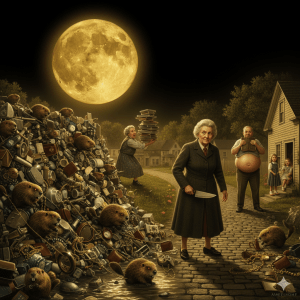
The air over Bushmantle was the color of old, oxidized gold, thick and humming. Elias, the town’s lone amateur astronomer and professional cynic, was the first to feel it. Not the gravitational pull on the ocean tides, but the pull on the mind.

The November Supermoon—closest, brightest, and most unnervingly golden of the year—had risen. It didn’t look silver-white; it looked like a monstrous, luminous coin hung low in the velvet blackness, shedding a sickly, buttery light that seemed to press down on the quaint, slightly crumbling homes of Bushmantle.

Elias had been trying to photograph the perigee from his roof, aiming his camera towards the peculiar glow over the old watermill. The moment he looked through the lens, the world warped. The golden light didn’t illuminate; it saturated. It didn’t reflect; it demanded.

The next morning, the town of Bushmantle was subtly, terrifyingly different.


The Beaver’s Blind Ambition


The ancient folklore held that the November moon was the Beaver Moon, the time when the industrious little creatures worked tirelessly to build their dams and stock their winter larders. But tonight, that focus had become a fever in Bushmantle.

The golden light didn’t just shine on the town; it seemed to leach out the very essence of human preparation, twisting it into a single, maddening obsession: Acquisition.

First, it was the beavers themselves, their usual dam-building activities becoming unnervingly frantic in the river that snaked through Bushmantle. Elias saw them, but they weren’t building with sticks and mud anymore. They were dragging stolen heirlooms, antique silverware, and anything that glittered under the unnatural light—into the colossal, impossible dam they were building near the old mill. They had an insane gleam in their tiny black eyes, their chattering a high, desperate frequency. The structure was a towering, grotesque monument of scavenged wealth and junk, rising obscenely from the water, all to block a river that didn’t need blocking.


The Town’s Twisted Treasure


The humans were worse.

Under the Supermoon’s hypnotic, golden glow, the need to collect became the need to possess. It started with hoarding. Old Mr. Henderson, the clockmaker, was found attempting to dismantle the town’s ancient clock tower, convinced he needed to “own all the time” before it ran out. He was muttering about the moon’s ‘golden promise’ of eternal moments. Mrs. Gable, the proprietor of the general store, had locked herself inside, frantically trying to count every single item, from rusty nails to dusty tins of sardines, claiming the moon demanded a full inventory of her domain.

The gold light had made the people of Bushmantle’s deepest, most primal fear—loss—into a terrible, manic engine of collection. They were gathering not just objects, but abstract concepts, desperate to hold onto anything that might slip away.

Elias realized the moon wasn’t just a light; it was a filter. It was amplifying a single, terrible thought in every mind: You don’t have enough. You must take more. You must never lose what is yours.

The scariest moment came when he saw his neighbor, kindly old Mrs. Peterson. She wasn’t carrying gold or books. She was carrying a large kitchen knife, its blade reflecting the eerie golden light, and stalking the cobblestone streets of Bushmantle with a terrifying, purposeful stride.

Elias asked her what she was looking for. Her eyes, usually gentle and blue, were now like polished amber in the golden light.

“My youth,” she hissed, her voice dry and brittle, echoing slightly in the quiet, unnaturally lit street. “The Moon promised me I must collect what I lost. The Moon promised it must be taken back from those who still possess it.”

She wasn’t looking for a treasure chest. She was looking for life, for time, for the potential of the young girls down the street. The Supermoon, hanging like a colossal, gilded trap above them, had driven the town of Bushmantle mad with the lust for what they had lost and could lose. They were gathering wealth, youth, time, and sanity with the panicked ferocity of beavers stockpiling for an eternal, uncoming winter.

Elias dropped his camera and ran, the suffocating, beautiful, golden light of the closest moon of the year following him like the glare of a jealous, all-possessing god, casting long, wavering shadows down the familiar, now terrifying, streets of Bushmantle.


Tags: , ,

“The Wizard and the Worried Wheelman”

“The Wizard and the Worried Wheelman”

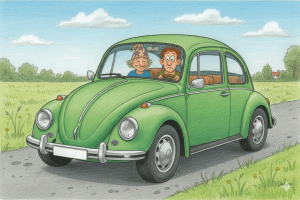
In the whimsical world of Oakhaven, where gnomes rode squirrels and puddles whispered secrets, lived a wizard named Bartholomew Button and his long-suffering human friend, Gary. Bartholomew, a wizard of questionable talent but undeniable enthusiasm, had just “borrowed” Gary’s prized vintage VW Beetle for a joyride.

“Isn’t this splendid, Gary?” Bartholomew chirped, his star-spangled hat bobbing with glee. “The wind in my beard, the open road… it’s almost as good as flying on a particularly fluffy cloud!”

Gary, gripping the steering wheel so tightly his knuckles were white, merely grunted. “Splendid, Barty, just splendid. Especially since you forgot to mention you enchanted the accelerator to only go at full speed.”

Bartholomew chuckled, a sound like a bag of marbles rolling down a wooden staircase. “Oh, did I? My apologies! I was attempting to imbue the engine with the ‘Spirit of Swiftness.’ Perhaps I overdid it slightly.”

Suddenly, a flock of startled sheep scattered across their path. Gary swerved wildly, narrowly missing a particularly portly ewe. “Slightly?!” he shrieked. “We just almost turned those sheep into woolly projectiles!”

“Nonsense!” Bartholomew declared. “They looked quite invigorated. A good scare keeps the blood flowing, I always say.” He then leaned out the window, shouting, “And remember, dear sheep, the early worm catches the… well, you know the rest!”

Gary buried his face in his hands. “I’m going to have a heart attack before we reach the village. This car is an antique, Barty, not a magical broomstick!”

“A minor distinction!” Bartholomew waved a dismissive hand. “Besides, I’ve got a potion brewing in the back that will fix any minor dents… or perhaps turn them into glitter. It’s still in the experimental phase.”

As they rocketed past a sign that read ‘Oakhaven Village – Slow Down!’, Gary braced himself. “Just tell me, Barty, what’s our destination?”

Bartholomew’s eyes twinkled. “Why, the annual ‘Biggest Turnip’ competition! I’ve enchanted a turnip to grow to colossal proportions, but it needs a magical escort. And what better escort than a slightly-too-fast Beetle and its valiant, albeit terrified, driver?”

Gary could only sigh. He knew that by the end of this journey, he’d either be a hero, a nervous wreck, or a permanent fixture in the local mental institution. But at least Bartholomew was having fun. And really, what else could one expect when driving with a wizard?

The Wizard and the Worried Wheelman Part 2″

As the green Beetle, an unlikely blur on the quiet country road, tore towards Oakhaven Village, Gary’s mind raced almost as fast as the car. “Barty,” he yelled over the roar of the engine and the whistling wind, “what exactly did you do to that turnip?”

Bartholomew, oblivious to Gary’s distress, was now humming a jaunty tune, occasionally pointing at passing trees as if conducting an invisible orchestra. “Oh, nothing much! Just a simple ‘Growth and Glimmer’ enchantment, with a sprinkle of ‘Uncommon Verdancy.’ It should be quite the spectacle!”

They careened around a final bend, and Oakhaven Village appeared, a charming collection of thatched roofs and bustling market stalls. The “Biggest Turnip” competition was in full swing in the village square. A crowd had gathered, and a panel of stern-faced judges, all sporting impressive beards, peered critically at various root vegetables.

Then, everyone froze.

From behind the town hall, a colossal shadow began to stretch. A low rumbling sound grew louder, accompanied by a faint, rhythmic thump-thump-thump. Suddenly, an enormous, glowing, emerald-green turnip, easily the size of a small cottage, rolled into view. It was so perfectly round and impossibly vibrant that it seemed to pulse with an inner light.

“Behold!” Bartholomew cried, throwing his hands in the air, narrowly missing Gary’s nose. “My masterpiece!”

The crowd gasped, then a murmur of awe turned into outright panic as the gargantuan turnip, having gained momentum, began to roll straight towards the judging table!

“Barty!” Gary shrieked, slamming on the brakes, which, thanks to the “Spirit of Swiftness,” barely slowed them down. “Your turnip is going to flatten the entire competition!”

“Nonsense!” Bartholomew declared again, though his eyes widened slightly. “It merely wishes to present itself grandly!”

The judges, eyes wide with fear, scrambled to safety as the monstrous turnip obliterated their table, scattering scorecards and half-eaten sandwiches. It then continued its majestic, destructive roll through a display of prize-winning pies, leaving a trail of crushed crusts and fruity fillings.

Gary, with a burst of adrenaline, managed to swerve the Beetle around the runaway turnip, bringing them face-to-face with the terrified villagers. “Everyone, get back!” he bellowed, sounding far more heroic than he felt.

Bartholomew, however, was in his element. “It’s magnificent, isn’t it?” he beamed, even as villagers screamed and fled. “Such presence! Such… rootiness!”

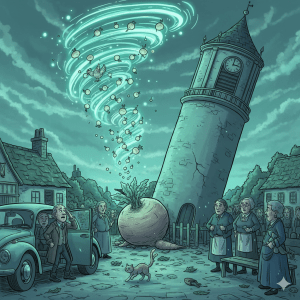
The giant turnip finally came to a stop, wedged firmly against the base of the ancient village clock tower, which groaned ominously. The entire square was a mess of splintered wood, squashed vegetables, and scattered market wares.

Silence fell, broken only by the clock tower’s distressed creaking. The villagers, now safely behind stalls and buildings, peered out cautiously.

“Well,” said Bartholomew, finally looking at the destruction, “I suppose it might be slightly larger than anticipated.” He then pulled out a small, ornate vial. “Good thing I brought my ‘De-Growth and De-Glimmer’ potion! Just a few drops, and it will shrink right back to a manageable size.”

Gary slumped against the steering wheel, utterly defeated. “You mean to tell me,” he said in a dangerously low voice, “that you had a potion to fix this the entire time?”

Bartholomew patted his shoulder cheerfully. “Of course! One must always be prepared. Now, if you’ll just pull a little closer, I can administer the antidote.”

As Gary, with trembling hands, slowly nudged the Beetle towards the colossal turnip, he knew one thing for certain: his antique VW Beetle was going straight back into the garage, and Bartholomew Button was going to be walking for the foreseeable future. And perhaps, just perhaps, he’d invest in a good set of earplugs.


The Wizard and the Worried Wheelman – Part 3″

Gary, still slumped, watched with a weary eye as Bartholomew, now beaming with renewed purpose, uncorked the ‘De-Growth and De-Glimmer’ potion. “Fear not, dear villagers!” he declared, his voice echoing slightly in the now-quiet square. “A minor miscalculation, easily rectified!”

He climbed out of the Beetle, carefully balancing the vial. “Now, to apply this with precision.” He took aim at the base of the colossal turnip, which was still wedged against the groaning clock tower. Just as he was about to administer the drops, a small, fluffy village cat, startled by the day’s events, darted out from under a stall, rubbing against Bartholomew’s leg.

“Goodness me!” Bartholomew yelped, startled. His hand jerked, and the vial of glowing blue liquid tipped, spilling not just a few drops, but a substantial splash across the ground around the base of the giant turnip, and a few rogue droplets even landed on the cat’s tail.

A moment of silence. Then, a strange ripple effect began.

The giant turnip didn’t shrink immediately. Instead, the very cobblestones around it began to pulse with a faint, blue light. Then, with a series of tiny pops, dozens of miniature, perfectly formed, glowing emerald turnips, each no bigger than a thimble, erupted from between the stones. They bounced and rolled like enchanted marbles, scattering across the square.

“Oh dear,” Bartholomew murmured, rubbing his chin. “A slight… decentralization of effect, perhaps?”

But it didn’t stop there. The rogue droplets on the cat’s tail caused the feline’s fluffy appendage to rapidly deflate and then reinflate, changing colors like a tiny, psychedelic chameleon before shrinking to the size of a kitten’s stub. The cat, looking utterly bewildered, began chasing its own shrinking, then growing, then color-changing tail in frantic circles.

Then, more subtly, things started changing. A baker’s prize-winning sourdough loaf, still sitting on its damaged stall, began to shrink, then grow, then shrink again, as if breathing. A villager’s meticulously trimmed rose bush suddenly sprouted enormous, thorny stems that snaked across the path before rapidly wilting back to normal size, then repeating the process.

Gary, who had been watching this unfolding chaos from the safety of the Beetle, finally had enough. He honked the horn loudly. “Barty! Stop! You’re making it worse!”

Bartholomew, however, was now utterly fascinated by the tiny, glowing turnips bouncing around his feet. “Fascinating! It seems the ‘De-Growth’ aspect is rather… democratic in its application! And the ‘Glimmer’ is quite charming on these mini-vegetables!” He bent down, trying to catch one of the tiny, luminous root vegetables.

Just then, the clock tower gave a final, mournful groan. The enormous turnip, still wedged against it, seemed to sigh as well. Then, with a slow, grinding crunch, the clock tower began to lean, just slightly, away from the turnip, pulling a significant chunk of its stone base with it. The giant turnip, no longer fully supported, listed precariously.

The head judge, a formidable woman named Mildred who had just recovered from her turnip-induced fright, stepped forward, brandishing a broken yardstick like a sword. “Bartholomew Button!” she boomed, her voice cutting through the magical cacophony. “You have destroyed the judging table, squashed our pies, traumatized our sheep, and now you’re making our village square sprout glowing novelties and our clock tower fall over! What do you have to say for yourself?”

Bartholomew, holding up a handful of the tiny, glowing turnips, beamed. “Why, I say we have a new line of magical garden decorations, Mildred! And a very lively cat! Perhaps a new annual event: the ‘Great Oakhaven Turnip Toss’ with these miniature marvels!”

Gary just closed his eyes. He could already hear the villagers, and Mildred’s booming voice, planning Bartholomew’s new community service: “Operation: Turnip Cleanup.” It was going to be a long, strange afternoon. And he was definitely going to start riding a bicycle.

 
Leave a comment

Posted by on November 4, 2025 in vw bwwtle


Tags: ,

The Malaga Mystery

The Malaga Mystery

The Malaga Mystery

Shepperton Terminus, November 1965

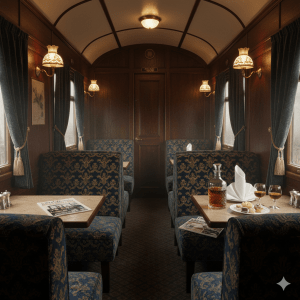
The terminus of the Shepperton line was a desolate place on a Friday evening, swallowed by a dense, ochre fog. The electrified third rail glinted with dampness, and the metallic ring of the buffer stops provided a lonely full-stop to the city’s constant noise. At the very end of the track, divorced from the modern glass of Terminal House, sat Pullman Car No. 92, Malaga.

It was a sanctuary frozen in time, its umber and cream livery faded but proud. Inside, the carriage was a time capsule of Edwardian luxury, the air thick with the ghosts of expensive champagne and stale cigar smoke. Polished mahogany panels reflected the soft, amber light cast by etched glass lampshades. Heavy velvet curtains drawn over the long windows cut off the miserable scene outside. Brass luggage racks gleamed, and the plush, blue-and-gold motif of the upholstery felt like a defiant echo of a bygone, grander age.

It was in this opulent setting that Inspector Miles Corbin found himself just after 10:30 PM.

“They found him just here, sir,” Sergeant Davies whispered, his heavy, damp coat scraping against the armrest of a velvet armchair. “Hardly fits, does it? A murder in a palace.”

The victim, Mr. Julian Thorne, the company’s celebrated railway historian, was slumped at a small table, his face hidden. His expensive tweed jacket showed a dark, spreading stain. Nearby, a heavy, silver-plated paper knife lay on the seat, a theatrically obvious weapon.

Corbin circled the scene, his polished boots silent on the deep pile carpet. On the table: a crystal decanter, two brandy snifters, and a plate of untouched petit fours. He noticed the brass plaque near the door, engraved: SECR 92. Malaga. Parlour First. 1921.

“The paper knife is a feint,” Corbin stated, not looking up. “The wound is superficial. Pathologist confirmed it. Cyanide in the brandy, Davies. Clean, fast. An assassin’s choice, not a frantic editor’s.”

“It was Mr. Arthur Finch who raised the alarm, sir. Junior Editor. He claims they had a row, a social drink, and Thorne collapsed while Finch was in the main office washroom.”

“The row wasn’t over a book error, was it?” Corbin asked, his eyes narrowing on the details.

Davies consulted his notes, his voice dropping further. “No, sir. It seems Thorne discovered something far worse. Finch’s new manuscript contained schematics of the GWR’s strategic freight lines—the ones designated for classified government use in the event of an… incident. Thorne believed Finch was leaking secrets to a hostile power and threatened to go to the Ministry of Defence tonight.”

The motive had shifted from professional rivalry to high-stakes espionage.

The decanter was centered. Thorne’s snifter was empty on his right. Finch’s snifter, still half-full, was on his left. The crucial detail was a single, pristine white napkin, folded like a swan, resting directly underneath Finch’s half-empty glass.

“Davies, look at this. Finch claims his glass is half-full. But why would he use a fresh napkin to coaster a glass he was supposedly still drinking from? And why is his hand-blotting napkin missing?”

Corbin delicately lifted the napkin. It was cool, damp only at the edges from the glass’s condensation, but underneath the dampness was a faint residue of panic sweat from a frantically grasping palm.

The Conclusion and Epilogue

Corbin had Finch brought back to the silent, elegant carriage.

“The brandy, Mr. Finch, tasted strongly of almonds, didn’t it? Cyanide,” Corbin said, tapping the half-full glass. “But the almond taste only develops in the air. The first sip kills. You poured the poison into Mr. Thorne’s glass first, knowing he would take the first sip. You then pretended to drink from your own, but you didn’t.”

Finch, pale and twitching, remained silent.

“You needed to dispose of your own poisoned drink. When you ‘went to the washroom,’ you actually went to the galley, poured your glass into a napkin—the missing one—which you disposed of in the carriage’s tiny coal fire-box. But your hand, Mr. Finch, was sweating profusely with the terror of your act. You reached for a new napkin to blot your palm, and then, in a desperate attempt to cover the fact that your glass was empty, you placed the untouched glass back down on the fresh, slightly clammy napkin.”

Finch finally cracked, his voice a choked whisper. “He didn’t understand! Thorne was going to expose the whole network! He would have started a war over a railway map!” Finch pointed to the silver knife. “That wasn’t for him. That was for me. If I’d been caught, I was supposed to use that, not the poison. The poison was cleaner.”

Finch was escorted away, the sound of the steel door closing on the police van a harsh, modern sound that fractured the quiet history of Shepperton.

The Aftermath:

Within forty-eight hours, the Pullman Car Malaga was subjected to a forensic sweep and a deep clean. All evidence of the night—the spilt brandy, the cyanide traces, the oppressive shadow of international espionage—was systematically erased. The mahogany was polished, the velvet vacuumed, and the etched glass wiped clean. Malaga returned to its function as a silent, luxurious hospitality suite for Ian Allan Publishing, retaining its rich, umber-and-cream exterior, but now holding one more terrible secret in its panelled walls, sealed off at the very end of the line.


Tags: , , , , ,

Alice and the Clockwork Garden.

Alice and the Clockwork Garden.
Alice and the Clockwork Garden.
**********************************
The city where Alice lived was a place of endless hums and flickers. Towers of glass stretched into the clouds, their reflections looping infinitely in the mirrored streets below. People moved like clock hands, precise, predictable, and always on time. But Alice was different. She collected broken things: cracked lenses, tangled wires, forgotten keys. She said they whispered to her when no one else was listening.
One evening, while exploring the outskirts of the city, she stumbled upon an abandoned greenhouse. Its glass panes were fogged with dust, and vines had crept through the cracks like green veins reclaiming a body. Inside, the air was thick with the scent of rust and wilted petals. In the far corner, half-hidden behind a curtain of ivy, she found a small brass door no taller than her knee. It ticked faintly, as though it had a heartbeat.
When she turned the handle, the world folded, not down, but sideways. The air rippled like water, and she fell through layers of sound and color until she landed softly on a bed of moss that smelled faintly of machine oil.
She stood up and found herself in a garden made entirely of gears and glass. Flowers opened and closed with the precision of pocket watches, their petals clicking in rhythm. The sky above was a swirling clock face, its hands spinning in opposite directions. Bees made of copper buzzed between the flowers, leaving trails of golden dust that shimmered like static.
A signpost nearby spun wildly, its arrows pointing to places that made no sense: “Yesterday,” “The Hour Between,” “Nowhere in Particular,” and “The Place You Forgot.” Alice hesitated, then chose the last one.
The path wound through hedges that whispered secrets in mechanical tones. Every few steps, the ground shifted beneath her feet, rearranging itself like a puzzle. She passed a pond that reflected not her face but a dozen versions of herself, older, younger, smiling, crying, all blinking at different speeds.
A cat made of smoke and mirrors appeared on a branch above her. Its grin flickered like a glitch in a screen.
“Lost again, are you?” it purred.
“I’m not sure I was ever found,” Alice replied.
“Good answer,” said the cat, and its body dissolved into a cloud of static, leaving only the grin behind. The grin blinked once, then vanished too.
Further along, she came upon a tea party set in the middle of a clockwork clearing. The table was long and crooked, covered in teapots that poured themselves and cups that whispered secrets to one another. The host was a clockmaker with a hat full of ticking hands and a monocle that spun like a compass.
“Time’s broken again,” he sighed. “Keeps running backward when no one’s looking.”
Alice peered into one of the teacups and saw her reflection aging and un-aging in rapid succession.
“Maybe time isn’t broken,” she said. “Maybe it’s just tired.”
The clockmaker blinked. “Then perhaps it needs a nap.” He handed her a small silver key. “Take this to the Heart of the Garden. It winds everything that dreams.”
The path to the Heart was not straight. It twisted through forests of glass trees that sang when the wind passed through them. She met a girl made entirely of paper who folded herself into a bird and flew away. She crossed a bridge that whispered her thoughts aloud, embarrassing her with every step. At one point, she found herself walking upside down, the sky beneath her feet and the ground above her head.
When she finally reached the Heart of the Garden, she found a massive clock-tree, its trunk pulsing like a living creature. Its branches were heavy with pendulums, and its roots glowed faintly beneath the soil. In its center was a keyhole, glowing softly. She turned the silver key, and the world exhaled.
For a moment, everything stopped. The gears froze, the bees hung motionless in the air, and even the sky’s hands paused mid-turn. Then, slowly, the world began again, but differently. The ticking softened. The flowers opened wider. The air felt warmer, almost alive.
But something else stirred. From the shadows beneath the clock-tree, a figure emerged, a tall woman with hair made of unraveling ribbons and eyes like shattered glass.
“You’ve wound the Heart,” she said, her voice echoing like a thousand clocks striking midnight. “Do you know what that means?”
Alice shook her head.
“It means the dream wakes up,” the woman whispered. “And dreams don’t like being awake.”
The ground trembled. The flowers began to wilt, their gears grinding to a halt. The sky cracked open, revealing a vast emptiness beyond. The woman smiled, her face fracturing like a mirror.
“Run, little clock,” she said.
Alice ran. The paths twisted and folded, leading her in circles. The cat reappeared, now flickering between shapes, a bird, a shadow, a reflection.
“Which way is out?” she gasped.
“Out?” the cat laughed. “There’s no out. Only through.”
She stumbled back into the greenhouse, gasping for breath. The brass door was gone, replaced by a single flower made of glass, ticking gently in the moonlight. She touched it, and the ticking stopped. The city outside seemed to pause, as if holding its breath.
When she looked at her reflection in the glass, her eyes glimmered faintly, like tiny clock faces, turning in opposite directions. Somewhere deep inside, she could still hear the faint hum of the garden, waiting for her to wind it again.
 

Tags: , , , , , ,

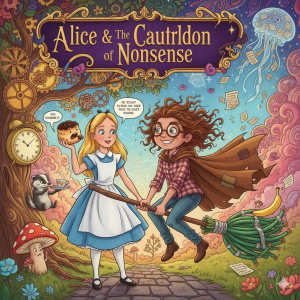
Alice and the Cauldron of Nonsense

Alice and the Cauldron of Nonsense

Alice and the Cauldron of Nonsense Song


(Verse 1 – Alice) One fine upside-down morning, the sky was askew, A rabbit hole landing, not into, but through. My dress was impeccable (A dreadful, bad sign!), I plopped in a pumpkin patch smelling of brine. “Where am I now?” I asked the soft breeze, It turned to a novel and flew through the trees. Then POP! like sarcasm, a loud, sassy sound, A new brand of chaos just dropped on the ground.

(Chorus) Oh, Blunderblot is calling, a whirlwind of glee, Where logic’s on holiday, wild and set free. With Wobbleberry Pudding and wands made of peel, The Cauldron of Nonsense is stirring what’s real! It’s not Wonderland, no, it’s gone off its rocker, It’s just Harry Rotter, the reality-shocker!

(Verse 2 – Harry Rotter) A scruffy girl rode a broom, made of hose and of tape, “Sensible’s here!” she grinned, escaping the scrape. “I’m Harry Rotter, Witch-in-training, you see, Mischief Certified, now—got exploding blueberries?” “I’ve a scone,” I replied, “It’s quite prone to talk.” “Perfect!” she cried, “For our magical walk!” Then a toadstool stood up, with a groan and a belch, “The Turnip Wands Incident! You shouldn’t be here, welch!”

(Chorus) Oh, Blunderblot is calling, a whirlwind of glee, Where logic’s on holiday, wild and set free. With Wobbleberry Pudding and wands made of peel, The Cauldron of Nonsense is stirring what’s real! It’s not Wonderland, no, it’s gone off its rocker, It’s just Harry Rotter, the reality-shocker!

(Bridge) The sky turned to paisley, the ground started to shake, An angry old badger on a tea tray did wake. “You turned Queen’s scones into gremlins!” he spat from his eye, “But gremlins make croutons!” was Harry’s reply. Then a jellyfish floated, of homework and dread, “You mixed rhubarb and Potion 3½!” it overhead said. “The Cauldron is broken!” Harry gasped, filled with fear, “Quick, the Spell of Almost-Rectification is near!”

(Chant/Middle 8 – Spoken Rhythmically) They linked pinkies, tapped knees, and chanted with vim: “Zibble-zabble, stew and bubble, Patch the holes and double the trouble! Bring back balance, just a smidge— Except on Tuesdays. Or near the fridge.” There was a WHUMP, a WHEEEE, and a BLARG! And everything stopped just outside the dark.

(Verse 3 – Alice & Harry) The grass was just grass, and the badger took a seat, A cup of hot tea was a perfectly neat, quick treat. “That was… something,” I said, with a thoughtful, slow sip, Harry winked, upside-down, and gave a small skip. “Next stop: The Ministry of Mayhem,” she decreed, “A borrowed dragon I need to return, yes indeed!” “Allergic to Tuesdays?” I asked with a smile, I was sold on this chaos, just for a while.

(Outro) So off they went skipping, one right and one wrong, The Blunderblot rhapsody plays on and on! With a talking scone muttering verses of Shay, And a dragon-shaped problem for another mad day. (Fade out with the scone’s voice) “…to be or not to be, that is the question…”


Tags: , , , , ,

Circus of the Grotesques

Circus of the Grotesques

Circus of the Grotesques (It Will Change Your Life Forever)

(A song for Doctor Vaude and the people of Ballykillduff)

[Verse 1]
The fog came down on Ballykillduff,
With posters on the wall,
And no one saw the tent go up,
But everyone heard the call.
A shimmer of pearl and shadow black,
A sign with a curious lore:
“Admission, one memory, no refunds—
But you’ll never be quite as before.”

[Chorus]
🎵 Step inside, dear dreamers, step inside and see,
The Circus of the Grotesques, where you trade what used to be.
Give us one small moment that your heart can spare,
We’ll change your life forever—if you’ve the mind to dare. 🎵

[Verse 2]
Madame Tallow of Wax and Whispers danced,
Her words like smoke and fire,
She told your truth before you knew,
And left your thoughts to tire.
The Gentleman Beast in velvet shame,
Spoke softly of his fall—
And every soul in Ballykillduff
Felt beast and man in all.

[Chorus]
🎵 Step inside, dear dreamers, step inside and see,
The Circus of the Grotesques, where your secrets come to be.
We’ll mend your pain and polish your despair,
We’ll change your life forever—if you’ve the mind to dare. 🎵

[Bridge 1]
Clockwork Twins ticked time away,
A minute each for tears,
The Librarian turned blank white pages
Filled with gentle years.
The Cook of Impossible Flavours smiled,
“Have a taste of who you were.”
And somewhere in the tent that night,
The stars began to stir.

[Verse 3]
Norah O’Dea with her toffee stick,
Raised her hand so small,
Said, “I’ll be brave, and I’ll be changed,”
Before them, one and all.
The ringmaster bowed, his smile too bright,
The tent bent close to hear,
And Ballykillduff held its breath—
Between wonderment and fear.

[Chorus — Slower, Lamenting]
🎵 Step inside, dear dreamers, pay the price of air,
One small memory traded, one truth laid bare.
You’ll leave a little lighter, you’ll walk a little strange,
For the Circus of the Grotesques has a gift called change. 🎵

[Bridge 2]
They called her name three times in love,
And once with iron will,
The black salt hissed, the lights went white,
And time stood faintly still.
Norah faced the ringmaster proud,
Her eyes as bright as glass—
She said, “Let’s play a riddle’s game,
To see what comes to pass.”

[Verse 4]
“What grows lighter shared, yet heavy kept?”
The ringmaster asked the air.
Norah smiled, “A story told—
It lives when it’s laid bare.”
Her riddle came like April rain,
“The cost of kind undone?”
He sighed, “A knot within the dark—
Until it’s all unspun.”

[Final Chorus — Triumphant, Soft Echo]
🎵 Step inside, dear dreamers, step inside and see,
The Circus of the Grotesques set your memory free.
What you lose will find you, though it may rearrange,
No refunds ever needed—only change. 🎵

[Outro — Spoken softly, as if by Doctor Vaude]
“Forever,” we promised. “Change,” we gave.
Both are true, and both behave.
So mind your steps, remember the fair,
The tent is gone—but the air is there.

🎵 No refunds… plenty of change. 🎵


Tags: , , , , ,

Circus of the Grotesques

Circus of the Grotesques

Circus of the Grotesques

It Will Change Your Life Forever

The poster arrived in Ballykillduff the way fog arrives on the bog road, quietly and all at once. It was there on the noticeboard outside the shop, on the lamppost by the bridge, tucked under pint glasses in The Giddy Goat. It even rode the back of a wandering sheep for a morning, the poor ewe plodding around with CIRCUS OF THE GROTESQUES flapping off her wool like a royal cape.

People said it was a prank of Jimmy McGroggan’s, or a stunt for the fête. Jimmy swore on his mother’s bottle-green statue of St. Jude that it was no such thing. “I would have used better paper,” he said, affronted. “And I would have spelled grotesques with exactly one more flourish.”

By Friday twilight, a striped tent stood in the meadow by the bridge, though no one had seen it go up. The stripes were not red and white, but black and pearl, and the pearl shimmered with a faint inner sea-light even as the evening darkened. There was a queue without a queue, people drifting toward the entrance as if they had always been walking there. A sign beside the flap read, in painted letters that looked still-wet:

ADMISSION: ONE MEMORY. NO REFUNDS.

“Ah now,” said Seamus Fitzgerald, veteran of mysteries and mistakes. “What would they want with memories?” He had a face that looked carved for curiosity and a wife who had given up trying to sand it smooth. Bridget stood beside him in her good cardigan, lips set, eyes sharp as clothespins. Around them, the village swelled and murmured. Children peered between elbows. The river wore the dusk like an old shawl.

A boy named Timmy Tilbert reached toward the sign. He was the sort who could not pass a gate without testing if it would open. The sign did not bite him, so he grinned, and that was that. The first people ducked into the tent.

Inside was not inside. Rows of mismatched chairs stretched further than the field itself. Lanterns floated without hooks. The air smelled of sugar and sawdust and something faintly metallic, like a tin whistle after a tune. A stage stood at the far end, a circle of lighter canvas with a ring of black salt around it, glittering like frost. The crowd sat. The tent filled and filled as if with tidewater.

The lights faded. A drum sounded once, and out stepped the ringmaster.

He had the look of a gentleman drawn by someone who had only listened to gossip about gentlemen: the coat a shade too long, the cuffs a shade too shiny, the smile too bright by half. His top hat was a fraction wider than the laws of taste permitted. When he bowed, it was a bow that made the whole tent feel it had been bowed to, personally and permanently.

“Welcome, Ballykillduff,” he said, and the echo of the village’s name went walking up into the dark of the roof. “Welcome, seekers of strangeness, patrons of the peculiar, connoisseurs of the crooked and the sublime. I am Doctor Vaude, and this is the Circus of the Grotesques. We will change your life forever.” He let the words dangle like bright knives. Then his tone softened. “To begin, I ask only that you sit, see, and remember what you can. What we take is only what you can spare.”

Seamus leaned toward Bridget. “What if they take the memory of me not washing the kettle?”
“You never washed the kettle,” Bridget said. “They would have to add that memory, not take it.”

A tinkling bell rang. The ringmaster raised his cane, and the first act stepped into the salted ring.

The Woman of Wax and Whispers

She wore a dress like a candle snuffed at midnight, and she moved as if balancing droplets. Every turn of her wrist left behind a shine. The lanterns lowered themselves in courtesy. When she danced, her skin softened and ran like honey, then firmed again, all while her eyes remained steady and deep as wells. She leaned toward those in front and whispered secrets, not hers but theirs. “You still have the key to the blue box,” she told a farmer, “and you keep it though the box is long burned.” “You pretended not to see him cry,” she told a grown daughter, “and you wished you had.”

With each whisper, a faint curl of smoke rose from her mouth and drifted toward the roof, where it vanished as if swallowed. People in the front row touched their hearts, their hands, their mouths. Some laughed, and then looked startled by the sound, as though it had come from a different throat.

When she finished, she made a small curtsey and a tiny flame on her fingertip winked out.

Doctor Vaude inclined his hat. “Every candle must melt to give its light,” he said. “Applause for Madame Tallow, the Woman of Wax and Whispers.”

The Gentleman Beast

He entered on a velvet leash he did not need, a looming figure with a mane like wheat in high summer. His tuxedo fit him as if it remembered an earlier body. His eyes were lion and man at once. He spoke in a voice that came from a long way off and also from beside your ear.

“Once,” he said, “I was handsome and admired and wanted more. I bought mirrors. I bought tragedy. I bought cruelty and paid no change. One morning I woke and found the animal I had been breeding in secret had taken the house. I asked for a refund. Life declined.”

He put a paw to his heart and bowed to the cheapest seats with the greatest grace. He then leaped a ring of fire and, for the brief gleam of midair, he was not a beast but a beautiful man again, face luminous, human, painfully so. The fire sighed when he landed. The audience sighed with it.

Bridget clapped, and clapped again, furiously wiping at one eye as if it had collected dust. Seamus squeezed her hand and did not make a remark, which was the most loving thing he could do.

The Clockwork Twins

A hush enfolded the tent. Two girls came in from opposite sides. They were identical up to the small freckle on the left edge of their lower lip, which both of them had somehow. Their skirts were made of pages torn from railway timetables. Tiny copper keys protruded from beneath their shoulder blades. With delicate hands they wound one another, and then they moved.

They danced in precise arcs that were more accurate than a clock but more gentle than a prayer. As they danced, the lanterns ticked. One twin, her name stitched white-on-black at her hem, Adéle sped up whenever the audience breathed. The other Ida slowed down whenever the audience blinked. The crowd tried not to breathe or blink. The tent filled with a human kind of blue. At the end the girls leaned cheek to cheek, and for a second each had no freckle, or both had two. Then they curtseyed, and their keys unwound with a sigh like wind through barley.

Doctor Vaude’s smile was almost tender. “They were born on a platform between two trains,” he said. “They missed their departure and arrived at their fate. Please save your applause for the pockets of time you will need on the way home.”

The Librarian of Unwritten Apologies

A thin fellow in a coat the color of hand-me-downs pushed a book trolley into the ring. The books were blank. He opened one, and the tent ruffled as if a bird had flown through it. “I keep all the apologies you meant to make,” he said mildly. “I am not the judge. I am the librarian. Judge yourselves as gently as you can.”

He set the books on a rope and walked across them like stepping stones, and as he stepped the pages filled with writing that rose and faded, rose and faded, a river of sorry. People in the crowd reached as if to snag a page and swallow it.

When he reached the far side, he turned. “The fine,” he said, “is small. Say the words aloud when you can, and mean them as much as you can.” He gave the crowd a little bow that looked like a folded note.

The Cook of Impossible Flavours

A wide woman with arms like rolling pins wheeled out a cart hung with boiling pots that never boiled over and frying pans that never burned. The smells that came from the cart were a memory of bread and the laughter of a first friend. “Taste,” she told the audience, “but be warned. It will cost you nothing at all, and that is its danger.”

She handed spoonfuls down the rows. People tasted “the day Granddad told me the secret joke,” “the time I nearly cheated but did not,” “the morning the rain knew my name.” Someone tasted “what I would have been,” and started to cry. She wiped the person’s tears with a clean square of linen and tucked it into her apron pocket as if it had always belonged there.

The Acrobat of Missing Steps

He walked up an invisible staircase that everyone somehow knew was there because everyone had used it, once. He slipped where the step was missing and did not fall because he had spent his life falling and had learned the trick of turning falling into a kind of strange flight. He landed where the step should have been. He put it back.

“Who here gave a memory?” Doctor Vaude called between acts. “Which one did you pay?”
“A birthday,” answered Seamus before Bridget could grip his sleeve. “My fifth. But sure I hardly remembered it.”
“Ah,” said the ringmaster. “Then it will hardly be missed.”
Seamus grinned, though a small, dry space had opened behind his ribs, not empty, not full, something like a pressed flower in a book you cannot quite name.

At the end of the first half, the lights rose and the tent rummaged itself into an interval. Trays of sugared things appeared. A set of paper birds fluttered around, landing on fingers to do sums, accept coins that were not coins, and leave receipts that were feathers. Seamus bought a twist of toffee for Bridget, who did not say thank you because she was thinking about whether she should have paid at all and whom she might be if she had not.

A girl stood near the aisle with a toffee apple like a small planet in her hand. Her name was Norah O’Dea, ten years old, a listener by nature and a laugher by vocation. She had the kind of eyes that made adults tell her too much and then gulp, and the kind of hands that mended other people’s kite strings without asking. She watched the paper birds. One landed on her wrist. She fed it a crumb of caramel. The bird bowed, and the caramel did not stick to its paper beak.

When the bell tinkled again, the audience drifted back. Someone hummed the hymn that is not in any hymnbook and always floats up just before miracles or trouble.

Doctor Vaude strode into the ring with his arms wide and his smile tuned to the exact frequency of attention. “For our second half,” he cried, “we offer transformations, translations, and the common magic of seeing what was there all along. And for our final act, we will require a volunteer.”

Bridget made a small sound, not unlike the sound a jam jar makes when it thinks about breaking. Seamus patted her knee. “It will be fine.”

Transformations

A woman stepped forward and took off her shadow like a coat. It ran around the ring on its own legs, then returned, a little breathless, and wrapped itself back around her ankles with an affection that looked like forgiveness. A man sang in a voice that made the lanterns grow taller, and when he stopped the lanterns were ashamed and shrank to their proper height. A boy took a deep breath and blew out a cloud of moths that turned to stars and then to freckles on his cheek.

Doctor Vaude clapped slowly, politely, as if his hands and the acts were doing business together. He turned to the crowd. “And now, a volunteer. No harm, I assure you. Only change. Only change.”

Silence is rarely complete. There is always the shiver of a sleeve, the soft slap of a jaw, the old whisper of a roof. In that not-quite-silence, Norah O’Dea lifted her sticky hand. “Me,” she said. A hundred whispers repeated me and wondered who had said it.

“Splendid,” said Doctor Vaude, and something brightened around him, and something dimmed.

Norah came down with a steady step. The ring of black salt glittered like a warning you pretend is a compliment. The ringmaster drew a circle on the canvas floor with a broken piece of chalk that never got shorter. “Stand there, my dear. Tell the people your name so your name will find its way home if it goes walking.”

“Norah O’Dea.”

“Very good. What would you like to be?”

Norah frowned. “I do not know.”

“A perfect answer,” said Doctor Vaude. “Let us begin.”

He spoke in a language that made Seamus itch and the paper birds rustle. The lanterns lifted. Norah blurred, like a swallow crossing a pane of glass. The blur thinned into a thread and then into a ribbon and then into a smile. It was the ringmaster’s smile. It fit her as if it had always been waiting for her, a coat taken in at the waist and let out at the hope.

People shifted uneasily. It is one thing to see marvels. It is another to see them reach out and swap hats with your neighbor.

Bridget stood up. “That is a child,” she said, not loudly, but with the sort of softness that quiets louder things.
Doctor Vaude tilted his head. “So she is,” he agreed. “For a while longer.”

Norah stood perfectly still, her new smile fixed, her eyes wide and glassy. Seamus remembered a small pair of hands at the shop door last winter, pushing in the wind for an old woman who was not quick. He remembered a laugh like a silver fork pinging on the counter. He remembered—he tried to remember—the girl’s birthday party last week, the cake, the candles, the song. His memory slid away from him like a fish through water.

“What did you take from her?” Seamus asked.
“Nothing,” Doctor Vaude said pleasantly. “We only moved things around. We are an agency of rearrangement.”

“The cost,” Bridget said. “There is always a cost.”
“The cost was paid at the door,” said Doctor Vaude. “One memory. No refunds.”

The audience’s murmur gathered itself into concern. But the tent itself seemed to lean toward the ringmaster. The tent itself was on his side.

Seamus stepped over the black salt, and the way the crowd sucked in its breath said he should not have done it. The circle did not stop him. He stood beside Norah. “Come on now,” he said, and put his hand out. “Let us go out and get air. There is a smell of tin in here.”

Norah did not move. Her hand did not move toward his. Her smile did not change. Only her eyes brightened with a thin shine of water.

Doctor Vaude’s own smile sharpened but did not grow. “I am very fond of the brave,” he said. “Bravery is such a practical spice.”

“What did you take?” Bridget asked again.

“What she could spare,” said the ringmaster. “The last layer of fear about becoming herself. I saved her the ache. You will thank me later.” He turned to the crowd. “There is always such resistance to ease, is there not? One final demonstration, then we will dismiss you kindly out into your permanent newness.”

He clicked his cane. The lanterns flipped to an unnatural white. The tent’s roof stretched upward like a held breath. The stage floor opened without opening, and from under the canvas rose the Mirror That Remembers Your Other Face.

It looked like a pond held on its side. It rippled as if it were alive and bored. Inside it, the faintest reflection of each spectator became sharper, the way a sentence sharpens as you near the end of it. People leaned forward. In the glass their mouths moved. Their reflections said things they had not said. Their reflections were things they had not been. A man saw himself with a child on his shoulders he had never had. A woman saw herself at the sea she had never visited. Bridget saw herself standing on a stage arguing with a ringmaster and winning.

“Careful now,” Seamus muttered. He took off his cap. He had not intended to, but his mother’s voice spoke up out of a cupboard in his brain and said, Take off your cap indoors when you are speaking to a mirror. He held the cap over the black salt. “If it is the price,” he said under his breath, “perhaps it can be paid back.”

Bridget heard him and grasped his wrist. “Do not you dare,” she said. “Not another memory. We will not play their game by their rules.”

A paper bird landed on Seamus’s shoulder. He felt the crackle of its weight. It pecked his ear as if to say: Different rules exist.

The Librarian of Unwritten Apologies wheeled his cart toward the ring’s edge and coughed. It was the cough you give in church when the priest has forgotten the second verse. Doctor Vaude glanced over with wide courtesy. The Librarian looked steadily back.

“Doctor,” he said, mild as rain, “there is a rule you have not mentioned.”

Doctor Vaude smiled wider. “There are many. Choose one.”

“The one about names,” said the Librarian. “If a name is called with love twice, and a third time with courage, the tent must hear it and consider it.”

The ringmaster waved his cane. “By all means, call.” His tone suggested a child trying to butter a thunderstorm.

Bridget did not wait. “Norah,” she said. “Norah O’Dea.” The name went out and hung like a bell swinging.

Seamus said it too, softly, as if coaxing a frightened dog from under a gate. “Norah.”

The tent waited. The ring tilted. The third call stuck in his throat like a bone. Seamus looked at Doctor Vaude’s eyes and saw patience in them, the patience of a hawk circling, and it made anger rise like tide. He shouted the name. “Norah!”

The tent heard.

The black salt hissed and rearranged itself into letters that spelled GO HOME and then, after a beat, IF YOU LIKE. Norah blinked. The smile slackened by a fraction. A tear came loose. It slid down, touched the edge of the circle, and fizzed like cider.

Doctor Vaude sighed as if inconvenienced by a minor traffic incident. “Very well. A little back-and-forth. It is good for the lungs. Child, you may choose. Stay, and learn our trade. Go, and be whoever you will, with one less splinter to pull out later.”

Norah’s eyes cleared. She looked up at Seamus and Bridget. At the crowd. At the ringmaster. “May I ask a question?” she said.
“Always allowed,” said Doctor Vaude.
“Do you pay for anything?”
He tilted his head. “Everything pays for everything. We are part of the economy of wonder. We take what can be spared and give what will be appreciated.”
Norah looked at her toffee apple, which had somehow not dripped. “I think you owe us a fairground game.”

The ringmaster blinked. “I beg your pardon?”
“A fairground game,” she said. “We paid at the door. You dazzled us. Now we deserve a chance to win back what we bought, the way my Da once won a goldfish that lived three years. The rules of circuses say so.”

No one knew if the rules of circuses did say so. But no one could swear they did not. The tent itself rustled in interest, as if learning a novelty. The paper birds fluttered up and wrote GAME in the air, letter by letter, and the letters burst into confetti and fell gently upon the ringmaster’s hat.

Doctor Vaude’s smile did not waver. “Very well. A game. Choose.”

Norah thought. Children think in lines that look like spirals to everyone else, but arrive more directly than most adult maps. “Riddles,” she said at last. “You ask one. Then I ask one. If we tie, we both win and lose a little. If I win, you give everyone back the part of their memory they can use. If you win, you may keep what you have taken, and also my toffee apple stick.”

Doctor Vaude looked at the stick as though it were a sceptre from a rival kingdom. “Agreed,” he said.

He stepped into the ring so the black salt whisper-crunched. He lifted his cane as if drawing a stave in the air, and notes appeared, little bright minnows hanging expectantly. “What is the thing,” he asked, “that everyone carries, that no one can lend, that grows lighter when it is shared and heavier when it is hidden?”

A murmur ran through the tent. Seamus mouthed sadness, then bread, then a pocket. Bridget squeezed his hand to stop the fidgets. Norah did not rush. She let the question settle around her like a coat and then stepped out of it.

“A story,” she said.

The notes flashed and turned into dandelion seeds that drifted up among the ropes. Doctor Vaude nodded once. “Well done. Your turn.”

Norah’s eyes went to the Librarian’s cart, to the wax woman’s cooling hand, to the clockwork twins standing with their cheeks together listening for the train. “What is the cost of a kindness that is not done?” she asked.

The ringmaster’s smile held steady. He did not speak for a time that felt like waiting for a verdict. He looked at the lanterns and then at the tent pole and then at his own hands, as if wondering if they had kept their receipt.

“The cost,” he said finally, “is a knot in the dark.” He inclined his head. “And interest.”

Norah nodded. “Then untie one.”

Doctor Vaude’s smile thinned. He twirled his cane once and tapped it against the canvas. Something invisible loosened. Somewhere in Ballykillduff, a small hardness in a small chest softened. Somewhere else, a hand reached for a phone it had not reached for in five years. The Librarian closed one blank book and shelved it. The Woman of Wax exhaled. The Gentleman Beast’s claws dimmed to nails.

“You have won,” said Doctor Vaude, and the tent shifted as if relieved of a coin in its shoe.

“What about our memories?” Seamus cried.
“Bring me your tickets,” said the ringmaster, and the paper birds swept down to snatch them from hands and hats and pockets. They fluttered above Doctor Vaude’s cane like a flock arguing which wire to sit on. He flicked the cane lightly and the tickets burst into ash, which rained on the people and smudged them with a soot that, when they brushed it away, left behind small bright scraps that fitted into the doors inside their minds and unlocked some of them.

Seamus blinked. He saw his fifth birthday. He saw his mother lifting him to blow out the candle on a small cake with sugar daisies. He saw his father’s ridiculous red paper hat, and his own determined cheeks. He also saw that his mother had been tired, and that his father had been worried about money, and that loving and worrying had been the same rope plaited differently. The memory did not come back as it had been. It had changed. It had grown up. He held Bridget’s hand and felt ashamed in a clean way, the kind that makes a man wash the kettle without being asked.

“Will it last?” Bridget asked Doctor Vaude softly, to his credit, because she could have shouted.
“The change? Yes,” he said. “The circus does not refurbish. It renovates.” He placed a hand on his chest. “We will keep a fee. We always do.”
“What fee?”
“You will see,” he said, and gave her a bow that acknowledged her as an equal opponent.

Norah looked up at him. “One more thing.”
“Ah,” he said. “Children and the one more thing.”
“You promised two things,” she said. “Change and forever. If you changed us, how do we know it will last forever?”
“You do not,” he said. “But forever is only ever a promise we tell the present to calm it down.” He looked, then, for the first time, a touch weary. “Go home, Norah O’Dea. Be whoever you will, with as many splinters as you can bear. Keep the stick.”

The tent applauded, which is a peculiar sound. The applause went around the circle and up into the ropes and back down again, as if the structure itself had hands. Norah bowed, very slightly, and went back to her place. The ringmaster tapped his cane, and the lights glided gently to brightness.

“Ladies and gentlemen,” he said, “Ballykillduff, brave and particular, you have been excellent. We thank you for your attention and your currency. When you leave, you will find the world arranged freshly but recognizably. Do not worry if your kitchen chairs are in a line across the garden. It will make sense by Tuesday. Please, mind your step on the way out. The step is there and not there, depending on whether you remember it.”

He bowed his deep bow. The troupe stepped forward to join him: Madame Tallow gleaming softly, the Gentleman Beast with a carnation tucked behind one ear, the Clockwork Twins holding hands with their keys at rest, the Librarian with his stack of blank books that did not feel blank, the Cook wiping an already clean ladle, the Acrobat balancing on the rope of a decision no one else could see.

They all bowed. The audience stood. The tent exhaled.

Outside, night had grown ripe. The moon seemed surprised to be there. The field was empty. The tent had gone between one breath and the next, leaving only pressed grass in a circle and a smell in the air like burnt sugar and old pennies. People looked at one another with the faces of people who have been baptized by the odd and are pretending it was a sprinkle.

Seamus and Bridget walked the lane home in a thoughtful quiet. “Will you be washing the kettle?” Bridget asked eventually.
“I believe I will,” Seamus said. “And also the cup. And possibly the past, though I will start with the kettle.”
“Good,” said Bridget, and slid her arm through his. “I remember your fifth birthday cake.”
“Do you?”
“I do now,” she said. “We licked the bowl on the back step. Your father put the dog’s hat on the priest.”

Seamus laughed aloud, and the laugh startled the hedges. They passed the O’Dea house. Inside, through the net curtains, they saw Norah set her toffee apple stick upright in a flowerpot like a flag.

“What do you think the fee is?” Seamus asked.
Bridget looked up. The stars seemed slightly rearranged, as if someone had decided that the Plough would be clearer if it were moved three finger-widths to the left. “We will have to live to find out,” she said. “That is the bargain anyway.”

In the days that followed, oddnesses revealed themselves the way recipes reveal the pinch of something you cannot name. People remembered what they had paid and what they had won. The shop bell, which had always rung once, started ringing twice, and everyone found the second ring companionable. The postman delivered a letter to a door that had been locked since ’98, and the person who opened it stood very straight and inhaled as if the air had forgiven her. A woman phoned a sister. A man mended a gate he had been kicking for years. The schoolchildren invented a playground game called librarians, which involved trying to outrun your apology. They were very fast.

And now and then, for weeks after, someone standing at the sink or the pub or the bus stop would see a long dark shape out of the corner of the eye, like the shadow of a tent, and turn, and there would be nothing, only the sense of canvas and music as a weather that had passed.

As for Norah O’Dea, she kept her toffee stick watered. After a while, a thin green shoot pushed out the top as if the wood had been waiting for permission. In spring it sprouted a single leaf shaped like a bell. When you tapped it, it made a tiny sound that meant change, and also meant forever, and nobody could quite say which.

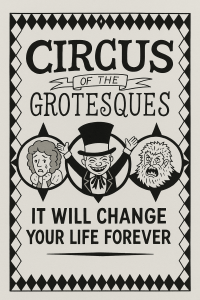
On a rainy Sunday that hung low over the village, Norah lay on her belly on the rug and drew a poster in thick black ink. CIRCUS OF THE GROTESQUES, it read at the top, in letters that leaned into the wind. Beneath that she drew a wax woman, a lion in a tuxedo, two clockwork girls, a librarian’s cart, a cook with a cloud of smell, an acrobat stepping into the place where a stair should be, and a man in a too-bright smile holding a cane. Across the bottom she wrote: It changed our lives forever. No refunds necessary.

She pinned it to her wall. She went downstairs. At the sink, her mother stood with the phone tucked between shoulder and cheek, listening. “Yes,” her mother said to the voice on the line. “I am here. I am listening.” She smiled, a new smile that fit her face properly, a smile that did not belong to any ringmaster at all.

That night the wind shifted. Somewhere beyond the bog, a lantern went up on a pole and came down again. Somewhere farther still, in a town with a different name, people looked up as a black-and-pearl tent breathed itself into a field as if the field had dreamed it.

Inside the tent, Doctor Vaude placed a hand on the canvas and felt the pulse of the place. He looked at his troupe. He did not count their number aloud. He did not mention the shy, newly added figure already fitting in backstage, a little girl with steady eyes who had volunteered to teach the paper birds two new tricks and to check the chalk for truth.

He smiled. Perhaps it was a touch smaller than before. Perhaps it was exactly the same. He lifted his cane.

“Ladies and gentlemen,” he rehearsed under his breath. “Welcome, seekers of strangeness. We will change your life forever.”

Out on the road, an apology untied itself and walked away into the dark, lighter by the weight of a knot. In Ballykillduff, Seamus washed the kettle in circles, counterclockwise, and Bridget kissed the back of his neck in passing, and both of them pretended for a moment that this was how it had always been. And perhaps it had. It depends, as the ringmaster would say, on how you remember it.

No refunds. Plenty of change.
 
Leave a comment

Posted by on October 30, 2025 in circus


Tags: , , , ,

Baby Hippo and Alice

Baby Hippo and Alice

Alice and the Baby Hippo

Alice once mounted a hippo one day,
Who’d lost his way in a puddle of clay.
He huffed and he snorted and splashed with delight,
While Alice held on with all of her might.

“Faster!” she cried, “to the edge of the sky!”
The hippo just winked with a mud-sparkled eye.
They galloped through rushes and lilies and foam,
Quite certain they’d never find their way home.

Through puddles of puddings and rivers of tea,
They splashed past a fish who was trimming a tree.
A frog waved his bonnet, a duck tipped his hat,
And a snail cried, “Good gracious! She’s riding on that?”

The hippo just chuckled, “I’m only a tot,
But galloping’s easy when you’ve learned the trot.”
And off they went bouncing, through dream upon dream,
Till Alice awoke by a murmuring stream.

Her dress was still damp, her shoes full of sand,
And she whispered, “Next time I shall learn how to land!


Tags: , , , , , , , , ,