RSS

Category Archives: Alice in Wonderland

Alice Logs In

Alice Logs In

Alice Logs In

One sunny day in Wonderland,
While sipping tea and chewing sand,
Young Alice yawned and had a thought:
“Why are we all so pre-internet caught?”

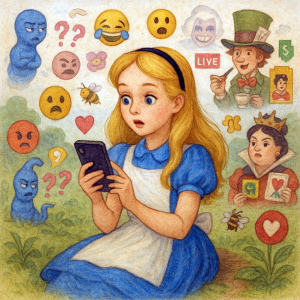
She pulled an iPhone from her sock,
(It ticked and tocked like a talking clock),
She poked the screen and gave a grin—
“Let’s see what world I’ve wandered in!”

The Caterpillar popped online:
“Who R U? U up? U fine?”
The Cheshire Cat just posted memes,
And vanished mid-conspiracy themes.

The Hatter live-streamed tea debates,
With Bonkers takes on interest rates.
The Queen of Hearts launched NFTs:
“Buy now! Each comes with severed knees!”

Alice sighed. “This can’t be right—
We’ve meme’d away the day and night.
No riddles, rhymes, no flights of fancy—
Just trolls and ads and apps called ‘Dancy.’”

She tried to post: “I miss the trees.”
But all she got were angry bees—
Replies that buzzed: “You’re cringe! You’re fake!”
“Return to hole! Go eat a cake!”

She shut the phone and dropped it fast,
Deciding screen life couldn’t last.
She skipped away through mushroom mist,
Her Twitter never once was missed.

So if you find your world askew,
Try Wonderland, not Webpage 2.
You won’t need likes or streams or fame—
Just talking cats who know your name.
 

Tags: , , , , , , ,

Alice and the Baby Hippo (A whimsical poem in rhyme)

Alice and the Baby Hippo (A whimsical poem in rhyme)

Alice and the Baby Hippo
(A whimsical poem in rhyme)

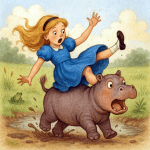
One dainty day beneath the sun,
Young Alice thought, “This could be fun!”
She saw a hippo, small and round,
Just waddling gently on the ground.

Its skin was grey, its tail went flip,
It wriggled with a wobbly skip.
Its ears were tiny, pink and proud—
It snorted once and drew a crowd.

“A mount!” cried Alice. “Oh, how grand!
I’ll ride across this soggy land!
No horse or donkey, goat or yak—
I’ve found a hippo for my back!”

She climbed atop its chubby rear,
The hippo blinked, then twitched an ear.
It gave a squeal, then took a dash—
And Alice flew off with a splash!

She landed in a muddy bog,
Just shy of hitting a startled frog.
Her hair was filled with weeds and goo—
Her sock was gone, her shoe was too.

The hippo, shocked by all the fuss,
Just blinked and snorted, “Don’t blame us!
We’re not for riding, no, not yet—
We’re more like mobile lumps of wet.”

Alice laughed, then bowed with grace,
Mud dripping gently down her face.
“Well thank you, friend,” she said, and grinned,
“As far as rides go—you were…wind!”

And off she skipped with squelchy feet,
Through meadows green and puddles sweet.
Behind, the hippo gave a sigh,
Then belly-flopped with glee nearby.

So if you spy a hippo small,
Be sure you ask, before you fall.
For though they’re cute and seem just right—
They’re not the steed for your next flight!


 

Tags: , , , , , , ,

The Mad Hatter Story

The Mad Hatter Story

The town square bustled with the usual midday activities. Vendors called out, children played, and the smell of freshly baked bread wafted through the air. It was a typical day in a place where the clocks had long ago forgotten to tick. Above the cobblestone streets, the sky remained a constant gray, as if painted on by an unenthusiastic artist who had abandoned their canvas.

In a quiet corner of the square, an old woman sat on a rickety chair. She had a table before her, laden with various odds and ends: a few dusty books, a jar of buttons that hadn’t seen use in decades, and a single, sad-looking hat. Her eyes squinted behind thick spectacles as she meticulously sewed a patch onto the hat’s tattered brim.

“Look at this,” she murmured to herself, her voice like the rustling of dry leaves. “Once it was a thing of beauty, and now…” Her words trailed off as she sighed heavily, her shoulders slumping.

Suddenly, the square grew eerily still. A shadow fell over the old woman, and she looked up to see a tall, lanky figure standing before her. His face was a ghastly pallor, and his eyes burned with a fiery madness that seemed to illuminate the dullness around them. He wore a wide-brimmed hat at a jaunty angle, adorned with a single red rose. The townsfolk had learned to fear this man, for his laughter was said to echo through their nightmares.

“Madam,” he spoke, his voice a chilling caress. “Your work is quite… intriguing.”

The woman peered up at him, curiosity piqued by the interruption. “What do you want?” she asked bluntly, not bothering to hide her suspicion.

He leaned closer, a twisted smile spreading across his face. “I’ve been searching for a hat, you see,” he began, his voice dropping to a whisper that seemed to carry on the wind. “One that speaks to me, calls to me, whispers secrets of wonderlands long forgotten…”

The old woman’s eyes narrowed, and she leaned back, eyeing him warily. “What makes you think I’d sell to the likes of you?”

The Mad Hatter’s grin grew wider, revealing teeth that looked more like the sharpened edges of a butterfly knife than anything natural. “Ah,” he said, “but I’m not just anyone, am I? I am the keeper of the hats, the teller of tales that make the very fabric of reality tremble. And I have need of one such as this.”

The woman studied the hat in her hands, her thoughts racing. It was just a simple, worn-out piece of headwear, yet the way he talked about it made it seem as if it held the power to change the course of the world.

“What’s so special about this hat?” she demanded, holding it up protectively.

The Mad Hatter leaned even closer, his breath a cold draft on her cheek. “This hat,” he whispered, “once belonged to a very important person. It’s seen things, felt things, that no ordinary hat could ever dream of. It’s a gateway to a realm of madness and beauty, where the only rule is that there are no rules at all.”

Her heart pounded in her chest. What could this madman possibly want with such a mundane object? And what secrets did it truly hold?

The Mad Hatter’s eyes gleamed as he reached into his coat pocket, pulling out a small velvet pouch. He placed it gently on the table, the clink of coins resonating through the unnerving silence that had enveloped the square.

“For your troubles,” he said, his smile never wavering. “But if you wish for something more… unique, I could offer you a glimpse into the looking glass.”

The old woman’s curiosity got the better of her. She had heard whispers of the Mad Hatter’s magic, of his ability to show one’s deepest desires or darkest fears. She hesitated, her trembling hand hovering over the pouch.

With a sudden jerk, she snatched it up and held it tightly. “I’ll take the coins,” she said, her voice a mix of defiance and fear.

The Mad Hatter’s smile grew colder. “Very well,” he said, his tone dripping with disappointment. “But know this: the price for what you seek is steeper than gold.”

He snatched the hat from her grasp, his eyes locked onto hers. “The looking glass,” he whispered, “it shows you what you truly are.”

The old woman felt a chill run down her spine as he placed the hat on his head, the rose seeming to pulse with a dark energy. He tipped it to her, bowing dramatically.

“Thank you,” he said, his voice now a cacophony of whispers. “I shall wear this to the next tea party. And perhaps, when the time is right, I shall invite you to join us. It’s always so much more fun with guests who know the truth of their own hearts.”

The Mad Hatter turned and strode away, his laughter echoing through the square, sending shivers down the spines of all who heard it. The townsfolk slowly resumed their activities, but the air remained thick with unease.

The old woman was left with her coins and her thoughts. What had she just done? And what was the true cost of her curiosity? She watched the Mad Hatter’s retreating figure, his shadow stretching out before him like a living, malevolent entity.

The hat sat on her table, seemingly innocuous, yet it seemed to pulsate with the same madness that filled the man who had just claimed it. She had a feeling that this was not the last she would see of the Mad Hatter or the secrets that lay hidden within his world.

The square gradually regained its normal rhythm, but the old woman found it difficult to shake the feeling of foreboding that had settled upon her. As she packed up her wares, she couldn’t help but glance back at the spot where he had stood, the memory of his burning eyes haunting her.

The gray sky above remained unchanged, a silent witness to the transaction that had just occurred. But somewhere, deep within the fabric of the town’s reality, something had shifted, and she knew that she had set in motion a chain of events that would forever alter her destiny.

The old woman’s name was Alice, and she had been the town’s seamstress for longer than she cared to remember. Her hands had stitched the fabric of a hundred lives, patching up the threads that time had worn thin. Yet she had always felt a pull towards something more, something beyond the dull routine that had come to define her existence.

As she counted the coins, a strange sensation grew inside her, a feeling that was equal parts exhilaration and dread. The Mad Hatter had offered her a glimpse into the looking glass, a chance to see beyond the veil of her mundane life. And for a brief, mad moment, she had been tempted to take it. But she had chosen the coins instead, the familiar comfort of security over the terrifying allure of the unknown.

Or so she told herself.

The days that followed were filled with whispers and half-seen movements from the corner of her eye. The townsfolk spoke in hushed tones about the Mad Hatter’s visit, their fear and fascination growing with each retelling of the tale. Alice tried to ignore them, to bury herself in her work, but the hat remained a constant reminder of what might have been.

One evening, as the light was fading into the ever-present gray, she found herself standing before the looking glass in her small cottage. Her reflection stared back at her, a mirror to the doubt and curiosity that gnawed at her soul. The Mad Hatter’s words echoed in her mind, and she felt a sudden, irresistible urge to know more.

With trembling hands, Alice reached out and touched the cold, unyielding glass. It rippled under her fingertips, and she watched as the room around her began to distort and twist, swirling away like paint in a storm. The reflection grew darker, the edges sharper, and she realized with a start that she was falling into it.

The world beyond the looking glass was not the Wonderland of her childhood stories but a place of shadows and whispers. The Mad Hatter was there, his eyes gleaming with malicious delight as he watched her descent. He held out a hand, beckoning her closer to the table set for an eternal tea party. The guests were a motley crew of nightmares made flesh, all wearing hats that reflected their own twisted realities.

“Welcome, Alice,” the Mad Hatter said, his voice a symphony of madness. “You’ve made quite the bargain today, and now it’s time to pay the piper.”

Her heart racing, Alice realized the true price of her curiosity. She had not just sold a hat; she had bartered a piece of her soul. And now, she would never truly leave the Mad Hatter’s world behind.

the mad hatter.


Tags: , ,

Alice on Top of the World

Alice on Top of the World

‘Alice on Top of the World’ First, she discovered Wonderland…Then, she slipped through that fascinating Looking Glass…Now, she is on Top of the World. Some fourteen years after her last adventure, Alice suddenly finds herself in a strange place, wondering how she could have got there let alone why she is child again. She meets the White Rabbit and they set off to find his new house at the top of the world. Alice soon falls far behind the fast hopping Rabbit, but she endeavours to find her way without him. While on her strange journey Alice comes across hungry aspidistras that beg her to find them some fertiliser, an incredibly old Elf called Fle, who, living in a fertiliser mine, has plenty, but is not disposed to giving her any, a white sea lion called King Tut, who gives her some extremely confusing directions, and a magical escalator that finally transports her to the very top of the World. The continuing adventures of a girl named Alice…

Chapter One
Into the Abyss

It had been many years since Alice’s last adventure, so she was rather surprised to find herself having another one. Even more surprising was that she was a child again—no older than when she first stepped through the Looking Glass or fell into Wonderland.

“How curious,” she murmured, trying to remember what it felt like to be small.

“You took your time getting here,” said a familiar voice. The White Rabbit appeared before her quite suddenly.

“I beg your pardon?” Alice asked, recalling how rather rude he could be when he was in a mood.

“I said, you took your time. You should have arrived fourteen years ago,” the Rabbit huffed, hopping away with great urgency.

“But—but I’ve no idea how I got here!” Alice cried, running after him. “Let alone why I’m so late!”

“We accept no ifs or buts here,” said the Rabbit over his shoulder. “You should know that by now.” As he spoke, a door materialised in front of him. He opened it and added, “Do hurry up. Don’t dawdle.”

Alice followed him through the door, trying to keep pace. She began to suspect the Rabbit had woken on the wrong side of the bed. It was, after all, a lovely day: the sun was warm and bright, and pink forget-me-nots lined the winding path ahead.

“I wonder where I could be,” Alice mused aloud. “Is this Wonderland?”

The Rabbit gave her a peculiar look just as another identical door appeared. “Of course not,” he said. “We’re on the top of the world.” He opened the second door and scurried off down another flower-lined path.

“The top of the world?” Alice gasped. “Why, that’s impossible!”

The Rabbit stopped and turned. “Then how do you explain being here, if it’s impossible?”

Alice opened her mouth but found no answer. All she could manage was, “I bet you’re mad!”

“That depends,” said the Rabbit seriously.

“Depends on what?”

“On whether you mean mad… or mad.”

“That’s nonsense,” said Alice. “They both mean the same thing.”

“Ah, but if you were Mad Number One,” said the Rabbit, “and someone called you Mad Number Two, wouldn’t you be terribly offended by the mistake?”

“But I’m not mad!” Alice insisted.

“And how would you know,” asked the Rabbit, “if you can’t tell the difference between Mad Number One and Mad Number Two?”

“I just do!” she shouted, stamping her foot. Then, noticing another door had appeared, she pointed it out.

The Rabbit turned to open it, but the handle wouldn’t budge.

“Might I try?” Alice asked sweetly. The Rabbit stepped aside, his pink eyes narrowed with suspicion.

Alice turned the handle, and the door swung open easily.

“Could a mad person have done that?” she asked smugly—then stepped through and promptly fell into a gaping hole on the other side.

“No,” the Rabbit chuckled as she vanished, “but would they have walked straight into a hole?” Laughing, he hopped in after her.

Down she fell, through near-total darkness. It reminded her of her fall into Wonderland, only this time the descent slowed—until she stopped completely and began to rise again.

“I don’t want to go back up,” she grumbled, gazing at the distant light above. “It’s far too far!”

Then something passed her by in the dark. Without thinking, Alice jumped onto its back and clung on tightly.

To her surprise, she was riding a baby hippopotamus. Its smooth, silky skin made it a poor choice for a mount, and she soon found herself slipping—then sliding—until she tumbled off and landed with a bump on hard, dusty ground.

“I don’t like this place,” she moaned. “Not one bit.”

“You don’t like it?” said the hippo in a surprisingly squeaky voice. “How do you think I feel? There’s not a drop of water anywhere. And hippos need loads of it!”

Dusting herself off, Alice said politely, “Mr. Hippopotamus, thank you for the ride. It was the most comfortable hippo ride I’ve ever had.” (Though she didn’t mention it was also the only one.)

“My dear child,” said the hippo, “you were so light I hardly noticed you. If you ever need a lift out of that dark place again, just hop on.”

“Oh, thank you! I’ll write it in my invitation book. And if I never use it, I’ll treasure it all the same.”

With that, the hippo turned and ambled back into the shadows in search of water. But before he could disappear entirely, there came another soft thud—less gentle than Alice’s.

In a flash, the White Rabbit appeared, sitting backward on the baby hippo, riding it into the light.

He gave a curt thank-you (nowhere near as gracious as Alice’s), then turned to scold her.

“If anyone’s to fall down holes around here, we must first have a vote. Is that clear?”

Alice nodded, though she privately decided he must be either Mad Number One or, if not, most definitely Mad Number Two.

Another winding path suddenly emerged, but this one felt far less inviting. Instead of forget-me-nots, it was lined with towering aspidistras—each one bearing a long green beak that snapped threateningly.

“Come along, Alice,” said the Rabbit, bounding ahead. “We must return to the very top of the world!”

Alice gasped as one of the plants snatched a tuft of fur from his back. “Come on!” he shouted again, oblivious to the danger.

Determined not to show fear—not of silly old flowers—Alice stepped toward the path. But before her foot touched the ground, a beak lunged for her ear. Another tugged at her hair. A third aimed squarely for her nose.

“Stop that!” Alice cried. “Stop that this instant, or I’ll dig you all up and replant you with rhubarb!”

At once, the attacks ceased. Alice checked herself—ear, hair, nose—all intact.

“Thank you,” she said firmly. “You really ought to behave more like proper plants. You’re not supposed to be frightful, you know.”

As she studied the plants, she heard the unmistakable sound of sobbing.

“Who’s crying?” she asked.

No one answered, but the gentle weeping continued. The plants began to sway, and their leafy beaks moved silently above her.

“Stop it! Tell me who’s crying!”

At last, one of the plants spoke. “She is,” said a deep voice. “The little offshoot beside my wife. See?” A long leaf pointed to a smaller plant nearby.

“Your wife?” Alice blinked. “You’re married?”

“Of course,” the aspidistra replied. “Can’t you see them?”

“I might, if you’d stop swaying,” she muttered. “You’re making me feel sick.”

“We can’t help it,” said the father plant. “When we’re upset, we sway. It’s why we sway in the wind—we’re simply heartbroken.”

“Oh, I’m terribly sorry,” said Alice. “Is there anything I can do?”

“You could promise not to dig us up…” came a tiny voice.

“I won’t, I promise,” said Alice gently. “I only said that because you were being so horrid.”

The plants stilled. Beneath the leaves, she spotted the baby plant—snuggled under its mother’s foliage.

“I’m sorry,” said Alice. “Do you forgive me?”

“Yes,” sniffed the baby. “We’re sorry too. We didn’t mean to scare you. We’re just so hungry. Usually we greet travellers with smiles.”

“Hungry?” asked Alice. “Don’t your roots find enough food?”

“We need fertilizer,” the baby explained. “None of us have had any in ages. I’ve never had any—ever! I don’t even know what it looks like.”

Alice scratched her head. “Could I fetch some for you?”

If plants could beam, these ones surely did. Chattering broke out all around.

“Stop! Stop, please!” cried Alice. “You’re hurting my ears!”

The voices died down, leaving only the mother plant speaking. “Do you know where to find fertilizer?”

“I… I don’t,” Alice admitted.

“There is a place,” the mother said. “The Fertilizer Mine. That’s where it comes from.”

“Where is it?” Alice asked eagerly.

“I’m afraid we don’t know,” the mother confessed. “But we know it exists.”

Seeing how sad they looked, Alice stood tall and declared, “I will find some fertilizer—enough for all of you. I promise.”


Chapter Two
The Fertilizer Mine

Though it pained Alice to leave the poor aspidistras behind, she had given them her word—and she intended to keep it. “All I need to do,” she said aloud, “is find the mine and fetch a bag of fertilizer. That can’t be too difficult… can it?”

She looked around thoughtfully. “Now, which way shall I go—left, right, or straight ahead?” With no clue where the mine might be, she decided to trust her nose. “Surely I can’t go too far wrong doing that,” she said, stepping off the path and onto a wide, neatly trimmed lawn.

But the lawn didn’t last long. The tidy grass gave way to wilder land—hill after hill, stretching far and wide. Alice trudged up one, then down another, then up again. She wasn’t sure if she had climbed ten hills or twenty, but by the end she was quite exhausted.

“They go on forever!” she cried, sinking to the ground. “I can’t take another step.” She removed her shoes and socks to rest her aching feet. As she sat there catching her breath, she spotted something halfway up the next hill—a dark opening that looked remarkably like the entrance to a mine.

Scrambling to her feet with shoes and socks tucked under her arm, she shouted, “That must be it!” and set off at a run. Despite having seen the entrance clearly, it took her longer than expected to reach it—whether a long time or a short one, she couldn’t tell.

When at last she arrived, she greeted the ramshackle gates breathlessly. “Oh, I’m so glad to see you. A minute later and I might never have made it!” She sat down to put on her shoes and socks, then stood to inspect a sign affixed to the gate. It was a square, yellow-painted piece of metal. Placing a finger to her lips to help her concentrate, she read:

‘This is a mine, of that you well know,
But what kind of mine—be it tin, be it coal?
If you dare to pass through and go down for a see,
Can you hope to return and be free?’

“What a strange sign to hang outside a mine,” she murmured, reading it again in case it made more sense the second time. It didn’t.

Tugging hard, Alice managed to pry open the rusty gates. The mine looked dark—very dark. She searched for a torch or something similar, but finding nothing, stepped carefully inside, hoping her eyes would adjust.

The passage sloped gently downward, letting some light from the entrance filter in. Alice searched everywhere—high and low, nook and cranny—for any trace of fertilizer. But no matter how hard she looked, she couldn’t find so much as a speck.

Sitting down on a rock jutting from the floor, she groaned. “It’s hopeless! I’ll never find anything in this silly old mine.”

“You’ll never find anything if you don’t look properly,” said a voice from the darkness.

Alice sprang to her feet. “Who’s there?” she called, peering toward the shadows.

“I might ask you the same question,” the voice replied, “seeing as you’ve wandered into my home.”

“Your home?” Alice repeated, shocked. “I’m not invading! I’m just looking for some fertilizer.”

“Well, that depends on how you see it,” said the voice.

“How you see it,” Alice corrected, though her confidence wavered.

“Let me explain,” the voice continued. “If I were to break into your home—”

“I didn’t break into anything!” Alice protested. “I just walked in!”

“Do you want me to continue or not?” the voice asked.

“I’m sorry,” she said quietly. “Please go on.”

“Now, where was I?”

“I was breaking into your home…” Alice prompted.

“Ah yes. If I were to do that, I might find myself before a gistrate.”

“A what?”

“A gistrate—y’know, one o’ them judgey-types what send folks to jail.”

“Oh! You mean a magistrate.”

“That’s what I said,” came the reply. “But you come down here, willy-nilly, like you own the place, and act all put out when I call you out on it!”

“Well… I might understand, if this were a house,” said Alice. “But it’s just an old mine.”

“An old mine to you, perhaps,” said the voice, growing closer, “but to me, it’s home.”

“If you were an elf or a troll—or even a goblin—I might believe that,” said Alice, growing impatient.

“And what makes you think I’m not?” asked the voice, just as a figure stepped into the dim light.

“You are an elf!” Alice gasped. “And a very old one, at that!”

“There’s no need to be rude,” said the little man as he sat on a stone opposite her.

His clothes were rough and scratchy-looking—hessian, Alice thought. “Are you really an elf?” she asked, trying to touch one of his long, pointy ears.

“Less of that, missy!” he snapped. “Don’t you know elf ears are sensitive things?”

“They are?”

“Of course!” he replied, his tone softening.

Just then, Alice remembered the aspidistras waiting for her. Tears welled up in her eyes. “I must find fertilizer,” she sniffled. “They haven’t had any in ages—possibly years!”

“Let’s not have any of that,” said the elf, who suddenly felt even smaller than his modest two feet and six inches. “You said fertilizer, didn’t you?”

Blowing her nose into a handkerchief she pulled from her apron, Alice nodded. “Oh yes, Mr Elf. But not for me. It’s for the aspidistras.”

Grinning, the elf said, “Fle. That’s my name. Spelt F-L-E. Elf backwards, see? My mum thought it would help her remember.”

“I shan’t laugh, Mr Fle,” Alice promised.

“Just Fle,” he chuckled. “Leave the ‘Mr’ off—it makes me feel ancient!” They both laughed.

“Is all this fertilizer?” Alice asked, wide-eyed, as Fle led her through a hidden passage to a secret chamber stacked to the ceiling with sacks.

“Every last bit,” he said proudly. Tugging a rope, he opened a high window, flooding the cavern with daylight. “Take as much as you need!”

“I only need one bag,” said Alice. “That’s all I can carry.”

“Only one?” Fle scratched his head. “Barely seems worth the effort.”

“Yes, just one, please,” she confirmed.

“How many of them oispidistries did you say there were?” Fle asked.

“They’re aspidistras,” Alice giggled. “And there must be… let me see…”

Raising her hands, she began counting on her fingers. She counted, lost track, remembered a ten she’d carried over, and started again. Finally, she whispered, “There might be a hundred—or two hundred on a good day. One bag isn’t nearly enough.”

“Oh, don’t worry, my dear,” Fle reassured her. “There’ll be plenty for all your oispidistries.”

He sent Alice back to the surface and disappeared into the mine. About thirty minutes later, he emerged, dragging a wobbly cart behind him, loaded with two sacks of fertilizer—one small, one large.

“Hello, m’dear,” he called through the gates.

“Oh, Mr Fle!” Alice cried. “Is that all for me?”

“It’s Fle, remember?” he chuckled.

“Sorry—Fle,” she giggled.

“And yes,” he nodded. “It’s all for your precious oispidistries.”

“You’re the nicest elf I could ever hope to meet,” said Alice, beaming.

Her gaze returned to the curious sign on the gate. “Why did you put that up?”

“To keep folks from sneakin’ in and nickin’ the fertilizer,” Fle explained.

“But you’ve got loads! There’s no shortage.”

Patting the side of his nose, Fle winked. “Ah, but it keeps ‘em on their toes, thinkin’ there might be…”


Chapter Three
A Series of Confusing Directions

Alice and Fle, pulling his little cart behind him, arrived at the path lined with aspidistras and immediately set to work. They carefully fed the hungry plants, spreading generous handfuls of fertilizer at the base of each one.

“Heavens above,” sighed the mother aspidistra, her leaves perking up, “I feel better already.”

“So do I!” chirped the baby plant, enjoying its first taste of the magical mixture.

“My!” exclaimed Alice, stepping back in amazement. “I can see you growing before my very eyes!”

“They all are,” said Fle, sprinkling the last of the fertilizer and watering it in with a flourish. And he was right. Each plant, reinvigorated, began to grow so vigorously that their long, strappy leaves soon engulfed the entire path from view.

“Oh dear,” said Alice, dizzy from the swaying plants. “How will I ever find my way now?” She grasped the side of Fle’s cart for balance as the foliage rustled and danced in the windless air.

“We can’t stop,” said the father plant, rocking rhythmically.

“But why ever not?” asked Alice, feeling slightly seasick.

“We’re unhappy again,” he confessed. “We’ve grown too much and ruined your path. Now you’ll never find the White Rabbit.”

Tugging at the thick leaves, Alice could see nothing ahead—just a great green wall of foliage. “Oh dear,” she murmured. “Fle, do you have any idea how I’m supposed to find the White Rabbit now, if there’s no path left to follow?”

“Ah, the White Rabbit,” said Fle, grinning broadly. “Why didn’t yous say that before?”

Alice thought she had. But then again, in this peculiar place, it was entirely possible she hadn’t. “Do you know where I might find him, Fle? He said to return to the top of the world, but I haven’t a clue how to get there.”

“That I moight,” said Fle, fishing a battered notebook from his pocket and thumbing through its dog-eared pages. “Now would he be under R for Rabbit or W for White?”

“Surely under W,” Alice said confidently.

Fle flipped to the W section. “Nope. Nuthin’ there.”

“Then he must be under R.”

Fle’s stubby fingers flicked to the R’s. “Still not there,” he said, scratching his head. “Strange.”

Alice began to wonder how Fle ever found anything at all in that raggedy book. Then, inspiration struck. “Wait! What if he’s under B—for Bunny?”

Fle’s eyes lit up. “B, yous ses?” He thumbed quickly to the correct page and grinned. “Moi God, you’re right. Here it is!”

“How do I find him, Fle?” Alice pleaded.

“Ah, let’s see here…” He squinted at the scribbled notes.

“Well?” asked Alice, impatiently tapping her foot.

“It’s no good rushin’, child,” Fle said. “The more yous hurry, the slower yous’ll go.”

“Oh please, Mr. Fle,” she implored, hoping the title might speed him up. “Please just tell me where he lives.”

“Oh, that’s easy,” Fle said, surprised. “He lives in his house.”

“In his house?” Alice echoed. “What kind of address is that?”

“It’s the only one he’s got,” Fle shrugged. “It’s written right here. All yous have to do is follow your nose, and soon enough you’ll see his neat little house. Same one as in Wonderland, I hear. Shiny brass plate and all. ‘W. Rabbit’ in big letters.”

“Well, thank you,” said Alice, stepping off the overgrown path. She gave a cheerful wave to the swaying aspidistras. “Goodbye, plants!” And with that, she vanished behind a large Castor Oil Plant.

No sooner had Alice rounded the enormous leaves than an entirely new landscape opened before her. And what a strange, delightful place it was! There were waterfalls everywhere—not great roaring ones, but gentle trickles tumbling into sparkling pools just the right size for dipping tired feet.

“What a brilliant idea,” Alice said aloud. Sitting on the soft grass beside one particularly pretty pool, she took off her shoes and socks and slid her aching feet into the cool, refreshing water.

It was so soothing that her eyelids began to droop. “I mustn’t fall asleep,” she murmured. “No, I mustn’t…” But the next thing she knew, she was fast asleep on the mossy bank.

“Excuse me! I said, excuse me!” barked a voice.

Alice snored softly.

“Little girl, can you hear me?”

“Pardon?” she muttered, blinking groggily.

“If you’d been paying attention,” the voice scolded, “you’d have heard me!”

Alice rubbed her eyes and sat up. Standing before her on four strong flippers was a majestic white sea lion, with a spinning red ball balanced perfectly on his shiny black nose.

“Mind you don’t drop that on me,” Alice warned, scooting back.

“You insult me!” the sea lion huffed. “I never drop it.”

“I’m sorry,” Alice said, realising her tone had been a little sharp. “I didn’t mean to offend. It’s just that I’m not used to waking up with spinning balls so close to my face.”

“It’s all right,” said the sea lion, brightening. “Everyone says that.”

“They do?”

“Oh yes. Ball-spinning is second nature to me. Half the time I forget I’m even doing it.”

“Allow me to introduce myself,” Alice began, standing to curtsy.

“But you didn’t,” said the sea lion flatly.

“I didn’t what?”

“Introduce yourself.”

“Oh! I really must be losing my head.” She laughed. “I’m starting to wonder if I remembered to bring it with me.”

“I am King Tut,” said the sea lion proudly. “King of the white sea lions.”

Alice nearly laughed out loud—King Tut was the name of an old Egyptian pharaoh, not a sea lion. And how many white sea lions could there be anyway? Still, she kept that thought to herself and curtsied again. “A pleasure to meet you, Your Majesty. I’m Alice.”

“That’s better,” said Tut, tossing the red ball to her. She caught it, barely.

“Thank you, your royal highness.”

“Just Tut,” he said. “I’ve never been one for formalities.”

“Thank you—Tut,” she said, dropping the ball as she curtsied once more.

Tut laughed. “Let me hold that.” He flicked the ball back onto his nose, where it began spinning again as if it had never stopped.

Remembering her quest, Alice resumed walking and sniffing the air.

“Where are you going?” asked Tut.

“I’m trying to find the White Rabbit, but the directions I received—‘follow your nose’—are proving quite confusing.”

“Why so?” Tut asked.

“Well, should I follow the left side of my nose or the right?” Alice asked earnestly. “I really don’t know which way to go!”

Tut burst out laughing. He laughed so hard a tear rolled down his cheek and he wiped it away with a flipper.

“Don’t you know,” he said, still chuckling, “that left is right and right is left in this part of the world?”

“How can that be?” Alice gasped, touching both sides of her nose to check if they’d switched places.

“Everything’s topsy-turvy up here,” said Tut. “Look.” He somehow produced a compass. The needle spun wildly.

“I see,” said Alice, watching it whirl. “That must mean… if I follow my nose up… I should go… left?”

“Now you’re getting it!” said Tut, spinning his ball faster with approval.

“But how do I get up and to the left?” Alice wondered aloud, gazing over the waterfall-laced hills.

Tut tossed his ball onto a nearby rock, where it continued to spin on its own, and dove into the water. When he re-emerged, he was holding a kipper in his mouth.

“A kipper?” Alice cried. “You can’t possibly have caught that in there! Kippers are made in smoky old sheds!”

Grinning, Tut swallowed it whole and let out a loud burp.

“You wished it, didn’t you?” Alice exclaimed. “That’s the secret! I have to wish for help!”

Tut flicked his ball back onto his nose and swam away without a word.

“Now I get it!” Alice shouted. “All that confusion—left, right, up, down—it doesn’t matter. I need to wish for the way.”

She closed her eyes. “I wish, I wish… I wish for an escalator! An escalator to take me to the top of the world!”

In an instant, a tall, glimmering escalator appeared before her. It twisted left, then right, then left again, spiralling into the clouds.

“This must be the way,” said Alice. “This must lead to the White Rabbit’s neat little house…”

And without another word, she stepped onto the first gleaming stair.


Chapter Four
A Most Unexpected Encounter

The moment Alice stepped onto the first stair of the escalator and gripped the swiftly moving handrail, she began rising from the ground at an astonishing speed.

“My, this is a fast escalator,” she said, trying to admire the shrinking countryside below. “It’s a shame it isn’t slower—I might have enjoyed the view much more.”

As the landscape disappeared beneath her, the wind grew wilder, whipping around her and sending her hair flying like a kite. The escalator climbed faster and faster, until Alice was holding on for dear life. Beautiful birds of every colour fluttered by, soaring above and below her, seemingly unbothered by the gusts that had her clinging to the rail with white-knuckled determination.

“Oh, this wind is just dreadful,” she complained, batting her flailing hair out of her eyes. Blinded by it, she didn’t see the top of the escalator approaching, and she tumbled off the final step in a most ungraceful fashion—elbows, knees and all.

Picking herself up from the snowy ground, Alice blinked in confusion. She had expected to see the White Rabbit’s neat little house. Instead, there was only snow. Snow, and more snow.

“I must have wished too hard,” she muttered, teeth chattering, “and ended up at the actual North Pole!”

At first, she danced around in delight as snowflakes fell all around her—tiny, perfect crystals that melted on her eyelashes. But as the snow fell heavier and the cold seeped through her clothes, her delight turned to dread.

“I need something warm—fur coat, hat, gloves…” she said, hugging herself tightly. “And boots! My toes are freezing!”

The snow kept falling, piling around her feet and shoulders, until she was nearly buried. She shook her head, sending flurries flying, and desperately wished for someone—anyone—to come and rescue her.

Then came the sound of bells—distant, jingling bells.

“Where are they?” she called out, squinting into the swirling snow. “What could it be?”

Soon a shape appeared through the blizzard. It grew clearer with every passing moment until Alice could see it plainly: a dog sleigh, driven by a fur-clad man with a great bushy beard.

“Whoa! Steady now!” the man called to his dogs, slowing the sleigh as he leapt down and approached Alice with a warm bundle of clothes.

“Here you are,” he said kindly, offering her a coat, hat, gloves, and boots. “Put these on, and I’ll bring you somewhere warmer.”

Though she had no idea who he was—and he could have been anyone, for all she knew—Alice gratefully took the warm garments, dressed quickly, and climbed into the sleigh, burrowing deep into the fur blankets piled high within it.

“Rarr!” the man shouted, setting the dogs in motion. “Rarr!” he called again as the sleigh surged forward, vanishing into the whiteout.

When the sleigh finally stopped, the same kind voice said, “Here we are, little girl—safe and sound.”

Two large hands began digging through the mountain of blankets to find her. Alice peeked out, squinting at the light.

“Where are we?” she asked, blinking.

“You’re in Santa’s workshop, of course,” the man replied, his face lit with a jolly grin.

“Santa’s workshop? Really?” Alice asked in amazement. She looked around, taking in the wooden floorboards and flickering lanterns. “Are you truly Santa Claus?”

He chuckled. “I prefer Father Christmas, truth be told. Santa Claus always sounded a bit… colonial.”

Alice gasped, remembering the exact gift he had given her the previous Christmas—the one she had asked for so carefully in her letter.

“And I’m Alice,” she said, emerging from the sleigh.

“Pleased to meet you, Alice,” Father Christmas said, lifting her gently to the floor.

She examined his clothes—jeans and a woolly jumper—not at all what she expected. “But… where’s your red and white suit?”

He laughed. “That’s just for Christmastime. A rather modern tradition, I’m afraid. I prefer something more comfortable the rest of the year.”

Alice giggled. “You look so ordinary in those clothes!”

“I used to wear green and white, long ago,” he said thoughtfully. “Thinking about going back to that. What do you think?”

“Oh yes, much more festive than red and white,” Alice replied.

Just then, Father Christmas clicked his fingers. “You must be hungry.”

Two little men—surely elves—appeared, one holding a tray of delicious-looking biscuits, the other with the biggest mug of hot chocolate Alice had ever seen.

“Help yourself,” Father Christmas said. “If you want sugar, just wish for it.”

But Alice didn’t need to. Everything was perfect as it was. Once she’d eaten her fill, she remembered her quest—but hesitated to mention it. She had so many questions to ask. Like what Father Christmas did for the rest of the year. Or whether he really was going to bring back his green-and-white outfit.

“I imagine you’d like a tour of my workshop,” he said, stepping away from the window. “It’s still snowing outside—no rush to leave, is there?”

“I do love the snow,” Alice said, “but I admit I was getting a bit too much of it before you rescued me.”

“Found you,” Father Christmas corrected gently. “And you were never in real danger—my elves are everywhere.”

“Why were you out there yourself?” she asked.

“For sport and exercise,” he grinned. “Reindeer are the top dogs, of course, but for sheer thrill on the ground, nothing beats a dog sleigh.”

“It was thrilling,” Alice admitted. “Even buried under all those blankets!”

“And what were you doing out there?” he asked, stroking his long beard—Alice was almost certain it shimmered with rainbow colours.

Alice hesitated, then told him everything—from the White Rabbit’s sudden appearance, to how she had ended up lost in the snow. She left out the odd detail about being a grown-up in a child’s body—best not complicate things.

“Well now,” Father Christmas said, brushing a few rainbow particles from his beard. “That is quite the story.”

“It’s true!” Alice insisted.

“I believe you,” he chuckled. “And it sounds like you could use some help finding your Rabbit.”

“Oh yes, please!”

“Then we shall kill two birds with one stone,” he said.

Alice looked horrified. “Kill birds? With a stone?”

Father Christmas laughed heartily. “It’s just a saying!”

Three elves entered through a small green door Alice hadn’t noticed before. Father Christmas gave them quiet instructions, and they slipped back through the door just as quickly.

“Where are they going?” she asked.

“To make preparations for our search,” he replied, strolling toward a regular-sized door beside the smaller one. “Now, ready for that tour?”

Clapping with excitement, Alice followed him through…

What lay beyond was a vast, magical workshop—filled with hundreds of busy elves, all hard at work building toys. Piles of them rose nearly to the ceiling.

“I always wondered what you did the rest of the year!” Alice exclaimed. “It must take forever to make all of this!”

She picked up a plain black cube. “What kind of toy is this?”

“I was hoping you’d ask,” said Father Christmas, lifting another. “We invented it ourselves—it’s a wishing cube.”

“A wishing cube?”

“Go on. Just wish for something—but don’t tell me what it is.”

Alice closed her eyes and wished with all her might—for one thing: the location of the White Rabbit’s neat little house.

At once, a tingling sensation spread from her fingertips through her whole body. She opened her eyes to see the cube glowing with thousands of brilliant stars. Then it began to fade… slowly… until it vanished completely. But the stars remained, now swirling all around her in a dazzling display.

They spun faster and faster, until she felt dizzy. Just as she was about to complain, they stopped, giving her a moment to take in their full, breathtaking beauty.

But then… they blurred, faded, and turned into a thick, white fog.

“Oh no,” Alice groaned, “how will I ever find the Rabbit’s house in this?”

Frustrated, she waved her arms to clear the fog—crash! The invisible cube slipped from her hand and shattered on the floor. The fog dispersed along with it.

“I’ve ruined everything,” Alice sobbed. “How will I ever find him now?”

Two elves rushed over with a dustpan and brush, quietly sweeping up the broken pieces.

Then Alice gasped. “Wait—there are more cubes! Please, dear Father Christmas, may I try another?”

He smiled kindly, but shook his head. “I’m sorry, Alice. The magic only works once for each person.”

Crushed with disappointment, she followed Father Christmas as he resumed the tour, showing her the most marvellous toys she’d ever seen. And soon, she had quite forgotten the accident.

As the tour ended, Father Christmas called for the elves to gather.

“I’m sure Alice would enjoy a song,” he said.

“I’d love one,” she beamed. “Even if it’s not Christmas yet—could you sing a Christmassy one anyway?”

The smallest elf raised his hand. “Especially for you,” he said, “we shall sing Oh, Why Wait for Christmas?

After a few throat-clearing coughs, the elves began:


Oh, why wait for Christmas when you can have it every day,
Be it June or September, March, April, or May.
The thing to remember is not the date or day,
But the feeling that goes behind it—so share it right away.

Enjoy your time for living; enjoy your time on Earth,
A time for celebration, a chance to share in mirth.
Each day will shine brightly as you step forth anew,
And all of this made possible because the gift is true.

Oh, why wait for Christmas when you can have it every day,
Be it June or September, March, April, or May.
The thing to remember is not the date or day,
But the feeling that goes behind it—so share it right away.


Alice clapped joyfully. “Thank you! That was wonderful!”

“I think it’s time we were off,” said Father Christmas, stepping into the loading bay where a great sleigh waited.

“Where did that come from?” Alice asked, wide-eyed.

He smiled, stroking his beard—more rainbow sparkles floated free. “Magic,” she whispered.

“Would you like to meet the reindeer?” he asked.

“Oh yes, please!”

He led her to the front of the team. “This is Rudolph—he’s a bit frisky today.”

Sure enough, Rudolph reared up. “They all had oats this morning,” Father Christmas said with a chuckle.

“May I pat him?”

As if he understood, Rudolph gently lowered his head. Alice gave him a pat and smiled.

“He likes you,” said Father Christmas. “Always a good judge of character.”

Next came Dasher and Dancer, both eager for attention, followed by Prancer and Vixen, Comet and Cupid, and finally, Donner and Blitzen.

“I love them all,” Alice sighed, giving Blitzen a special pat.

“Time to climb aboard,” Father Christmas said.

Alice tried, but the sleigh’s step was too high. Laughing, he clicked his fingers. Two elves ran over with a little staircase.

“Thank you!” Alice said, climbing aboard.

Once settled under a warm blanket, the sleigh began to move.

“Rarr, rarr!” Father Christmas shouted, and the reindeer galloped forward—lifting the sleigh into the starlit sky.


Chapter Five
The Trip of a Lifetime, and the Fright of Her Life

The sleigh hurtled across the snowy terrain, bumping and bouncing under a pale, lazy quarter moon. The sky was deepening swiftly, and Alice, bundled beneath a thick blanket, gazed in wonder at the strange sights speeding by—igloos, beavers, tiny cottages, kittens, babies in bonnets, hatters with teapots, and even a walrus reclining beside a coat stand. She wasn’t entirely sure whether she was seeing these things, or merely imagining them, but they fascinated her all the same.

“Oh dear,” she murmured, spotting a solitary kitten in the snow. “I do hope that’s not Dinah. If it is, she’ll catch her death of cold out there.”

Despite the curious sights flashing past, Alice began to wonder why the magical sleigh, so often associated with flight, remained stubbornly on the ground. Still, she said nothing—for Father Christmas, though jolly, was entirely focused on driving.

“Rarr, rarr!” he cried, eyes fixed on the horizon. “Rarr, rarr!”

Alice followed his gaze—and immediately saw the reason for his urgency. Looming ahead was the largest, darkest forest she had ever seen. The sleigh thundered toward it at alarming speed.

“RARR, RARR!” bellowed Father Christmas one last time. With a tremendous heave, the reindeer surged forward, and the sleigh soared up into the air—missing the trees by mere inches.

The sudden silence of the sky was deafening. Though the reindeer still galloped through the air, their hooves struck only wind. Alice peeked out from under her blanket.

“I’m sorry if I frightened you,” Father Christmas said kindly.

Alice gasped at the sight of the world below. “Are we really flying?”

“As surely as there is a Father Christmas!” he laughed.

Alice laughed too. She rather liked this old man.

“It’s so quiet up here,” she said, peering over the side of the sleigh into the inky dark. “How high are we?”

“Not quite at cruising altitude yet,” he replied. “But once we are, we’ll be about nine hundred feet up—give or take a few.”

“Nine hundred feet?” Alice echoed, astonished. “Is that as high as the moon?”

“Oh no,” he chuckled. “The moon’s more than a quarter million miles away—not even my reindeer could reach that far.”

They both laughed heartily. For a moment, Alice forgot all about her quest.

“You can relax now,” said Father Christmas. “We’ve reached cruising height. The air up here is as smooth as a hippopotamus’ hide.”

And it was. The sleigh barely seemed to move, as if they were gliding through velvet.

“Do you think the Rabbit is nearby?” she asked softly, her thoughts turning once more to the elusive creature.

Father Christmas stroked his beard and considered. “That all depends…”

“On what?”

“On where you think he might be,” he said. “Things are different in the north, Alice. Left may be right. Up may be down. The important thing is to believe he’s findable.”

She nodded, remembering King Tut’s similar advice. After that, neither of them spoke. They sailed in silence above the frozen wastes, scanning the snowbound landscape for any sign of a small white house—or a small white rabbit.

For hours they searched. At last, dawn began to nibble away at the darkness.

“I’m afraid that’s it,” Father Christmas said gently, admitting defeat. “We must head home. Christmas is nearly upon us…”

“No!” Alice cried, surprising herself. “I can’t give up. I must go on.”

And just then, she spotted something—movement below, small and slow. A lone figure trudged through the deep snow.

“Look!” she exclaimed. “There’s someone down there!”

Father Christmas looked uncertain. “Are you sure? You don’t know who—or what—that is. You’re welcome to come back with me, to the workshop. It’s warm, and the elves make excellent hot chocolate.”

“But it isn’t even November!” Alice replied, brushing the thought aside. “Please, let me down. I have to find out who it is.”

He didn’t press her further. Instead, he whispered to Rudolf, “Rarr… rarr…” and guided the sleigh gently down, landing in front of the figure.

Alice leapt out. “Thank you for everything!” she said.

“Here,” said Father Christmas, handing her a small black cube. “If you need me, use this to call.” Then, with a final “Rarr, rarr!” he was gone—reindeer and all—rising into the pinkish sky.

Alice turned to the cloaked figure, now only steps away. “Good morning,” she said kindly. “I’m Alice. Pleased to make your acquaintance.”

The figure did not reply.

“I said, good morning—”

She stopped. The figure had raised its head.

Alice staggered backwards, coughing in fright. Beneath the torn layers of clothing was a face—no, not a face. A skull. A human skull.

With trembling hands, she reached into her pocket and drew the cube. “Please come back,” she whispered. “Please…”

But before she could use it, the figure lifted a bony hand to where its lips should have been and said, “Wait…”

Alice froze.

“Wait,” it whispered again, and pointed ahead—into the blinding snow.

“What… what are you?” Alice asked, her voice shaking.

“I am Death,” it said softly. Then added, “And Life.”

Alice blinked. “But that makes no sense! Death and Life are opposites.”

The figure gave no answer, only glided forward, its arm still outstretched.

“Do you want me to follow?” she asked. “I thought you told me to wait!”

It gave no reply.

Snow swirled thickly around them as Alice trudged behind. The warmth of the sleigh ride was long gone, replaced by a hollow cold that settled deep in her bones. The figure glided, silent. She followed, step after painful step, longing for it to speak again, to say something—anything—kind.

But it didn’t. It only pointed forward.

The journey grew harder. Ice beneath her boots, snowflakes blinding her eyes. She began to limp. A blister formed, then burst, soaking her sock in searing pain. At last, she collapsed.

“I can’t go on!” she cried. “I can’t take another step!”

The figure stopped. They had arrived.

Alice found herself before a strange building, its tall door framed by carved columns and frosted leaded windows. The pain in her foot vanished. She removed her shoe and sock—astonished. The blister was gone.

“How curious,” she said. “But then again, everything here is.”

She knocked firmly on the heavy door. A wreath of holly rustled in the wind.

“Surely someone is home,” she said. “I need to warm myself by a fire. This snow is dreadful.”

The door creaked open. But no one was there.

“Hello?” she called. “Is anyone inside?”

No reply.

Cold wind pushed snow through the open doorway. “I’ll catch my death if I stand out here,” Alice muttered, stepping into the silent hall.

She wandered down a long corridor. “Hello? Is anyone home?” Still nothing.

She opened a white door at the far end and found herself in a large, empty room—save for a crackling fire in the hearth. She hurried to it and warmed her hands.

“At least I’m out of the cold,” she murmured. “And far away from that frightful figure. Those dreadful bony fingers!”

Movement caught her eye.

A mouse scurried along the skirting board, vanishing beneath a door. Curious, Alice followed.

The next room was as empty as the last. Again, the mouse ran ahead and disappeared under another door. Alice followed without hesitation.

But this room was very different. It was packed with furniture—so much of it that she could barely move. She squeezed past wardrobes, presses, tables and chairs until she found a small clear space in the rear.

There stood two beautifully carved chairs.

“How lovely,” she whispered. She sat in the first one—it was elegant, but too firm.

Then she tried the second. It was perfect.

“I do like this one,” she said, snuggling into it. “So comfortable… I think I might…”

She yawned.

“…take a little nap…”

And before she could finish the sentence, Alice was fast asleep.

CONTD

mad mr viscous


Tags: , , , , , , , , , , , , , , , , ,

The Whimsical World of Wonderland

Once upon a time, in the whimsical world of Wonderland, Christmas had arrived! And who better to join in the festive fun than our beloved adventurer, Alice?
With her curiosity piqued and her sense of wonder ignited, Alice embarked on a magical holiday journey like no other. She wandered through snow-covered forests with talking flowers wearing Santa hats, stumbled upon tea parties featuring gingerbread cookies that never crumbled, and even found herself conversing with a rather sassy snowman who refused to let her go until she answered his riddles.
As she hopped from one peculiar Christmas scene to another, Alice couldn’t help but marvel at the delightful absurdity that surrounded her. The Cheshire Cat transformed into a mischievous reindeer with disappearing antlers, while the Queen of Hearts insisted on decorating all of Wonderland’s roses with candy cane stripes.
Amidst all this holiday chaos, Alice discovered that the true spirit of Christmas was not just about presents and decorations – it was about joy, companionship, and embracing the extraordinary in every moment. She joined in a grand feast where Mad Hatter served an endless supply of mince pies and caterpillars twirled gracefully on ice skates.
And so it was that Alice’s adventure in Wonderland at Christmas became legend – an enchanting tale filled with merriment and wonder. Because sometimes all you need is a little madness to make your holidays truly extraordinary!
Remember folks: if your Christmas feels too ordinary this year, just take some inspiration from Alice and dive down the rabbit hole into your own magical wonderland!
 

Tags: , , , ,

Down the Rabbit Hole

Down the Rabbit Hole

[Stanza 1]

Down the rabbit hole she fell,

Alice, with her curious spell,

A whimsical adventure awaits,

In Wonderland, where time abates.

[Stanza 2]

She meets a grinning Cheshire Cat,

Who loves to tease and play with that,

A mad tea party, so absurd,

With the Hatter and Hare, quite absurd!

[Stanza 3]

The Queen of Hearts, so regal and loud,

With flamingos as croquet mallets, how proud!

Off with their heads, she’d shout with glee,

But Alice navigates through cleverly.

[Stanza 4]

Shrinking and growing, oh what a sight,

In this topsy-turvy world, day and night,

With the White Rabbit’s watch in hand,

Alice explores this enchanting Wonderland.

[Stanza 5]

A journey of wonder, strange delight,

With logic defied at every sight,

Alice dances through this dreamy land,

With her imagination forever grand!


Tags: , , , , , ,

Alice in Wonderland Christmas Story

Alice in Wonderland Christmas Story

Chapter Six

Off With Her head!

A New Alice in Wonderland story for Christmas

Alice in Wonderland and Fle set about making some Arcanum.

“OFF WITH HER HEAD!”

Awakening with a start, Alice mumbled, “What, what was that? Did someone say something?”

“I said off with your head!” the Queen of Hearts roared at her. Looking about her royal self, she said, “Where is that executioner when you have need of him? Off with his head!”

Although suffering the Queen’s icy cold glare, Alice tried to be as polite as she might possibly be, considering the circumstances. “Excuse me, please,” she said, “is it really you? And if so, is this your seat?” Uncharacteristically silent, the Queen eyed Alice most suspiciously. Alice, however, pressed her further. “If it really is you, the Queen of Hearts – your majesty – I am delighted to meet you again, and I am most frightfully sorry for having fallen asleep in your chair. It is your chair, isn’t it?” she asked, and all of this in the one long breath. Taking another deep breath, trying to explain further, Alice said, “Unfortunately, since my arrival here, at the top of the world, if that is where I really am, I have been overtaken by these sudden spells of acute tiredness…”

“Where is the King?” the Queen asked, changing the subject from her chair, and why Alice was sitting upon it, to her missing husband, without as much as a by your leave.

Stepping away from the chair (Alice had no intention of being the target of the Queen’s rage for a second longer than was absolutely necessary), she replied, “I have only just arrived in this house, but if it pleases you, m’am, I will help you to find him.”

“If it pleases me?” the Queen roared, eying Alice with even greater suspicion than before. “It will please me if you stop assuming that you know what I want before even I do!”

“I was only trying to…”

“Off with her head!” the Queen shouted again, weaving between the wardrobes, tables, tallboys and presses, hoping to find the missing executioner, there.

“Please will you stop that!” said Alice in as firm a tone as she dared, considering it was a queen she was addressing.

The Queen’s jaw dropped in sheer disbelief that anyone might dare to address her in such a wanton manner. And she was just about to repeat her call for the beheading of Alice, when the King stepped out from one of the wardrobes.

Seeing her husband, the Queen cheered up considerably, and calling Alice to come closer, she said, “Thank you, my child, for having found my King.”

“B, but,” Alice spluttered, trying to explain that the King’s appearance had been nothing to do with her.

“I will hear no more on the matter,” the Queen ordered, returning to her usual gruff manner. Then stepping up to her chair (it was actually her throne), she sat upon it and bade her husband to do likewise.

Although Alice thought it most peculiar for the King to have been inside one of the wardrobes, the Queen appeared to see nothing unusual with it, so following her example Alice said nothing about it, either. Holding her tongue, Alice waited to see what the outspoken monarch might do next.

“The top of the world,” said the Queen, without the slightest trace of emotion in her voice.

“I beg your pardon, ma’m,” Alice replied, again in her politest tone of voice (you see, she wanted to keep the Queen onside, thinking her far better a friend than a foe).

“You said you were still not convinced that you were really on the top of the world, child.”

“That is most true, your majesty,” said Alice, baring her fears to the Queen sitting so proudly before her.  “You see,” Alice continued, “I do so want to believe that I am on the top of the world, but whenever I take something for granted, it changes – like being here with you and the King, in this room, or house or whatever it happens to be – that makes me think I am somewhere else, or dreaming. It’s all so terribly confusing,” Alice sighed.

After studying Alice’s face in minute detail, the Queen leant over to the King and whispered something into his ear, then returning her attention to Alice, she said, “We have discussed this problem of yours, and have decided that you are taking far too many things for granted.”

Speaking for the first time, the King said, “Yes, the Queen is right, you are taking far too many things for granted, this night.”

“But it’s not night,” Alice spluttered. “And why are you speaking in rhyme?”

The king, however, would have none of her questions, and he continued, “How do you think Wonderland might be, if the executioner took the Queen’s orders for granted – Can’t you see?”

“I don’t know,” said Alice, watching the Queen for any sign that she might disapprove of the conversation, wondering where it might actually be going, and also feeling almost as confused as the King and Queen seemingly were.

“I can help you, to understand – this is true,” said the King, standing up and strolling across to one of the wardrobes, which he duly opened.

Alice watched in silence as the King opened the door, stepped into the wardrobe and closed it behind him.

Once again, the Queen appeared to see nothing unusual with the King’s actions. Indeed, she was now so relaxed she began singing a song. Rubbing her hands along the gold painted armrests of her throne, she sang:

“If you take things for granted, be they right or they wrong,

You will surely get into a pickle before very long.

So listen to my words as I sing you this song

And we’ll all get by swimmingly, am I right or am I wrong?”

Despite feeling quite frustrated by the King and Queen’s eccentric behaviour, Alice held her temper and her ground, then following the King, she stepped up to the wardrobe and knocked on its door.

From within the wardrobe, and without a hint of a rhyme in his voice, the King asked “Yes?”

“It’s me, you wanted to show me something,” said Alice.

“Me – who is me?” he asked, surprised that he was having a visitor at all.

“Alice,” said Alice, tapping her foot on the floor, in growing frustration at the King’s increasingly erratic behaviour.

Opening the door, the King looked out from the wardrobe and saw Alice. “Ah, it’s young Alice,” he said. “What an unexpected surprise!” Opening the door fully, he said, “Please do come in…” Before accepting the King’s invitation, Alice tried to see past him, into the wardrobe’s mysterious interior, in case anything dangerous might be lurking there, but she was unable to see anything more threatening than a shadow or two. So stepping up, she accepted the King’s invitation and, for the time being at least, left her concerns over his unusual behaviour, outside.

“Shoes off, first,” the King ordered, scolding Alice for having taken for granted that she could enter with them on.

After slipping off her shoes, Alice placed them to one side of the entrance, and then squeezing past the King’s rotund body, she stepped cautiously into the wardrobe.

Once inside, Alice was pleasantly surprised by what she found.  “This is so nice,” she said, as she continued her inspection of the surprisingly roomy interior.

“I designed it myself,” said the King, walking on ahead of her, lifting an arm, here and there, to show off a painting, a candelabra or some other such item that he was particularly proud of.

“How were you able to find so much room inside an old wardrobe?” Alice asked, as she came upon an exquisitely carved chaise longue.  Sitting upon it, to see if it was as comfortable as it looked, Alice sank deep into its soft upholstery.

“That’s one of my favourite pieces of furniture,” said the King, sitting next to Alice, running his hand along the rich, red and gold fabric.

Wondering why the King would want to have such a splendid interior to a common old wardrobe, Alice said, “This wardrobe is as good as a palace.”

“It is a palace,” the King replied quite matter-of-factly. “And so are all the others – that’s why we need so much room inside them…”

“Others – what others?”

“All the other wardrobes the Queen and I own, of course. You saw them outside.”

“This palace is undeniably nice,” said Alice, feeling increasing confused by the concept of palaces within wardrobes, “but don’t you have a real one, anymore?”

“We do – in Wonderland – you know that,” said the King, giving Alice a look as peculiar as the one the White Rabbit had given, when she had asked if she was in Wonderland. Temporarily at a loss for words, Alice said nothing.  Seeing how confused she still was, the King, trying to clarify the matter further, said, “These wardrobes are our Travelling Palaces – now do you understand?”

“If I am to be perfectly honest with you,” Alice replied, “No, I do not.” Shaking her head in bewilderment, Alice struggled, trying to understand the need for one Travelling Palace, let alone so many.

“Ah,” said the King, “you are wondering why we have so many of them, aren’t you?”

Alice nodded.

“That’s easy,” he said, happy that he had finally got to the bottom of Alice’s quandary. “They are spares!”

“Spares?”

“Yes,” he said adamantly. “You never know when you might misplace a palace or two – do you?”

“If I owned some, perhaps I might find it possible to mislay a palace or two,” said Alice, trying to understand the logic of the King’s argument. “But considering the fact that I don’t even own one, I am finding it difficult to understand how it might feel. I am sorry.”

With no hesitation, the King said, “It’s yours,” and with that he handed Alice a brass key.

“Mine? What’s mine?”

“The palace, this Travelling Palace, that is,” the King said. “You can have it. It’s yours. We really have far too many of them, anyhow.”

Looking at the key, Alice asked, “What do I need this for?”

“To lock it, of course, you never know when someone might want to steal it. Why, only last week I had two palaces stolen from right under my nose… Do you think it might be that dreadful Knave of Hearts, again?”

Having no intention of getting involved in another trial, the last one having tested her patience to the limit, Alice steered the conversation away from the alleged theft, saying, “Thank you so very much for this Travelling Palace, I will always treasure it.” Then, accepting the key, she slipped it into her apron pocket.

“I must be on my way,” said the King.

“Oh, must you leave so soon,” said Alice, upset that her first guest was leaving so abruptly. “I had taken for granted that you would be staying for tea…”

On those words, looking deep into Alice’s eyes, the King smiled.  And she then understood the lesson he had invited her into the wardrobe, to learn. “I have been taking far too many things for granted, haven’t I?” she declared. “I can see that, now.” Then opening the door, Alice laughed, saying, “Come on, let’s see how the Queen is getting on with her song…”

Stepping out of the wardrobe, Alice picked up her shoes and walked away from her Travelling Palace without giving it a backward glance.

“Don’t forget to lock it,” said the King, pointing to Alice’s apron pocket, and her key.

Laughing, she replied, “If I lock it, I shall be taking it for granted that someone wants to steal it, so I won’t. And do you know, your majesty, what I am thinking of?”

The King shrugged his shoulders.

“I am thinking that I must surely be on the top of the world, that I must not take my search for the White Rabbit for granted, and after that anything is possible. Oh, King, you are so clever.”

Embarrassed by the unexpected compliment, the King turned redder than he already was.

“Come on,” said Alice, “I think the Queen is nearing the end of her song.” And she was, the Queen of Hearts though still singing contentedly, was beginning the twenty-third and final verse. The song finished thus…


“So don’t take for granted the slightest thing you see,

And your life will run smoother; your life will feel so free.

So listen to my words now as I sing you this song

And we’ll all get by so swimmingly, am I right or am I wrong?”


After the Queen had finished singing, Alice and the King gave her a tremendous round of applause. While she at first appeared quite overcome by the unexpected praise, the Queen all too soon returned to her usual state of mind, and she shouted, “You missed most of my song – Off with your heads!”

“See,” said the King. “We can’t take for granted that she really means that, now, can we?”

“I hope not,” said Alice, “I certainly hope not.”

Having already forgotten the lesson of her song, the Queen shouted, “Off with your heads – Where is that executioner when you have need of him?”

CONTD

This is a FREE eBook at amazon.com


Tags: , , , ,

Alice in Wonderland Christmas story

Alice in Wonderland Christmas story – for FREE

free ebook

A Christmas message


Tags: , ,

Alice in Wonderland Christmas Story

Chapter Seven

Bells, Again


“Where are you going, child?” asked the Queen of Hearts, when Alice curtsied, bidding both her and the King goodbye.

“I really have no idea,” Alice admitted, curtsying again, trying to decide which of the two doors might lead her out from the building, the easiest.

Seeing her dilemma, the King said,” It matters not which one you take, both doors will lead you, make no mistake.” (Once again Alice found herself wondering why the King was speaking in rhyme).

Raising an eyebrow, she said, “Both doors will lead me out?”

“Yes,” said the King. “For sure you will walk right out from here, but tread carefully lest Life and Death might hear.”

“Life and Death? You mean that frightful, skeletal thing?” Alice asked the fear patently obvious in her young voice.

The King, however, offered Alice no reply, he just strolled over to another one of his wardrobes and, opening its door, stepped into it. He was gone.

Turning her attention to the Queen of Hearts, Alice tried asking her, to see if she knew anything about Life and Death, but snoring loudly, having fallen asleep on her throne as fast as the King had disappeared into yet another one of his Travelling Palaces, she was of no use.

“I shan’t risk waking her,” Alice whispered. “Going by her mood when fully awake, I dread to think of how cranky she must be when awoken, and especially so before she is good and ready. No, I will have to work this out for myself, taking nothing for granted.”

Just then, from out of the corner of her eye, Alice saw the same little mouse as before, running along the skirting board. “Perhaps that little mouse can tell me where the White Rabbit’s house is located. To be sure, I can’t be that far away, after all of the travelling I have done.”

Alice got down onto her hands and knees (thinking it easier to follow a mouse in this manner), following the fast-moving rodent. Stopping at a hole in the wall, in the corner of the room, she said, “That’s a mouse hole if ever I saw one.” Alice lowered her head, trying to see into its dark interior.

“Excuse me! I said excuse me!”

Shuffling round, to see who was addressing her, Alice was pleasantly surprised to see that it was the Cheshire Cat – and wearing a fine white coloured coat and pants, no less.

“Hello, Cat,” she said with a smile. “What are you doing, here?”

Giving Alice a disapproving look, without even bothering to return her greeting, the Cat said, “I was chasing after that mouse, if you must know. It was to be my supper, but it will surely be many miles away from here by now.” The Cat hissed, displaying its annoyance at missing its intended meal.

“I am terribly sorry to have been the cause of you missing your supper,” Alice apologised. “Not that it makes any difference; I haven’t eaten since I met Father Christmas.” Scratching her head, Alice struggled to remember when she had actually met the old man, “It was last October, I think.”

Grinning, the Cat replied, “That is a long time, considering it’s now well into December.”

Once again, on hearing that it was actually December, Alice fought hard with her memory, trying to remember where the time might have gone. But after trying hard for more than five minutes, she was still none the wiser, so returning to her conversation with the grinning Cat, she said, “If it pleases you, Cat, I might be able to find you something to eat in my Travelling Palace…” Delving a hand into her apron pocket, Alice withdrew the brass key and showed it the Cat.

Edging back apiece, the Cat hissed again, saying, “I prefer to find food by own means, and I can certainly do without suffering from travel sickness in one of those hideous things.” He pointed a paw at one of the wardrobes and began fading away.

“I have no time for that game, now!” Alice retorted. “Will you please reappear?”

Grinning, a scrawny little tail dangling from out of its mouth, the Cheshire Cat reappeared,

“Oh, you didn’t – you can’t have,” said Alice, in shock at the sight of the tail wriggling, so.

Speaking though his grin, the Cat replied, “Why not? I am a cat, you know!”

Choosing her words carefully, for fear he might suddenly swallow the unfortunate mouse, Alice said, “Have you not considered that this poor mouse might be the very same one I met in Wonderland?”

Although still grinning, the Cat’s face displayed a hint of remorse. “The same one?” he asked.

“Yes, the very same one,” said Alice, feeling she might be getting through to the bold feline.

“Did you know him well?” the Cat asked (Alice thought she saw a bit more remorse appearing on the Cat’s grinning face).

“Quite well,” she replied, “and well enough to know that he has a lifelong fear of cats…”

At Alice’s last remark, what little remorse the Cheshire Cat might or might not have been feeling suddenly vanished, and he said, “That’s how we cats like it.” The mouse’s tail began wriggling about in a most agitated manner.

Feeling the situation was now desperate, that the poor mouse might at any moment be eaten alive, Alice begged the Cat to release it, making a promise to find it a Grand Supper, far better than a scrawny old mouse.

“If I let it go,” said the Cat through its tightly clenched teeth, “you will find me a Grand Supper?”

“Yes, yes,” said Alice, panicking that the poor mouse might be eaten alive.

“Fish?”

“I beg your pardon?”

“Will there be fish in my Grand Supper?” the Cat asked, his grip on the mouse loosening a touch.

“Yes, as much as you can eat,” Alice promised (though, in truth, she had absolutely no idea where she might find some).

“In that case,” said the Cat, releasing its grip on the rodent, “the mouse is free.” Running across to Alice, the mouse began thanking her for saving its life.

Picking up the small creature, immediately recognising it as the very same mouse she had met in the pool of tears, Alice said, “Hello again, I am so pleased to see you, and all in the one piece.”

The Mouse shuddered at the thought of being in more than one piece. Then sizing up Alice, it said, “My how you’ve grown, the last time I saw you, you were no taller than a grasshopper’s knee.”

“And you recited the ‘Mouse’s Tail’.”

“Hmm,” the Mouse replied, remembering her less than polite reception of his epic story.

“My supper?” said the Cat, butting in.

“I beg your pardon,” said Alice (you see, she had already forgotten about her promise to find the Cat a Grand Supper).

“If I have to wait any longer,” he said, “it will be past December and well into January before I have eaten.”

“I am so sorry, Cat,” said Alice, in fright that she could be so unthinking to a dumb animal.

“I heard that,” the Cat warned, giving her a curt look, for thinking of him as something that was so blatantly untrue, and also quite hurtful.

“It was just a figure of speech,” Alice explained; perplexed at how the Cat had been able to read her thoughts, in the first place. “Though in this case,” she explained, “it was a figure of thought, I think…”

Returning her attention to the Mouse, Alice asked was it also hungry. It said that it was. After placing the Mouse into her apron pocket, Alice asked the Cat to lead the way out from the building (although Alice assumed the Cat knew the way, she had no intention of taking it for granted).

Although it was still snowing heavily outside, and bitterly cold to boot, there was no sign to be seen of Life and Death, so pulling her coat tightly closed and tugging hard on her hat (the wind was blowing wildly by now) Alice followed the Cat through the bleak wintry landscape. Beneath Alice’s coat, tucked up snug in her apron pocket, the Mouse was fast asleep, oblivious to the extreme weather that she and the Cat were forced to endure.

“I know that I should be following my nose,” thought Alice, “but the Cat is following his – that must surely be as good.”  Just then, stepping into a deep drift of snow, Alice felt the cold particles making their way down the inside of her boots. “I do hope it’s not too far,” she said, pulling herself out, running awkwardly, and trying to catch up with the free-thinking feline. Squinting, trying to see the Cat, Alice said, “I wish his clothes were of another colour. White is just so hard to see in this snow.”

Unhearing, the Cat kept up his fast pace, fading in and out at regular intervals. In fact they were so regular Alice suspected he was doing it on purpose, to annoy her.

After trekking through the snow for a good thirty minutes, the Cat suddenly stopped, allowing Alice to finally catch up.

Still grinning, he said, “Well?”

“Well – what?” she asked, in surprise that he had stopped, let alone be asking her questions.

“Where is my Supper?”

“Your Supper?” said Alice, looking about herself, wondering where she could hope to procure the promised Grand Supper, in so bleak a landscape.

His yellow eyes narrowing, the Cat hissed, “I have brought you this far, now it’s your turn – you did promise…”

“I know, I hadn’t forgotten,” said Alice, telling a white lie (for she had in truth completely forgotten about the promised meal).

“Where is the Mouse?” asked the Cat licking his lips as he spoke. Alice was sure she saw little dribbles of saliva running down from them).

Fearing for the Mouse’s safety, Alice wished that she had all the food necessary for the promised Grand Supper. She wished and she wished, and then she wished some more until after what seemed like an eternally of wishing she heard the sound of bells ringing, ringing joyfully from somewhere high above her.

“Look!” shouted the Cat, pointing into the snowy sky, with a paw. “Is that who I think it is?” he asked, meowing with excitement.

“It’s Father Christmas – I am sure of it!” Alice shouted, taking off her hat and waving it even though she saw nothing at all. “But I can’t see him, for all this snow!”

Seeing her consternation, the Cat said, “Don’t you mind, my dear, us cats have far better eyesight than you humans – even that of little girls. I can see him clearly enough for us all. He’s up there, believe me.”

Although believing the Cat, Alice’s eyes continued (but in vain) to search the wintry sky for signs of Father Christmas and his sky vehicle.

As the sound of the sleigh bells grew louder, Alice’s heart beat faster and faster, until she feared at any moment it might jump out from her chest and leave her totally heartless. “I do hope he arrives soon,” she said holding her chest, trying to calm her speeding heart, and hoping that the sound of it didn’t awaken the sleeping mouse.

“Can you see him, now?” asked the Cheshire Cat, surprised that she was still trying to the fast-approaching sleigh.

“No, Cat, I cannot see a thing through all this snow,” Alice bemoaned, worried that she might miss the arrival of the old man.

Pointing a paw, the Cat said, “Look, he’s close to us now. He’s over there, to the left.”

Alice looked to the left, but she saw nothing.

“Get back!” the Cat suddenly shouted, slapping Alice with one of its paws, scratching her face.

Falling hard to the ground, Alice almost disappeared into the thick layer of snow. “Why did you do that?” she asked, struggling to her feet and rubbing the painful scratch, only to be struck down again by the troublesome feline. The sound of sleigh bells, reindeer and a jolly old man laughing away heartily, whizzing past just over their heads, told her why; Father Christmas was landing.

Pulling herself up, Alice said, “I do wish you would stop doing that, I shall be covered all over in cuts and bruises if you continue.” The Cat’s yellow eyes narrowed, showing its disgust at the ungrateful young girl. “Now, will you please tell me why you did that?” she insisted. “And can you please tell me what is going on, for I am now finding it hard to see anything at all.” Fumbling about with her outstretched hands, Alice searched for the Cat.

Waving a paw in front of Alice’s face (she was totally oblivious to it), the Cat realised that she was blind. And although he was a cat, and quite capable of being hard and cruel whenever it suited, he was also a kindred spirit far from home, so taking her by the hand, he told Alice that the sleigh had just landed, and offered to lead her to it.

Although she was blind, Alice had no idea that she was, thinking the heavily falling snow being the reason she could see. She said, “Thank you, Cat, I don’t know what would have happened if you had not been here to guide me through all this snow with your excellent eyesight.” Guiding her towards the sleigh, the Cat remained silent.

“Well, what have we got here?” asked Father Christmas when he saw Alice and the Cat emerging from the whiteout.

“Is that really you, Father Christmas?” Alice asked. “This snowstorm is so terribly heavy I cannot see a thing, and if it were not for the Cat helping me I might be lost somewhere deep within it.”

Laughing amicably, the old man took hold of Alice and lifted her into his sleigh. As the Cat jumped in beside her, Father Christmas tucked them warmly into the bench seat. Then grabbing hold of the reins, he shouted, “Rarr,” rarr.” And with that, the sky vehicle sped fast along the icy cold surface, rising into the snowy sky and disappearing far over the horizon.

CONTD


Tags: , , ,

Alice in Wonderland Christmas Story

Alice in Wonderland Christmas Story

Chapter Six

Off With Her head!


“OFF WITH HER HEAD!”

Awakening with a start, Alice mumbled, “What, what was that? Did someone say something?”

“I said off with your head!” the Queen of Hearts roared at her. Looking about her royal self, she said, “Where is that executioner when you have need of him? Off with his head!”

Although suffering the Queen’s icy cold glare, Alice tried to be as polite as she might possibly be, considering the circumstances. “Excuse me, please,” she said, “is it really you? And if so, is this your seat?” Uncharacteristically silent, the Queen eyed Alice most suspiciously. Alice, however, pressed her further. “If it really is you, the Queen of Hearts – your majesty – I am delighted to meet you again, and I am most frightfully sorry for having fallen asleep in your chair. It is your chair, isn’t it?” she asked, and all of this in the one long breath. Taking another deep breath, trying to explain further, Alice said, “Unfortunately, since my arrival here, at the top of the world, if that is where I really am, I have been overtaken by these sudden spells of acute tiredness…”

“Where is the King?” the Queen asked, changing the subject from her chair, and why Alice was sitting upon it, to her missing husband, without as much as a by your leave.

Stepping away from the chair (Alice had no intention of being the target of the Queen’s rage for a second longer than was absolutely necessary), she replied, “I have only just arrived in this house, but if it pleases you, m’am, I will help you to find him.”

“If it pleases me?” the Queen roared, eying Alice with even greater suspicion than before. “It will please me if you stop assuming that you know what I want before even I do!”

“I was only trying to…”

“Off with her head!” the Queen shouted again, weaving between the wardrobes, tables, tallboys and presses, hoping to find the missing executioner, there.

“Please will you stop that!” said Alice in as firm a tone as she dared, considering it was a queen she was addressing.

The Queen’s jaw dropped in sheer disbelief that anyone might dare to address her in such a wanton manner. And she was just about to repeat her call for the beheading of Alice, when the King stepped out from one of the wardrobes.

Seeing her husband, the Queen cheered up considerably, and calling Alice to come closer, she said, “Thank you, my child, for having found my King.”

“B, but,” Alice spluttered, trying to explain that the King’s appearance had been nothing to do with her.

“I will hear no more on the matter,” the Queen ordered, returning to her usual gruff manner. Then stepping up to her chair (it was actually her throne), she sat upon it and bade her husband to do likewise.

Although Alice thought it most peculiar for the King to have been inside one of the wardrobes, the Queen appeared to see nothing unusual with it, so following her example Alice said nothing about it, either. Holding her tongue, Alice waited to see what the outspoken monarch might do next.

“The top of the world,” said the Queen, without the slightest trace of emotion in her voice.

“I beg your pardon, ma’m,” Alice replied, again in her politest tone of voice (you see, she wanted to keep the Queen onside, thinking her far better a friend than a foe).

“You said you were still not convinced that you were really on the top of the world, child.”

“That is most true, your majesty,” said Alice, baring her fears to the Queen sitting so proudly before her.  “You see,” Alice continued, “I do so want to believe that I am on the top of the world, but whenever I take something for granted, it changes – like being here with you and the King, in this room, or house or whatever it happens to be – that makes me think I am somewhere else, or dreaming. It’s all so terribly confusing,” Alice sighed.

After studying Alice’s face in minute detail, the Queen leant over to the King and whispered something into his ear, then returning her attention to Alice, she said, “We have discussed this problem of yours, and have decided that you are taking far too many things for granted.”

Speaking for the first time, the King said, “Yes, the Queen is right, you are taking far too many things for granted, this night.”

“But it’s not night,” Alice spluttered. “And why are you speaking in rhyme?”

The king, however, would have none of her questions, and he continued, “How do you think Wonderland might be, if the executioner took the Queen’s orders for granted – Can’t you see?”

“I don’t know,” said Alice, watching the Queen for any sign that she might disapprove of the conversation, wondering where it might actually be going, and also feeling almost as confused as the King and Queen seemingly were.

“I can help you, to understand – this is true,” said the King, standing up and strolling across to one of the wardrobes, which he duly opened.

Alice watched in silence as the King opened the door, stepped into the wardrobe and closed it behind him.

Once again, the Queen appeared to see nothing unusual with the King’s actions. Indeed, she was now so relaxed she began singing a song. Rubbing her hands along the gold painted armrests of her throne, she sang:

“If you take things for granted, be they right or they wrong,

You will surely get into a pickle before very long.

So listen to my words as I sing you this song

And we’ll all get by swimmingly, am I right or am I wrong?”

Despite feeling quite frustrated by the King and Queen’s eccentric behaviour, Alice held her temper and her ground, then following the King, she stepped up to the wardrobe and knocked on its door.

From within the wardrobe, and without a hint of a rhyme in his voice, the King asked “Yes?”

“It’s me, you wanted to show me something,” said Alice.

“Me – who is me?” he asked, surprised that he was having a visitor at all.

“Alice,” said Alice, tapping her foot on the floor, in growing frustration at the King’s increasingly erratic behaviour.

Opening the door, the King looked out from the wardrobe and saw Alice. “Ah, it’s young Alice,” he said. “What an unexpected surprise!” Opening the door fully, he said, “Please do come in…” Before accepting the King’s invitation, Alice tried to see past him, into the wardrobe’s mysterious interior, in case anything dangerous might be lurking there, but she was unable to see anything more threatening than a shadow or two. So stepping up, she accepted the King’s invitation and, for the time being at least, left her concerns over his unusual behaviour, outside.

“Shoes off, first,” the King ordered, scolding Alice for having taken for granted that she could enter with them on.

After slipping off her shoes, Alice placed them to one side of the entrance, and then squeezing past the King’s rotund body, she stepped cautiously into the wardrobe.

Once inside, Alice was pleasantly surprised by what she found.  “This is so nice,” she said, as she continued her inspection of the surprisingly roomy interior.

“I designed it myself,” said the King, walking on ahead of her, lifting an arm, here and there, to show off a painting, a candelabra or some other such item that he was particularly proud of.

“How were you able to find so much room inside an old wardrobe?” Alice asked, as she came upon an exquisitely carved chaise longue.  Sitting upon it, to see if it was as comfortable as it looked, Alice sank deep into its soft upholstery.

“That’s one of my favourite pieces of furniture,” said the King, sitting next to Alice, running his hand along the rich, red and gold fabric.

Wondering why the King would want to have such a splendid interior to a common old wardrobe, Alice said, “This wardrobe is as good as a palace.”

“It is a palace,” the King replied quite matter-of-factly. “And so are all the others – that’s why we need so much room inside them…”

“Others – what others?”

“All the other wardrobes the Queen and I own, of course. You saw them outside.”

“This palace is undeniably nice,” said Alice, feeling increasing confused by the concept of palaces within wardrobes, “but don’t you have a real one, anymore?”

“We do – in Wonderland – you know that,” said the King, giving Alice a look as peculiar as the one the White Rabbit had given, when she had asked if she was in Wonderland. Temporarily at a loss for words, Alice said nothing.  Seeing how confused she still was, the King, trying to clarify the matter further, said, “These wardrobes are our Travelling Palaces – now do you understand?”

“If I am to be perfectly honest with you,” Alice replied, “No, I do not.” Shaking her head in bewilderment, Alice struggled, trying to understand the need for one Travelling Palace, let alone so many.

“Ah,” said the King, “you are wondering why we have so many of them, aren’t you?”

Alice nodded.

“That’s easy,” he said, happy that he had finally got to the bottom of Alice’s quandary. “They are spares!”

“Spares?”

“Yes,” he said adamantly. “You never know when you might misplace a palace or two – do you?”

“If I owned some, perhaps I might find it possible to mislay a palace or two,” said Alice, trying to understand the logic of the King’s argument. “But considering the fact that I don’t even own one, I am finding it difficult to understand how it might feel. I am sorry.”

With no hesitation, the King said, “It’s yours,” and with that he handed Alice a brass key.

“Mine? What’s mine?”

“The palace, this Travelling Palace, that is,” the King said. “You can have it. It’s yours. We really have far too many of them, anyhow.”

Looking at the key, Alice asked, “What do I need this for?”

“To lock it, of course, you never know when someone might want to steal it. Why, only last week I had two palaces stolen from right under my nose… Do you think it might be that dreadful Knave of Hearts, again?”

Having no intention of getting involved in another trial, the last one having tested her patience to the limit, Alice steered the conversation away from the alleged theft, saying, “Thank you so very much for this Travelling Palace, I will always treasure it.” Then, accepting the key, she slipped it into her apron pocket.

“I must be on my way,” said the King.

“Oh, must you leave so soon,” said Alice, upset that her first guest was leaving so abruptly. “I had taken for granted that you would be staying for tea…”

On those words, looking deep into Alice’s eyes, the King smiled.  And she then understood the lesson he had invited her into the wardrobe, to learn. “I have been taking far too many things for granted, haven’t I?” she declared. “I can see that, now.” Then opening the door, Alice laughed, saying, “Come on, let’s see how the Queen is getting on with her song…”

Stepping out of the wardrobe, Alice picked up her shoes and walked away from her Travelling Palace without giving it a backward glance.

“Don’t forget to lock it,” said the King, pointing to Alice’s apron pocket, and her key.

Laughing, she replied, “If I lock it, I shall be taking it for granted that someone wants to steal it, so I won’t. And do you know, your majesty, what I am thinking of?”

The King shrugged his shoulders.

“I am thinking that I must surely be on the top of the world, that I must not take my search for the White Rabbit for granted, and after that anything is possible. Oh, King, you are so clever.”

Embarrassed by the unexpected compliment, the King turned redder than he already was.

“Come on,” said Alice, “I think the Queen is nearing the end of her song.” And she was, the Queen of Hearts though still singing contentedly, was beginning the twenty-third and final verse. The song finished thus…


“So don’t take for granted the slightest thing you see,

And your life will run smoother; your life will feel so free.

So listen to my words now as I sing you this song

And we’ll all get by so swimmingly, am I right or am I wrong?”


After the Queen had finished singing, Alice and the King gave her a tremendous round of applause. While she at first appeared quite overcome by the unexpected praise, the Queen all too soon returned to her usual state of mind, and she shouted, “You missed most of my song – Off with your heads!”

“See,” said the King. “We can’t take for granted that she really means that, now, can we?”

“I hope not,” said Alice, “I certainly hope not.”

Having already forgotten the lesson of her song, the Queen shouted, “Off with your heads – Where is that executioner when you have need of him?”

CONTD

This is a FREE eBook at amazon.com