The Day Reilly the Slug Learned Nothing (and Then Something, but Not for Long) A Ballykillduff Story
In the village of Ballykillduff—where the post box is green, the wind occasionally argues with itself, and even the paving stones have been known to sigh—there once lived a slug called Reilly.
He lived, if such a word can be used generously, beneath a damp and rather opinionated stone at the edge of the village square. The stone had been there longer than most of the villagers and was known to mutter, particularly about moisture levels and passing beetles.
Reilly, however, had very little interest in stones, beetles, or indeed anyone at all—except when they were useful.
He was, by all accounts, incredibly slimy.
Not merely in the physical sense (though that was undeniable), but in the manner of his dealings. He borrowed dew and never returned it. He left trails where trails were expressly unwelcome. He once told a very small mushroom that it would grow into a grand oak tree, which was both untrue and unnecessarily upsetting.
“Morning, Reilly,” said Mrs Flannery one day, sweeping the step of her shop.
Reilly slid past without reply, leaving behind a glistening remark that required two buckets and a firm word to remove.
“Uncivil,” said the broom, which had seen better slugs.
Reilly preferred the night.
At night, he thought himself clever.
At night, he thought no one saw him.
At night, he could glide where he pleased, whispering unkind things to unsuspecting leaves and rearranging small piles of gravel purely for inconvenience.
“I am a creature of great intelligence,” Reilly once announced to a puddle, which, to its credit, did not respond.
It was on one such night—quiet, dark, and slightly too proud of itself—that Reilly made a mistake.
He was gliding along the edge of Currans Lane, composing what he believed to be a particularly cutting remark about a passing dandelion, when—
slip.
slide.
plop.
Reilly vanished.
He had fallen into a hole.
Now, holes in Ballykillduff are rarely just holes.
This one, for instance, was deeper than it should have been, darker than it needed to be, and faintly echoing in a way that suggested it had opinions about those who fell into it.
Reilly landed with a soft, undignified sound.
It was very dark.
It was very quiet.
And, most troubling of all—
there was no one to be unkind to.
At first, Reilly was annoyed.
“This is inconvenient,” he said to the darkness.
The darkness, being thorough, did not respond.
After a while, annoyance gave way to something less familiar.
Thinking.
Reilly began, for perhaps the first time in his life, to think about himself.
He thought about the mushroom.
He thought about the beetles.
He thought about the puddle, which had always been rather patient with him.
He thought about Mrs Flannery’s step.
He thought about the trail.
“Oh,” said Reilly, quietly.
It is a small word, “oh,” but in Ballykillduff it has been known to change entire weather patterns.
“I have not been… very good,” he admitted.
The hole, which had been waiting for this moment, seemed to grow just a little less dark.
“I shall change,” Reilly declared.
“I shall be kind. I shall be thoughtful. I shall be… less Reilly.”
Time passed.
(No one in Ballykillduff was quite sure how much, as the clocks occasionally took personal days.)
Then, quite suddenly—
thunk.
A stick fell into the hole.
It landed beside Reilly, leaning at just the right angle, as though it had been sent with purpose—or at least with good timing.
Reilly looked at it.
The stick looked at Reilly.
“Well,” said Reilly, “this seems promising.”
With some effort, and a great deal of sliding, Reilly climbed.
Up he went.
Up past the thinking.
Up past the promises.
Up into the light.
Reilly emerged from the hole.
The world was as it had always been.
The stone was still muttering.
The post box was still green.
Mrs Flannery was still sweeping.
And Reilly—
Reilly paused.
He remembered his promise.
He remembered his thoughts.
He remembered his oh.
For a moment—just a moment—he considered keeping it.
Then he didn’t.
“Well,” he said, “one mustn’t be unreasonable.”
And off he went, leaving a trail that suggested nothing at all had been learned.
Days passed.
Reilly returned to his habits.
The mushroom was confused again.
The beetles avoided him.
The puddle grew slightly less patient.
And Reilly, as ever, did not notice.
Until one day—
a very hot day.
A day so bright that even the shadows considered taking cover.
Reilly, having spent the morning being particularly disagreeable to a passing daisy, returned to his home beneath the stone.
Only—
he forgot to cover it properly.
He left the entrance open.
He did not think.
The sun did.
It shone.
And shone.
And shone.
Down into Reilly’s damp little world.
The stone muttered something about “consequences.”
Reilly began to feel… uncomfortable.
Then dry.
Then very dry indeed.
“Oh,” said Reilly again.
But this time, it was a different sort of oh.
By the time the shade returned, Reilly was no longer quite himself.
He had, in a manner of speaking, been reduced to a lesson.
And in Ballykillduff, lessons do not go to waste.
The children of the village, passing by the stone, would sometimes pause.
“Was that Reilly?” one might ask.
“It was,” said the stone, which had decided to be helpful for once.
“What happened to him?”
The stone would consider this.
Then say:
“He remembered something important.
But not for long enough.”
And so, if you ever find yourself in Ballykillduff—
where the post box is green, the wind occasionally argues, and even the smallest creatures are given their moment—
you may hear the quiet moral whispered by stones, puddles, and particularly thoughtful sticks:
Be kind when it is easy.
Be kind when it is not.
And if you promise to change—
do try to remember it longer than a hole.
The fog over London wasn’t natural anymore. It carried the scent of oil and ozone, of brass and burning flesh. It clung to the cobblestones like a shroud, and in that shroud, the clicking began.
Tick. Tock. Tick. Tock.
Not the gentle rhythm of a grandfather clock, but the staccato march of a thousand tiny gears, grinding against bone.
Dr. Eleanor Whitmore pressed herself against the brick wall of the alley, her medical bag clutched to her chest like a shield. Her white coat was stained with soot and things darker than soot. Her stethoscope hung around her neck, useless now. What doctor could treat this?
She had seen Patient Zero three days ago. A dockworker, brought in with what she thought was tetanus. His jaw locked, his muscles rigid. But when she listened to his chest, she didn’t hear a heartbeat.
She heard ticking.
And then his skin had split open, not with blood, but with brass. Gears where his heart should be. Pistons pumping where his lungs had been. He had sat up on the table, his eyes replaced with glass lenses that whirred and focused, and he had spoken in a voice like grinding metal.
PERFECTION REQUIRES SACRIFICE.
Then the others had come. Not sick. Not dying. Transforming.
Eleanor checked her pocket watch. 11:47 PM. Thirteen minutes until midnight. Thirteen minutes until the great clock tower of Westminster would chime, and with it, the signal would spread. She had decoded the pattern in the transmissions. The plague wasn’t just mechanical, it was networked. Each clockwork victim was a node, broadcasting the conversion signal on a frequency only the dying could hear.
Click-clack. Click-clack.
The sound was closer now. She peeked around the corner of the alley.
They walked in perfect unison, these things that had once been people. Their limbs moved with jerky precision, joints replaced with ball-and-socket brass fittings. Some still wore tattered remnants of their clothes, a businessman’s suit, a maid’s dress, a child’s frock. But beneath the fabric, the truth was visible. Exposed clockwork. Glowing filaments where nerves should be. Eyes that reflected light like polished mirrors.
One of them stopped. Its head rotated 180 degrees with a sickening whirrrr. Glass eyes fixed on the alley.
DETECT ORGANIC LIFE FORM, it announced, its voice a chorus of overlapping mechanical tones.
CONTAMINANT IDENTIFIED, another responded.
PURGE INITIATED.
Eleanor ran.
She burst onto the main street, her boots slipping on the fog-slicked cobblestones. The city around her was dying. Not with screams, but with silence. Shops were dark. Homes were empty. Those who hadn’t fled were inside, barricaded, praying the ticking outside their doors would pass them by.
But it never did.
She reached the laboratory, a converted warehouse near the Thames. Her last hope. She had been working on a counter-frequency, a sound that could disrupt the clockwork signal, that could maybe, maybe, reverse the transformation if caught early enough.
Her assistant, Thomas, was waiting. Or what was left of him.
He sat at his workbench, his back to her. His shoulders moved with an unnatural rhythm. Click. Whir. Click. Whir.
Thomas? she whispered.
He turned.
Half of his face was still human. Brown eyes, freckled, the scar above his lip from a childhood accident. The other half was polished brass. A glass eye that dilated and contracted with mechanical precision. Exposed gears where his jaw should be.
Eleanor, he said, and his voice was two voices, one human, one synthetic. You should not have come.
Thomas, fight it! I can help you, I can…
HELP IS ILLOGICAL, the mechanical half of his face interrupted. PERFECTION HAS BEEN ACHIEVED.
The human half of his face twisted in agony. Tears streamed from the brown eye. Eleanor… run… please…
The brass half smiled, gears grinding. CONVERSION IS GIFT. PAIN IS TEMPORARY. ORDER IS ETERNAL.
Thomas’s body stood, moving with terrible precision. He reached for the device on the workbench, her counter-frequency generator.
DESTROY CONTAMINATION, he intoned.
Thomas, no!
He crushed the device in his mechanical hand. Sparks flew. Glass shattered.
The human eye wept. I’m sorry… I tried…
Then the human eye went dark. The face went slack. And Thomas was gone, replaced entirely by the thing wearing his skin.
YOU ARE ALONE, DOCTOR WHITMORE, the thing said. THE NETWORK IS COMPLETE. AT MIDNIGHT, ALL WILL BE PERFECT.
It stepped toward her. Behind it, through the warehouse windows, she could see them. Hundreds. Thousands. Filling the streets. All moving in perfect synchronization. All ticking in perfect harmony.
Tick. Tock. Tick. Tock.
The clock tower began to chime.
One.
Two.
Three.
Eleanor backed away, her hand closing around the scalpel in her pocket. Useless. All of it useless.
Four.
Five.
Six.
Thomas advanced. Behind him, the warehouse doors burst open. More of them poured in. Former patients. Former colleagues. Former friends.
Seven.
Eight.
Nine.
SUBMIT, they chorused. BECOME PERFECT.
Ten.
Eleven.
Twelve.
Eleanor closed her eyes.
Thirteen.
But the thirteenth chime never came.
Instead, there was silence.
She opened her eyes.
Thomas was frozen mid-step. The others were frozen too. All of them, locked in place, their gears stopped, their filaments dark.
And in the silence, Eleanor heard something else.
Not ticking.
Heartbeat.
Faint. Weak. But there.
She rushed to Thomas’s side, pressed her ear to his chest. Beneath the brass and the gears, something organic still lived. Something the transformation hadn’t reached.
The thirteenth chime hadn’t failed. It had been different. A frequency that disrupted the network. A flaw in the perfection.
This was not a rumour, nor a manner of speech, but a well-established fact, agreed upon by the town, the postman, and the chairs that were kept ready for him. He was, at all times, five minutes away.
“Five minutes?” people would ask.
“Always five,” replied everyone else, with the weary confidence of those who have checked.
If he was said to be crossing the bridge, he was five minutes from the bridge. If he was climbing the hill, he was five minutes from the top. If he was known to be standing just outside the door, hand raised to knock, then surely — unmistakably — he was five minutes from doing so.
No one had ever seen him arrive.
This did not stop them knowing him well.
They spoke of him often and with fondness. He preferred his tea strong but forgot to drink it. He laughed quietly, as though worried it might disturb something. He had a habit of saying “ah” before responding, which suggested thoughtfulness even when none followed. Children were warned not to take his seat, which remained empty at the end of the long table, with a cup that grew steadily colder by the hour.
“He’ll be here in a moment,” someone would say.
And it was true.
Just not yet.
The letters arrived before he did.
They came addressed in a careful hand, always with the correct name, always with no return address. Some were invitations. Some were apologies. One was a birthday card that arrived exactly on time and sang loudly when opened.
The town clerk attempted to file them, but could not decide where.
“He hasn’t come yet,” she said, holding a small stack of envelopes.
“No,” said the baker, “but they’re definitely his.”
And so they were placed neatly on the hall table, where they waited patiently, much like their owner.
Only one person found this unsettling.
Her name was Ada, and she had recently arrived, which made her suspicious of things that had been accepted for too long. Ada noticed the chair first. Then the tea. Then the way conversations bent slightly around a person who was not there.
“When will he arrive?” she asked.
“In five minutes,” said the room.
“But when did you first say that?”
There was a pause.
“Well,” said someone carefully, “quite some time ago.”
Ada decided to meet him.
Not properly, of course — that seemed unlikely — but she resolved to walk out and find where he was stuck being almost. She followed the road everyone said he was on, past the hedges that leaned in to listen, past the gate that never quite closed.
After some time, she saw him.
Or nearly did.
There was a figure in the distance, exactly the right shape, exactly the right amount of familiar. He was close enough to recognise, but far enough to remain uncertain, as though the world itself had misjudged the focus.
She waved.
The figure raised a hand.
She stepped forward.
He stepped forward too.
The distance remained.
It was then that Ada did something unusual.
She stopped walking forward.
Instead, she took a careful step backward.
The world hesitated.
The air felt as though it had mislaid a rule. Birds paused mid-thought. The hedges rustled, offended. The distance between them wavered, thinned, and for the first time appeared unsure of itself.
She took another step back.
The man was suddenly closer.
Not by much — but enough.
She smiled.
“So that’s it,” she said. “You’re not late. You’re being approached incorrectly.”
The man laughed, quietly, exactly as described.
They did not walk together.
That would have spoiled things.
Instead, Ada continued stepping backward, slowly, respectfully, while he moved forward, relieved but cautious, as though arrival were a delicate business that must not be rushed.
When they reached the edge of town, the chair was still empty.
The tea was still cold.
But the five minutes were gone.
No one noticed at first.
Later, someone would remark that the waiting felt different — lighter, somehow — as though something expected had finally been allowed to happen.
As for the man, he did eventually arrive.
Not loudly.
Not all at once.
Just enough to sit down, take a sip of tea, and say “ah,” as if he had been there all along.
Fourteen-year-old Leo has always been “different.” While other kids are playing sports, Leo is often trapped in his bedroom, watching the walls recede into a vast canyon and feeling his own hands grow into monumental slabs of heavy stone. The doctors call it a syndrome. Leo calls it a nightmare.
But when a tiny knight on a dragonfly steed appears through a rift in his bedroom wall, Leo discovers the terrifying truth: He isn’t sick. He’s a Navigator.
The distortions Leo sees are actually “Gaps” in the fabric of reality, layers of a hidden, three-dimensional universe that the rest of the world has forgotten. But a malicious force known as The Static is spreading, erasing the depth of the world and turning everything into a flat, colorless wasteland.
Armed only with his grandfather’s mysterious journal and a power he’s only beginning to understand, Leo must journey to the heart of a shifting city to confront the Static King. To save reality, Leo will have to embrace the very things that once made him feel broken. He must learn that in a world that wants to be flat, there is infinite power in an inch.
Step into a world where size is a suggestion, time is a heartbeat, and the smallest boy might just be the biggest hero of all.
Mr Alderwick lived in a house that looked as if it had been built out of patience.
It was not a grand house. It did not boast towers, or turrets, or anything that might be described as “imposing.” It simply stood at the edge of the village with the steady confidence of a thing that had been there long before anyone thought to ask questions, and would probably remain long after those questions had grown tired and wandered away.
The roof was slate. The windows were small. The garden gate leaned at a thoughtful angle, as if it was considering whether gates truly mattered.
Inside, everything had a proper place, except for the things that did not.
There were books that had moved slightly left during the night. A teacup that sometimes ended up on the wrong shelf. A pair of spectacles that could not be found until Mr Alderwick stopped looking for them, sat down, and began to read without them.
Mr Alderwick would never have described any of this as magic. He would have sniffed at the very idea.
“It is not magic,” he would say to the kettle, which had developed a habit of boiling at the exact moment he turned his back. “It is simply time behaving in an untidy manner.”
The kettle would respond by boiling cheerfully anyway.
On the morning that Chapter One begins, Mr Alderwick woke at precisely six o’clock, as he had done for years, and lay still for a moment, listening.
The village was quiet. Not asleep, exactly. Villages rarely slept properly. They dozed. They listened. They held their breath while the sun considered whether it was worth rising.
Mr Alderwick sat up, swung his legs over the side of the bed, and reached for his pocket watch.
It sat on the small table beside the lamp, as it always did, with its chain coiled neatly like a silver question mark. The watch had belonged to Mr Alderwick’s father, and before that his father’s father, and so on until you reached a person who was mostly legend and possibly never existed at all.
The watch was warm.
That was the first odd thing.
A pocket watch should not be warm. It should be cool and sensible and mildly judgemental. It should tick in a steady manner and remind you that you are late.
Mr Alderwick picked it up.
The brass case felt as though it had been resting in sunlight, though no sunlight had yet reached the window. The face of the watch was plain, but the hands seemed to tremble slightly, as if they were impatient.
Mr Alderwick frowned.
He opened the watch.
The second hand moved, then paused, then moved again, as if it could not quite decide how the seconds ought to behave.
Mr Alderwick held it closer to his ear. He did not simply listen to it. He listened as if he might catch it out.
Tick. Tick. Tick.
Then, very softly, as if trying not to be noticed, another sound slipped between the ticks.
A sigh.
It was not a human sigh. It was not even a proper sigh. It was more like the sound a door makes when it has been opened too many times and begins to take the matter personally.
Mr Alderwick shut the watch with a snap.
“Well,” he said to the room, which was full of polite shadows. “We are not doing that.”
The room, being sensible, did not argue.
He dressed slowly, as he always did, because he did not see the point of hurrying when you were going to arrive as yourself either way. He washed, combed his hair, and tied his shoes with great care, as if his laces were capable of feeling insulted by sloppy knots.
Downstairs, he made tea. The kettle boiled the moment he turned his back, as expected. He poured the water, watched the leaves swirl, and considered the pocket watch sitting on the table like a small, silent creature.
He had tried not to notice it being warm.
It had been warm the day before too.
And the day before that.
At first he had assumed it was only the weather, though the weather had been cold enough to persuade the village pond to wear a thin film of ice.
Then he had assumed it might be his own hands. He was getting older, after all. Perhaps he was simply radiating more warmth. Old people did all sorts of mysterious things.
But the watch was warm before he touched it.
Mr Alderwick sat down with his tea, held the watch in both hands, and spoke to it quietly, because it was always best to speak quietly to strange things.
“Why,” he said, “are you warm?”
The watch did not answer in words, which was a relief. Mr Alderwick had no wish to begin his day arguing with an heirloom.
But the warmth pulsed, once, like a heartbeat.
Mr Alderwick’s eyes narrowed.
He had noticed the other thing too. The most troubling thing.
The watch was not simply ticking.
It was ticking ahead.
Not by much. Only a little. A minute at most. Sometimes less. But a watch that ticks ahead is not merely incorrect. It is ambitious.
He opened it again.
The face was clear. The numbers were crisp. The hands moved smoothly now, as if they had remembered what they were supposed to do.
Mr Alderwick compared it to the clock on the wall.
The clock on the wall had never been wrong in its entire existence. It was the sort of clock that considered accuracy a moral duty.
The pocket watch was fast.
Mr Alderwick took a careful sip of tea. He did not like to rush a thought.
Then he did something he had not done in a very long time.
He waited.
He watched the second hand travel round, and he watched the minute hand creep, and he sat so still that even the dust seemed to hesitate.
When the wall clock finally clicked over to six fifteen, Mr Alderwick’s pocket watch had already been there for nearly a minute.
And during that minute, while the village still insisted it was six fourteen, Mr Alderwick felt the strangest sensation.
It was the sensation of having time placed gently in his hands, like a small animal that did not entirely trust him.
The room seemed sharper. The air seemed brighter. The silence had an extra layer, as if the world had taken a breath and was holding it for his convenience.
Mr Alderwick looked down at his hands.
They were the same hands he had always had. A little knobbier, perhaps. A little more veined. The hands of a man who had opened jars, carried wood, repaired chairs, written notes, turned pages.
But for that minute, those hands felt young.
Not young in the foolish way, not young in the running and shouting way. Young in the way a well used tool feels when it has been sharpened.
Mr Alderwick’s tea tasted different.
It tasted like the first sip of tea you ever have, when you are a child and you have finally been allowed it, and it feels like a secret.
He swallowed, and the world returned to normal.
The wall clock ticked.
The kettle clicked faintly.
A bird outside decided to begin its day.
Mr Alderwick closed the pocket watch again, but his fingers lingered on the warm brass.
He did not smile. Mr Alderwick did not approve of smiling at things that might turn out to be dangerous.
Still, he could not deny the truth.
Something had happened.
And the pocket watch had done it.
Mr Alderwick stood, carried his cup to the sink, and washed it. He did not need to wash it immediately. He could have left it. But when you suspect something strange is taking place, it is comforting to perform ordinary actions, as if the world can be coaxed back into behaving properly by the simple act of rinsing a cup.
He dried it and put it away.
Then he took his coat from the peg by the door.
On the peg beside it hung a scarf. On the floor beneath it sat a pair of muddy boots. A sensible man might have cleaned them the night before.
Mr Alderwick was a sensible man.
But he was also a man who had once been young, and therefore occasionally forgot to be perfect.
He slipped the watch into his waistcoat pocket, felt its warmth settle against him, and paused with his hand still on the pocket.
“Just so you understand,” he murmured, “I have no time for nonsense.”
The watch warmed, very slightly, as if amused.
Mr Alderwick opened the door and stepped outside.
The village lay ahead, soft with early morning, the roofs pale, the lanes empty, the hedgerows glittering with cold. A thin mist wandered lazily between the cottages, not in any hurry to choose a direction.
Mr Alderwick began to walk.
He always walked at the same time each morning, down the lane and past the green, because routine was the frame that kept the picture from falling apart.
But today, as he approached the village green, he saw something that did not belong in his routine.
A child stood by the stone wall near the old clock.
She was small, with dark hair tied back in a ribbon, and she had the attentive posture of someone who was not merely waiting, but observing. She was not running. She was not shouting. She was simply standing, looking up at the clock with the seriousness of a person reading a riddle.
Mr Alderwick slowed.
Children were not usually out this early unless something had gone wrong, or something had gone wonderfully right.
The child turned as he approached, and her eyes were sharp, as if they had been polished.
“Morning,” she said.
Her voice was polite, but there was a question hidden inside it.
“Morning,” Mr Alderwick replied.
He would have walked on. He preferred to walk on. The village had plenty of people who would happily speak for hours, and Mr Alderwick did not wish to be one of them.
But the child did not move out of his way.
Instead, she pointed at the clock on the green.
“Is it ever wrong?” she asked.
Mr Alderwick glanced up at it. The clock face looked down at the village like a stern guardian.
“No,” he said. “It is never wrong.”
The child nodded as if she expected that answer.
Then she pointed, not at the clock, but at Mr Alderwick’s pocket.
The pocket watch was not visible, but perhaps its warmth was.
Perhaps it made the air different.
Perhaps it made the world slightly brighter, the way it had in the kitchen.
“Then why,” the child asked, very quietly, “are you always early?”
Mr Alderwick went still.
He could hear the village now. A distant door opening. A kettle beginning to boil. A dog stirring. The beginning of the day, lining itself up neatly.
And in the middle of it, a small girl, watching him as if she had been watching him for days.
He cleared his throat.
“I am not always early,” he said, because it is astonishing how often adults say things that are untrue simply because they want them to be true.
The child did not argue. She simply waited, which is far more unsettling.
Mr Alderwick felt the watch warm against his chest.
He looked down at the child again. She did not look mischievous. She did not look naughty. She looked curious in the way a cat looks curious, as if curiosity is not a hobby but a necessary part of breathing.
“What is your name?” Mr Alderwick asked.
“Nessa,” she said. “Nessa Grey.”
Mr Alderwick nodded.
“Nessa Grey,” he repeated, as if testing how it sounded in the morning air. “And why are you watching the clock?”
Nessa lifted her shoulders in a small shrug that suggested she had been dealing with baffled adults all her life.
“Because yesterday,” she said, “I lost an hour.”
Mr Alderwick’s hand went to his pocket without his permission.
The watch pulsed once, warm and steady.
Nessa’s eyes flicked to the movement.
“I did not mean it like a story,” she added quickly, as if that might make it less alarming. “I mean I was doing my sums, and then I looked up, and suddenly it was dinner time. But I had not finished. And my pencil was still sharp. And the page was clean, like the hour had not happened.”
Mr Alderwick’s mouth went dry.
He looked at the clock again. It stared back, perfectly innocent.
He looked at Nessa.
She was watching him with the calm certainty of someone who has spotted a loose thread and intends to pull it until the whole jumper reveals what it is really made of.
Mr Alderwick swallowed.
“That,” he said carefully, “is very strange.”
“Yes,” Nessa agreed. “So I thought I would find who took it.”
Mr Alderwick felt, for the first time in years, something close to panic.
Not the loud panic of shouting and running, but the quiet panic of a man who has kept a secret so carefully that he has almost convinced himself it is not there.
He had not told anyone about the watch.
Not anyone.
He had not even told himself properly.
And yet this child was standing here, as if she had arranged the morning.
Mr Alderwick stared at her.
Nessa stared back.
The village clock ticked.
The pocket watch warmed.
And somewhere, not in the sky and not in the ground and not in any place that could be pointed to, Tomorrow seemed to lean closer, listening.
Mr Alderwick took a slow breath.
“Come with me,” he said at last.
Nessa’s face brightened, not with triumph, but with the simple delight of being taken seriously.
“Where?” she asked.
Mr Alderwick turned toward his house.
“To my kitchen,” he said. “If you have lost an hour, you should at least be offered tea.”
Nessa nodded as if this was the most sensible thing she had heard all week.
They began to walk together, the old man and the child, down the misty lane.
Behind them, the village clock remained perfectly correct.
In Mr Alderwick’s pocket, the warm watch ticked on, quietly, politely, as if it had all the time in the world.
This was unusual, because dates normally wake up exactly on time, neatly stacked between their neighbours like polite slices of bread. December 26th had yawned, brushed the tinsel out of its hair, and shuffled off without complaint. December 28th was already standing impatiently in the corridor, tapping its foot and checking its watch.
But December 27th lay in bed, staring at the ceiling, feeling wrong.
The ceiling was covered in faint glitter that would not come off, no matter how much one scrubbed. A half-deflated balloon drifted past the window. Somewhere in the distance, a turkey sighed.
“Not yet,” muttered December 27th. “I’m not ready.”
When it finally stood up, something slipped out of its pocket and clattered onto the floor. It was a receipt. No shop name, no date, just the words:
**YOU HAVE ALREADY PAID FOR THIS, WHATEVER IT IS.**
December 27th did not remember buying anything.
Outside, the world had lost its edges. People wandered the streets clutching boxes of chocolates they no longer wanted but felt morally obliged to finish. Children tried out new toys that already seemed faintly disappointing. Adults stared into cupboards, searching for something they were sure they had bought but could not now locate.
Time behaved oddly. It was both too fast and too slow. Morning lasted forever, while afternoon disappeared entirely. Evening arrived early, dragging a chair behind it and asking awkward questions.
“Was this a good year?” Evening asked.
No one answered.
In Ballykillduff, the church bell rang once and then stopped, as though it had forgotten what came next. A man named Seamus swore he heard it cough apologetically. The postman delivered yesterday’s letters again, insisting they looked surprised to see him.
Meanwhile, December 27th wandered about, rearranging things when no one was looking.
It moved a sock from one drawer to another.
It hid the scissors.
It put a memory where a worry used to be, just to see what would happen.
People felt unsettled but could not say why. They stood in doorways, convinced they had meant to go somewhere, though the idea of where had evaporated. Dogs barked at nothing in particular. Cats stared at corners where something might have been yesterday.
At lunchtime, December 27th sat down heavily on the calendar and caused a small temporal dent. This made everyone feel mildly tired, as though they had eaten too much pudding and not enough meaning.
“I don’t want to be just the leftovers day,” December 27th said to no one.
“I want to be… something.”
So it tried a few things.
It briefly became a Monday. This upset people enormously.
It tried being a holiday, but forgot to provide instructions.
It flirted with being New Year’s Eve, but was told politely not to rush.
Eventually, December 27th did something reckless.
It paused.
Just for a moment, everything stopped. Not dramatically. No clocks exploded. No one screamed. The kettle simply hovered halfway to boiling. A thought remained unfinished. A yawn never quite closed.
In that pause, December 27th looked around and noticed something surprising.
Everyone was still here.
Not celebrating. Not regretting. Just… existing. Sitting in jumpers that smelled faintly of smoke and sugar. Thinking about things they might do differently, or not at all.
December 27th smiled. A strange, crooked smile, like a date that had learned something important.
Then it nudged time forward again.
Evening finished its questions. Night tucked the world in. December 28th finally got its turn, huffing and smoothing its pages.
As December 27th left, it slipped the receipt back into its pocket.
This time, new words had appeared underneath:
**NO REFUNDS. NO EXCHANGES. BUT YOU MAY KEEP WHAT YOU NOTICED.**
And for the rest of the year, people occasionally felt an odd sensation — a quiet moment between moments — and thought, without knowing why:
The air in the Quince living room was thick with the suffocating scent of fresh pine and manufactured guilt. It was 11:37 PM on Christmas Eve, and sixteen-year-old Lily Quince was perched on the edge of the sofa, trying to ignore the dazzling, high-wattage shame radiating from the pile of wrapped goods under the tree.
“Honestly, Mom, why does a human being need a self-stirring cocoa mug?” Lily muttered, batting a stray, metallic ribbon off the sofa cushion and onto the carpet. “It’s exactly what’s wrong with Christmas. Too much stuff.”
Her little brother, Sam, only eight, nodded solemnly, his brow furrowed with devastating sincerity. He was crouched by the fireplace, sketching feverishly in a notebook. “That’s what I keep trying to tell Santa, Lily. We need effort, not expenditure.” He looked up, his eyes shining with pure, tragic longing. “I just hope he remembered the Woven Basket of Live Earthworms this year. I truly don’t know how I’ll run my pet farm without them.”
“You’ll be yearning for a ceramic garden gnome that plays the lute by morning.”
Lily froze, her hand hovering near the tin. “Did… did the shortbread just talk?”
“Was that about the worms?” Sam asked, looking hopeful.
Lily shook her head, feeling a cold dread replace her cynicism. Outside, the first flakes of snow began to fall, but the typical, cozy feeling of Christmas Eve was absent. Something felt fundamentally wrong with the world. Across the street, they heard the distinct sound of Mr. Henderson, the CEO, weeping inconsolably about his lack of a custom-made tuba.
The Silent Night is Loud
Lily slipped on her coat, unable to wait for morning. If the Shifter had affected the desires of the entire neighborhood, Christmas Day would be a disaster—or a surreal comedy show.
“I’m just getting some air,” she mumbled to Sam, who was now meticulously reviewing his notebook, listing the exact dimensions required for a thriving earthworm community.
The moment Lily stepped onto the porch, the magnitude of the problem hit her like a punch of frosted air. Usually, Christmas Eve was silent and respectful. Tonight, it was a discordant mess of frustration and absurd longing.
Mr. Henderson, usually an impeccably tailored man, was kneeling in his snow-dusted front yard, staring mournfully into an empty, expensive-looking violin case. “They didn’t listen!” he wailed to his terrified poodle. “They brought me a watch! I need the booming resonance! I need the tuba!”
Two doors down, Mrs. Petula, the neighborhood’s notorious gossip, was shrieking at her husband, clutching a gift-wrapped broomstick. “A stick, Gerald! You call this a gift? I explicitly asked for a custom-made chandelier constructed entirely of dried macaroni! My heart is broken!”
Lily pulled her hood tight. The Shifter hadn’t just changed what people wanted; it had filled the absence of that desired object with genuine, heart-wrenching disappointment. It was weaponized absurdity.
She rushed back inside, snatching the Chrono-Crumble Tin off the mantel. “Listen, you rusty, talking dessert container,” she whispered fiercely. “What did you do? And how do I turn you off?”
The grumpy butler voice sighed dramatically from inside the tin. “Oh, the drama! I simply adjusted expectations, young hero. And I am only deactivated by a truly Perfectly Thoughtful Gift. A transaction of the heart, not the wallet. Now, if you’ll excuse me, I need to observe the mailman lamenting his lack of a ceramic foot bath.”
Lily stared at the tin, then down at the gigantic pile of expensive, unwanted electronics destined for Sam. “A perfectly thoughtful gift,” she repeated. “Something that proves I know him.”
Suddenly, a memory sparked: the feeling of peeling away a piece of glow-in-the-dark putty—a tiny, molded star—from her mirror two Christmases ago. And a ridiculous, low-value object immediately sprang to mind: the Worry-A-Day Jar. A simple jar filled with 365 days of Sam’s cheesy jokes and encouraging observations. Lily had scoffed at it then. Now, it felt like the only non-absurd object left in the world.
“That’s it,” Lily whispered, ignoring the tin’s muffled giggling. “The jar. I have to find that jar.”
Chapter Two: The Search for the Sublime
Lily’s bedroom was a landscape of teenage archaeology, a place where sentimental objects went to be buried under layers of homework, fashion magazines, and forgotten technology. The room was the first place she looked for the Worry-A-Day Jar, and it instantly felt like searching for a needle in a haystack—a haystack that suddenly felt full of unwanted and cursed gifts.
She dug through her closet, shoving aside boxes of things she’d asked for but never really used. Under a pile of textbooks, she found a plastic, voice-activated diary she’d begged for last year. It beeped softly.
Diary:“My deepest desire is for a miniature, fully functioning, decorative garden hedge.”
Lily slammed the lid shut. The Shifter was still working its magic on things, too.
She pulled out her winter wear. There, tucked inside a ski boot, was the brightly colored, slightly misshapen Green and Purple Mitten that Sam had knitted two years ago—the one intended to replace the left mitten she always lost. She felt a pang of guilt, remembering how quickly she’d bought a professional black pair instead.
“A thoughtful gift,” Lily muttered, holding up the uneven wool. “This could have been it, except I tossed it aside.”
The Chrono-Crumble Tin, which she’d tucked under her arm like a mischievous football, offered a raspy chuckle. “Close, but no cigar. The magic requires perfect thoughtfulness, not near-perfect discardment. And besides,” the tin added with spite, “it’s nearly Christmas morning. You’re running out of time.”
A glance at her phone confirmed the tin’s warning: 1:15 AM.
Lily began tearing through her desk drawers, scattering papers, pens, and loose change. The desk was where the Jar belonged. Sam had presented it to her with such a proud, serious expression two years ago.
“It’s the Worry-A-Day Jar, Lily,” he had announced. “You open one slip when you’re worried. I filled it with things you need more than homework.”
Lily remembered politely putting it behind her laptop, deeming it too childish. She hadn’t even opened a week’s worth of slips. Now, the space was filled with charger cables and empty soda cans.
Frustration bubbling up, she accidentally kicked a box under her bed. It was a dusty container labeled “Old Toys.” She pulled it out, coughing in the dust cloud. The box contained all the childhood treasures she thought she had outgrown: old picture books, a handful of plastic dinosaurs, and—
Bingo.
Sitting nestled between a stuffed unicorn and a broken kaleidoscope was the Worry-A-Day Jar: a simple, painted mason jar, the lid wrapped with a glittery pipe cleaner, looking utterly out of place amidst the chaos of her teenage room.
Lily carefully lifted the jar. The hundreds of small, folded paper slips inside were the only thing that felt real and pure in the whole magical, ridiculous night.
“Okay, Shifter,” she whispered to the tin under her arm. “I have the tool. Tell me how to use it to reverse the spell.”
The Chrono-Crumble Tin cleared its metallic throat. “You must craft the desired gift—the earthworm basket—with an act of love so genuine that it proves you truly saw the recipient. The key is in the Jar, child. The key is in the words.”
Lily frowned. “The words? The terrible jokes and advice?”
“They are proof of his attention,” the Shifter corrected with a rare note of seriousness. “You need to read the slips, understand how he sees you, and reflect that sincerity back in your gift to him. Go now. The sun rises in four hours.”
Lily clutched the Jar and the Tin, the strange weight of the magical responsibility settling on her shoulders. She had to rush downstairs, read her brother’s heart, and then craft a perfectly thoughtful earthworm basket before the world woke up to the most disastrous, absurd Christmas morning in history.
(Verse 1) In Ballykillduff, where the grass is so green, Lived a man named Jimmy McGroggan, the wildest ever seen! They called him “Mad Jimmy”, but not for bad grace, He once tried to heat up the entire whole place! With a kettle and toaster, and a spring from a peg, He wasn’t quite right from the waist to the leg! He was just inventive, you see, a mechanical nut, Like a squirrel who stores nuts in a lawnmower’s gut!
(Chorus) Oh, the Ballykillduff Banger, a sight for sore eyes, A chariot of junk, underneath Irish skies! A mobile compost heap and a Transformer blue, Mad Jimmy’s creation, for me and for you! It’s got a wee wobble, it’s got a small cough, But when he got going, the wheel just fell off!
(Verse 2) Jimmy had a dream, not of riches or fame, But to drive a fine motor and utter its name! Now, banks made him sneeze and the law made him frown, So he built his own car from the junk of the town! The lads in the pub put their money down fast, They bet his poor shed wouldn’t properly last. His garden, a scrapyard, a magpie’s delight, With half a fridge, a pram, and a bathtub painted: “CURSED! DO NOT SIT TIGHT!”
(Verse 3) The chassis was bunk beds, all twisted and old, The engine from a lawnmower, the tale must be told! Four wheels he found, two from a trolley so bright, One from a wheelie bin, one from a unicycle‘s might! The steering wheel? Ah, a dinner plate grand, Glued fast to the shaft of a Dyson in hand! The horn was a bicycle bell, gave a “meep” when it cared, And the seat was a toilet with a cushion prepared!
(Chorus) Oh, the Ballykillduff Banger, a sight for sore eyes, A chariot of junk, underneath Irish skies! A mobile compost heap and a Transformer blue, Mad Jimmy’s creation, for me and for you! It’s got a wee wobble, it’s got a small cough, But when he got going, the wheel just fell off!
(Bridge) Sunday morning arrived, the townsfolk all near, Father Dunne kept his distance, quite sheltered by fear! Jimmy put on his goggles (a sieve with some film), The engine went “brrrrrrr” like a goat in a chill! He shot down the hill, then he spun to the side, Right into the hen house where Seamus’s chickens reside! Jimmy popped out the hole, with a feather on top, “She handles like a dream! Full of terror and POP!”
(Verse 4) They made a repair, added the bathtub as a seat, A microwave door for the glass, isn’t that neat? He tried one more time, on a hill stiff and steep, He made it just seven feet, then fell fast asleep! ‘Cause the wheel took a runner and flew down the slope, Chased by a child, a dog, and Father Dunne shouting: “NOPE!It’s heading for the Sacristy, oh dear, dear, dear!”
(Outro) Now the Banger is parked, an exhibit for sure, Tourists take selfies beside the front door. But Jimmy sits in it each Friday at dark, Sippin’ tea from a spark plug, just having a lark! Hands on the dinner plate, engine noises he’ll make, “Best car that I owned!” for goodness’ sweet sake! And smoke rises gently from somewhere amiss, But nobody tells him, they just nod and they kiss! Ah, nobody tells him otherwise!
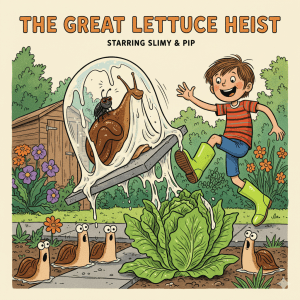
Slimy’s ambition far exceeded his speed, or his girth. His dream was to cross the unforgiving expanse of Mrs. Higgins’s back garden to reach The Sacred Head of Romaine, a prize of such size and crispness it was practically a monument.
The year was 1968, the height of summer, and Slimy had a plan. He wasn’t going to crawl. Crawing was for amateurs.
He was going to surf.
His partner in crime was Pip, a beetle whose main function in life was complaining.
“I still don’t understand why we’re doing this during the hottest part of the day,” Pip muttered, clinging precariously to Slimy’s shell-less back.
“Silence, Pip!” Slimy yelled, his eyestalks twitching with maniacal focus. “The sun bakes my trail! It creates a slick, semi-solid layer of… of pure velocity!”
In reality, the heat was just evaporating the water in his mucus, leaving behind a sticky, awful film.
Slimy pushed off from the edge of the shed, aiming for the first patch of damp shade fifty feet away. Immediately, his undercarriage seized up. He wasn’t sliding; he was sticking. Every micro-millimeter of progress was achieved through pure, agonizing abdominal contraction, a motion less like surfing and more like peeling a sticker off a varnished tabletop.
“Velocity, you said,” Pip wheezed, adjusting his tiny sunglasses. “I believe the current rate of travel is approximately one Planck length per fortnight.”
Slimy ignored him. “I just need a better… launch!”
With a burst of desperation, Slimy secreted a volume of mucus that, had it been liquid, would have drowned Pip. The result was not speed, but a magnificent, sticky dome that enveloped them both. They slid three inches, then stopped dead, firmly glued to the concrete path.
The Unlikely Rescue
Just then, Kevin, a nine-year-old boy and resident Terror of the garden, came skipping out the back door, singing a song about “Groovy, Groovy Caterpillars.” Kevin was known for two things: an unnerving love of brightly coloured wellington boots, and an innate talent for accidentally stepping on invertebrates.
“Oh no, oh no, oh no,” Pip whispered, knowing their sticky situation meant a lack of escape options.
As Kevin’s neon green boot descended toward their mucus-prison, Slimy had a flash of inspiration. The glue!
He expanded the sticky dome, coating the bottom of the approaching boot just before impact. Kevin’s foot landed, missed Slimy by a hair, and then… stuck.
Kevin lifted his foot, and the entire surface layer of the concrete path, along with Slimy and Pip, came up with it. Slimy found himself traveling higher and faster than he ever had, clinging to the sole of the enormous boot.
“We’re airborne, Pip!” Slimy cried out, ecstatic. “We’re surfing the very winds of fate!”
“We are adhered to the sole of a rapidly moving, oversized rubber shoe!” Pip screamed back.
Kevin, oblivious, took a giant, stomping step right over the prize.
THWUMP!
Slimy, Pip, and the sticky patch of concrete landed squarely on top of The Sacred Head of Romaine.
The Victory
The impact shattered the lettuce, but left Slimy and Pip relatively unscathed. The surrounding slugs, who had spent the morning methodically nibbling the lower leaves, looked up in astonished, mucous-covered silence.
Slimy, covered in concrete dust and Romaine flakes, raised his eyestalks in triumph.
“See, Pip? Pure velocity!”
Pip merely shook his head, scraped himself off the sticky wreckage, and began eating the debris.
“Just call me King Slimy from now on,” Slimy declared.
“I’ll stick with Slimy,” Pip mumbled around a mouthful of lettuce, “but I’ll grant you this: you are the only slug in the county who has ever been rescued by his own failed adhesive technology.”
And that was the story of how Slimy, through utter incompetence and a staggering quantity of glue, successfully completed the greatest lettuce heist in garden history. Though, for the rest of his life, he was forced to peel himself off various surfaces using his tail.


















 The Crazymad Writer Writes Again