Happy Saint Patrick’s Day.

Have a good day.
Why wait for Christmas when you can have it every day,
Be it June or September, March, April or May.
The thing to remember is not the date or day,
But the feeling that goes behind it, so share it right away.
**********
Enjoy your time for living; enjoy your time on earth,
A time for celebration, a chance to spend in mirth,
Each day will go brightly as you strike out forth,
And all of this made possible because of the virgin birth.
**********
Why wait for Christmas when you can have it every day,
Be it June or September, March, April or May.
The thing to remember is not the date or day,
But the feeling that goes behind it, so share it right away.

The Whispering Woods were always a place of mystery, but none was as profound as the legend of the Whistling Moon. Old Man Tiber, his beard as white as winter snow, would spin tales by the crackling fire, his voice a low rumble. “They say,” he’d begin, “that when the moon hangs full and low, a melody drifts down from the heavens, a song of forgotten dreams and futures yet unwritten.”
Ríona (pronounced REE-uh-na), a young girl with eyes the color of the forest moss, listened intently to every word. She longed to hear the Whistling Moon, to feel its magic weave through her soul. One crisp autumn evening, as the moon, round and luminous, began its ascent, Ríona ventured out, leaving the warm glow of Tiber’s cottage behind.
The forest was alive with the hushed sounds of the night. Leaves rustled like whispered secrets, and the distant hoot of an owl echoed through the trees. Ríona walked deeper, her heart thrumming with anticipation. Finally, she reached a clearing she knew, a place where the ancient oaks formed a natural amphitheater, open to the vast, inky sky.
She settled on a bed of soft moss, gazing up at the celestial orb. It hung there, a pearlescent disc against the velvet black, seemingly larger and closer than ever before. A gentle breeze stirred, carrying with it a faint, ethereal sound. It was soft at first, like the sigh of the wind through reeds, then it grew, weaving intricate patterns of sound that seemed to dance in the air around her. It wasn’t a tune she recognized, yet it felt intimately familiar, a melody that resonated deep within her spirit.
The Whistling Moon’s song filled the clearing, a symphony of gentle hums and clear, pure notes. It spoke of journeys across starlit skies, of quiet moments of joy, and of the enduring beauty of the world. Ríona closed her eyes, letting the sound wash over her, feeling a sense of peace she had never known. When the last note faded, leaving only the quiet hum of the night, Ríona opened her eyes. The moon still shone, perhaps a little less brightly now, as if having poured its heart out in its song.
She returned to her cottage a changed girl. The Whistling Moon had not only sung to her, it had sung through her, leaving an echo of its magic in her heart. From that day on, Ríona carried a quiet knowing, a gentle wisdom that seemed to hum just beneath the surface. And sometimes, when the moon was full and bright, if you listened very carefully in the Whispering Woods, you could still hear a faint, beautiful melody, a reminder of the night the Whistling Moon sang its song to a curious young girl named Ríona.

Years had woven themselves into Ríona’s life since she first heard the moon’s song. She was no longer the wide-eyed girl, but a young woman whose presence brought a quiet stability to the village. Her eyes, still the color of forest moss, held the steady, unchanging rhythm she had learned.
Then came the year of the Silence.
It began on the night of the full Harvest Moon—the very night when the Whistling Moon always poured its melody down upon the earth. The sky was clear, the orb hung low and vast, yet no song came. Not a whisper, not a hum, only a dense, unnatural quiet. It was the absence of sound that felt louder than any storm.
The villagers stirred with immediate dread. Old Man Tiber, now frail and trembling, muttered, “The bond is broken. The moon has turned its face from us.”
And indeed, the earth seemed to follow. Within a week, the apples on the high branches shriveled. The spring-fed stream, usually a rushing source of life, shrank to a sluggish trickle. Fear, cold and sharp, replaced the harmony Ríona had helped maintain. The villagers, desperate, looked to her, but their eyes held a new doubt. Was her wisdom a blessing, or had she somehow angered the celestial muse?
Ríona felt the silence deepest of all. It was not just outside; it was within her, a hollow echo where the moon’s rhythm once resonated. Her inner compass was spinning wildly. She knew then that her quiet knowing was not about hearing the song, but about understanding the silence.
She dressed in her plainest cloak and carried only a simple wooden staff. She knew she couldn’t wait for the sound to return; she had to find out where it had gone. She walked past the borders of the village and plunged into the deepest part of the Whispering Woods, a region known as the Gloomwood, where the trees grew so thick the sun rarely touched the ground.
The air here was heavy, almost resistant. After walking for hours, she came to a small, hidden pool. It was not stagnant, but its surface was eerily still, perfectly reflecting the massive moon above.
She looked up at the moon, then down at its mirrored image in the water. The lunar light felt cold, detached.
“Why the silence?” Ríona whispered, the sound absorbed instantly by the heavy air. “What have we forgotten this time?”
She knelt by the pool and noticed something odd. Beneath the reflected moon, at the very bottom of the pool, was a clump of dark, fibrous roots. They were not water plants; they looked like the aggressive, choking roots of the Gloomwood trees, seeking out the deepest water source. They had woven themselves into a dense, interlocking net, covering a small, smooth stone.
Ríona reached into the icy water and slowly, carefully, began to pull the roots away. They resisted her, slick and strong. She pulled and tugged, remembering the moon’s lesson: patience. She did not rip or tear, but worked them loose, strand by strand, until they finally broke free.
The small, smooth stone was then revealed. It was a piece of pale quartz, naturally shaped like a crescent moon.
As soon as the last root was severed, the air around the pool shimmered. The surface of the water rippled violently, and the reflected moon seemed to breathe.
Suddenly, the silence was shattered. But it wasn’t the sweet, ethereal whistle of the moon above. It was a low, powerful hum, emanating from the little quartz stone in her hand.
Ríona realized the truth: The Whistling Moon did not just sing to the world; it needed the world to receive and amplify its song. The little quartz crescent, a tiny piece of the earth that mirrored the moon, was the community’s receiver. The selfish, tangled roots of the Gloomwood, seeking all the water for themselves, had choked its ability to sing.
As she held the stone, the soft, bright light returned to the stream, and a gentle breeze, carrying the faintest echo of the moon’s true whistle, began to stir the leaves. The bounty would return, for the harmony was found not in a grand song, but in clearing the things that silence the small, essential voices.
Ríona returned to the village, not with a triumphant shout, but with the quiet knowing restored. She did not preach or explain the roots. She simply placed the clean quartz crescent on a stone altar near the now-reviving stream.
That night, the Whistling Moon sang again. And the villagers, hearing the melody, didn’t just feel joy; they felt a sudden, collective understanding: their harmony with the natural world depended not on the grand gestures of the heavens, but on their own vigilance in protecting the small, sacred things that keep the connection alive.
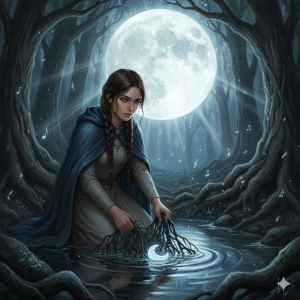

A lonely Irish field. An ancient stone table the locals dare not cross after dusk. And music—sweet, wordless, and terrible—drifting over the hedgerows at twilight.
When the TARDIS sets down near Haroldstown Dolmen in nineteenth-century County Carlow, the Doctor dismisses it as a simple megalith. But the parish books tell another story: of vanished boys and broken fiddle-bows left upon the stone; of a lady in green velvet singing the living down into silence. Investigating beneath the dolmen, the Doctor discovers a chamber of whispering figures—neither alive nor dead—while the song coils tighter around his companions.
What lies under the stone is no tomb—but a trap still feeding. To save Ian, Barbara and Susan from the music’s call, the Doctor must confront the intelligence that plays human souls like strings… before the last note falls.
Do you want to read more?
Click on the link – and enjoy.

Fle, an elf so ancient he remembered when the stars were new, had dedicated his incredibly long life to a singular, earthly purpose: fertilizer. For over 1,700 years, his world had been the quiet, luminescent depths of his subterranean mine. His greatest achievement was the “Black Gold”, a powerful, slow-release compost brewed from a secret recipe of volcanic ash, enchanted mushroom spores, and the finest river silt. It was his masterpiece, stored in dozens of perfectly stacked bags.
One morning, the serene hum of his mine was replaced by a jarring, hollow silence. A large, clumsy wheelbarrow track led from the mine’s entrance, and the tell-tale scent of stolen goods hung in the air. A quick count confirmed the damage: twenty-three bags of his precious Black Gold were gone. Fle’s fury was a cold, quiet thing, a force that had been dormant for centuries.
Cursing in a dialect older than the mountains themselves, Fle dusted off his tracking cloak and followed the trail. The thief, a human, was leaving a trail of astonishing carelessness—a dropped coin, a ripped piece of burlap, and the occasional, rogue sprig of basil from the surface world. Fle expected a short pursuit, but the thief was surprisingly cunning, ducking through thickets and wading through streams to break the trail. This wasn’t a simple robbery; it was a determined escape.
The chase stretched across leagues, a game of cat-and-mouse between ancient wisdom and youthful desperation. Fle, unused to the chaos of the overworld, was bewildered by its noise and frantic pace. He navigated bustling market towns and sprawling farms, his frustration mounting. Finally, by the light of a pale moon, he cornered the thief in a field of withered, black stalks.
The thief, a young woman named Elara, was collapsed beside a makeshift cart. Her face was smudged with dirt and streaked with tears. Fle saw not defiance in her eyes, but a profound, bone-deep sorrow. “It was the only thing I could do,” she whispered, her voice raw. “The blight… it took everything. I just needed enough to save what’s left.”
Fle’s anger faltered. He saw the truth in her eyes. Her village was starving, and she, a thief driven by love, had taken the only thing that could save them. He looked at the twenty-three bags of Black Gold, now scattered around the barren field. The fertilizer’s magic was already weakening, its slow-release potency starting to leak into the polluted soil.
With a heavy sigh, Fle made a decision that astonished even himself. “The fertilizer is worthless to you now,” he said, his voice softer than she expected. “You handled it incorrectly. But… I can show you how to use it. And you can work to pay your debt.” He pointed at a few stalks that had resisted the blight. “I will teach you to tend the earth, but in return, you will help me tend my mine. From this day forward, you will be my apprentice.”
Elara’s tears flowed freely, not from sadness, but from overwhelming relief. Her gaze met the old elf’s, and for the first time, she saw not a terrifying creature of legend, but an unexpected, and incredibly grumpy, ally. Fle, for his part, looked at the ruined field and felt a twinge of something new: a purpose beyond his mine, a responsibility to a world he had long since left behind.
Want to read more?
Click on the link, below, and enjoy.


The Crazymad Writer, that’s me, you see,
A brain in chaos, a wild decree.
My thoughts, a whirlwind, a tangled yarn,
A literary tempest in a barn.
The words they tumble, they leap, they fly,
A frantic stampede beneath the sky.
A comma here, a semi-colon there,
A frantic dance on the brink of despair.
I write of dragons with spectacles perched,
Of teacups singing, for them I’ve searched.
Of socks that vanish, a mystery grand,
Of polka-dot elephants in the land.
Why do I do it? The mad, mad scrawl?
It’s either that, or climb the wall!
The stories bubble, they must break free,
Lest I become a footnote in history.
So forgive the frenzy, the ink-stained hand,
The logic lost on this scribbling land.
It’s not a choice, it’s a desperate need,
To plant this crazy, literary seed.


She sits by the window, pipe in her hand,
A curl of blue smoke like a silken strand.
The weather may bluster, the winds may bite,
But her old clay pipe is her one delight.
“A hundred,” she says, “and not a cough,
Still climb the stairs, still shake the frost off.
They warned me once—oh, they tried in vain—
But this little pipe keeps off the pain.”
She puffs with pride, her eyes aglow,
Recalling winters full of snow.
“When the frost would nip and the fire ran low,
This pipe would set my cheeks aglow.”
“And come the summer, sweltering heat,
When stockings stick to swollen feet—
A puff or two beneath the tree,
And suddenly I’m cool as can be.”
She taps the bowl, a rhythmic beat,
Her slippers scuff the ancient seat.
“They sell their lotions, teas, and pills—
I’ve only this and strong old will.”
“Doctors tut, and children frown,
But I’ve outlived half the town!
They’ll see me walking, cane in hand—
While they queue up for rubber bands.”
So puff she does, and smiles so wide,
The years have not slowed down her stride.
“Smoke?” she says, “Oh yes, I do—
And I’ll smoke ’til I’m a hundred and two!”
For warmth or chill, for joy or strife,
She’s smoked that pipe her entire life.
A tale of age, of stubborn cheer—
And a pipe that’s outlasted every year.


Once upon a time, there lived a troll called Garlic. He was not a happy troll; in fact, he was the most dejected troll you could have the misfortune of meeting. How could he have been happy, when he had what he believed was the worst name in the entire troll world? Read this story and see what happened to him.
Click on the link below to download this free eBook – and enjoy.



 The Crazymad Writer Writes Again