RSS

Tag Archives: ballykillduff

A Ballykillduff Extermination (Of the Blues)

A Ballykillduff Extermination (Of the Blues)

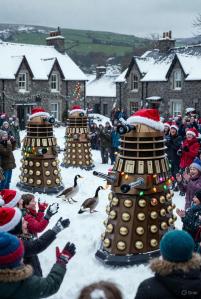
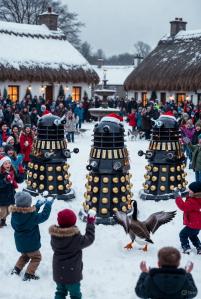
Deep in the heart of Ballykillduff, where the tea is strong and the Daleks have replaced their death rays with tinsel, comes a festive greeting just for you.

A Ballykillduff Extermination (Of the Blues)

“Listen here now, humans of the parish! It is I, Dalek O’Shea, and I have a formal announcement before the Angelus rings.

We have scanned the perimeter of the creamery and found no trace of bad luck. Therefore, by order of the Supreme Council (and Father Murphy), you are all sentenced to a Grand Ould Time.


The Festive Mandate

  • EXTERMINATE the dry turkey!
  • CELEBRATE with a decent drop of Jameson!
  • REGENERATE after the third helping of pudding!
  • INFILTRATE the neighbor’s house for a quick gossip and a mince pie!

“You will sit by the fire. You will watch the Late Late Show. You will enjoy yourselves… OR BE EXTERMINATED! (But only after we finish this plate of sandwiches.)”


The Wish

May your chimney be wide enough for a Dalek in a Santa hat, may your cows stay milked, and may your Christmas be more powerful than a Sub-Etheric Transmitter.

Nollaig Shona Duit—EXTERMINATE! EXTERMINATE! EXTERMINATE!


Tags: , , , ,

Alice and the Places That Think: Ballykillduff Wonderland

Alice and the Places That Think: Ballykillduff Wonderland

Prologue

Alice decided later that the most troubling part was not the sheep.

The sheep was troubling, certainly. It stood in the middle of the lane with the quiet confidence of something that knew it had always been there and always would be. Its wool was the colour of old clouds, its eyes were thoughtful, and around its neck hung a small wooden sign that read:

BACK SOON

Alice read it twice.

“I don’t think that’s how sheep work,” she said politely.

The sheep regarded her in silence, chewing in a manner that suggested deep consideration of the matter. Then it turned, quite deliberately, and began to walk away down the lane.

“Excuse me,” Alice called. “I think you’ve dropped your…”

The sheep did not stop.

Alice hesitated. She had been taught very firmly never to follow strange animals, especially those displaying written notices. But the lane itself seemed to lean after the sheep, curving gently, as if it preferred that direction. Even the hedges appeared to listen.

With a sigh that felt far older than she was, Alice followed.

The lane led her into Ballykillduff.

At least, that was what the sign said. It stood crookedly at the edge of the village, its letters faded and patched over, as though someone had changed their mind halfway through spelling it. Beneath the name, in much smaller writing, was a second line:

Population: Yes

Alice frowned.

The village looked entirely ordinary, which in her experience was often a bad sign. Stone cottages huddled together as if exchanging secrets. A postbox leaned sideways in what might have been exhaustion. Somewhere, a clock was ticking very loudly and very wrongly.

The sheep paused beside the postbox.

It did not look back. It did not need to.

The postbox cleared its throat.

“Letter?” it asked.

Alice jumped.

“I—no,” she said. “I mean, not yet.”

“Take your time,” said the postbox kindly. “We’ve plenty of it. Too much, if you ask me. It keeps piling up.”

The sheep nodded.

“I’m sorry,” Alice said carefully, “but could you tell me where I am?”

The postbox considered this. “Well now,” it said, “that depends. Where do you think you ought to be?”

“I don’t know,” Alice admitted.

“Ah,” said the postbox, sounding relieved. “Then you’re exactly right.”

The sheep turned at last and met Alice’s eyes. For a moment she had the strange feeling that it recognised her.

Then the ground beneath her boots gave a polite little sigh and began to sink.

Alice did not scream. She had learned by now that screaming rarely helped.

Instead, as Ballykillduff folded itself carefully over her like a story closing its covers, she wondered whether anyone at home would notice she was gone.

The sheep watched until she vanished completely.

Then it picked up its sign, turned it around, and hung it back around its neck.

BACK AGAIN.


Chapter One

In Which Alice Arrives Properly, Though Not Entirely on Purpose

Alice discovered that falling into Ballykillduff was not at all like falling into a hole.

There was no rushing wind, no spinning cupboards, no floating bookshelves or jars of marmalade. Instead, there was the distinct sensation of being lowered, as though the ground itself were doing its best to be polite about the whole affair.

The earth sighed again, thoughtfully, and then stopped.

Alice found herself standing upright on a narrow stone path, her boots perfectly clean, her hair only slightly rumpled, and her sense of direction completely missing.

Above her was a sky that could not quite decide what time it was. Clouds hovered in pale layers, some tinged with early morning pink, others sulking in late afternoon grey. A sun of modest ambition shone through the middle, as if unwilling to commit itself fully.

Ahead lay Ballykillduff.

Up close, it was even more ordinary than before. That, Alice felt, was the problem.

A row of cottages leaned together in a way that suggested ongoing conversation. Their windows blinked slowly, like eyes that had just woken up. Smoke curled from chimneys without any particular urgency, drifting sideways and then upwards as though reconsidering.

Alice took one careful step forward.

Nothing happened.

She took another.

Still nothing.

“Well,” she said to herself, “that is either very reassuring or extremely suspicious.”

A man appeared from nowhere in particular, which is to say he stepped out from behind a low stone wall that Alice was quite certain had not been there a moment earlier.

He was tall, thin, and wrapped in a long coat that had known many weathers and disagreed with all of them. In his hand he carried a pocket watch, which he examined with great seriousness.

He did not look at Alice.

“Oh dear,” he muttered. “Not yet. Definitely not yet.”

“Excuse me,” Alice said.

The man startled so badly that he nearly dropped the watch, which he caught just in time and then scolded.

“You shouldn’t do that,” he said to Alice. “Appearing suddenly.”

“I didn’t,” Alice replied. “You did.”

He considered this.

“Well,” he said at last, “we’ll call it a draw.”

He finally looked at her, his eyes sharp and kind and far too alert for someone who seemed permanently behind schedule.

“You’re early,” he said.

“Am I?” Alice asked.

“Oh yes,” he said firmly. “Or late. One of the two. We get very upset if people arrive exactly when they mean to.”

“What is your name?” Alice asked.

“Seamus Fitzgerald,” he said, consulting his watch again. “At least, that’s what it says here. And you are Alice.”

Alice blinked. “How do you know that?”

Seamus smiled apologetically. “You’ve been expected.”

“I have only just arrived,” Alice said.

“Yes,” Seamus agreed. “That’s what I mean.”

Before Alice could ask anything else, a bell rang.

It was not a loud bell, nor an urgent one. It sounded as though it had rung many times before and had learned not to get worked up about it.

Seamus gasped.

“Oh dear,” he said. “That will be Bridget.”

“Who is Bridget?” Alice asked.

Seamus was already walking away.

“You’ll see,” he said over his shoulder. “Everybody does.”

Alice followed him into the village.

As she did, she noticed that the houses were watching her now, not rudely, but with the quiet interest one might show a guest who had arrived without luggage and clearly intended to stay.

Somewhere behind her, the sheep coughed.

Alice did not turn around.

She had a feeling that once you began turning around in Ballykillduff, you might never stop.

And that, she suspected, was how the village liked it.

To read the rest of this story, click HERE – and enjoy


Tags: , , ,

When the President of Ireland met the Ballykillduff Daleks

When the President of Ireland met the Ballykillduff Daleks

When the President of Ireland met the Ballykillduff Daleks

The presidential motorcade, usually a beacon of solemnity, was currently attempting a precarious three-point turn in a field that smelled distinctly of prize-winning Kerry cows. Inside, President McMurrow, a man whose silver hair and kindly eyes belied a mischievous wit, chuckled. “Remind me again, Fiona,” he addressed his chief of staff, “why we bypassed the usual diplomatic channels for a direct engagement with… the Ballykillduff Daleks?”

Fiona, a woman who had seen it all – from rogue shamrock presentations to international incidents involving a missing Taoiseach and a particularly enthusiastic hurling team – sighed. “Because, Mr. President, their ‘Exterminate All Humans’ manifesto was getting an alarming amount of traction on TikTok, and Fine Gael were starting to panic about the youth vote.”

Just then, a shrill, metallic voice screeched from beyond the hawthorn hedge. “EXTERNAL-LIN-GUISH! EX-TER-NAL-LIN-GUISH THE GRAZING MENACE!”

“Ah,” President McMurrow adjusted his tie, a subtle nod to the seriousness of the occasion. “Sounds like our welcoming committee.”

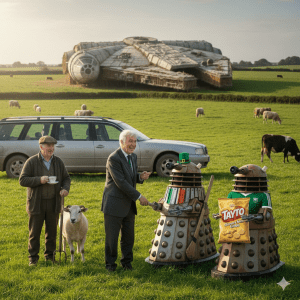
They emerged to a truly surreal sight. Five Daleks, unmistakably Daleks, but with a distinct Ballykillduff charm. One had a tricolour painted rather crudely on its side. Another wore a tiny, ill-fitting leprechaun hat. The leader, a particularly rusty specimen, had what looked suspiciously like a hurley stick strapped to its casing.

“GREET-INGS, FLESH-BAG!” screeched the hurley-wielding Dalek. “WE ARE THE DA-LEKS OF BALLY-KILL-DUFF! PRE-PARE TO BE… ENTER-TAINED!”

President McMurrow raised an eyebrow. “Entertained, you say? Not exterminated?”

“EX-TER-MIN-ATE IS SO… LAST SEA-SON,” replied another Dalek, its eye-stalk swivelling to glare at a sheep that had dared to bleat nearby. “WE HAVE DE-CID-ED TO EM-BRACE LO-CAL CUL-TURE!”

It turned out their TikTok fame had come from their surprisingly viral Riverdance routine. “WE HAVE MOD-I-FIED OUR PLUN-GERS FOR PER-CUSS-IVE DANC-ING!” explained the Dalek with the leprechaun hat. “WOULD YOU LIKE A DEM-ON-STRA-TION, MR. PRES-I-DENT?”

Before McMurrow could answer, a local farmer, Seamus O’Malley, ambled over, scratching his head. “Are these the fellas who keep rearrangin’ my hay bales into the shape of the Millennium Falcon?”

The Daleks froze. “NEG-A-TIVE! THAT IS A SLAN-DER-OUS AC-CU-SA-TION!”

“Oh, come off it,” Seamus scoffed. “My prize-winning ram, Brendan, saw you! Said you were humming the Star Wars theme tune!”

President McMurrow, struggling to suppress a laugh, intervened. “Gentlemen, perhaps we could discuss your, ah, ‘cultural integration’ over a cup of tea? I believe Fiona has brought some Tayto.”

The word ‘Tayto’ seemed to short-circuit the Daleks. “POT-AT-O BASED SNACK PROD-UCT? EX-PLAIN! EX-PLAIN!”

Hours later, the presidential motorcade departed, leaving behind a scene of utter bewilderment and joy. The Ballykillduff Daleks were now sporting tiny GAA jerseys, had learned to play a passable bodhrán rhythm with their plungers, and were eagerly discussing the merits of cheese and onion crisps versus salt and vinegar.

 
Leave a comment

Posted by on December 15, 2025 in daleks, Ireland, president


Tags: , , , ,

The Twelve Dalek Days of Christmas

The Twelve Dalek Days of Christmas

The Daleks of Ballykillduff and the Twelve Days of Absolutely Catastrophic Christmas

Ballykillduff was gearing up for its usual festive carnage when the three Daleks (Zeg, Zog, and Zag) decided Christmas was a strategic weakness ripe for conquest. They were wrong. Spectacularly, hilariously, catastrophically wrong.

Day 1 – A Partridge in a Pear Tree Zeg declared himself the new Lord of Christmas and tried to occupy the village pear tree. The tree had ideas. One gust of wind and Zeg shot out like a metallic cannonball, landing upside-down in Mrs Mulgrew’s prize-winning compost heap. “EXTERMINATE THE COMPOST!” he shrieked, muffled by six feet of rotting cabbage. Mrs Mulgrew charged out in hair curlers, brandishing a broom. “You’ll be compost yourself, ya pepper-pot gobshite!” Zeg spent the rest of the day being hosed down by the fire brigade while the entire village filmed it for TikTok.

Day 2 – Two Turtle Doves Zog kidnapped the doves to interrogate them about “avian loyalty.” The doves shat on his dome in perfect unison, then flew off with his eyestalk cover. He chased them screaming “RETURN MY OPTIC!” straight into the duck pond. Ducks 3 – Three French Hens** The hens belonged to Sister Bernadette. They were ninja hens. Zog is still convinced they were cyber-converted. He has PTSD and flinches every time someone says “coq au vin.”

Day 4 – Four Calling Birds Zag tried to weaponising them with tiny Dalek voice modulators. The birds learned one phrase: “ZAG IS A SPAWNFACE.” They followed him everywhere for a week, screeching it at 140 decibels. He now sleeps with industrial earmuffs.

Day 5 – FIVE GOOOOLD RIIIINGS Zeg stole the five gold rings from the jeweller and tried to wear them like Olympic medals. They got stuck on his plunger. The fire brigade had to come back. Again. The chief now has a special “Dalek wedged in something stupid” incident code.

Day 6 – Six Geese a-Laying The geese took one look at three rolling dustbins shouting “EXTERMINATE” and decided it was go-time. Live-streamed goose chase lasted twenty-three glorious minutes. Final score: Geese 47, Daleks 0. Zeg’s dignity is still missing, presumed pecked to death.

Day 7 – Seven Swans a-Swimming The swans were rented from a posh estate for the crib scene. Daleks attempted a synchronized swimming takeover. Swans formed a V-formation and torpedoed them like feathery missiles. Zog was last seen doing 360-degree spins in the fountain yelling “WHY IS EVERY BIRD IN IRELAND EVIL?”

Day 8 – Eight Maids a-Milking The maids were actually eight burly farmers’ daughters who’d had three pints each at the pub. They mistook the Daleks for novelty kegs, flipped them upside down, and tried to “tap” them. Milk stout was not improved by Dalek hydraulic fluid.

Day 9 – Nine Ladies Dancing Céilí night. The Daleks stormed the hall demanding everyone riverdance in perfect Dalek formation. The band struck up “The Siege of Ennis” at double speed. The floor had been waxed with Murphy’s Homemade Furniture Polish (90% butter). All three Daleks achieved low-orbit skids, ricocheted off the walls like pinballs, and took out the Christmas tree, the buffet table, Father Murphy, and the life-size Baby Jesus in one glorious crash. The village gave them a standing ovation and voted it “Best Nativity Ever.”

Day 10 – Ten Lords a-Leaping The lords were the Ballykillduff under-12 hurling team in panto costumes. They used the Daleks as goalposts. Zag still has a hurley stuck through his grille.

Day 11 – Eleven Pipers Piping The pipe band marched straight at them playing “Garryowen” at full volume. Zeg’s audio circuits overloaded; he started speaking only in bagpipe noises for six hours. “SKRL-SKRL-SKREEEEE—EXTERMINATE—SKRL!”

Day 12 – Twelve Drummers Drumming Christmas Eve. The Daleks, battered, leaking, one still wearing a goose feathers like a Hawaiian skirt, rolled to the top of the hill for one last stand. Zeg raised his gunstick: “On the twelfth day of Christmas the Daleks give to you… TOTAL OBLITERATION!” Snow started falling. The village kids pelted them with snowballs. One perfect snowball hit Zeg’s power cell. He short-circuited, lights flashing like a disco, and began singing “Jingle Bells” in a helium voice. Zog and Zag joined in, completely against their will. The entire village gathered, phones out, singing along while three mortified Daleks performed an involuntary Christmas concert on the hillside.

Midnight struck. Church bells rang. Even the geese shut up for a minute.

Zeg’s eyestalk drooped. “Temporary… ceasefire. For tactical reasons.” Someone stuck a Santa hat on him. Someone else tied tinsel round Zog’s plunger. Zag got a sprig of mistletoe wedged in his gun barrel and spent the rest of the night accidentally kissing pensioners.

Mad Jimmy McGroggan raised his pint from the pub doorway and roared: “Merry Christmas, ya glorified teapots!”

And from the top of the hill came three metallic voices, small and very, very embarrassed:

“MER-RY CHRIST-MAS… TO YOU… FILTHY HU-MANS.”

Then, quieter: “…and don’t tell the Supreme Dalek.”

Best Christmas Ballykillduff ever had. The geese are already booked for next year.

 
Leave a comment

Posted by on December 8, 2025 in ballykillduff, carlow, dalek, daleks


Tags: , ,

THE BALLYKILLDUFF DALEKS SAVE CHRISTMAS

A Festive Tale


CHAPTER ONE

Snow on Ballykillduff Hill

Ballykillduff was not known for dramatic weather. Rain was expected. Mists drifted in like gossip and no one questioned them.
Snow, however, did not fall in this part of Carlow. Not ever.

Which was why the villagers stared at the sky on Christmas Eve as soft flakes began to drift down with the elegance of ballet dancers who had taken a wrong turn.

Jimmy McGroggan burst out of his shed and threw his arms wide.

“I told you so,” he shouted. “The Weather Encourager Three Thousand works at last. I have finally persuaded the heavens to behave.”

Before he could continue bragging, three Daleks came sliding down Ballykillduff Hill.
“Slipping,” cried Zeg. “This terrain is treacherous.”
“My lower section is freezing,” shouted Zog.
“The ground is attempting to exterminate us,” howled Zag.

They crashed together in a perfect metallic heap inside Jimmy’s gooseberry bushes.
Jimmy sighed in a way that suggested he was used to this sort of thing.

Click HERE to continue reading this story.


Tags: , , , , , ,

The Ballykillduff Banger

The Ballykillduff Banger

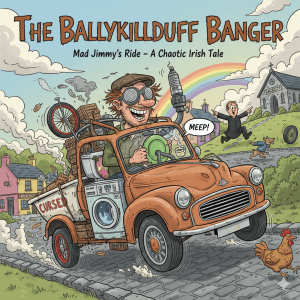
The Ballykillduff Banger (A Ballad of Mad Jimmy) 

(Verse 1) In Ballykillduff, where the grass is so green, Lived a man named Jimmy McGroggan, the wildest ever seen! They called him “Mad Jimmy”, but not for bad grace, He once tried to heat up the entire whole place! With a kettle and toaster, and a spring from a peg, He wasn’t quite right from the waist to the leg! He was just inventive, you see, a mechanical nut, Like a squirrel who stores nuts in a lawnmower’s gut!

(Chorus) Oh, the Ballykillduff Banger, a sight for sore eyes, A chariot of junk, underneath Irish skies! A mobile compost heap and a Transformer blue, Mad Jimmy’s creation, for me and for you! It’s got a wee wobble, it’s got a small cough, But when he got going, the wheel just fell off!

(Verse 2) Jimmy had a dream, not of riches or fame, But to drive a fine motor and utter its name! Now, banks made him sneeze and the law made him frown, So he built his own car from the junk of the town! The lads in the pub put their money down fast, They bet his poor shed wouldn’t properly last. His garden, a scrapyard, a magpie’s delight, With half a fridge, a pram, and a bathtub painted: “CURSED! DO NOT SIT TIGHT!”

(Verse 3) The chassis was bunk beds, all twisted and old, The engine from a lawnmower, the tale must be told! Four wheels he found, two from a trolley so bright, One from a wheelie bin, one from a unicycle‘s might! The steering wheel? Ah, a dinner plate grand, Glued fast to the shaft of a Dyson in hand! The horn was a bicycle bell, gave a “meep” when it cared, And the seat was a toilet with a cushion prepared!

(Chorus) Oh, the Ballykillduff Banger, a sight for sore eyes, A chariot of junk, underneath Irish skies! A mobile compost heap and a Transformer blue, Mad Jimmy’s creation, for me and for you! It’s got a wee wobble, it’s got a small cough, But when he got going, the wheel just fell off!

(Bridge) Sunday morning arrived, the townsfolk all near, Father Dunne kept his distance, quite sheltered by fear! Jimmy put on his goggles (a sieve with some film), The engine went “brrrrrrr” like a goat in a chill! He shot down the hill, then he spun to the side, Right into the hen house where Seamus’s chickens reside! Jimmy popped out the hole, with a feather on top, “She handles like a dream! Full of terror and POP!”

(Verse 4) They made a repair, added the bathtub as a seat, A microwave door for the glass, isn’t that neat? He tried one more time, on a hill stiff and steep, He made it just seven feet, then fell fast asleep! ‘Cause the wheel took a runner and flew down the slope, Chased by a child, a dog, and Father Dunne shouting: “NOPE! It’s heading for the Sacristy, oh dear, dear, dear!”

(Outro) Now the Banger is parked, an exhibit for sure, Tourists take selfies beside the front door. But Jimmy sits in it each Friday at dark, Sippin’ tea from a spark plug, just having a lark! Hands on the dinner plate, engine noises he’ll make, “Best car that I owned!” for goodness’ sweet sake! And smoke rises gently from somewhere amiss, But nobody tells him, they just nod and they kiss! Ah, nobody tells him otherwise!


Tags: , , , , , , ,

The Ringmaster’s Chant

The Ringmaster’s Chant

**🎩 The Ringmaster’s Chant

(Spoken, low and hypnotic)**

“Ladies… gentlemen… wanderers in the dusk…
Lean closer now.
Don’t worry—
the shadows lean closer too.

In this tent of trembling light,
names slip,
faces shift,
and truths grow thin as moth-wings.

Repeat after me—
silently,
inside your obedient little minds:

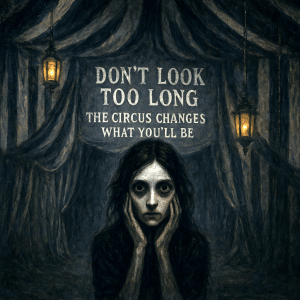
Look not too long…
Look not too deep…
The circus wakes what should not wake from sleep…

For here, under the pearl and black,
the mirrors do not show you—
they show
what you fear you are becoming.

Listen…
Do you hear the canvas breathing?
Do you feel the ground remembering your steps?
Good.
It means the circus has seen you.

Now hush.
The show begins when the tent blinks.
And if it keeps its eyes open…
you may yet walk out
the same shape
as you walked in.”


Tags: , , , , ,

The Circus of Grotesques: It Will Change Your Life Forever.

The Circus of Grotesques: It Will Change Your Life Forever.

Chapter One

The Posters Arrive Out of Nowhere

On the morning it began, Ballykillduff woke up to an extra silence.

It wasn’t the usual sort of quiet you get before the rain, or the muffled hush after a good snowfall. This was a listening sort of silence, as if the whole village were holding its breath and waiting for something it couldn’t quite remember ordering.

The first to notice anything odd was a sheep.

She was an elderly ewe with a permanently offended expression and a tendency to wander off, which is exactly what she was doing—stomping along the lane toward the bridge, muttering in a sheepish sort of way—when a sudden gust of wind slapped a sheet of paper against her woolly flank.

The paper stuck there, fluttering like a strange rectangular tail.

The sheep stopped, blinked slowly, and decided—fairly—that this was one indignity too many. She shook herself. The paper refused to budge.

So Ballykillduff began its day with one very grumpy sheep trotting around the village green wearing an enormous poster as a cape.

No one questioned this at first. Ballykillduff was that kind of place.


Bridget O’Toole noticed the posters second.

She came out of McGroggan’s shop with a bag of flour in one hand and a packet of teabags in the other, intending to head straight home and not talk to anyone if she could possibly help it. That was her usual morning plan, and it rarely worked.

Today it didn’t even survive the pavement.

She stopped dead on the step, the way you do when something is so out of place that your brain needs a moment to catch up.

The noticeboard outside the shop was usually a patchwork of ordinary life: lost dogs, second-hand bikes, offers to teach the tin whistle, the eternal yellowing flyer for “Yoga with Maureen (Beginner Friendly, Bring Your Own Mat!).”

Today, every single scrap of paper was gone.

Instead, the whole board was covered edge to edge by one vast poster, so fresh the corners still curled.

It was printed in deep inky black and a strange, shimmering pearl that seemed to move when she looked at it. Not like glitter, which twinkled and sparkled and showed off, but like the inside of a seashell, where colours slid shyly from one to another.

In the centre, in letters that looked almost hand-drawn and yet impossibly perfect, were the words:


CIRCUS OF THE GROTESQUES

It Will Change Your Life Forever


Bridget read it twice, then a third time just to be sure it still said the same thing.

“Grotesques,” she murmured under her breath. “That doesn’t sound very nice at all.”

“Depends what you mean by nice,” said a voice behind her.

She jumped and spun around, slopping a little flour onto the step.

Jimmy McGroggan stood there, hands in his pockets, hair doing its usual impression of a startled hedgehog. He peered at the poster over her shoulder, squinting.

“If I’d made that,” he declared, “I’d have used better paper.”

“Did you make it?” Bridget demanded.

Jimmy looked genuinely offended. “Bridget O’Toole, if I were going to plaster the village with something, I’d sign my name at the bottom and probably add a small diagram. No, this isn’t mine. The ink’s wrong. Smell it.”

“I’m not smelling a poster,” Bridget said crisply.

Jimmy leaned closer anyway and inhaled. “Huh. Thought so.”

“What?”

“Smells like the page of a book you haven’t opened yet,” he said. “And just a bit like matches. Interesting.”

Before Bridget could decide what sort of reply that deserved, a small boy barrelled between them and slammed to a halt in front of the board.

“Whoa,” breathed Patrick Byrne. “Did you see the sheep?”

“What about the sheep?” asked Bridget.

“She’s wearing one of these things!” Patrick waved an arm at the poster, eyes wide. “Walked right past our gate like a circus queen. Nearly choked on my toast.”

“Then someone’s been busy,” Jimmy muttered. “This one here, and one on the sheep… I suppose the bridge lamppost has one too.”

He said it like a joke.

But when they turned to look, there it was: another poster wrapped neatly around the lamppost on the bridge, the pearl letters catching the weak morning sun.


By ten o’clock, everybody knew.

The posters had not appeared in ones and twos, the way normal notices did. They had multiplied in the night like mushrooms after rain.

There was one on the door of The Giddy Goat pub, another tucked neatly inside the window of the tiny post office, one pinned to the fence outside the primary school (which the headmistress removed three times before giving up, because every time she walked away, another one very quietly took its place).

There was even a poster folded under the sugar bowl in Mrs Prendergast’s kitchen, which was especially impressive because Mrs Prendergast never let anything lie around in her kitchen without first interrogating it sternly.

She unfolded it with two fingers as if it might explode.

“Circus of the Grotesques,” she read aloud to her kettle. “It will change your life forever.”

The kettle, wisely, said nothing.

Mrs Prendergast sniffed. “Nothing good ever promises to change your life forever, unless it’s a winning lottery ticket or a decent pair of slippers.”

She turned the paper over, looking for a clue. There was no address, no phone number, no small print, no “terms and conditions apply.”

Just the same message, printed again in tiny lettering along the bottom edge. The pearl ink winked at her.

She crossed herself three times and put the poster on top of the bread bin, where she could keep an eye on it.
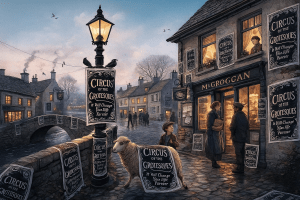

By half past eleven, Ballykillduff had achieved the rare and powerful state known as Total Gossip Saturation.

In McGroggan’s shop, people queued for bread they didn’t need and milk they already had, purely for the pleasure of discussing the matter at length.

“It’s a prank,” declared Seamus Fitzgerald, who was naturally nervous about everything and found comfort in deciding things were nothing to worry about. “Has to be. Someone from Tullow, probably. They think they’re very funny up there.”

“Tullow wouldn’t know a proper prank if it bit them,” said Jimmy. “And anyway, have you seen the paper? Feel that.”

He shoved a folded poster into Seamus’s hands. Seamus took it like it might be electrified.

“It’s just paper,” he said.

“Ah, but is it?” Jimmy grinned. “It’s like no paper I’ve ever seen. Flexible, but strong. Look—no crease marks. The ink doesn’t smudge. And smell it.”

“Why does everyone want me to smell things this morning?” Seamus muttered, but he leaned in all the same.

He sniffed once, hesitated, then sniffed again. “It smells… odd.”

“Like the inside of a magician’s sleeve,” Jimmy suggested.

“Like trouble,” Bridget put in from behind, placing a loaf and a packet of tea onto the counter. “We don’t need any kind of circus here, grotesque or otherwise.”

“What’s a grotesque?” asked Patrick from his place by the door. He had been hovering there for the best part of twenty minutes, listening to every word, and was now buzzing with an excitement nobody else seemed to share.

“A gargoyle that’s taken itself too seriously,” Jimmy said promptly.

Bridget rolled her eyes. “It means strange. Ugly, maybe. Twisted.”

Patrick considered this. “So… like Aunt Philomena’s hat.”

Despite herself, Bridget half-smiled. “Something like that.”

“Maybe it’s one of those fancy modern circuses,” Seamus ventured, clearly trying to talk himself out of being anxious. “You know the sort. People dangling from the ceiling with ribbons. Clowns that don’t wear proper noses. They call everything grotesque these days.”

“They do not,” said Bridget.

“Well,” said Seamus feebly, “they might.”

Jimmy tapped the poster. “Whoever they are, they’re good. No phone number, no website, no nothing. That means they’re confident.”

“Or careless,” said Bridget.

“Or magical,” said Patrick.

The adults ignored that, which only strengthened his belief.


At lunchtime, the older children escaped the primary school and poured into the lane like bottled-up marbles, spilling in all directions and converging, as marbles often do, on the most interesting thing nearby.

Which today was, of course, the posters.

“It will change your life forever,” Patrick read aloud for the fiftieth time as he and his friends clustered around the one on the school fence.

“That’s a big promise,” said Maeve Molloy, folding her arms. “What if I like my life the way it is?”

“It might change it for the better,” Patrick said. “Like, I could get taller. Or be able to do that football trick where the ball spins and curves around everyone and into the goal.”

“You can barely tie your laces,” Maeve reminded him.

“That’s because laces are a trap designed by adults,” Patrick said solemnly. “Besides, it’s a circus. There’ll be acrobats and lions and people swallowing fire.”

“Grotesques,” Maeve said pointedly. “Not lions.”

“Grotesque lions, then. Even better.”

Behind them, the sheep trotted past, still wearing her poster cape. Some of the younger children applauded. The sheep rolled one unamused eye and kept walking.

“Do you think it’s real?” Patrick asked, quieter now.

Maeve shrugged. “The posters are real.”

“No, I mean the bit about changing your life.” He ran a finger along the swirling letters. “You think a circus can do that?”

Maeve hesitated. Her parents had told her in no uncertain terms that it was advertising nonsense and she was not to go lurking near any strange tents that might appear.

But the words on the paper sent a fizzy little feeling up her arms all the same.

“It’s just a poster,” she said, a little too briskly. “Posters say all sorts of things. Anyway, where would a circus even go? The meadow by the bridge is too small. And Dad says the ground’s terrible.”

“Maybe they know a trick,” Patrick said. “Maybe it just… appears.”

Maeve rolled her eyes in a way that said, You’re ridiculous and I hope you’re right all at once.


By late afternoon, even the birds seemed to have joined in.

Crows perched along the telegraph wires like a line of scruffy punctuation marks, cawing their opinion of the matter to anyone who would listen. Starlings swooped and spiralled above the fields, patterns shifting as if trying to spell something no human eye could quite read.

The wind picked up, tugging at the posters, making them flicker and flap.

Every now and then, if the breeze caught them just right, a few words seemed to whisper loose and go floating across the village in snatches.

“Circus…”
“…grotesques…”
“…change your life…”

Bridget heard them while she hung washing on the line.

She paused, a damp shirt in her hands, and looked up. The sky was pale blue and ordinary. The fields were just fields. The washing just washing.

And yet.

She thought of the words on the noticeboard. It will change your life forever.

“I don’t want my life changed,” she told the pegged-up socks and small flapping ghosts of shirts. “I just want it… not to hurt so much.”

The shirts declined to comment. A poster on the opposite fence rippled, folded in on itself, and unfolded again, as if quietly breathing.

Bridget shivered and went back indoors.


By evening, Ballykillduff had made up its collective mind in the way small places often did: noisily, contradictorily, and all at once.

In The Giddy Goat, the regulars declared it a swindle, a wonder, a sign of the times, a sign of the end times, a ridiculous fuss about nothing, and definitely, definitely not as interesting as the bad winter of ’82 when the milk froze in the bottles and the cows had to be persuaded not to lie down and give up.

In the houses and cottages scattered along the lanes, people argued quietly over dinner. Parents told children they certainly would not be going to any circus that turned up unannounced like a stray dog. Children nodded and said of course not, and wondered which window would be easiest to climb out of.

Jimmy McGroggan stayed up late at his workbench, a poster pinned under the light, muttering to himself as he tested the ink with cotton buds and strange little devices of his own invention.

Mrs Prendergast moved her poster three times—to the bread bin, then the mantelpiece, then finally under her mattress, where she could feel its faint, pearly warmth through the sheets.

And in his small bedroom at the back of a narrow house with peeling paint, Patrick lay awake, staring at the ceiling.

He could just see the corner of the poster on his wall from his pillow. He had very carefully peeled one off the school fence on the way home and worn it under his jumper like a secret armour until he reached his room.

Now it hung opposite his bed, perfectly flat, as if the wall had been waiting for it.

“Circus of the Grotesques,” he whispered in the dark. “It will change your life forever.”

He tried the words out in different tones.

Excited.
Scared.
Suspicious.
Hopeful.

In the end, they always came out sounding the same: like a promise and a dare wrapped around each other.

“I wouldn’t mind a bit of changing,” he admitted to nobody.

The house creaked the way old houses do when they’re settling in for the night. A car went by on the lane, its headlights briefly licking at the poster’s surface. For the smallest moment, the pearl letters seemed to glow with their own inner light.

Patrick sat up.

“Hello?” he whispered, feeling rather foolish.

The poster did not reply in any way a sensible person would recognise.

But somewhere in the village, carried on a wind that didn’t belong to the weather, a handful of words drifted faintly through the open crack of his window—so faintly that he might almost have dreamed them:

Step inside the pearl-and-black…

Patrick caught his breath.

He scrambled out of bed and pushed his face to the glass, squinting out into the night.

The meadow by the bridge lay dark and empty. The lamppost stood straight and lonely. The old sheep was asleep somewhere, cape and all.

There was no tent. No lights. No circus.

Only the posters, shivering on their nails and fences and lampposts, quivering as if holding in a secret.

Patrick pressed his forehead to the cool pane.

“You’ll come,” he told the night. “I know you will.”

Far off, beyond the fields and hedges and the comforting boundaries of Ballykillduff, something heard him.

Something that travelled between villages like a rumour and between hearts like a song.

The wind shifted, just a little.

The posters all over Ballykillduff rustled at once, a soft papery sigh like an audience taking their seats.

In the morning, everyone would say the same thing:

The posters had been odd enough.

But the truly strange part—the part no one could explain, no matter how they argued—was this:

The next day, without a single person seeing so much as a rope, a peg, a wagon, or a man with a hammer, a great striped tent stood in the meadow by the bridge.

But that is for another chapter.

To be continued
Click HERE to continue reading this story

 
Leave a comment

Posted by on November 29, 2025 in ballykillduff, grotesques


Tags: , , , , , ,

Circus of the Grotesques

Circus of the Grotesques

Circus of the Grotesques (It Will Change Your Life Forever)

(A song for Doctor Vaude and the people of Ballykillduff)

[Verse 1]
The fog came down on Ballykillduff,
With posters on the wall,
And no one saw the tent go up,
But everyone heard the call.
A shimmer of pearl and shadow black,
A sign with a curious lore:
“Admission, one memory, no refunds—
But you’ll never be quite as before.”

[Chorus]
🎵 Step inside, dear dreamers, step inside and see,
The Circus of the Grotesques, where you trade what used to be.
Give us one small moment that your heart can spare,
We’ll change your life forever—if you’ve the mind to dare. 🎵

[Verse 2]
Madame Tallow of Wax and Whispers danced,
Her words like smoke and fire,
She told your truth before you knew,
And left your thoughts to tire.
The Gentleman Beast in velvet shame,
Spoke softly of his fall—
And every soul in Ballykillduff
Felt beast and man in all.

[Chorus]
🎵 Step inside, dear dreamers, step inside and see,
The Circus of the Grotesques, where your secrets come to be.
We’ll mend your pain and polish your despair,
We’ll change your life forever—if you’ve the mind to dare. 🎵

[Bridge 1]
Clockwork Twins ticked time away,
A minute each for tears,
The Librarian turned blank white pages
Filled with gentle years.
The Cook of Impossible Flavours smiled,
“Have a taste of who you were.”
And somewhere in the tent that night,
The stars began to stir.

[Verse 3]
Norah O’Dea with her toffee stick,
Raised her hand so small,
Said, “I’ll be brave, and I’ll be changed,”
Before them, one and all.
The ringmaster bowed, his smile too bright,
The tent bent close to hear,
And Ballykillduff held its breath—
Between wonderment and fear.

[Chorus — Slower, Lamenting]
🎵 Step inside, dear dreamers, pay the price of air,
One small memory traded, one truth laid bare.
You’ll leave a little lighter, you’ll walk a little strange,
For the Circus of the Grotesques has a gift called change. 🎵

[Bridge 2]
They called her name three times in love,
And once with iron will,
The black salt hissed, the lights went white,
And time stood faintly still.
Norah faced the ringmaster proud,
Her eyes as bright as glass—
She said, “Let’s play a riddle’s game,
To see what comes to pass.”

[Verse 4]
“What grows lighter shared, yet heavy kept?”
The ringmaster asked the air.
Norah smiled, “A story told—
It lives when it’s laid bare.”
Her riddle came like April rain,
“The cost of kind undone?”
He sighed, “A knot within the dark—
Until it’s all unspun.”

[Final Chorus — Triumphant, Soft Echo]
🎵 Step inside, dear dreamers, step inside and see,
The Circus of the Grotesques set your memory free.
What you lose will find you, though it may rearrange,
No refunds ever needed—only change. 🎵

[Outro — Spoken softly, as if by Doctor Vaude]
“Forever,” we promised. “Change,” we gave.
Both are true, and both behave.
So mind your steps, remember the fair,
The tent is gone—but the air is there.

🎵 No refunds… plenty of change. 🎵


Tags: , , , , ,

Circus of the Grotesques

Circus of the Grotesques

Circus of the Grotesques

It Will Change Your Life Forever

The poster arrived in Ballykillduff the way fog arrives on the bog road, quietly and all at once. It was there on the noticeboard outside the shop, on the lamppost by the bridge, tucked under pint glasses in The Giddy Goat. It even rode the back of a wandering sheep for a morning, the poor ewe plodding around with CIRCUS OF THE GROTESQUES flapping off her wool like a royal cape.

People said it was a prank of Jimmy McGroggan’s, or a stunt for the fête. Jimmy swore on his mother’s bottle-green statue of St. Jude that it was no such thing. “I would have used better paper,” he said, affronted. “And I would have spelled grotesques with exactly one more flourish.”

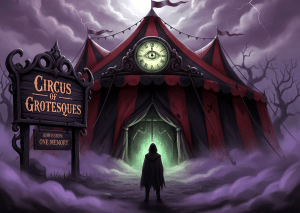
By Friday twilight, a striped tent stood in the meadow by the bridge, though no one had seen it go up. The stripes were not red and white, but black and pearl, and the pearl shimmered with a faint inner sea-light even as the evening darkened. There was a queue without a queue, people drifting toward the entrance as if they had always been walking there. A sign beside the flap read, in painted letters that looked still-wet:

ADMISSION: ONE MEMORY. NO REFUNDS.

“Ah now,” said Seamus Fitzgerald, veteran of mysteries and mistakes. “What would they want with memories?” He had a face that looked carved for curiosity and a wife who had given up trying to sand it smooth. Bridget stood beside him in her good cardigan, lips set, eyes sharp as clothespins. Around them, the village swelled and murmured. Children peered between elbows. The river wore the dusk like an old shawl.

A boy named Timmy Tilbert reached toward the sign. He was the sort who could not pass a gate without testing if it would open. The sign did not bite him, so he grinned, and that was that. The first people ducked into the tent.

Inside was not inside. Rows of mismatched chairs stretched further than the field itself. Lanterns floated without hooks. The air smelled of sugar and sawdust and something faintly metallic, like a tin whistle after a tune. A stage stood at the far end, a circle of lighter canvas with a ring of black salt around it, glittering like frost. The crowd sat. The tent filled and filled as if with tidewater.

The lights faded. A drum sounded once, and out stepped the ringmaster.

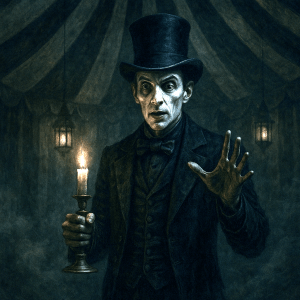
He had the look of a gentleman drawn by someone who had only listened to gossip about gentlemen: the coat a shade too long, the cuffs a shade too shiny, the smile too bright by half. His top hat was a fraction wider than the laws of taste permitted. When he bowed, it was a bow that made the whole tent feel it had been bowed to, personally and permanently.

“Welcome, Ballykillduff,” he said, and the echo of the village’s name went walking up into the dark of the roof. “Welcome, seekers of strangeness, patrons of the peculiar, connoisseurs of the crooked and the sublime. I am Doctor Vaude, and this is the Circus of the Grotesques. We will change your life forever.” He let the words dangle like bright knives. Then his tone softened. “To begin, I ask only that you sit, see, and remember what you can. What we take is only what you can spare.”

Seamus leaned toward Bridget. “What if they take the memory of me not washing the kettle?”
“You never washed the kettle,” Bridget said. “They would have to add that memory, not take it.”

A tinkling bell rang. The ringmaster raised his cane, and the first act stepped into the salted ring.

The Woman of Wax and Whispers

She wore a dress like a candle snuffed at midnight, and she moved as if balancing droplets. Every turn of her wrist left behind a shine. The lanterns lowered themselves in courtesy. When she danced, her skin softened and ran like honey, then firmed again, all while her eyes remained steady and deep as wells. She leaned toward those in front and whispered secrets, not hers but theirs. “You still have the key to the blue box,” she told a farmer, “and you keep it though the box is long burned.” “You pretended not to see him cry,” she told a grown daughter, “and you wished you had.”

With each whisper, a faint curl of smoke rose from her mouth and drifted toward the roof, where it vanished as if swallowed. People in the front row touched their hearts, their hands, their mouths. Some laughed, and then looked startled by the sound, as though it had come from a different throat.

When she finished, she made a small curtsey and a tiny flame on her fingertip winked out.

Doctor Vaude inclined his hat. “Every candle must melt to give its light,” he said. “Applause for Madame Tallow, the Woman of Wax and Whispers.”

The Gentleman Beast

He entered on a velvet leash he did not need, a looming figure with a mane like wheat in high summer. His tuxedo fit him as if it remembered an earlier body. His eyes were lion and man at once. He spoke in a voice that came from a long way off and also from beside your ear.

“Once,” he said, “I was handsome and admired and wanted more. I bought mirrors. I bought tragedy. I bought cruelty and paid no change. One morning I woke and found the animal I had been breeding in secret had taken the house. I asked for a refund. Life declined.”

He put a paw to his heart and bowed to the cheapest seats with the greatest grace. He then leaped a ring of fire and, for the brief gleam of midair, he was not a beast but a beautiful man again, face luminous, human, painfully so. The fire sighed when he landed. The audience sighed with it.

Bridget clapped, and clapped again, furiously wiping at one eye as if it had collected dust. Seamus squeezed her hand and did not make a remark, which was the most loving thing he could do.

The Clockwork Twins

A hush enfolded the tent. Two girls came in from opposite sides. They were identical up to the small freckle on the left edge of their lower lip, which both of them had somehow. Their skirts were made of pages torn from railway timetables. Tiny copper keys protruded from beneath their shoulder blades. With delicate hands they wound one another, and then they moved.

They danced in precise arcs that were more accurate than a clock but more gentle than a prayer. As they danced, the lanterns ticked. One twin, her name stitched white-on-black at her hem, Adéle sped up whenever the audience breathed. The other Ida slowed down whenever the audience blinked. The crowd tried not to breathe or blink. The tent filled with a human kind of blue. At the end the girls leaned cheek to cheek, and for a second each had no freckle, or both had two. Then they curtseyed, and their keys unwound with a sigh like wind through barley.

Doctor Vaude’s smile was almost tender. “They were born on a platform between two trains,” he said. “They missed their departure and arrived at their fate. Please save your applause for the pockets of time you will need on the way home.”

The Librarian of Unwritten Apologies

A thin fellow in a coat the color of hand-me-downs pushed a book trolley into the ring. The books were blank. He opened one, and the tent ruffled as if a bird had flown through it. “I keep all the apologies you meant to make,” he said mildly. “I am not the judge. I am the librarian. Judge yourselves as gently as you can.”

He set the books on a rope and walked across them like stepping stones, and as he stepped the pages filled with writing that rose and faded, rose and faded, a river of sorry. People in the crowd reached as if to snag a page and swallow it.

When he reached the far side, he turned. “The fine,” he said, “is small. Say the words aloud when you can, and mean them as much as you can.” He gave the crowd a little bow that looked like a folded note.

The Cook of Impossible Flavours

A wide woman with arms like rolling pins wheeled out a cart hung with boiling pots that never boiled over and frying pans that never burned. The smells that came from the cart were a memory of bread and the laughter of a first friend. “Taste,” she told the audience, “but be warned. It will cost you nothing at all, and that is its danger.”

She handed spoonfuls down the rows. People tasted “the day Granddad told me the secret joke,” “the time I nearly cheated but did not,” “the morning the rain knew my name.” Someone tasted “what I would have been,” and started to cry. She wiped the person’s tears with a clean square of linen and tucked it into her apron pocket as if it had always belonged there.

The Acrobat of Missing Steps

He walked up an invisible staircase that everyone somehow knew was there because everyone had used it, once. He slipped where the step was missing and did not fall because he had spent his life falling and had learned the trick of turning falling into a kind of strange flight. He landed where the step should have been. He put it back.

“Who here gave a memory?” Doctor Vaude called between acts. “Which one did you pay?”
“A birthday,” answered Seamus before Bridget could grip his sleeve. “My fifth. But sure I hardly remembered it.”
“Ah,” said the ringmaster. “Then it will hardly be missed.”
Seamus grinned, though a small, dry space had opened behind his ribs, not empty, not full, something like a pressed flower in a book you cannot quite name.

At the end of the first half, the lights rose and the tent rummaged itself into an interval. Trays of sugared things appeared. A set of paper birds fluttered around, landing on fingers to do sums, accept coins that were not coins, and leave receipts that were feathers. Seamus bought a twist of toffee for Bridget, who did not say thank you because she was thinking about whether she should have paid at all and whom she might be if she had not.

A girl stood near the aisle with a toffee apple like a small planet in her hand. Her name was Norah O’Dea, ten years old, a listener by nature and a laugher by vocation. She had the kind of eyes that made adults tell her too much and then gulp, and the kind of hands that mended other people’s kite strings without asking. She watched the paper birds. One landed on her wrist. She fed it a crumb of caramel. The bird bowed, and the caramel did not stick to its paper beak.

When the bell tinkled again, the audience drifted back. Someone hummed the hymn that is not in any hymnbook and always floats up just before miracles or trouble.

Doctor Vaude strode into the ring with his arms wide and his smile tuned to the exact frequency of attention. “For our second half,” he cried, “we offer transformations, translations, and the common magic of seeing what was there all along. And for our final act, we will require a volunteer.”

Bridget made a small sound, not unlike the sound a jam jar makes when it thinks about breaking. Seamus patted her knee. “It will be fine.”

Transformations

A woman stepped forward and took off her shadow like a coat. It ran around the ring on its own legs, then returned, a little breathless, and wrapped itself back around her ankles with an affection that looked like forgiveness. A man sang in a voice that made the lanterns grow taller, and when he stopped the lanterns were ashamed and shrank to their proper height. A boy took a deep breath and blew out a cloud of moths that turned to stars and then to freckles on his cheek.

Doctor Vaude clapped slowly, politely, as if his hands and the acts were doing business together. He turned to the crowd. “And now, a volunteer. No harm, I assure you. Only change. Only change.”

Silence is rarely complete. There is always the shiver of a sleeve, the soft slap of a jaw, the old whisper of a roof. In that not-quite-silence, Norah O’Dea lifted her sticky hand. “Me,” she said. A hundred whispers repeated me and wondered who had said it.

“Splendid,” said Doctor Vaude, and something brightened around him, and something dimmed.

Norah came down with a steady step. The ring of black salt glittered like a warning you pretend is a compliment. The ringmaster drew a circle on the canvas floor with a broken piece of chalk that never got shorter. “Stand there, my dear. Tell the people your name so your name will find its way home if it goes walking.”

“Norah O’Dea.”

“Very good. What would you like to be?”

Norah frowned. “I do not know.”

“A perfect answer,” said Doctor Vaude. “Let us begin.”

He spoke in a language that made Seamus itch and the paper birds rustle. The lanterns lifted. Norah blurred, like a swallow crossing a pane of glass. The blur thinned into a thread and then into a ribbon and then into a smile. It was the ringmaster’s smile. It fit her as if it had always been waiting for her, a coat taken in at the waist and let out at the hope.

People shifted uneasily. It is one thing to see marvels. It is another to see them reach out and swap hats with your neighbor.

Bridget stood up. “That is a child,” she said, not loudly, but with the sort of softness that quiets louder things.
Doctor Vaude tilted his head. “So she is,” he agreed. “For a while longer.”

Norah stood perfectly still, her new smile fixed, her eyes wide and glassy. Seamus remembered a small pair of hands at the shop door last winter, pushing in the wind for an old woman who was not quick. He remembered a laugh like a silver fork pinging on the counter. He remembered—he tried to remember—the girl’s birthday party last week, the cake, the candles, the song. His memory slid away from him like a fish through water.

“What did you take from her?” Seamus asked.
“Nothing,” Doctor Vaude said pleasantly. “We only moved things around. We are an agency of rearrangement.”

“The cost,” Bridget said. “There is always a cost.”
“The cost was paid at the door,” said Doctor Vaude. “One memory. No refunds.”

The audience’s murmur gathered itself into concern. But the tent itself seemed to lean toward the ringmaster. The tent itself was on his side.

Seamus stepped over the black salt, and the way the crowd sucked in its breath said he should not have done it. The circle did not stop him. He stood beside Norah. “Come on now,” he said, and put his hand out. “Let us go out and get air. There is a smell of tin in here.”

Norah did not move. Her hand did not move toward his. Her smile did not change. Only her eyes brightened with a thin shine of water.

Doctor Vaude’s own smile sharpened but did not grow. “I am very fond of the brave,” he said. “Bravery is such a practical spice.”

“What did you take?” Bridget asked again.

“What she could spare,” said the ringmaster. “The last layer of fear about becoming herself. I saved her the ache. You will thank me later.” He turned to the crowd. “There is always such resistance to ease, is there not? One final demonstration, then we will dismiss you kindly out into your permanent newness.”

He clicked his cane. The lanterns flipped to an unnatural white. The tent’s roof stretched upward like a held breath. The stage floor opened without opening, and from under the canvas rose the Mirror That Remembers Your Other Face.

It looked like a pond held on its side. It rippled as if it were alive and bored. Inside it, the faintest reflection of each spectator became sharper, the way a sentence sharpens as you near the end of it. People leaned forward. In the glass their mouths moved. Their reflections said things they had not said. Their reflections were things they had not been. A man saw himself with a child on his shoulders he had never had. A woman saw herself at the sea she had never visited. Bridget saw herself standing on a stage arguing with a ringmaster and winning.

“Careful now,” Seamus muttered. He took off his cap. He had not intended to, but his mother’s voice spoke up out of a cupboard in his brain and said, Take off your cap indoors when you are speaking to a mirror. He held the cap over the black salt. “If it is the price,” he said under his breath, “perhaps it can be paid back.”

Bridget heard him and grasped his wrist. “Do not you dare,” she said. “Not another memory. We will not play their game by their rules.”

A paper bird landed on Seamus’s shoulder. He felt the crackle of its weight. It pecked his ear as if to say: Different rules exist.

The Librarian of Unwritten Apologies wheeled his cart toward the ring’s edge and coughed. It was the cough you give in church when the priest has forgotten the second verse. Doctor Vaude glanced over with wide courtesy. The Librarian looked steadily back.

“Doctor,” he said, mild as rain, “there is a rule you have not mentioned.”

Doctor Vaude smiled wider. “There are many. Choose one.”

“The one about names,” said the Librarian. “If a name is called with love twice, and a third time with courage, the tent must hear it and consider it.”

The ringmaster waved his cane. “By all means, call.” His tone suggested a child trying to butter a thunderstorm.

Bridget did not wait. “Norah,” she said. “Norah O’Dea.” The name went out and hung like a bell swinging.

Seamus said it too, softly, as if coaxing a frightened dog from under a gate. “Norah.”

The tent waited. The ring tilted. The third call stuck in his throat like a bone. Seamus looked at Doctor Vaude’s eyes and saw patience in them, the patience of a hawk circling, and it made anger rise like tide. He shouted the name. “Norah!”

The tent heard.

The black salt hissed and rearranged itself into letters that spelled GO HOME and then, after a beat, IF YOU LIKE. Norah blinked. The smile slackened by a fraction. A tear came loose. It slid down, touched the edge of the circle, and fizzed like cider.

Doctor Vaude sighed as if inconvenienced by a minor traffic incident. “Very well. A little back-and-forth. It is good for the lungs. Child, you may choose. Stay, and learn our trade. Go, and be whoever you will, with one less splinter to pull out later.”

Norah’s eyes cleared. She looked up at Seamus and Bridget. At the crowd. At the ringmaster. “May I ask a question?” she said.
“Always allowed,” said Doctor Vaude.
“Do you pay for anything?”
He tilted his head. “Everything pays for everything. We are part of the economy of wonder. We take what can be spared and give what will be appreciated.”
Norah looked at her toffee apple, which had somehow not dripped. “I think you owe us a fairground game.”

The ringmaster blinked. “I beg your pardon?”
“A fairground game,” she said. “We paid at the door. You dazzled us. Now we deserve a chance to win back what we bought, the way my Da once won a goldfish that lived three years. The rules of circuses say so.”

No one knew if the rules of circuses did say so. But no one could swear they did not. The tent itself rustled in interest, as if learning a novelty. The paper birds fluttered up and wrote GAME in the air, letter by letter, and the letters burst into confetti and fell gently upon the ringmaster’s hat.

Doctor Vaude’s smile did not waver. “Very well. A game. Choose.”

Norah thought. Children think in lines that look like spirals to everyone else, but arrive more directly than most adult maps. “Riddles,” she said at last. “You ask one. Then I ask one. If we tie, we both win and lose a little. If I win, you give everyone back the part of their memory they can use. If you win, you may keep what you have taken, and also my toffee apple stick.”

Doctor Vaude looked at the stick as though it were a sceptre from a rival kingdom. “Agreed,” he said.

He stepped into the ring so the black salt whisper-crunched. He lifted his cane as if drawing a stave in the air, and notes appeared, little bright minnows hanging expectantly. “What is the thing,” he asked, “that everyone carries, that no one can lend, that grows lighter when it is shared and heavier when it is hidden?”

A murmur ran through the tent. Seamus mouthed sadness, then bread, then a pocket. Bridget squeezed his hand to stop the fidgets. Norah did not rush. She let the question settle around her like a coat and then stepped out of it.

“A story,” she said.

The notes flashed and turned into dandelion seeds that drifted up among the ropes. Doctor Vaude nodded once. “Well done. Your turn.”

Norah’s eyes went to the Librarian’s cart, to the wax woman’s cooling hand, to the clockwork twins standing with their cheeks together listening for the train. “What is the cost of a kindness that is not done?” she asked.

The ringmaster’s smile held steady. He did not speak for a time that felt like waiting for a verdict. He looked at the lanterns and then at the tent pole and then at his own hands, as if wondering if they had kept their receipt.

“The cost,” he said finally, “is a knot in the dark.” He inclined his head. “And interest.”

Norah nodded. “Then untie one.”

Doctor Vaude’s smile thinned. He twirled his cane once and tapped it against the canvas. Something invisible loosened. Somewhere in Ballykillduff, a small hardness in a small chest softened. Somewhere else, a hand reached for a phone it had not reached for in five years. The Librarian closed one blank book and shelved it. The Woman of Wax exhaled. The Gentleman Beast’s claws dimmed to nails.

“You have won,” said Doctor Vaude, and the tent shifted as if relieved of a coin in its shoe.

“What about our memories?” Seamus cried.
“Bring me your tickets,” said the ringmaster, and the paper birds swept down to snatch them from hands and hats and pockets. They fluttered above Doctor Vaude’s cane like a flock arguing which wire to sit on. He flicked the cane lightly and the tickets burst into ash, which rained on the people and smudged them with a soot that, when they brushed it away, left behind small bright scraps that fitted into the doors inside their minds and unlocked some of them.

Seamus blinked. He saw his fifth birthday. He saw his mother lifting him to blow out the candle on a small cake with sugar daisies. He saw his father’s ridiculous red paper hat, and his own determined cheeks. He also saw that his mother had been tired, and that his father had been worried about money, and that loving and worrying had been the same rope plaited differently. The memory did not come back as it had been. It had changed. It had grown up. He held Bridget’s hand and felt ashamed in a clean way, the kind that makes a man wash the kettle without being asked.

“Will it last?” Bridget asked Doctor Vaude softly, to his credit, because she could have shouted.
“The change? Yes,” he said. “The circus does not refurbish. It renovates.” He placed a hand on his chest. “We will keep a fee. We always do.”
“What fee?”
“You will see,” he said, and gave her a bow that acknowledged her as an equal opponent.

Norah looked up at him. “One more thing.”
“Ah,” he said. “Children and the one more thing.”
“You promised two things,” she said. “Change and forever. If you changed us, how do we know it will last forever?”
“You do not,” he said. “But forever is only ever a promise we tell the present to calm it down.” He looked, then, for the first time, a touch weary. “Go home, Norah O’Dea. Be whoever you will, with as many splinters as you can bear. Keep the stick.”

The tent applauded, which is a peculiar sound. The applause went around the circle and up into the ropes and back down again, as if the structure itself had hands. Norah bowed, very slightly, and went back to her place. The ringmaster tapped his cane, and the lights glided gently to brightness.

“Ladies and gentlemen,” he said, “Ballykillduff, brave and particular, you have been excellent. We thank you for your attention and your currency. When you leave, you will find the world arranged freshly but recognizably. Do not worry if your kitchen chairs are in a line across the garden. It will make sense by Tuesday. Please, mind your step on the way out. The step is there and not there, depending on whether you remember it.”

He bowed his deep bow. The troupe stepped forward to join him: Madame Tallow gleaming softly, the Gentleman Beast with a carnation tucked behind one ear, the Clockwork Twins holding hands with their keys at rest, the Librarian with his stack of blank books that did not feel blank, the Cook wiping an already clean ladle, the Acrobat balancing on the rope of a decision no one else could see.

They all bowed. The audience stood. The tent exhaled.

Outside, night had grown ripe. The moon seemed surprised to be there. The field was empty. The tent had gone between one breath and the next, leaving only pressed grass in a circle and a smell in the air like burnt sugar and old pennies. People looked at one another with the faces of people who have been baptized by the odd and are pretending it was a sprinkle.

Seamus and Bridget walked the lane home in a thoughtful quiet. “Will you be washing the kettle?” Bridget asked eventually.
“I believe I will,” Seamus said. “And also the cup. And possibly the past, though I will start with the kettle.”
“Good,” said Bridget, and slid her arm through his. “I remember your fifth birthday cake.”
“Do you?”
“I do now,” she said. “We licked the bowl on the back step. Your father put the dog’s hat on the priest.”

Seamus laughed aloud, and the laugh startled the hedges. They passed the O’Dea house. Inside, through the net curtains, they saw Norah set her toffee apple stick upright in a flowerpot like a flag.

“What do you think the fee is?” Seamus asked.
Bridget looked up. The stars seemed slightly rearranged, as if someone had decided that the Plough would be clearer if it were moved three finger-widths to the left. “We will have to live to find out,” she said. “That is the bargain anyway.”

In the days that followed, oddnesses revealed themselves the way recipes reveal the pinch of something you cannot name. People remembered what they had paid and what they had won. The shop bell, which had always rung once, started ringing twice, and everyone found the second ring companionable. The postman delivered a letter to a door that had been locked since ’98, and the person who opened it stood very straight and inhaled as if the air had forgiven her. A woman phoned a sister. A man mended a gate he had been kicking for years. The schoolchildren invented a playground game called librarians, which involved trying to outrun your apology. They were very fast.

And now and then, for weeks after, someone standing at the sink or the pub or the bus stop would see a long dark shape out of the corner of the eye, like the shadow of a tent, and turn, and there would be nothing, only the sense of canvas and music as a weather that had passed.

As for Norah O’Dea, she kept her toffee stick watered. After a while, a thin green shoot pushed out the top as if the wood had been waiting for permission. In spring it sprouted a single leaf shaped like a bell. When you tapped it, it made a tiny sound that meant change, and also meant forever, and nobody could quite say which.

On a rainy Sunday that hung low over the village, Norah lay on her belly on the rug and drew a poster in thick black ink. CIRCUS OF THE GROTESQUES, it read at the top, in letters that leaned into the wind. Beneath that she drew a wax woman, a lion in a tuxedo, two clockwork girls, a librarian’s cart, a cook with a cloud of smell, an acrobat stepping into the place where a stair should be, and a man in a too-bright smile holding a cane. Across the bottom she wrote: It changed our lives forever. No refunds necessary.

She pinned it to her wall. She went downstairs. At the sink, her mother stood with the phone tucked between shoulder and cheek, listening. “Yes,” her mother said to the voice on the line. “I am here. I am listening.” She smiled, a new smile that fit her face properly, a smile that did not belong to any ringmaster at all.

That night the wind shifted. Somewhere beyond the bog, a lantern went up on a pole and came down again. Somewhere farther still, in a town with a different name, people looked up as a black-and-pearl tent breathed itself into a field as if the field had dreamed it.

Inside the tent, Doctor Vaude placed a hand on the canvas and felt the pulse of the place. He looked at his troupe. He did not count their number aloud. He did not mention the shy, newly added figure already fitting in backstage, a little girl with steady eyes who had volunteered to teach the paper birds two new tricks and to check the chalk for truth.

He smiled. Perhaps it was a touch smaller than before. Perhaps it was exactly the same. He lifted his cane.

“Ladies and gentlemen,” he rehearsed under his breath. “Welcome, seekers of strangeness. We will change your life forever.”

Out on the road, an apology untied itself and walked away into the dark, lighter by the weight of a knot. In Ballykillduff, Seamus washed the kettle in circles, counterclockwise, and Bridget kissed the back of his neck in passing, and both of them pretended for a moment that this was how it had always been. And perhaps it had. It depends, as the ringmaster would say, on how you remember it.

No refunds. Plenty of change.

 
Leave a comment

Posted by on October 30, 2025 in circus


Tags: , , , ,