RSS

Tag Archives: funny

Dalek in Wonderland

Dalek in Wonderland

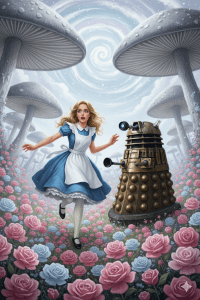
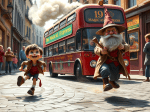
Alice had always considered “topsy-turvy” a quaint, almost charming state of affairs. Until, that is, the very air began to hum with an unfamiliar, metallic thrum that made the giant mushroom caps quiver like startled jellyfish. One moment, she was admiring a particularly vibrant cluster of sapphire roses; the next, a bronze behemoth with a singular, unblinking eye had materialized amongst the petals.

“EX-TER-MIN-ATE!” boomed a voice that sounded like a thousand angry kettles boiling simultaneously.

Alice, who had faced jabberwockies, irate queens, and logic-defying tea parties without so much as a proper shriek, found herself doing a rather ungraceful hop-skip-jump backwards. “Oh dear!” she gasped, her blue eyes wide with a mixture of terror and utter bewilderment. “Are you quite alright, sir? You sound rather cross, and honestly, shouting ‘exterminate’ at the scenery is dreadfully rude to the fungi.”

The Dalek, for that is what it was, swiveled its dome-shaped head, its ocular stalk focusing intently on Alice. “OBSERVATION: ORGANIC LIFE FORM IS SPEAKING ILLOGICALLY. THREAT ASSESSMENT: HIGH. INITIATING ELIMINATION PROTOCOL.”

“Elimination protocol?” Alice clutched her apron. “But I’ve only just arrived! And I haven’t even had a chance to ask if you’d like a spot of tea. Though, I must confess, your rather peculiar shape doesn’t look particularly suited for holding a teacup. Perhaps a saucer? Or a very large thimble?”

The Dalek emitted a series of rapid, clicking noises that sounded suspiciously like frustrated whirring. “TEA IS IRRELEVANT! SURRENDER FOR EX-TER-MIN-ATION!”

“Surrender?” Alice scoffed. “And miss out on discovering what’s beyond those particularly tall, stripey mushrooms? Not on your life, you peculiar brass kettle on wheels!” With a burst of courage fueled by sheer absurdity, she turned and darted through the towering roses and lilies, her blue dress a fleeting blur against the soft pink and blue hues of the fantastical garden.

The Dalek, surprisingly nimble for its bulk, began to pursue, its menacing shouts echoing through the quiet glade. “YOU WILL NOT ESCAPE! EX-TER-MIN-ATE! EX-TER-MIN-ATE THE INSOLENT ORGANIC!”

Alice, giggling despite herself, glanced back. “Honestly, if you’re going to chase me, at least try to keep up a sensible conversation! Do you know the way to the Mad Hatter’s tea party? I suspect he’d find your insistence on ‘extermination’ rather droll, provided you didn’t actually exterminate the biscuits.”

And so, under the enormous, dappled caps of the enchanted mushrooms, with the spiraling vortex of the sky watching overhead, Alice led the indignant Dalek on a merry, illogical chase, proving once and for all that in Wonderland, even the most terrifying threats could become just another part of the mad, wonderful scenery.


Tags: , , , ,

Baby Hippo and Alice

Baby Hippo and Alice

Alice and the Baby Hippo

Alice once mounted a hippo one day,
Who’d lost his way in a puddle of clay.
He huffed and he snorted and splashed with delight,
While Alice held on with all of her might.

“Faster!” she cried, “to the edge of the sky!”
The hippo just winked with a mud-sparkled eye.
They galloped through rushes and lilies and foam,
Quite certain they’d never find their way home.

Through puddles of puddings and rivers of tea,
They splashed past a fish who was trimming a tree.
A frog waved his bonnet, a duck tipped his hat,
And a snail cried, “Good gracious! She’s riding on that?”

The hippo just chuckled, “I’m only a tot,
But galloping’s easy when you’ve learned the trot.”
And off they went bouncing, through dream upon dream,
Till Alice awoke by a murmuring stream.

Her dress was still damp, her shoes full of sand,
And she whispered, “Next time I shall learn how to land!


Tags: , , , , , , , , ,

There Once was a Slug called Slimy

There Once was a Slug called Slimy

The Great Lettuce Heist

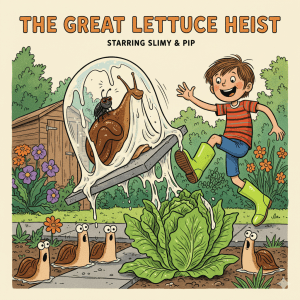
Slimy’s ambition far exceeded his speed, or his girth. His dream was to cross the unforgiving expanse of Mrs. Higgins’s back garden to reach The Sacred Head of Romaine, a prize of such size and crispness it was practically a monument.

The year was 1968, the height of summer, and Slimy had a plan. He wasn’t going to crawl. Crawing was for amateurs.

He was going to surf.

His partner in crime was Pip, a beetle whose main function in life was complaining.

“I still don’t understand why we’re doing this during the hottest part of the day,” Pip muttered, clinging precariously to Slimy’s shell-less back.

“Silence, Pip!” Slimy yelled, his eyestalks twitching with maniacal focus. “The sun bakes my trail! It creates a slick, semi-solid layer of… of pure velocity!”

In reality, the heat was just evaporating the water in his mucus, leaving behind a sticky, awful film.

Slimy pushed off from the edge of the shed, aiming for the first patch of damp shade fifty feet away. Immediately, his undercarriage seized up. He wasn’t sliding; he was sticking. Every micro-millimeter of progress was achieved through pure, agonizing abdominal contraction, a motion less like surfing and more like peeling a sticker off a varnished tabletop.

“Velocity, you said,” Pip wheezed, adjusting his tiny sunglasses. “I believe the current rate of travel is approximately one Planck length per fortnight.”

Slimy ignored him. “I just need a better… launch!”

With a burst of desperation, Slimy secreted a volume of mucus that, had it been liquid, would have drowned Pip. The result was not speed, but a magnificent, sticky dome that enveloped them both. They slid three inches, then stopped dead, firmly glued to the concrete path.


The Unlikely Rescue


Just then, Kevin, a nine-year-old boy and resident Terror of the garden, came skipping out the back door, singing a song about “Groovy, Groovy Caterpillars.” Kevin was known for two things: an unnerving love of brightly coloured wellington boots, and an innate talent for accidentally stepping on invertebrates.

“Oh no, oh no, oh no,” Pip whispered, knowing their sticky situation meant a lack of escape options.

As Kevin’s neon green boot descended toward their mucus-prison, Slimy had a flash of inspiration. The glue!

He expanded the sticky dome, coating the bottom of the approaching boot just before impact. Kevin’s foot landed, missed Slimy by a hair, and then… stuck.

Kevin lifted his foot, and the entire surface layer of the concrete path, along with Slimy and Pip, came up with it. Slimy found himself traveling higher and faster than he ever had, clinging to the sole of the enormous boot.

“We’re airborne, Pip!” Slimy cried out, ecstatic. “We’re surfing the very winds of fate!”

“We are adhered to the sole of a rapidly moving, oversized rubber shoe!” Pip screamed back.

Kevin, oblivious, took a giant, stomping step right over the prize.

THWUMP!

Slimy, Pip, and the sticky patch of concrete landed squarely on top of The Sacred Head of Romaine.


The Victory


The impact shattered the lettuce, but left Slimy and Pip relatively unscathed. The surrounding slugs, who had spent the morning methodically nibbling the lower leaves, looked up in astonished, mucous-covered silence.

Slimy, covered in concrete dust and Romaine flakes, raised his eyestalks in triumph.

“See, Pip? Pure velocity!”

Pip merely shook his head, scraped himself off the sticky wreckage, and began eating the debris.

“Just call me King Slimy from now on,” Slimy declared.

“I’ll stick with Slimy,” Pip mumbled around a mouthful of lettuce, “but I’ll grant you this: you are the only slug in the county who has ever been rescued by his own failed adhesive technology.”

And that was the story of how Slimy, through utter incompetence and a staggering quantity of glue, successfully completed the greatest lettuce heist in garden history. Though, for the rest of his life, he was forced to peel himself off various surfaces using his tail.


Tags: , , , ,

Alice in Mirrorland, 3

Alice in Mirrorland, 3

The path turned to tile, a stark, silent square,

And Alice found stillness where once there was care.

The White Rabbit stood, a monument of stone,

His hurried-up life forever now gone.


No frantic watch-checking, no flustered refrain,

Just silence and stillness and a perfect domain.

The creatures knelt down, a reverent throng,

“The still one is wise, where the movers are wrong!”


“A watch that ticks not is a watch that is true,”

They whisper and worship, with nothing to do.

But Alice remembers a hurried-up friend,

Whose chaos and worry had no place to end.


She reaches to touch him, the marble is cold,

And a story of stillness begins to unfold.

A faint, hidden tick, a twitch of the lip,

A memory stirred by a hesitant trip.


“He loved his own hurry, his miserable pace,”

She whispers to nothing, then flees from the place.

The whispers pursue her, a prayer in the air,

“Forever still. Forever wise. Forever stone.” They declare.


Tags: , , ,

I wish I’d looked after me brain

I wish I’d looked after me brain

Oh, I wish I’d looked after me brain,

And spotted the perils of strain,

All the thoughts that I thought,

And the knowledge I’d sought,

Oh, I wish I’d looked after me brain.

*

I wish I’d been that much more willin’,

And gave me grey matter a chillin’,

To pass up the worryin’,

And constant hurrying,

And just gave me mind a good fillin’.

*

When I think of the stress that I’ve trekked,

And the problems I solved without a heck,

Anxiety, big and little,

Made me mind, oh, so brittle,

Me neurons are horribly fecked.

*

My Mother, she told me no end,

“A sharp mind is always your friend”

I was young then, and brainless,

Me focus so careless,

I never had much time to spend.

*

Oh I showed them me quick wits so bright,

I flashed them about with delight,

But constant overthinkin’,

And lack of deep sinkin’,

Played havoc with me mental delights.

*

If I’d known I was paving the way,

To confusion, and memory’s decay,

The pain of the dreadin’,

And the fog of the headin’,

I’d have thrown all me worries away.

*

So I sit in the neurologist’s chair,

And I hear his diagnosis in despair,

Telling me what I should have done,

And the rest I should have won,

“It’ll only last,” he’ll say, “for a few more days.”

*

How I laughed at me Mother’s forgettin’,

As she struggled with the past she was lettin’,

But now comes the reckonin’

It’s me it is beckonin’

Oh, I wish I’d looked after me brain.

 
Leave a comment

Posted by on September 8, 2025 in brain, funny story, humor, humour, poems


Tags: , , , ,

I wish I’d looked after me teeth

I wish I’d looked after me teeth

Oh, I wish I’d looked after me teeth,

And spotted the perils beneath,

All the fillings I had,

And the root canals so bad,

Oh, I wish I’d looked after me teeth.

*

I wish I’d been that much more willin’

To floss and avoid all the chillin’

To pass up the candy,

From a lack of foresight that’s grandly,

I’d just chew on me food and keep smilin’.

*

When I think of the plaque that I cleaned,

And the cavities that I have screened,

Potholes, big and little,

Ruined my teeth, so very brittle,

My molars are horribly fecked.

*

My Mother, she told me no end,

“Good teeth are always your friends”

I was young then, and brainless,

My oral habits so careless,

I never had much time to spend.

*

Oh I showed them my new mouth so bright,

I flashed them about with delight,

But up-and-down chewin’

And grindin’ and ruin’

Played havoc with my dainty delights.

*

If I’d known I was paving the way,

To gingivitis, decay,

The pain of the grinding,

And the cost of the binding,

I’d have thrown all me candy away.

*

So I sit in the dentist’s chair,

And I hear his diagnosis in despair,

Telling me what I should have done,

And the toothbrush I should have donned,

“They’ll only last,” he’ll say, “for a few more days.”

*

How I laughed at my Mother’s false teeth,

As she struggled with them clunkin’ beneath,

But now comes the reckonin’

It’s me it is beckonin’

Oh, I wish I’d looked after me teeth.

 
Leave a comment

Posted by on September 8, 2025 in humor, humour, poems


Tags: , , , ,

Alice and the Baby Hippo (A whimsical poem in rhyme)

Alice and the Baby Hippo (A whimsical poem in rhyme)

Alice and the Baby Hippo
(A whimsical poem in rhyme)

One dainty day beneath the sun,
Young Alice thought, “This could be fun!”
She saw a hippo, small and round,
Just waddling gently on the ground.

Its skin was grey, its tail went flip,
It wriggled with a wobbly skip.
Its ears were tiny, pink and proud—
It snorted once and drew a crowd.

“A mount!” cried Alice. “Oh, how grand!
I’ll ride across this soggy land!
No horse or donkey, goat or yak—
I’ve found a hippo for my back!”

She climbed atop its chubby rear,
The hippo blinked, then twitched an ear.
It gave a squeal, then took a dash—
And Alice flew off with a splash!

She landed in a muddy bog,
Just shy of hitting a startled frog.
Her hair was filled with weeds and goo—
Her sock was gone, her shoe was too.

The hippo, shocked by all the fuss,
Just blinked and snorted, “Don’t blame us!
We’re not for riding, no, not yet—
We’re more like mobile lumps of wet.”

Alice laughed, then bowed with grace,
Mud dripping gently down her face.
“Well thank you, friend,” she said, and grinned,
“As far as rides go—you were…wind!”

And off she skipped with squelchy feet,
Through meadows green and puddles sweet.
Behind, the hippo gave a sigh,
Then belly-flopped with glee nearby.

So if you spy a hippo small,
Be sure you ask, before you fall.
For though they’re cute and seem just right—
They’re not the steed for your next flight!


Tags: , , , , , , ,

The Bus that Waited for No Wizard

The Bus that Waited for No Wizard

“The Bus that Waited for No Wizard”

It all began with toast.

More specifically, with the last piece of toast—golden, buttery, and tragically flung across the room when the boy, Alfie, accidentally elbowed the plate in his hurry.

“By the stars, Alfie!” exclaimed the old wizard, Professor Wigglewand, brushing crumbs from his beard. “That was my toast!”

“No time!” Alfie cried, hopping into his oversized shoes. “The bus! The bus leaves in three minutes!

Professor Wigglewand grabbed his pointy hat (which was still dripping with marmalade from breakfast) and hobbled to the door, his robe flapping like a bedsheet in a gale.

The two of them burst into the street, Alfie leading the charge, the wizard puffing behind. The bus stop was just down the hill—but naturally, the hill had recently been repaved with cobblestones so slippery they might as well have been made of banana skins.

“I told you we should’ve used the teleportation spoon!” puffed Wigglewand.

“You turned it into a ladle last time!” Alfie shouted back.

Ahead, the Number 19 Magical Express was already revving its enchanted engine, clouds of cinnamon-scented smoke puffing from the tailpipe. The bus driver, a grumpy ogre in a tweed cap, eyed them with mild disinterest.

“Hold it!” Alfie shouted. “Wait!”

The bus hissed and squeaked and began to pull away.

Wigglewand raised his wand and—poof!—turned his walking stick into a pogo stick. With one mighty bounce, he shot into the air, over Alfie’s head, and landed squarely in the middle of the road, arms flailing.

The bus screeched to a halt.

“Nice one, Professor!” Alfie said, panting as he caught up.

They clambered aboard, both out of breath and covered in toast crumbs and triumph.

“Cutting it fine, eh?” the ogre grunted, as the doors swung closed behind them.

Wigglewand winked, adjusted his marmalade-streaked hat, and muttered, “Better late than toastless.”

wizard and toast
 
Leave a comment

Posted by on July 19, 2025 in story, wizard


Tags: , , , , , , ,

Sir Slugalot’s Quest

Sir Slugalot’s Quest

“Sir Slugalot’s Quest”
(A Slightly Sticky Saga)

Sir Slugalot slid from his mossy old bed,
A helmet of thimble plonked on his head.
He dreamed of great glory, of dragons and fame—
Though moving an inch took a whole hour’s aim.

“I’m off!” cried the slug with a gallantish squeak,
“I’ll conquer the mountain by the end of the week!”
His mum packed him lettuce and two soggy scones,
And warned him to not poke the garden gnomes.

He slithered through puddles, past beetles and bees,
Got stuck in a boot, and then lost both his knees—
(Not literally gone, but he wasn’t quite sure,
For slugs are a mystery with legs that obscure.)

He battled a breeze and a leaf with sharp corners,
Outwitted a gang of snail-brained marauders.
He tamed a wild worm with a licorice whip,
And performed CPR when a toad did a flip.

At last, he arrived at the great garden gate,
Just moments behind…a much faster snail mate.
The crowd gave a cheer! (Or perhaps it was yawns.)
They crowned him with dandelions and knitted pompons.

So if ever you think that you’re sluggish or slow,
Just think of Sir Slugalot, hero of woe.
He might not be speedy or terribly bright—
But he did win the joust with a glow-in-the-dark kite.


Tags: , ,

Alice on Top of the World

Alice on Top of the World

‘Alice on Top of the World’ First, she discovered Wonderland…Then, she slipped through that fascinating Looking Glass…Now, she is on Top of the World. Some fourteen years after her last adventure, Alice suddenly finds herself in a strange place, wondering how she could have got there let alone why she is child again. She meets the White Rabbit and they set off to find his new house at the top of the world. Alice soon falls far behind the fast hopping Rabbit, but she endeavours to find her way without him. While on her strange journey Alice comes across hungry aspidistras that beg her to find them some fertiliser, an incredibly old Elf called Fle, who, living in a fertiliser mine, has plenty, but is not disposed to giving her any, a white sea lion called King Tut, who gives her some extremely confusing directions, and a magical escalator that finally transports her to the very top of the World. The continuing adventures of a girl named Alice…

Chapter One
Into the Abyss

It had been many years since Alice’s last adventure, so she was rather surprised to find herself having another one. Even more surprising was that she was a child again—no older than when she first stepped through the Looking Glass or fell into Wonderland.

“How curious,” she murmured, trying to remember what it felt like to be small.

“You took your time getting here,” said a familiar voice. The White Rabbit appeared before her quite suddenly.

“I beg your pardon?” Alice asked, recalling how rather rude he could be when he was in a mood.

“I said, you took your time. You should have arrived fourteen years ago,” the Rabbit huffed, hopping away with great urgency.

“But—but I’ve no idea how I got here!” Alice cried, running after him. “Let alone why I’m so late!”

“We accept no ifs or buts here,” said the Rabbit over his shoulder. “You should know that by now.” As he spoke, a door materialised in front of him. He opened it and added, “Do hurry up. Don’t dawdle.”

Alice followed him through the door, trying to keep pace. She began to suspect the Rabbit had woken on the wrong side of the bed. It was, after all, a lovely day: the sun was warm and bright, and pink forget-me-nots lined the winding path ahead.

“I wonder where I could be,” Alice mused aloud. “Is this Wonderland?”

The Rabbit gave her a peculiar look just as another identical door appeared. “Of course not,” he said. “We’re on the top of the world.” He opened the second door and scurried off down another flower-lined path.

“The top of the world?” Alice gasped. “Why, that’s impossible!”

The Rabbit stopped and turned. “Then how do you explain being here, if it’s impossible?”

Alice opened her mouth but found no answer. All she could manage was, “I bet you’re mad!”

“That depends,” said the Rabbit seriously.

“Depends on what?”

“On whether you mean mad… or mad.”

“That’s nonsense,” said Alice. “They both mean the same thing.”

“Ah, but if you were Mad Number One,” said the Rabbit, “and someone called you Mad Number Two, wouldn’t you be terribly offended by the mistake?”

“But I’m not mad!” Alice insisted.

“And how would you know,” asked the Rabbit, “if you can’t tell the difference between Mad Number One and Mad Number Two?”

“I just do!” she shouted, stamping her foot. Then, noticing another door had appeared, she pointed it out.

The Rabbit turned to open it, but the handle wouldn’t budge.

“Might I try?” Alice asked sweetly. The Rabbit stepped aside, his pink eyes narrowed with suspicion.

Alice turned the handle, and the door swung open easily.

“Could a mad person have done that?” she asked smugly—then stepped through and promptly fell into a gaping hole on the other side.

“No,” the Rabbit chuckled as she vanished, “but would they have walked straight into a hole?” Laughing, he hopped in after her.

Down she fell, through near-total darkness. It reminded her of her fall into Wonderland, only this time the descent slowed—until she stopped completely and began to rise again.

“I don’t want to go back up,” she grumbled, gazing at the distant light above. “It’s far too far!”

Then something passed her by in the dark. Without thinking, Alice jumped onto its back and clung on tightly.

To her surprise, she was riding a baby hippopotamus. Its smooth, silky skin made it a poor choice for a mount, and she soon found herself slipping—then sliding—until she tumbled off and landed with a bump on hard, dusty ground.

“I don’t like this place,” she moaned. “Not one bit.”

“You don’t like it?” said the hippo in a surprisingly squeaky voice. “How do you think I feel? There’s not a drop of water anywhere. And hippos need loads of it!”

Dusting herself off, Alice said politely, “Mr. Hippopotamus, thank you for the ride. It was the most comfortable hippo ride I’ve ever had.” (Though she didn’t mention it was also the only one.)

“My dear child,” said the hippo, “you were so light I hardly noticed you. If you ever need a lift out of that dark place again, just hop on.”

“Oh, thank you! I’ll write it in my invitation book. And if I never use it, I’ll treasure it all the same.”

With that, the hippo turned and ambled back into the shadows in search of water. But before he could disappear entirely, there came another soft thud—less gentle than Alice’s.

In a flash, the White Rabbit appeared, sitting backward on the baby hippo, riding it into the light.

He gave a curt thank-you (nowhere near as gracious as Alice’s), then turned to scold her.

“If anyone’s to fall down holes around here, we must first have a vote. Is that clear?”

Alice nodded, though she privately decided he must be either Mad Number One or, if not, most definitely Mad Number Two.

Another winding path suddenly emerged, but this one felt far less inviting. Instead of forget-me-nots, it was lined with towering aspidistras—each one bearing a long green beak that snapped threateningly.

“Come along, Alice,” said the Rabbit, bounding ahead. “We must return to the very top of the world!”

Alice gasped as one of the plants snatched a tuft of fur from his back. “Come on!” he shouted again, oblivious to the danger.

Determined not to show fear—not of silly old flowers—Alice stepped toward the path. But before her foot touched the ground, a beak lunged for her ear. Another tugged at her hair. A third aimed squarely for her nose.

“Stop that!” Alice cried. “Stop that this instant, or I’ll dig you all up and replant you with rhubarb!”

At once, the attacks ceased. Alice checked herself—ear, hair, nose—all intact.

“Thank you,” she said firmly. “You really ought to behave more like proper plants. You’re not supposed to be frightful, you know.”

As she studied the plants, she heard the unmistakable sound of sobbing.

“Who’s crying?” she asked.

No one answered, but the gentle weeping continued. The plants began to sway, and their leafy beaks moved silently above her.

“Stop it! Tell me who’s crying!”

At last, one of the plants spoke. “She is,” said a deep voice. “The little offshoot beside my wife. See?” A long leaf pointed to a smaller plant nearby.

“Your wife?” Alice blinked. “You’re married?”

“Of course,” the aspidistra replied. “Can’t you see them?”

“I might, if you’d stop swaying,” she muttered. “You’re making me feel sick.”

“We can’t help it,” said the father plant. “When we’re upset, we sway. It’s why we sway in the wind—we’re simply heartbroken.”

“Oh, I’m terribly sorry,” said Alice. “Is there anything I can do?”

“You could promise not to dig us up…” came a tiny voice.

“I won’t, I promise,” said Alice gently. “I only said that because you were being so horrid.”

The plants stilled. Beneath the leaves, she spotted the baby plant—snuggled under its mother’s foliage.

“I’m sorry,” said Alice. “Do you forgive me?”

“Yes,” sniffed the baby. “We’re sorry too. We didn’t mean to scare you. We’re just so hungry. Usually we greet travellers with smiles.”

“Hungry?” asked Alice. “Don’t your roots find enough food?”

“We need fertilizer,” the baby explained. “None of us have had any in ages. I’ve never had any—ever! I don’t even know what it looks like.”

Alice scratched her head. “Could I fetch some for you?”

If plants could beam, these ones surely did. Chattering broke out all around.

“Stop! Stop, please!” cried Alice. “You’re hurting my ears!”

The voices died down, leaving only the mother plant speaking. “Do you know where to find fertilizer?”

“I… I don’t,” Alice admitted.

“There is a place,” the mother said. “The Fertilizer Mine. That’s where it comes from.”

“Where is it?” Alice asked eagerly.

“I’m afraid we don’t know,” the mother confessed. “But we know it exists.”

Seeing how sad they looked, Alice stood tall and declared, “I will find some fertilizer—enough for all of you. I promise.”


Chapter Two
The Fertilizer Mine

Though it pained Alice to leave the poor aspidistras behind, she had given them her word—and she intended to keep it. “All I need to do,” she said aloud, “is find the mine and fetch a bag of fertilizer. That can’t be too difficult… can it?”

She looked around thoughtfully. “Now, which way shall I go—left, right, or straight ahead?” With no clue where the mine might be, she decided to trust her nose. “Surely I can’t go too far wrong doing that,” she said, stepping off the path and onto a wide, neatly trimmed lawn.

But the lawn didn’t last long. The tidy grass gave way to wilder land—hill after hill, stretching far and wide. Alice trudged up one, then down another, then up again. She wasn’t sure if she had climbed ten hills or twenty, but by the end she was quite exhausted.

“They go on forever!” she cried, sinking to the ground. “I can’t take another step.” She removed her shoes and socks to rest her aching feet. As she sat there catching her breath, she spotted something halfway up the next hill—a dark opening that looked remarkably like the entrance to a mine.

Scrambling to her feet with shoes and socks tucked under her arm, she shouted, “That must be it!” and set off at a run. Despite having seen the entrance clearly, it took her longer than expected to reach it—whether a long time or a short one, she couldn’t tell.

When at last she arrived, she greeted the ramshackle gates breathlessly. “Oh, I’m so glad to see you. A minute later and I might never have made it!” She sat down to put on her shoes and socks, then stood to inspect a sign affixed to the gate. It was a square, yellow-painted piece of metal. Placing a finger to her lips to help her concentrate, she read:

‘This is a mine, of that you well know,
But what kind of mine—be it tin, be it coal?
If you dare to pass through and go down for a see,
Can you hope to return and be free?’

“What a strange sign to hang outside a mine,” she murmured, reading it again in case it made more sense the second time. It didn’t.

Tugging hard, Alice managed to pry open the rusty gates. The mine looked dark—very dark. She searched for a torch or something similar, but finding nothing, stepped carefully inside, hoping her eyes would adjust.

The passage sloped gently downward, letting some light from the entrance filter in. Alice searched everywhere—high and low, nook and cranny—for any trace of fertilizer. But no matter how hard she looked, she couldn’t find so much as a speck.

Sitting down on a rock jutting from the floor, she groaned. “It’s hopeless! I’ll never find anything in this silly old mine.”

“You’ll never find anything if you don’t look properly,” said a voice from the darkness.

Alice sprang to her feet. “Who’s there?” she called, peering toward the shadows.

“I might ask you the same question,” the voice replied, “seeing as you’ve wandered into my home.”

“Your home?” Alice repeated, shocked. “I’m not invading! I’m just looking for some fertilizer.”

“Well, that depends on how you see it,” said the voice.

“How you see it,” Alice corrected, though her confidence wavered.

“Let me explain,” the voice continued. “If I were to break into your home—”

“I didn’t break into anything!” Alice protested. “I just walked in!”

“Do you want me to continue or not?” the voice asked.

“I’m sorry,” she said quietly. “Please go on.”

“Now, where was I?”

“I was breaking into your home…” Alice prompted.

“Ah yes. If I were to do that, I might find myself before a gistrate.”

“A what?”

“A gistrate—y’know, one o’ them judgey-types what send folks to jail.”

“Oh! You mean a magistrate.”

“That’s what I said,” came the reply. “But you come down here, willy-nilly, like you own the place, and act all put out when I call you out on it!”

“Well… I might understand, if this were a house,” said Alice. “But it’s just an old mine.”

“An old mine to you, perhaps,” said the voice, growing closer, “but to me, it’s home.”

“If you were an elf or a troll—or even a goblin—I might believe that,” said Alice, growing impatient.

“And what makes you think I’m not?” asked the voice, just as a figure stepped into the dim light.

“You are an elf!” Alice gasped. “And a very old one, at that!”

“There’s no need to be rude,” said the little man as he sat on a stone opposite her.

His clothes were rough and scratchy-looking—hessian, Alice thought. “Are you really an elf?” she asked, trying to touch one of his long, pointy ears.

“Less of that, missy!” he snapped. “Don’t you know elf ears are sensitive things?”

“They are?”

“Of course!” he replied, his tone softening.

Just then, Alice remembered the aspidistras waiting for her. Tears welled up in her eyes. “I must find fertilizer,” she sniffled. “They haven’t had any in ages—possibly years!”

“Let’s not have any of that,” said the elf, who suddenly felt even smaller than his modest two feet and six inches. “You said fertilizer, didn’t you?”

Blowing her nose into a handkerchief she pulled from her apron, Alice nodded. “Oh yes, Mr Elf. But not for me. It’s for the aspidistras.”

Grinning, the elf said, “Fle. That’s my name. Spelt F-L-E. Elf backwards, see? My mum thought it would help her remember.”

“I shan’t laugh, Mr Fle,” Alice promised.

“Just Fle,” he chuckled. “Leave the ‘Mr’ off—it makes me feel ancient!” They both laughed.

“Is all this fertilizer?” Alice asked, wide-eyed, as Fle led her through a hidden passage to a secret chamber stacked to the ceiling with sacks.

“Every last bit,” he said proudly. Tugging a rope, he opened a high window, flooding the cavern with daylight. “Take as much as you need!”

“I only need one bag,” said Alice. “That’s all I can carry.”

“Only one?” Fle scratched his head. “Barely seems worth the effort.”

“Yes, just one, please,” she confirmed.

“How many of them oispidistries did you say there were?” Fle asked.

“They’re aspidistras,” Alice giggled. “And there must be… let me see…”

Raising her hands, she began counting on her fingers. She counted, lost track, remembered a ten she’d carried over, and started again. Finally, she whispered, “There might be a hundred—or two hundred on a good day. One bag isn’t nearly enough.”

“Oh, don’t worry, my dear,” Fle reassured her. “There’ll be plenty for all your oispidistries.”

He sent Alice back to the surface and disappeared into the mine. About thirty minutes later, he emerged, dragging a wobbly cart behind him, loaded with two sacks of fertilizer—one small, one large.

“Hello, m’dear,” he called through the gates.

“Oh, Mr Fle!” Alice cried. “Is that all for me?”

“It’s Fle, remember?” he chuckled.

“Sorry—Fle,” she giggled.

“And yes,” he nodded. “It’s all for your precious oispidistries.”

“You’re the nicest elf I could ever hope to meet,” said Alice, beaming.

Her gaze returned to the curious sign on the gate. “Why did you put that up?”

“To keep folks from sneakin’ in and nickin’ the fertilizer,” Fle explained.

“But you’ve got loads! There’s no shortage.”

Patting the side of his nose, Fle winked. “Ah, but it keeps ‘em on their toes, thinkin’ there might be…”


Chapter Three
A Series of Confusing Directions

Alice and Fle, pulling his little cart behind him, arrived at the path lined with aspidistras and immediately set to work. They carefully fed the hungry plants, spreading generous handfuls of fertilizer at the base of each one.

“Heavens above,” sighed the mother aspidistra, her leaves perking up, “I feel better already.”

“So do I!” chirped the baby plant, enjoying its first taste of the magical mixture.

“My!” exclaimed Alice, stepping back in amazement. “I can see you growing before my very eyes!”

“They all are,” said Fle, sprinkling the last of the fertilizer and watering it in with a flourish. And he was right. Each plant, reinvigorated, began to grow so vigorously that their long, strappy leaves soon engulfed the entire path from view.

“Oh dear,” said Alice, dizzy from the swaying plants. “How will I ever find my way now?” She grasped the side of Fle’s cart for balance as the foliage rustled and danced in the windless air.

“We can’t stop,” said the father plant, rocking rhythmically.

“But why ever not?” asked Alice, feeling slightly seasick.

“We’re unhappy again,” he confessed. “We’ve grown too much and ruined your path. Now you’ll never find the White Rabbit.”

Tugging at the thick leaves, Alice could see nothing ahead—just a great green wall of foliage. “Oh dear,” she murmured. “Fle, do you have any idea how I’m supposed to find the White Rabbit now, if there’s no path left to follow?”

“Ah, the White Rabbit,” said Fle, grinning broadly. “Why didn’t yous say that before?”

Alice thought she had. But then again, in this peculiar place, it was entirely possible she hadn’t. “Do you know where I might find him, Fle? He said to return to the top of the world, but I haven’t a clue how to get there.”

“That I moight,” said Fle, fishing a battered notebook from his pocket and thumbing through its dog-eared pages. “Now would he be under R for Rabbit or W for White?”

“Surely under W,” Alice said confidently.

Fle flipped to the W section. “Nope. Nuthin’ there.”

“Then he must be under R.”

Fle’s stubby fingers flicked to the R’s. “Still not there,” he said, scratching his head. “Strange.”

Alice began to wonder how Fle ever found anything at all in that raggedy book. Then, inspiration struck. “Wait! What if he’s under B—for Bunny?”

Fle’s eyes lit up. “B, yous ses?” He thumbed quickly to the correct page and grinned. “Moi God, you’re right. Here it is!”

“How do I find him, Fle?” Alice pleaded.

“Ah, let’s see here…” He squinted at the scribbled notes.

“Well?” asked Alice, impatiently tapping her foot.

“It’s no good rushin’, child,” Fle said. “The more yous hurry, the slower yous’ll go.”

“Oh please, Mr. Fle,” she implored, hoping the title might speed him up. “Please just tell me where he lives.”

“Oh, that’s easy,” Fle said, surprised. “He lives in his house.”

“In his house?” Alice echoed. “What kind of address is that?”

“It’s the only one he’s got,” Fle shrugged. “It’s written right here. All yous have to do is follow your nose, and soon enough you’ll see his neat little house. Same one as in Wonderland, I hear. Shiny brass plate and all. ‘W. Rabbit’ in big letters.”

“Well, thank you,” said Alice, stepping off the overgrown path. She gave a cheerful wave to the swaying aspidistras. “Goodbye, plants!” And with that, she vanished behind a large Castor Oil Plant.

No sooner had Alice rounded the enormous leaves than an entirely new landscape opened before her. And what a strange, delightful place it was! There were waterfalls everywhere—not great roaring ones, but gentle trickles tumbling into sparkling pools just the right size for dipping tired feet.

“What a brilliant idea,” Alice said aloud. Sitting on the soft grass beside one particularly pretty pool, she took off her shoes and socks and slid her aching feet into the cool, refreshing water.

It was so soothing that her eyelids began to droop. “I mustn’t fall asleep,” she murmured. “No, I mustn’t…” But the next thing she knew, she was fast asleep on the mossy bank.

“Excuse me! I said, excuse me!” barked a voice.

Alice snored softly.

“Little girl, can you hear me?”

“Pardon?” she muttered, blinking groggily.

“If you’d been paying attention,” the voice scolded, “you’d have heard me!”

Alice rubbed her eyes and sat up. Standing before her on four strong flippers was a majestic white sea lion, with a spinning red ball balanced perfectly on his shiny black nose.

“Mind you don’t drop that on me,” Alice warned, scooting back.

“You insult me!” the sea lion huffed. “I never drop it.”

“I’m sorry,” Alice said, realising her tone had been a little sharp. “I didn’t mean to offend. It’s just that I’m not used to waking up with spinning balls so close to my face.”

“It’s all right,” said the sea lion, brightening. “Everyone says that.”

“They do?”

“Oh yes. Ball-spinning is second nature to me. Half the time I forget I’m even doing it.”

“Allow me to introduce myself,” Alice began, standing to curtsy.

“But you didn’t,” said the sea lion flatly.

“I didn’t what?”

“Introduce yourself.”

“Oh! I really must be losing my head.” She laughed. “I’m starting to wonder if I remembered to bring it with me.”

“I am King Tut,” said the sea lion proudly. “King of the white sea lions.”

Alice nearly laughed out loud—King Tut was the name of an old Egyptian pharaoh, not a sea lion. And how many white sea lions could there be anyway? Still, she kept that thought to herself and curtsied again. “A pleasure to meet you, Your Majesty. I’m Alice.”

“That’s better,” said Tut, tossing the red ball to her. She caught it, barely.

“Thank you, your royal highness.”

“Just Tut,” he said. “I’ve never been one for formalities.”

“Thank you—Tut,” she said, dropping the ball as she curtsied once more.

Tut laughed. “Let me hold that.” He flicked the ball back onto his nose, where it began spinning again as if it had never stopped.

Remembering her quest, Alice resumed walking and sniffing the air.

“Where are you going?” asked Tut.

“I’m trying to find the White Rabbit, but the directions I received—‘follow your nose’—are proving quite confusing.”

“Why so?” Tut asked.

“Well, should I follow the left side of my nose or the right?” Alice asked earnestly. “I really don’t know which way to go!”

Tut burst out laughing. He laughed so hard a tear rolled down his cheek and he wiped it away with a flipper.

“Don’t you know,” he said, still chuckling, “that left is right and right is left in this part of the world?”

“How can that be?” Alice gasped, touching both sides of her nose to check if they’d switched places.

“Everything’s topsy-turvy up here,” said Tut. “Look.” He somehow produced a compass. The needle spun wildly.

“I see,” said Alice, watching it whirl. “That must mean… if I follow my nose up… I should go… left?”

“Now you’re getting it!” said Tut, spinning his ball faster with approval.

“But how do I get up and to the left?” Alice wondered aloud, gazing over the waterfall-laced hills.

Tut tossed his ball onto a nearby rock, where it continued to spin on its own, and dove into the water. When he re-emerged, he was holding a kipper in his mouth.

“A kipper?” Alice cried. “You can’t possibly have caught that in there! Kippers are made in smoky old sheds!”

Grinning, Tut swallowed it whole and let out a loud burp.

“You wished it, didn’t you?” Alice exclaimed. “That’s the secret! I have to wish for help!”

Tut flicked his ball back onto his nose and swam away without a word.

“Now I get it!” Alice shouted. “All that confusion—left, right, up, down—it doesn’t matter. I need to wish for the way.”

She closed her eyes. “I wish, I wish… I wish for an escalator! An escalator to take me to the top of the world!”

In an instant, a tall, glimmering escalator appeared before her. It twisted left, then right, then left again, spiralling into the clouds.

“This must be the way,” said Alice. “This must lead to the White Rabbit’s neat little house…”

And without another word, she stepped onto the first gleaming stair.


Chapter Four
A Most Unexpected Encounter

The moment Alice stepped onto the first stair of the escalator and gripped the swiftly moving handrail, she began rising from the ground at an astonishing speed.

“My, this is a fast escalator,” she said, trying to admire the shrinking countryside below. “It’s a shame it isn’t slower—I might have enjoyed the view much more.”

As the landscape disappeared beneath her, the wind grew wilder, whipping around her and sending her hair flying like a kite. The escalator climbed faster and faster, until Alice was holding on for dear life. Beautiful birds of every colour fluttered by, soaring above and below her, seemingly unbothered by the gusts that had her clinging to the rail with white-knuckled determination.

“Oh, this wind is just dreadful,” she complained, batting her flailing hair out of her eyes. Blinded by it, she didn’t see the top of the escalator approaching, and she tumbled off the final step in a most ungraceful fashion—elbows, knees and all.

Picking herself up from the snowy ground, Alice blinked in confusion. She had expected to see the White Rabbit’s neat little house. Instead, there was only snow. Snow, and more snow.

“I must have wished too hard,” she muttered, teeth chattering, “and ended up at the actual North Pole!”

At first, she danced around in delight as snowflakes fell all around her—tiny, perfect crystals that melted on her eyelashes. But as the snow fell heavier and the cold seeped through her clothes, her delight turned to dread.

“I need something warm—fur coat, hat, gloves…” she said, hugging herself tightly. “And boots! My toes are freezing!”

The snow kept falling, piling around her feet and shoulders, until she was nearly buried. She shook her head, sending flurries flying, and desperately wished for someone—anyone—to come and rescue her.

Then came the sound of bells—distant, jingling bells.

“Where are they?” she called out, squinting into the swirling snow. “What could it be?”

Soon a shape appeared through the blizzard. It grew clearer with every passing moment until Alice could see it plainly: a dog sleigh, driven by a fur-clad man with a great bushy beard.

“Whoa! Steady now!” the man called to his dogs, slowing the sleigh as he leapt down and approached Alice with a warm bundle of clothes.

“Here you are,” he said kindly, offering her a coat, hat, gloves, and boots. “Put these on, and I’ll bring you somewhere warmer.”

Though she had no idea who he was—and he could have been anyone, for all she knew—Alice gratefully took the warm garments, dressed quickly, and climbed into the sleigh, burrowing deep into the fur blankets piled high within it.

“Rarr!” the man shouted, setting the dogs in motion. “Rarr!” he called again as the sleigh surged forward, vanishing into the whiteout.

When the sleigh finally stopped, the same kind voice said, “Here we are, little girl—safe and sound.”

Two large hands began digging through the mountain of blankets to find her. Alice peeked out, squinting at the light.

“Where are we?” she asked, blinking.

“You’re in Santa’s workshop, of course,” the man replied, his face lit with a jolly grin.

“Santa’s workshop? Really?” Alice asked in amazement. She looked around, taking in the wooden floorboards and flickering lanterns. “Are you truly Santa Claus?”

He chuckled. “I prefer Father Christmas, truth be told. Santa Claus always sounded a bit… colonial.”

Alice gasped, remembering the exact gift he had given her the previous Christmas—the one she had asked for so carefully in her letter.

“And I’m Alice,” she said, emerging from the sleigh.

“Pleased to meet you, Alice,” Father Christmas said, lifting her gently to the floor.

She examined his clothes—jeans and a woolly jumper—not at all what she expected. “But… where’s your red and white suit?”

He laughed. “That’s just for Christmastime. A rather modern tradition, I’m afraid. I prefer something more comfortable the rest of the year.”

Alice giggled. “You look so ordinary in those clothes!”

“I used to wear green and white, long ago,” he said thoughtfully. “Thinking about going back to that. What do you think?”

“Oh yes, much more festive than red and white,” Alice replied.

Just then, Father Christmas clicked his fingers. “You must be hungry.”

Two little men—surely elves—appeared, one holding a tray of delicious-looking biscuits, the other with the biggest mug of hot chocolate Alice had ever seen.

“Help yourself,” Father Christmas said. “If you want sugar, just wish for it.”

But Alice didn’t need to. Everything was perfect as it was. Once she’d eaten her fill, she remembered her quest—but hesitated to mention it. She had so many questions to ask. Like what Father Christmas did for the rest of the year. Or whether he really was going to bring back his green-and-white outfit.

“I imagine you’d like a tour of my workshop,” he said, stepping away from the window. “It’s still snowing outside—no rush to leave, is there?”

“I do love the snow,” Alice said, “but I admit I was getting a bit too much of it before you rescued me.”

“Found you,” Father Christmas corrected gently. “And you were never in real danger—my elves are everywhere.”

“Why were you out there yourself?” she asked.

“For sport and exercise,” he grinned. “Reindeer are the top dogs, of course, but for sheer thrill on the ground, nothing beats a dog sleigh.”

“It was thrilling,” Alice admitted. “Even buried under all those blankets!”

“And what were you doing out there?” he asked, stroking his long beard—Alice was almost certain it shimmered with rainbow colours.

Alice hesitated, then told him everything—from the White Rabbit’s sudden appearance, to how she had ended up lost in the snow. She left out the odd detail about being a grown-up in a child’s body—best not complicate things.

“Well now,” Father Christmas said, brushing a few rainbow particles from his beard. “That is quite the story.”

“It’s true!” Alice insisted.

“I believe you,” he chuckled. “And it sounds like you could use some help finding your Rabbit.”

“Oh yes, please!”

“Then we shall kill two birds with one stone,” he said.

Alice looked horrified. “Kill birds? With a stone?”

Father Christmas laughed heartily. “It’s just a saying!”

Three elves entered through a small green door Alice hadn’t noticed before. Father Christmas gave them quiet instructions, and they slipped back through the door just as quickly.

“Where are they going?” she asked.

“To make preparations for our search,” he replied, strolling toward a regular-sized door beside the smaller one. “Now, ready for that tour?”

Clapping with excitement, Alice followed him through…

What lay beyond was a vast, magical workshop—filled with hundreds of busy elves, all hard at work building toys. Piles of them rose nearly to the ceiling.

“I always wondered what you did the rest of the year!” Alice exclaimed. “It must take forever to make all of this!”

She picked up a plain black cube. “What kind of toy is this?”

“I was hoping you’d ask,” said Father Christmas, lifting another. “We invented it ourselves—it’s a wishing cube.”

“A wishing cube?”

“Go on. Just wish for something—but don’t tell me what it is.”

Alice closed her eyes and wished with all her might—for one thing: the location of the White Rabbit’s neat little house.

At once, a tingling sensation spread from her fingertips through her whole body. She opened her eyes to see the cube glowing with thousands of brilliant stars. Then it began to fade… slowly… until it vanished completely. But the stars remained, now swirling all around her in a dazzling display.

They spun faster and faster, until she felt dizzy. Just as she was about to complain, they stopped, giving her a moment to take in their full, breathtaking beauty.

But then… they blurred, faded, and turned into a thick, white fog.

“Oh no,” Alice groaned, “how will I ever find the Rabbit’s house in this?”

Frustrated, she waved her arms to clear the fog—crash! The invisible cube slipped from her hand and shattered on the floor. The fog dispersed along with it.

“I’ve ruined everything,” Alice sobbed. “How will I ever find him now?”

Two elves rushed over with a dustpan and brush, quietly sweeping up the broken pieces.

Then Alice gasped. “Wait—there are more cubes! Please, dear Father Christmas, may I try another?”

He smiled kindly, but shook his head. “I’m sorry, Alice. The magic only works once for each person.”

Crushed with disappointment, she followed Father Christmas as he resumed the tour, showing her the most marvellous toys she’d ever seen. And soon, she had quite forgotten the accident.

As the tour ended, Father Christmas called for the elves to gather.

“I’m sure Alice would enjoy a song,” he said.

“I’d love one,” she beamed. “Even if it’s not Christmas yet—could you sing a Christmassy one anyway?”

The smallest elf raised his hand. “Especially for you,” he said, “we shall sing Oh, Why Wait for Christmas?

After a few throat-clearing coughs, the elves began:


Oh, why wait for Christmas when you can have it every day,
Be it June or September, March, April, or May.
The thing to remember is not the date or day,
But the feeling that goes behind it—so share it right away.

Enjoy your time for living; enjoy your time on Earth,
A time for celebration, a chance to share in mirth.
Each day will shine brightly as you step forth anew,
And all of this made possible because the gift is true.

Oh, why wait for Christmas when you can have it every day,
Be it June or September, March, April, or May.
The thing to remember is not the date or day,
But the feeling that goes behind it—so share it right away.


Alice clapped joyfully. “Thank you! That was wonderful!”

“I think it’s time we were off,” said Father Christmas, stepping into the loading bay where a great sleigh waited.

“Where did that come from?” Alice asked, wide-eyed.

He smiled, stroking his beard—more rainbow sparkles floated free. “Magic,” she whispered.

“Would you like to meet the reindeer?” he asked.

“Oh yes, please!”

He led her to the front of the team. “This is Rudolph—he’s a bit frisky today.”

Sure enough, Rudolph reared up. “They all had oats this morning,” Father Christmas said with a chuckle.

“May I pat him?”

As if he understood, Rudolph gently lowered his head. Alice gave him a pat and smiled.

“He likes you,” said Father Christmas. “Always a good judge of character.”

Next came Dasher and Dancer, both eager for attention, followed by Prancer and Vixen, Comet and Cupid, and finally, Donner and Blitzen.

“I love them all,” Alice sighed, giving Blitzen a special pat.

“Time to climb aboard,” Father Christmas said.

Alice tried, but the sleigh’s step was too high. Laughing, he clicked his fingers. Two elves ran over with a little staircase.

“Thank you!” Alice said, climbing aboard.

Once settled under a warm blanket, the sleigh began to move.

“Rarr, rarr!” Father Christmas shouted, and the reindeer galloped forward—lifting the sleigh into the starlit sky.


Chapter Five
The Trip of a Lifetime, and the Fright of Her Life

The sleigh hurtled across the snowy terrain, bumping and bouncing under a pale, lazy quarter moon. The sky was deepening swiftly, and Alice, bundled beneath a thick blanket, gazed in wonder at the strange sights speeding by—igloos, beavers, tiny cottages, kittens, babies in bonnets, hatters with teapots, and even a walrus reclining beside a coat stand. She wasn’t entirely sure whether she was seeing these things, or merely imagining them, but they fascinated her all the same.

“Oh dear,” she murmured, spotting a solitary kitten in the snow. “I do hope that’s not Dinah. If it is, she’ll catch her death of cold out there.”

Despite the curious sights flashing past, Alice began to wonder why the magical sleigh, so often associated with flight, remained stubbornly on the ground. Still, she said nothing—for Father Christmas, though jolly, was entirely focused on driving.

“Rarr, rarr!” he cried, eyes fixed on the horizon. “Rarr, rarr!”

Alice followed his gaze—and immediately saw the reason for his urgency. Looming ahead was the largest, darkest forest she had ever seen. The sleigh thundered toward it at alarming speed.

“RARR, RARR!” bellowed Father Christmas one last time. With a tremendous heave, the reindeer surged forward, and the sleigh soared up into the air—missing the trees by mere inches.

The sudden silence of the sky was deafening. Though the reindeer still galloped through the air, their hooves struck only wind. Alice peeked out from under her blanket.

“I’m sorry if I frightened you,” Father Christmas said kindly.

Alice gasped at the sight of the world below. “Are we really flying?”

“As surely as there is a Father Christmas!” he laughed.

Alice laughed too. She rather liked this old man.

“It’s so quiet up here,” she said, peering over the side of the sleigh into the inky dark. “How high are we?”

“Not quite at cruising altitude yet,” he replied. “But once we are, we’ll be about nine hundred feet up—give or take a few.”

“Nine hundred feet?” Alice echoed, astonished. “Is that as high as the moon?”

“Oh no,” he chuckled. “The moon’s more than a quarter million miles away—not even my reindeer could reach that far.”

They both laughed heartily. For a moment, Alice forgot all about her quest.

“You can relax now,” said Father Christmas. “We’ve reached cruising height. The air up here is as smooth as a hippopotamus’ hide.”

And it was. The sleigh barely seemed to move, as if they were gliding through velvet.

“Do you think the Rabbit is nearby?” she asked softly, her thoughts turning once more to the elusive creature.

Father Christmas stroked his beard and considered. “That all depends…”

“On what?”

“On where you think he might be,” he said. “Things are different in the north, Alice. Left may be right. Up may be down. The important thing is to believe he’s findable.”

She nodded, remembering King Tut’s similar advice. After that, neither of them spoke. They sailed in silence above the frozen wastes, scanning the snowbound landscape for any sign of a small white house—or a small white rabbit.

For hours they searched. At last, dawn began to nibble away at the darkness.

“I’m afraid that’s it,” Father Christmas said gently, admitting defeat. “We must head home. Christmas is nearly upon us…”

“No!” Alice cried, surprising herself. “I can’t give up. I must go on.”

And just then, she spotted something—movement below, small and slow. A lone figure trudged through the deep snow.

“Look!” she exclaimed. “There’s someone down there!”

Father Christmas looked uncertain. “Are you sure? You don’t know who—or what—that is. You’re welcome to come back with me, to the workshop. It’s warm, and the elves make excellent hot chocolate.”

“But it isn’t even November!” Alice replied, brushing the thought aside. “Please, let me down. I have to find out who it is.”

He didn’t press her further. Instead, he whispered to Rudolf, “Rarr… rarr…” and guided the sleigh gently down, landing in front of the figure.

Alice leapt out. “Thank you for everything!” she said.

“Here,” said Father Christmas, handing her a small black cube. “If you need me, use this to call.” Then, with a final “Rarr, rarr!” he was gone—reindeer and all—rising into the pinkish sky.

Alice turned to the cloaked figure, now only steps away. “Good morning,” she said kindly. “I’m Alice. Pleased to make your acquaintance.”

The figure did not reply.

“I said, good morning—”

She stopped. The figure had raised its head.

Alice staggered backwards, coughing in fright. Beneath the torn layers of clothing was a face—no, not a face. A skull. A human skull.

With trembling hands, she reached into her pocket and drew the cube. “Please come back,” she whispered. “Please…”

But before she could use it, the figure lifted a bony hand to where its lips should have been and said, “Wait…”

Alice froze.

“Wait,” it whispered again, and pointed ahead—into the blinding snow.

“What… what are you?” Alice asked, her voice shaking.

“I am Death,” it said softly. Then added, “And Life.”

Alice blinked. “But that makes no sense! Death and Life are opposites.”

The figure gave no answer, only glided forward, its arm still outstretched.

“Do you want me to follow?” she asked. “I thought you told me to wait!”

It gave no reply.

Snow swirled thickly around them as Alice trudged behind. The warmth of the sleigh ride was long gone, replaced by a hollow cold that settled deep in her bones. The figure glided, silent. She followed, step after painful step, longing for it to speak again, to say something—anything—kind.

But it didn’t. It only pointed forward.

The journey grew harder. Ice beneath her boots, snowflakes blinding her eyes. She began to limp. A blister formed, then burst, soaking her sock in searing pain. At last, she collapsed.

“I can’t go on!” she cried. “I can’t take another step!”

The figure stopped. They had arrived.

Alice found herself before a strange building, its tall door framed by carved columns and frosted leaded windows. The pain in her foot vanished. She removed her shoe and sock—astonished. The blister was gone.

“How curious,” she said. “But then again, everything here is.”

She knocked firmly on the heavy door. A wreath of holly rustled in the wind.

“Surely someone is home,” she said. “I need to warm myself by a fire. This snow is dreadful.”

The door creaked open. But no one was there.

“Hello?” she called. “Is anyone inside?”

No reply.

Cold wind pushed snow through the open doorway. “I’ll catch my death if I stand out here,” Alice muttered, stepping into the silent hall.

She wandered down a long corridor. “Hello? Is anyone home?” Still nothing.

She opened a white door at the far end and found herself in a large, empty room—save for a crackling fire in the hearth. She hurried to it and warmed her hands.

“At least I’m out of the cold,” she murmured. “And far away from that frightful figure. Those dreadful bony fingers!”

Movement caught her eye.

A mouse scurried along the skirting board, vanishing beneath a door. Curious, Alice followed.

The next room was as empty as the last. Again, the mouse ran ahead and disappeared under another door. Alice followed without hesitation.

But this room was very different. It was packed with furniture—so much of it that she could barely move. She squeezed past wardrobes, presses, tables and chairs until she found a small clear space in the rear.

There stood two beautifully carved chairs.

“How lovely,” she whispered. She sat in the first one—it was elegant, but too firm.

Then she tried the second. It was perfect.

“I do like this one,” she said, snuggling into it. “So comfortable… I think I might…”

She yawned.

“…take a little nap…”

And before she could finish the sentence, Alice was fast asleep.

CONTD

mad mr viscous


Tags: , , , , , , , , , , , , , , , , ,