RSS

Tag Archives: story

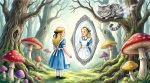
Alice on Top of the World

Alice on Top of the World

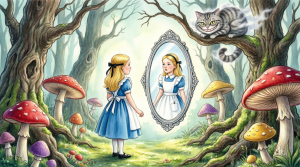
Alice discovered quite by accident that the world has a top.

Most people, she had noticed, were too busy walking around it to check.

It wasn’t marked by a flag or a signpost—nothing as sensible as that. Instead, it felt like a place the world itself had agreed upon in a moment of quiet pride. When Alice stepped there, the ground did not wobble or roll away. It simply paused, as though holding its breath.

Below her, the Earth unfolded in bright, broken shapes: seas made of blue ideas, continents stitched together with yellows and greens, clouds cut into careful pieces like a puzzle no one had finished. The sun shone from one side and the moon from the other, neither arguing about whose turn it was.

Alice put her hands on her hips—not because she felt particularly brave, but because it seemed like the correct posture for standing somewhere important.

She waited for something dramatic to happen.

Nothing did.

“Well,” she said to the air, which was listening, “that’s rather the point, isn’t it?”

From up here, worries shrank into polite little shapes. Arguments lost their sharp edges. Even time—dangling somewhere nearby with its pocket watch—seemed unsure whether to tick forward or simply admire the view.

Alice realised then that being on top of the world did not mean ruling it, or shouting instructions down at it. It meant seeing how all the pieces fitted together, even the crooked ones. Especially the crooked ones.

After a while, she stepped down again, because no place likes to be stood upon forever.

But the world remembered.

And from that day on, whenever things felt impossibly large, Alice smiled—quietly—knowing exactly where the top was, and that she had already been there once.


Tags: , , , ,

The First Pipe

The First Pipe
The First Pipe.
*************
The pipe appeared sometime between the last letter being posted and the postmistress locking the door.
No one saw it arrive.
In Ballykillduff, this was not considered suspicious. Things often arrived without arriving. Days slipped in sideways. Tuesdays borrowed from Thursdays. A sheep once spent an entire afternoon convinced it was a gate. Compared to these, a pipe was a small matter.
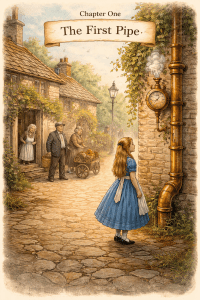
It was brass, newly polished but already faintly tired-looking, as though it had anticipated being admired for only a short while. It ran vertically up the outside wall of the post office, stopping just short of the roof, and ended in a small valve that hissed very gently, like someone attempting to whisper a secret to a brick.
Below the valve was a round gauge.
The needle trembled.
The word printed beneath it read: NEARLY
To be continued
 

Tags: , , , ,

The Man Who Was Always Almost There

The Man Who Was Always Almost There

The Man Who Was Always Almost There

There was a man who was always almost there.

This was not a rumour, nor a manner of speech, but a well-established fact, agreed upon by the town, the postman, and the chairs that were kept ready for him. He was, at all times, five minutes away.

“Five minutes?” people would ask.

“Always five,” replied everyone else, with the weary confidence of those who have checked.

If he was said to be crossing the bridge, he was five minutes from the bridge. If he was climbing the hill, he was five minutes from the top. If he was known to be standing just outside the door, hand raised to knock, then surely — unmistakably — he was five minutes from doing so.

No one had ever seen him arrive.

This did not stop them knowing him well.

They spoke of him often and with fondness. He preferred his tea strong but forgot to drink it. He laughed quietly, as though worried it might disturb something. He had a habit of saying “ah” before responding, which suggested thoughtfulness even when none followed. Children were warned not to take his seat, which remained empty at the end of the long table, with a cup that grew steadily colder by the hour.

“He’ll be here in a moment,” someone would say.

And it was true.

Just not yet.


The letters arrived before he did.

They came addressed in a careful hand, always with the correct name, always with no return address. Some were invitations. Some were apologies. One was a birthday card that arrived exactly on time and sang loudly when opened.

The town clerk attempted to file them, but could not decide where.

“He hasn’t come yet,” she said, holding a small stack of envelopes.

“No,” said the baker, “but they’re definitely his.”

And so they were placed neatly on the hall table, where they waited patiently, much like their owner.


Only one person found this unsettling.

Her name was Ada, and she had recently arrived, which made her suspicious of things that had been accepted for too long. Ada noticed the chair first. Then the tea. Then the way conversations bent slightly around a person who was not there.

“When will he arrive?” she asked.

“In five minutes,” said the room.

“But when did you first say that?”

There was a pause.

“Well,” said someone carefully, “quite some time ago.”


Ada decided to meet him.

Not properly, of course — that seemed unlikely — but she resolved to walk out and find where he was stuck being almost. She followed the road everyone said he was on, past the hedges that leaned in to listen, past the gate that never quite closed.

After some time, she saw him.

Or nearly did.

There was a figure in the distance, exactly the right shape, exactly the right amount of familiar. He was close enough to recognise, but far enough to remain uncertain, as though the world itself had misjudged the focus.

She waved.

The figure raised a hand.

She stepped forward.

He stepped forward too.

The distance remained.


It was then that Ada did something unusual.

She stopped walking forward.

Instead, she took a careful step backward.

The world hesitated.

The air felt as though it had mislaid a rule. Birds paused mid-thought. The hedges rustled, offended. The distance between them wavered, thinned, and for the first time appeared unsure of itself.

She took another step back.

The man was suddenly closer.

Not by much — but enough.

She smiled.

“So that’s it,” she said. “You’re not late. You’re being approached incorrectly.”

The man laughed, quietly, exactly as described.


They did not walk together.

That would have spoiled things.

Instead, Ada continued stepping backward, slowly, respectfully, while he moved forward, relieved but cautious, as though arrival were a delicate business that must not be rushed.

When they reached the edge of town, the chair was still empty.

The tea was still cold.

But the five minutes were gone.

No one noticed at first.

Later, someone would remark that the waiting felt different — lighter, somehow — as though something expected had finally been allowed to happen.

As for the man, he did eventually arrive.

Not loudly.

Not all at once.

Just enough to sit down, take a sip of tea, and say “ah,” as if he had been there all along.

 
Leave a comment

Posted by on January 12, 2026 in fantasy story, Short story


Tags: , , , ,

The Cat-Hat

The Cat-Hat

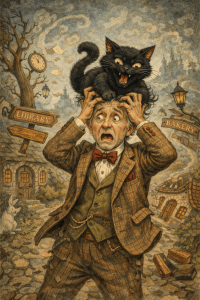
There once was a man with a hat who believed, quite firmly, that he knew exactly where he was at.
He stood in the middle of a street that looked familiar enough, nodded wisely to himself, and announced, “Ah yes. Here.”

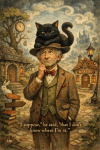
Unfortunately, his hat was a cat.

This was not immediately obvious, as the cat had mastered the ancient and difficult art of Looking Like a Hat. It sat very still upon the man’s head, curling its tail neatly around the brim and narrowing its eyes in a way that suggested felt, wool, or possibly tweed.

“Left,” said the man confidently, and turned left.

“No,” said the hat.

The man paused. “Hats don’t usually talk,” he said.

“I’m not usually a hat,” replied the cat, adjusting itself slightly and knocking the man’s sense of direction sideways.

They walked on. Or rather, the man walked on, while the hat gently leaned him in directions that felt interesting at the time. Streets rearranged themselves. Doorways swapped places. A bakery became a library. A lamppost insisted it had always been a tree.

“Are we lost?” asked the man.

“Entirely,” purred the hat. “But very stylishly.”

By now the man noticed that every time he felt certain, the world became uncertain, and every time he admitted he didn’t know where he was, things calmed down a little. The cat-hat hummed contentedly and pointed with one ear toward a place that might have been somewhere or might have been nowhere at all.

At last, the man sighed. “I suppose,” he said, “that I don’t know where I’m at.”

The hat purred, pleased at last to be properly acknowledged, and for the first time all day, they arrived exactly where they were meant to be.

Which, of course, was nowhere in particular. And that was perfectly fine.

The Cat-Hat, part two

There once was a man with a hat who believed, with the stubborn confidence of the mildly informed, that he knew exactly where he was at.

He stood quite still, for standing still always felt like proof. The street beneath him did not object, though it had rearranged itself several times since he arrived. The houses leaned. The sky blinked. A signpost nearby whispered directions to itself and then forgot them.

The man nodded. “Here,” he said aloud.

At this point, the hat cleared its throat.

The man did not look up, for hats were not supposed to have throats, and it is rude to notice such things when they do. The hat, however, was a cat, and cats have very definite opinions about being ignored.

“You are mistaken,” said the hat softly, close to the man’s thoughts rather than his ears.

“I can’t be,” said the man. “I know where I’m at.”

The hat tightened slightly.

With this small adjustment, the street lengthened, the corners bent inward, and the idea of where slid a few inches to the left. A bakery across the way shuddered and decided it had always been a courtroom. A lamppost turned its head.

The man felt a peculiar wobble behind his eyes.

“Left,” he said, pointing.

“No,” said the hat.

The man frowned. “Hats shouldn’t argue.”

“I’m not arguing,” said the hat. “I’m correcting.”

They began to walk, though the man could not recall starting. Each step took him somewhere slightly less certain than the one before. When he felt sure, the ground softened. When he hesitated, it tilted. The cat-hat purred, pleased with the arrangement.

“Are we lost?” the man asked at last, his voice thinner than before.

The hat paused. “Lost implies a map,” it said. “You gave that up three streets ago.”

The man reached up, intending to remove his hat, but found that his hands could not agree on where his head was. His thoughts had begun to wander without him.

“I don’t know where I’m at,” he said quietly.

The world stopped moving.

The hat loosened its grip, satisfied. “That,” it said, “is much better.”

And with that admission, the man arrived—precisely, irrevocably—exactly where he was.

Which was nowhere he could leave, and nowhere he could name.

The hat settled back into place and went to sleep, dreaming of maps that bite.

 
Leave a comment

Posted by on January 11, 2026 in funny story, Short story


Tags: , , , ,

Sluggy, the Slug

Sluggy, the Slug

To a creature only two inches long, a backyard isn’t just a yard—it’s a continent. For Sluggy, a lime-green gastropod with a thirst for adventure and a silver trail of ambition, the edge of the patio was the edge of the known world.

The Great Concrete Desert

Sluggy began his journey at dawn, while the dew still clung to the hostas like liquid diamonds. His goal: The Great Wooden Gate, a towering monolith that promised a world beyond the rosebushes.

The first obstacle was the Patio. To a slug, sun-baked stone is a treacherous wasteland.

  • The Risk: Drying out before reaching the shade.
  • The Strategy: Constant production of high-grade slime.
  • The Close Call: A giant, rubber-soled “Human Boot” thundered down inches from his eyestalks, vibrating the very earth.

Sluggy didn’t retreat. He tucked his stalks, waited for the earthquake to pass, and soldiered on.


The Jungle of Long Grass

Beyond the patio lay the Unmown Realm. Here, the blades of grass were like emerald skyscrapers swaying in the wind.

Sluggy met a Cricket named Kip, who was tuning his legs for the evening performance.

“You’re going to the Outside?” Kip chirped, incredulous. “It takes me three jumps to reach the gate. It’ll take you… well, a lifetime.”

“It’s not about the speed,” Sluggy replied with a rhythmic ripple of his foot. “It’s about the detail. I bet you’ve never seen the patterns on the underside of a dandelion leaf.”


The Summit of the Threshold

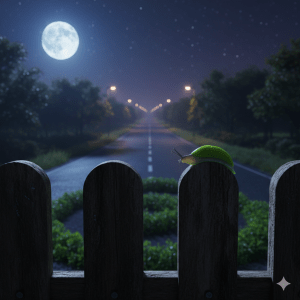
By sunset, Sluggy reached the base of the gate. He didn’t go under it; he chose to go over. The climb was vertical and grueling. Every inch was a battle against gravity, his body glistening under the rising moon.

As he reached the top of the wooden slat, the world finally opened up. He didn’t see a backyard anymore. He saw:

  1. The Black River: A shimmering asphalt road stretching to infinity.
  2. The Fireflies of the Sky: Distant streetlamps and stars that mirrored his own silver trail.
  3. The Unknown: A forest of oaks across the street, whispering secrets in the breeze.

The Horizon Awaits

Sluggy looked back at his garden—a small, safe circle of green. Then he looked forward. He was the first of his kind to reach the Summit of the Gate. He wasn’t just a slug; he was an explorer.

With a slow, deliberate tilt of his head, he began his descent into the new world. He had nowhere to be, and all the time in the universe to get there.

To continue reading this story, click HERE and enjoy.

 
Leave a comment

Posted by on January 7, 2026 in adventure story


Tags: , , ,

December 27th

December 27th
**December 27th Refuses to Behave**
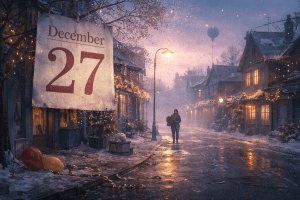
December 27th woke up late.
This was unusual, because dates normally wake up exactly on time, neatly stacked between their neighbours like polite slices of bread. December 26th had yawned, brushed the tinsel out of its hair, and shuffled off without complaint. December 28th was already standing impatiently in the corridor, tapping its foot and checking its watch.
But December 27th lay in bed, staring at the ceiling, feeling wrong.
The ceiling was covered in faint glitter that would not come off, no matter how much one scrubbed. A half-deflated balloon drifted past the window. Somewhere in the distance, a turkey sighed.
“Not yet,” muttered December 27th. “I’m not ready.”
When it finally stood up, something slipped out of its pocket and clattered onto the floor. It was a receipt. No shop name, no date, just the words:
**YOU HAVE ALREADY PAID FOR THIS, WHATEVER IT IS.**
December 27th did not remember buying anything.
Outside, the world had lost its edges. People wandered the streets clutching boxes of chocolates they no longer wanted but felt morally obliged to finish. Children tried out new toys that already seemed faintly disappointing. Adults stared into cupboards, searching for something they were sure they had bought but could not now locate.
Time behaved oddly. It was both too fast and too slow. Morning lasted forever, while afternoon disappeared entirely. Evening arrived early, dragging a chair behind it and asking awkward questions.
“Was this a good year?” Evening asked.
No one answered.
In Ballykillduff, the church bell rang once and then stopped, as though it had forgotten what came next. A man named Seamus swore he heard it cough apologetically. The postman delivered yesterday’s letters again, insisting they looked surprised to see him.
Meanwhile, December 27th wandered about, rearranging things when no one was looking.
It moved a sock from one drawer to another.
It hid the scissors.
It put a memory where a worry used to be, just to see what would happen.
People felt unsettled but could not say why. They stood in doorways, convinced they had meant to go somewhere, though the idea of where had evaporated. Dogs barked at nothing in particular. Cats stared at corners where something might have been yesterday.
At lunchtime, December 27th sat down heavily on the calendar and caused a small temporal dent. This made everyone feel mildly tired, as though they had eaten too much pudding and not enough meaning.
“I don’t want to be just the leftovers day,” December 27th said to no one.
“I want to be… something.”
So it tried a few things.
It briefly became a Monday. This upset people enormously.
It tried being a holiday, but forgot to provide instructions.
It flirted with being New Year’s Eve, but was told politely not to rush.
Eventually, December 27th did something reckless.
It paused.
Just for a moment, everything stopped. Not dramatically. No clocks exploded. No one screamed. The kettle simply hovered halfway to boiling. A thought remained unfinished. A yawn never quite closed.
In that pause, December 27th looked around and noticed something surprising.
Everyone was still here.
Not celebrating. Not regretting. Just… existing. Sitting in jumpers that smelled faintly of smoke and sugar. Thinking about things they might do differently, or not at all.
December 27th smiled. A strange, crooked smile, like a date that had learned something important.
Then it nudged time forward again.
Evening finished its questions. Night tucked the world in. December 28th finally got its turn, huffing and smoothing its pages.
As December 27th left, it slipped the receipt back into its pocket.
This time, new words had appeared underneath:
**NO REFUNDS. NO EXCHANGES. BUT YOU MAY KEEP WHAT YOU NOTICED.**
And for the rest of the year, people occasionally felt an odd sensation — a quiet moment between moments — and thought, without knowing why:
*Ah. That must have been December 27th.*


Tags: , , , , ,

Old Elf and the Dragon

Old Elf and the Dragon

Fle and the Obsidian Sky-Weaver

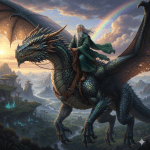
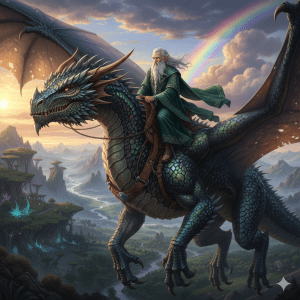
The air tasted like crushed silver and distant thunder. Below them, the valley of the Winding River was painted in the soft, bruised colours of twilight, where mushroom-capped towers and luminous flora dotted the emerald cliffs.

Fle, the Old Elf, sat tall upon Kaelen, the Sky-Weaver, his emerald robes catching the last amber rays of the setting sun. Fle’s face was a map of ages, his eyes holding the patient light of a thousand moons, but his grip on the dragon’s jeweled harness was firm. He was guiding Kaelen through the Veil of the Shifting Dusk, the narrow passage between the mortal realm and the High Dreaming.

Kaelen, whose scales were an armour of deep, shimmering teal and night-sky black, did not flap his colossal wings with brute force. He moved with a mystical grace, riding the invisible currents that flowed from the Rainbow of Eld arching high above them—a phenomenon that only appears when a creature of pure elemental magic and a being of profound age travel together.

“The Gem of Constant Dawn,” Kaelen’s thought resonated, deep and guttural, in Fle’s mind, “lies just beyond that cloud-bank, where the river meets the mist. But the Silence has claimed it.”

“The Silence,” Fle murmured, pulling his hood closer, “is fear, Kaelen. It is the dread that paralyzes creativity. And it has used the Gem to still the music of the World-Heart.”

Their mission was perilous: The Gem of Constant Dawn, which normally sang the world into existence every morning, had been stolen and wrapped in the Web of the Soul-Moths, creatures of pure, paralyzing inertia. If the Gem was not freed by midnight, the sun would rise only as a suggestion, and the world would remain perpetually quiet, perpetually grey.

As they flew past the floating, crystalline peaks, Fle reached into a hidden pouch woven into his sash and withdrew three small items:

  1. A feather from a thought-bird, which allowed him to hear the whispers of possibility.
  2. A shard of frozen laughter, which could break the densest concentration of sorrow.
  3. A single, petrified tear of a nymph, which held the warmth of summer.

They broke through the last cloud layer. There, floating motionless above the swirling mist, was the Gem—a sphere of blinding, imprisoned light, tightly encased in thick, silvery cobwebs. And hovering around it were the Soul-Moths, silent, dark insects whose flapping wings emitted a negative sound that drained the air of hope.

Kaelen stopped, hanging suspended in the air. “I cannot approach, Old Friend,” he admitted. “My fire is too loud, my being too grand. The Silence would snuff me out like a candle.”

“Then we shall be quiet,” Fle replied, his voice barely a breath.

He slipped off Kaelen’s back and, rather than falling, began to descend slowly on a column of shimmering, green energy—the focused memory of every happy song he had ever heard.

As he neared the Gem, the cold of the Silence hit him. His memories felt heavy, his purpose uncertain. He could feel the Soul-Moths trying to wrap his own thoughts in their numbing web.

Fle raised his hand and opened his palm. He did not cast a spell; he simply released the shard of frozen laughter.

The laughter shard—the captured echo of a thousand innocent giggles—didn’t explode. It simply melted, forming a thin, high chime. The sound was so unexpected, so pure and non-serious, that the Soul-Moths paused, momentarily confused.

In that fraction of a moment, Fle used his second item: he took the thought-bird feather and gently tickled the Web of the Soul-Moths. The Moths, overwhelmed by the sudden influx of chaotic and funny possibilities, flew away in disarray, unable to process the illogical joy.

The Gem of Constant Dawn was now free, but still cold and muted. Fle pressed the petrified tear of the nymph against the crystalline sphere. Instantly, the warmth of all past summers infused the Gem. It flared, shining with a light that pushed back the twilight and sent a vibrant, resonant thrum through the entire valley.

Above, Kaelen roared—a sound that was now one of pure, unrestrained elemental joy. The Rainbow of Eld above them deepened in colour, and the Winding River below seemed to sing as the music of the World-Heart returned.

Fle rose back to Kaelen’s side, weary but successful. “The Silence is broken, my friend. Let us fly home. It’s been a long age.”

Kaelen dipped his great head in agreement. With a powerful beat of his massive wings, he turned toward the dawn, carrying Fle, the keeper of memory and laughter, out of the high, mystical air and back toward the newly singing world.


Tags: , , , , ,

There Once was a Slug called Slimy

There Once was a Slug called Slimy

The Great Lettuce Heist

Slimy’s ambition far exceeded his speed, or his girth. His dream was to cross the unforgiving expanse of Mrs. Higgins’s back garden to reach The Sacred Head of Romaine, a prize of such size and crispness it was practically a monument.

The year was 1968, the height of summer, and Slimy had a plan. He wasn’t going to crawl. Crawing was for amateurs.

He was going to surf.

His partner in crime was Pip, a beetle whose main function in life was complaining.

“I still don’t understand why we’re doing this during the hottest part of the day,” Pip muttered, clinging precariously to Slimy’s shell-less back.

“Silence, Pip!” Slimy yelled, his eyestalks twitching with maniacal focus. “The sun bakes my trail! It creates a slick, semi-solid layer of… of pure velocity!”

In reality, the heat was just evaporating the water in his mucus, leaving behind a sticky, awful film.

Slimy pushed off from the edge of the shed, aiming for the first patch of damp shade fifty feet away. Immediately, his undercarriage seized up. He wasn’t sliding; he was sticking. Every micro-millimeter of progress was achieved through pure, agonizing abdominal contraction, a motion less like surfing and more like peeling a sticker off a varnished tabletop.

“Velocity, you said,” Pip wheezed, adjusting his tiny sunglasses. “I believe the current rate of travel is approximately one Planck length per fortnight.”

Slimy ignored him. “I just need a better… launch!”

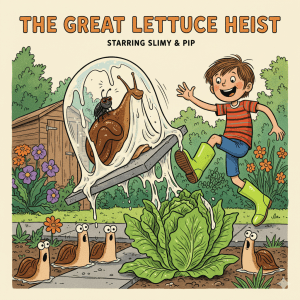
With a burst of desperation, Slimy secreted a volume of mucus that, had it been liquid, would have drowned Pip. The result was not speed, but a magnificent, sticky dome that enveloped them both. They slid three inches, then stopped dead, firmly glued to the concrete path.


The Unlikely Rescue


Just then, Kevin, a nine-year-old boy and resident Terror of the garden, came skipping out the back door, singing a song about “Groovy, Groovy Caterpillars.” Kevin was known for two things: an unnerving love of brightly coloured wellington boots, and an innate talent for accidentally stepping on invertebrates.

“Oh no, oh no, oh no,” Pip whispered, knowing their sticky situation meant a lack of escape options.

As Kevin’s neon green boot descended toward their mucus-prison, Slimy had a flash of inspiration. The glue!

He expanded the sticky dome, coating the bottom of the approaching boot just before impact. Kevin’s foot landed, missed Slimy by a hair, and then… stuck.

Kevin lifted his foot, and the entire surface layer of the concrete path, along with Slimy and Pip, came up with it. Slimy found himself traveling higher and faster than he ever had, clinging to the sole of the enormous boot.

“We’re airborne, Pip!” Slimy cried out, ecstatic. “We’re surfing the very winds of fate!”

“We are adhered to the sole of a rapidly moving, oversized rubber shoe!” Pip screamed back.

Kevin, oblivious, took a giant, stomping step right over the prize.

THWUMP!

Slimy, Pip, and the sticky patch of concrete landed squarely on top of The Sacred Head of Romaine.


The Victory


The impact shattered the lettuce, but left Slimy and Pip relatively unscathed. The surrounding slugs, who had spent the morning methodically nibbling the lower leaves, looked up in astonished, mucous-covered silence.

Slimy, covered in concrete dust and Romaine flakes, raised his eyestalks in triumph.

“See, Pip? Pure velocity!”

Pip merely shook his head, scraped himself off the sticky wreckage, and began eating the debris.

“Just call me King Slimy from now on,” Slimy declared.

“I’ll stick with Slimy,” Pip mumbled around a mouthful of lettuce, “but I’ll grant you this: you are the only slug in the county who has ever been rescued by his own failed adhesive technology.”

And that was the story of how Slimy, through utter incompetence and a staggering quantity of glue, successfully completed the greatest lettuce heist in garden history. Though, for the rest of his life, he was forced to peel himself off various surfaces using his tail.


Tags: , , , ,

Fle, an ancient old elf


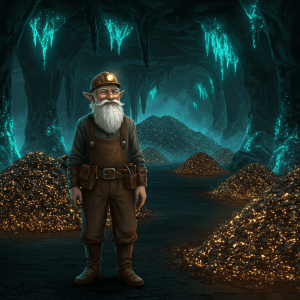
Fle, an elf so ancient he remembered when the stars were new, had dedicated his incredibly long life to a singular, earthly purpose: fertilizer. For over 1,700 years, his world had been the quiet, luminescent depths of his subterranean mine. His greatest achievement was the “Black Gold”, a powerful, slow-release compost brewed from a secret recipe of volcanic ash, enchanted mushroom spores, and the finest river silt. It was his masterpiece, stored in dozens of perfectly stacked bags.

One morning, the serene hum of his mine was replaced by a jarring, hollow silence. A large, clumsy wheelbarrow track led from the mine’s entrance, and the tell-tale scent of stolen goods hung in the air. A quick count confirmed the damage: twenty-three bags of his precious Black Gold were gone. Fle’s fury was a cold, quiet thing, a force that had been dormant for centuries.

Cursing in a dialect older than the mountains themselves, Fle dusted off his tracking cloak and followed the trail. The thief, a human, was leaving a trail of astonishing carelessness—a dropped coin, a ripped piece of burlap, and the occasional, rogue sprig of basil from the surface world. Fle expected a short pursuit, but the thief was surprisingly cunning, ducking through thickets and wading through streams to break the trail. This wasn’t a simple robbery; it was a determined escape.

The chase stretched across leagues, a game of cat-and-mouse between ancient wisdom and youthful desperation. Fle, unused to the chaos of the overworld, was bewildered by its noise and frantic pace. He navigated bustling market towns and sprawling farms, his frustration mounting. Finally, by the light of a pale moon, he cornered the thief in a field of withered, black stalks.

The thief, a young woman named Elara, was collapsed beside a makeshift cart. Her face was smudged with dirt and streaked with tears. Fle saw not defiance in her eyes, but a profound, bone-deep sorrow. “It was the only thing I could do,” she whispered, her voice raw. “The blight… it took everything. I just needed enough to save what’s left.”

Fle’s anger faltered. He saw the truth in her eyes. Her village was starving, and she, a thief driven by love, had taken the only thing that could save them. He looked at the twenty-three bags of Black Gold, now scattered around the barren field. The fertilizer’s magic was already weakening, its slow-release potency starting to leak into the polluted soil.

With a heavy sigh, Fle made a decision that astonished even himself. “The fertilizer is worthless to you now,” he said, his voice softer than she expected. “You handled it incorrectly. But… I can show you how to use it. And you can work to pay your debt.” He pointed at a few stalks that had resisted the blight. “I will teach you to tend the earth, but in return, you will help me tend my mine. From this day forward, you will be my apprentice.”

Elara’s tears flowed freely, not from sadness, but from overwhelming relief. Her gaze met the old elf’s, and for the first time, she saw not a terrifying creature of legend, but an unexpected, and incredibly grumpy, ally. Fle, for his part, looked at the ruined field and felt a twinge of something new: a purpose beyond his mine, a responsibility to a world he had long since left behind.

Want to read more?

Click on the link, below, and enjoy.

The Origins of Black Gold

 
Leave a comment

Posted by on September 11, 2025 in Uncategorized


Tags: , , ,

The World’s Gone Bonkers (Since We All Went Online)

The World’s Gone Bonkers (Since We All Went Online)

The World’s Gone Bonkers (Since We All Went Online)
A Crazymad Poem by Someone Who’s Had Enough Wi-Fi

Once upon a saner time,
We’d write with pens—imagine the crime!
Now thumbs do tap and fingers swipe,
And talking’s swapped for “liking” hype.

The dog has TikTok, Mum’s on Zoom,
Dad live-streams himself in the loo.
Gran’s gone viral doing squats,
With hashtags like #KnitYourOwnTeaPots.

The fridge has Wi-Fi, the toaster too,
It knows your name, and your blood type too.
The mirror tells you you look sad—
(“Apply more blush, you silly lad!”)

Ding! goes the phone.
Ping! goes the watch.
Beep! says the toaster.
Snap! goes your crotch—
Because your smart jeans now detect
Too many pies? That gets a text.

People walk while texting fast,
Right into bins and duck ponds, SPLASH!
They film themselves while falling in,
Then cry, “Oh wow, I’ll post again!”

The baby’s named @Lil_Snacc,
He’s got a filter, six-pack abs.
The cat’s an influencer now,
With brand deals for organic chow.

We used to talk. We used to think.
Now Siri tells us when to blink.
“Alexa, what’s the point of life?”
She answers, “Please repeat your wife.”

Our minds are now a cloud-based mess,
We Google every minor stress.
Can’t sleep? There’s apps! Can’t cry? There’s bots!
Can’t love? Just swipe until it rots.

AI writes your granny’s will.
A drone drops off your sleeping pill.
We’ve screens for eyes, and wires for veins,
And autocorrect rewrites our brains.

Oh world, oh world, you pixelated freak!
You’ve swapped the meadow for a selfie streak.
The birds don’t tweet, the bees don’t hum—
They’re on Threads now, posting “Here we come!”

So switch it off—go out, get lost!
Climb a tree, no signal cost.
But if you fall—don’t dare complain…
Just film it, post it, dance again!

 
Leave a comment

Posted by on August 1, 2025 in humor, humour, internet, online, poems


Tags: , , , , , , , , , ,