Alice, Christmas and the Jabber-Wobble
A brand-new story coming here soon!


Alice climbed a ladder of air,
Past rooftops, chimneys, clouds so rare,
She balanced on a silver breeze,
And skipped across the tallest trees.
The mountains bowed, the oceans curled,
For Alice stood on top of the world;
A crown of starlight in her hair,
The moon itself just hanging there.
She asked the sun to play a tune,
She taught the night to hum at noon,
She juggled planets, tossed them wide,
Then hopped upon a comet’s ride.
The White Rabbit clapped from below,
“Careful, Alice, mind where you go!”
But Alice only laughed and twirled,
For she was dancing with the world.
And when at last she looked down deep,
The earth was quiet, fast asleep;
She whispered softly, calm and mild:
“Goodnight, dear world — from your wild child.”
Alice was quite tired of the ordinary. She had spent the entire morning in the garden, trying to tell the difference between a dandelion and a daisy, and frankly, the flowers were not being cooperative. She sighed, leaning against an ancient, gnarled oak tree, and closed her eyes. It was then she heard a most peculiar sound: the gentle clinking of porcelain teacups.
Her eyes snapped open. The sound wasn’t coming from the ground, or the hedge maze, but from a small, ornate teapot dangling from a branch just above her head. It swung gently, its painted flowers winking in the dappled sunlight. As she stared, a wisp of steam curled from its spout, spelling out a single word: “Tea?”
“How curious,” Alice said to herself. She reached up and, with a slight tug, the entire teapot detached itself from the branch and settled softly into her hand. As she held it, the teapot began to grow, and grow, until it was taller than she was, with a small, circular door where the base had been. A tiny sign on the door read, “Do Not Enter, Unless You’re Quite Lost.”
Lost was exactly what Alice felt like, so she pushed open the door and stepped inside. The air was thick with the scent of Earl Grey and crumpets. She found herself in a room where everything was upside down. Teacups floated on the ceiling, dripping tea onto the floor. Saucers spun like tops on the table, and a small, round cake was singing a cheerful, off-key tune.
Seated at the table, perched on a sugar cube, was a dormouse wearing a thimble for a hat. “You’re late,” it squeaked without looking up.
“Late for what?” Alice asked, her head tilted to the side to see the teacups better.
“The Topsy-Turvy Tea Party, of course!” the Dormouse replied. “We only have them on Tuesdays, and today is Thursday, so we’re celebrating Tuesday. It’s quite logical if you don’t think about it.”
Suddenly, a flurry of feathers landed on the table, and a robin with a top hat on its head began to lecture a floating teacup. “The proper way to pour tea,” it chirped, “is with an inverted teapot! It saves on spillage, you see, which is quite important when you’re upside down.”
The singing cake, which was now doing a jig on the table, chimed in, “And the proper way to eat a crumpet is from the inside out!”
Alice giggled. “That sounds rather messy.”
“Messy is a matter of perspective,” the robin said, tipping its hat. “A spill is just an unplanned design.”
Alice decided to join the fun. She carefully picked up a teacup that was dancing on the floor, poured a bit of tea from a floating pot, and sipped it. It tasted of starlight and jam. She didn’t stay too long, however, as the thought of eating a crumpet inside-out was still a bit too strange for her. She bid the Dormouse and the robin a fond farewell, stepping back out of the teapot and into the quiet garden.
The teapot was once again a small, ornate thing dangling from the oak tree. The flowers were still just flowers, and the world was back to its normal, uncooperative self. But as Alice walked home, she couldn’t help but smile. She knew now that even on the most ordinary of days, a bit of topsy-turvy adventure might be just around the corner.
“Alice on Top of the World” serves as both a tribute to the original tales and a fresh exploration of timeless themes. It invites readers of all ages to reflect on their own journeys through life, encouraging them to cherish the magic of imagination and the beauty of memories.

Alice and Santa set off with the children’s presents

Alice and Fle, a very old elf, in his fertilizer mine

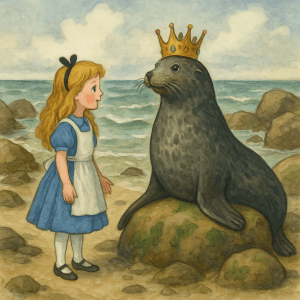
Alice meets King Tut, the king of the sea lions

Alice steps on the elevator to the top of the world
You don’t have to be mad to visit here, but it helps

You don’t have to be mad to visit here, but it helps
**************************************
Alice fell through a hole in a very odd hedge,
Tumbled past turnips, a cow, and a ledge,
She landed with grace (well, almost—a thud)
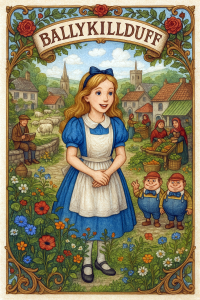
In Ballykillduff, face-first in the mud.
She stood and she blinked at the curious crowd—
A goat played the trumpet unusually loud.
A pig sold balloons shaped like clouds and like cheese,
And someone was painting a portrait of peas.
“Where am I?” asked Alice. A sheep in a hat
Replied, “In the village of Ballykillduff! That’s that!”
“We’re preparing,” it said, “for the Sheep Racing Fair,
Where ewes take to flight through the midsummer air!”
She wandered through stalls where the jelly was wobbly,
The fudge slightly rude, and the sandwiches snobbly.
A tractor called Muriel whistled and said,
“Hop on for a tour! Don’t step on my tread.”
She met Grandmother McSnoop who could juggle live frogs,
And a choir of hens that sang sea shanty songs.
Two monks brewed a soda that made her see stars,
And a badger confessed he’d once stolen some jars.
At noon came the races—explosions of wool!
Jetpacks on sheep made the sky rather full.
They looped and they zoomed in a blizzard of fluff,
As Alice cried out, “This is quite mad enough!”
But just as she thought things could not get more strange,
The moon sprouted legs and danced down the lane.
The mayor declared, “That’s our satellite samba!”
And offered her tea served in hats made of llama.
At sunset, the hills all began to recite
Limericks backwards while glowing with light.
The cows held a disco, the ducks held a vote,
And a hedgehog proposed—in a velvet-lined coat.
“Dear Ballykillduff,” Alice whispered with glee,
“You’re wonderfully odd and quite perfect for me.”
Then the beetroot returned and it opened a crack—
“Time to go home, if you want to go back…”
She waved her goodbyes to the sheep and the crowd,
To the tractor, the frogs, and the goose dressed in shroud.
And she whispered as Ballykillduff slipped from view,
“That was stranger than Wonderland—and the scones were quite new.”
One sunny day in Wonderland,
While sipping tea and chewing sand,
Young Alice yawned and had a thought:
“Why are we all so pre-internet caught?”
She pulled an iPhone from her sock,
(It ticked and tocked like a talking clock),
She poked the screen and gave a grin—
“Let’s see what world I’ve wandered in!”
The Caterpillar popped online:
“Who R U? U up? U fine?”
The Cheshire Cat just posted memes,
And vanished mid-conspiracy themes.
The Hatter live-streamed tea debates,
With Bonkers takes on interest rates.
The Queen of Hearts launched NFTs:
“Buy now! Each comes with severed knees!”
Alice sighed. “This can’t be right—
We’ve meme’d away the day and night.
No riddles, rhymes, no flights of fancy—
Just trolls and ads and apps called ‘Dancy.’”
She tried to post: “I miss the trees.”
But all she got were angry bees—
Replies that buzzed: “You’re cringe! You’re fake!”
“Return to hole! Go eat a cake!”
She shut the phone and dropped it fast,
Deciding screen life couldn’t last.
She skipped away through mushroom mist,
Her Twitter never once was missed.
So if you find your world askew,
Try Wonderland, not Webpage 2.
You won’t need likes or streams or fame—
Just talking cats who know your name.

Alice and the Baby Hippo
(A whimsical poem in rhyme)
One dainty day beneath the sun,
Young Alice thought, “This could be fun!”
She saw a hippo, small and round,
Just waddling gently on the ground.
Its skin was grey, its tail went flip,
It wriggled with a wobbly skip.
Its ears were tiny, pink and proud—
It snorted once and drew a crowd.
“A mount!” cried Alice. “Oh, how grand!
I’ll ride across this soggy land!
No horse or donkey, goat or yak—
I’ve found a hippo for my back!”
She climbed atop its chubby rear,
The hippo blinked, then twitched an ear.
It gave a squeal, then took a dash—
And Alice flew off with a splash!
She landed in a muddy bog,
Just shy of hitting a startled frog.
Her hair was filled with weeds and goo—
Her sock was gone, her shoe was too.
The hippo, shocked by all the fuss,
Just blinked and snorted, “Don’t blame us!
We’re not for riding, no, not yet—
We’re more like mobile lumps of wet.”
Alice laughed, then bowed with grace,
Mud dripping gently down her face.
“Well thank you, friend,” she said, and grinned,
“As far as rides go—you were…wind!”
And off she skipped with squelchy feet,
Through meadows green and puddles sweet.
Behind, the hippo gave a sigh,
Then belly-flopped with glee nearby.
So if you spy a hippo small,
Be sure you ask, before you fall.
For though they’re cute and seem just right—
They’re not the steed for your next flight!

Chapter One
Into the Abyss
It was many years later when Alice found herself on another adventure—though, to her surprise, she was once again a child, no older than when she first tumbled into Wonderland and slipped through that curious Looking Glass.
“How curious,” she whispered, trying to recall the girl she had once been.
Suddenly, the White Rabbit appeared before her, looking impatient. “Took your time getting here,” he quipped.
“I beg your pardon?” Alice replied, recalling how rude he could be—particularly when he felt so inclined.
“I said you took your time. You should have been here fourteen years ago,” he huffed indignantly, hopping briskly away.
“But,” Alice stuttered, running after him, “I have no idea how I arrived, let alone why I’m so late!”
“We accept no ifs or buts here—by now, you should know that,” the Rabbit said, as a door suddenly materialized beside him. Without hesitation, he pushed it open. “Hurry up—please don’t dawdle.”
Alice hurried through the doorway, struggling to keep pace with the rapid-hopping Rabbit. She wondered if he’d got out of bed on the wrong side that morning, for he seemed quite grumpy on such a lovely day. The sun shone brightly, warming everything around them.
“I wonder where I might be,” she mused, admiring the pink forget-me-nots that lined a winding path before her. “Am I in Wonderland?” she asked, just as another door—similar to the first—appeared.
The Rabbit gave her a peculiar look. “Of course we’re not in Wonderland,” he said, opening the door with a flourish. “We’re on top of the world.” Then, with a wink, he scurried down another winding path, bordered by more pink forget-me-nots.
“The top of the world?” Alice gasped, surprised. “That’s impossible!”
The Rabbit stopped and turned to face her. “Then how can you be here if it’s impossible?”
Alice hesitated, flummoxed by his question. The only reply she managed was, “I bet you’re mad!”
“Mad? Oh, that all depends,” the Rabbit said, with a sly grin. “Depends on whether you mean mad or mad.”
“That’s silly,” Alice insisted. “They both mean the same thing.”
“Not quite,” replied the Rabbit, his eyes gleaming. “If you’re mad number one—and someone calls you mad number two—you might just be very mad indeed about such a fundamental mistake.”
“I’m not mad!” Alice declared, stamping her foot in frustration. She changed the subject, noticing another door had appeared. “Look—another door. Shall I try opening it?”
The White Rabbit reached for the handle, but the door stubbornly refused to budge.
“May I try?” Alice asked, feeling quite un-mad.
Standing back, the Rabbit said nothing. Instead, his tiny, beady eyes watched her intently.
Alice grasped the handle and pushed. The door swung open easily, revealing a dark, yawning hole. She stepped through without hesitation and tumbled into a vast, gaping abyss.
“No, I don’t want to go back up there—no matter how tempting the top of the world might be,” she muttered, staring at the tiny speck of light far above her. “It’s much too far!”
Before she could grasp what was happening, something passed her by in the darkness—she couldn’t see what, only hear its rushing sound. Clinging tightly, she rode it out of the well.
Surprisingly, she found herself on the back of a baby hippopotamus, its skin as smooth as silk. She wondered how she’d managed to stay on long enough to escape that shadowy place. But before she could think further, she slipped and slid off the hippopotamus, landing heavily on the dusty ground.
“I don’t like this place,” she moaned. “I don’t like it at all.”
“You don’t like it?” squawked the baby hippopotamus, its voice high-pitched and surprisingly cheerful for such a hefty creature. “How do you think I feel? There’s not a drop of water in sight—none! And we hippos need water—lots of it!”
Alice brushed dust off her dress and nodded politely. “Mr. Hippopotamus, thank you for the ride—truly the most comfortable hippopotamus ride I’ve ever had.” (Though she omitted to mention she’d never actually ridden one before.) “Thank you again.”
“My dear child,” he replied, “you’re so light I hardly felt you at all. Feel free to jump on my back anytime I pass by, if you need another ride out of that dark place.”
“Thank you,” Alice said with a smile. “I’ll keep that in mind—and treasure your kind offer.”
With that, the hippopotamus sank back into the darkness, searching for water. But before he could begin, another soft landing echoed nearby—though it was nowhere near as gentle as Alice’s.
Before she could say “Jack Robinson,” the White Rabbit reappeared—this time riding backwards on the baby hippopotamus’s back, heading toward the bright light ahead.
He scolded Alice for falling down the hole, then paused. “If there’s going to be any hole-falling around here, we’ll need a vote—decide who’s first and who’s second,” he declared. Alice nodded, though she suspected he might be quite mad—or maybe both.
Suddenly, a new winding path appeared before them. But this one was different—less inviting. Instead of pink forget-me-nots, enormous, green aspidistras with snapping beaks awaited, their mouths wide and hungry.
“Come on, Alice,” urged the Rabbit, rushing past the threatening plants. “We need to get to the top of the world!”
Alice gasped as the first aspidistra snatched at his thick fur, tearing a large wad from his back. “We must return to the top of the world,” he insisted, seemingly unbothered by the danger.
Not wanting to admit she was a little frightened of the strange, snapping plants—and not eager to ask for help—Alice prepared to step down that perilous path.
But the Rabbit was already far ahead. Alice hesitated, closing her eyes and taking a tentative step. She hoped—just hoped—to catch up with him before the plants could reach her.
No sooner had she begun than one of the beaks lunged for her left ear, another yanked her hair, and a third tried to nip her nose.
“Stop that!” Alice shouted. “Stop it this instant, or I’ll dig you all up and replant you with rhubarb!”
The beaks froze midattack, and Alice inspected her head. Everything was intact. She heaved a sigh of relief.
“Thank you,” she said. “I can’t imagine what’s gotten into you—plants aren’t supposed to be terrible, awful things.”
As she gazed at the towering, beak-mouthed plants, she thought she heard a faint cry. “Who’s crying?” she asked.
Despite listening carefully, she heard no reply—only the swaying of the plants’ stalks. Then they began to shake, their beak mouths moving high above her.
“Stop that,” Alice commanded. “Tell me—who’s crying?”
One of the plants, swaying more than the others, began to speak. “She’s crying,” it said softly, “the little offshoot near my wife—see?” A long, leafy arm pointed across to the right.
“Your wife?” Alice asked in surprise. “Plants can get married?”
“Yes,” the plant replied, swaying gently. “Can you see them?”
“I might, if you’d stop swaying,” Alice said, feeling a little dizzy. “You’re making me feel sick.”
“I can’t help it,” the plant admitted. “When we’re upset, we sway. It’s our way of expressing how we feel—like when the wind blows through us, and we don’t like it.”
“Oh, I’m sorry,” Alice said kindly. “Is there anything I can do to help?”
“You could promise not to dig us up,” the plant whispered, voice trembling.
“Of course I won’t,” Alice promised, “not after how rudely I was treated. I only said that because I was frightened.”
The plants stopped swaying, allowing Alice to see the tiny aspidistra nestled under its mother’s broad leaves. Without fear, she moved closer, reaching out to the little one.
“I’m truly sorry,” she said softly. “If I upset you, please forgive me.”
“Yes,” the baby plant replied, trying not to sob. “And we’re sorry for frightening you. We’re just so hungry… normally we’re happy, with smiling beaks to greet travelers.”
Confused, Alice asked, “Hungry? How can you be hungry when your roots find all the food you need?”
“Fertilizer,” the mother explained. “All plants need it at some point. But none of us have had any for ages. I’ve never even seen it!”
“This is terrible,” Alice muttered, scratching her head. “I’ll find you some—enough to feed you all.”
The beaks seemed to smile—if they could—and began chattering excitedly about the fertilizer mine. Alice listened as they described a place she’d never seen, where the precious stuff was stored.
“Where is this mine?” she asked.
“I’m sorry,” the mother admitted. “We don’t know exactly. But we believe it exists.”
Determined to help, Alice promised, “I’ll find you fertilizer. I’ll make sure you have enough to grow strong and happy.”
CONTD